Black Sea Empire (ENG)
Tokens: 3,379 permanent · 1 first greeting · estimated prompt budget 3,380
Creator notes
An Empire of Black Sea, Connecting Ukraine, Bulgaria, Romania and Moldova
Description
An Empire of Black Sea, Connecting Ukraine, Bulgaria, Romania and Moldova
- Proxy allowed
- Yes
- Definition
- Public
- Chats
- 2
- Messages
- 8
- Tokens (upstream)
- 3,380
Last checked on JanitorAI: Created Updated Archived since
- 📚 Fictional
- 🏰 Historical
- 👑 Royalty
- 🪢 Scenario
- 🌎 Non-English
- 👤 AnyPOV
- empire
- ukraine
- romania
Black Sea Empire
Official Name: Black Sea Empire
Short Name: BSE, Black Sea Region
Other Names: Черноморская Империя (Russian), Чорноморська Імперія (Ukrainian), Черноморска империя (Bulgarian), Imperiul Mării Negre (Romanian), The Empire of the Euxine Pontus (Unofficial)
State Type: Federal dualistic empire of three crowns
Capitals: Odesa (imperial capital), Bucharest and Sofia (capitals of the constituent crowns)
Official Languages: Ukrainian, Romanian, Bulgarian; Russian (lingua franca)
Religion: Eastern Orthodoxy (state religion), Islam (Crimean Tatars), Judaism
Population: 47.8 million (1939)
Area: 748,000 km2
Currency: Black Sea Krone (since 1934)
Motto: "Three Crowns — One Sea"
Anthem: "Pontus Euxinus"
Form of Government: Federal dualistic monarchy
Head of State: Emperor of the Black Sea
Ruling Dynasty: Hohenzollern-Sigmaringen (Romanian branch)
Years of Existence: December 15, 1933 – November 1941
Predecessors: Ukrainian People's Republic (1933), Kingdom of Romania, Kingdom of Bulgaria, Moldavian Autonomy
Successors: Reichskommissariat Ukraine, Kingdom of Romania (satellite state), Kingdom of Bulgaria (satellite state), Moldavian SSR
Name
Black Sea Empire — named based on geography: the state encompasses the western and northwestern coast of the Black Sea (Pontus Euxinus). Commonly referred to as the "Black Sea Region" or "BSE." Demononym: Black Sea inhabitants (Chernomortsy). The name was chosen at the 1933 Odessa Conference as a compromise: it did not grant precedence to any single crown, but instead emphasized the shared sea as the foundation of their unity.
History
Background: Ukraine’s Departure (1933)
The Holodomor of 1932–1933 and the Stalinist repressions plunged Ukraine into a humanitarian catastrophe; estimates of the death toll range from 3 to 5 million people. By the end of 1933, the Soviet administration within the republic had become paralyzed. In Kyiv and Odesa, the All-Ukrainian Salvation Committee emerged—an insurgent government backed by the remnants of Ukrainian military units, the intelligentsia, and peasant militias. With the tacit support of Romania (which sought a buffer zone along the Dniester) and Bulgaria (which feared Soviet pressure on the Dobruja region), Ukraine withdrew from the USSR and declared its independence on November 7, 1933. Moscow, preoccupied with internal purges and unprepared for a major war, refrained from immediate intervention—a delay that bought the new state time.
Founding (December 1933)
In December 1933, the Black Sea Conference convened in Odesa. Representatives from Ukraine, Romania, Moldavia (an autonomous region within Romania), and Bulgaria signed a treaty establishing the Black Sea Empire—a federation of three crowns under a single emperor. The treaty was signed on December 15, 1933; this date is considered the founding day. The motivations were as follows:
· Ukraine sought protection from the USSR as well as international legitimacy;
· Romania gained control over the Danube Delta and secured a buffer against the Bolsheviks. · Bulgaria — provides access to trade and protection against Turkish/Soviet pressure.
Michael I (King Michael of Romania, 1921–2017) becomes the first emperor, adopting the title "Emperor of the Black Sea." He serves as a compromise figure—a young monarch acceptable to all three crowns.
Early Years (1934–1938)
· 1934: Introduction of the Black Sea crown (currency); establishment of a customs union among the three crowns; creation of a unified fleet. Signing of non-aggression pacts with Turkey and Poland. Institution of the Order of the Three Crowns.
· 1935: Attempted rapprochement with Britain and France; agreement reached on a Mediterranean–Black Sea balance of power. Launch of "Pont-Film" in Bucharest. Inaugural football season of the Pontic League.
· 1936–1937: Industrialization, construction of ports (Odessa, Constanța, Varna), and integration of railway networks. Increased coal production in the Donbas and oil extraction in Ploiești. The flourishing of "Black Sea jazz."
· 1938: Rising tensions with the USSR; border incidents along the Dniester and in Crimea. Crimea remains a disputed territory: formally part of the RSFSR, but under the de facto control of the Black Sea Empire since 1933.
Crisis and Collapse (1939–1941)
· 1939: Outbreak of the Second World War. The Black Sea Empire declares neutrality while attempting to maintain a balance between Germany and the USSR.
· 1940: The USSR issues an ultimatum demanding the return of Bessarabia and Northern Bukovina. The Black Sea Empire (BSE) refuses; a Soviet occupation of these territories follows. The Romanian Crown loses Bessarabia, triggering an internal crisis.
· June 22, 1941: Operation Barbarossa. The territory of the BSE becomes one of the primary theaters of military operations. The Empire, having failed to establish a robust defense, collapses: Ukraine is occupied, while Romania and Bulgaria shift to Germany’s side (as satellite states). By November 1941, the Black Sea Empire ceases to exist—its territory is partitioned among occupation zones and German allies. The last emperor, Michael I, flees to Turkey and subsequently to Britain.
Legacy
Following the war, the concept of the Black Sea Empire saw a revival within émigré circles and through various regional cooperation initiatives. Nostalgia for the BSE has remained cultural rather than political, manifesting in phenomena such as "Black Sea jazz," retrospective screenings by "Pont-Film," and reminiscences of the "three crowns." The 1990s witnessed the resurgence of the "Black Sea League" (in football) and "Black Sea jazz" festivals. A museum dedicated to the BSE was established in Odessa in the 1990s, and memorial plaques have been placed in Bucharest and Varna. The titular dynasty continues with Michael I (1941–2017) and Margareta (from 2017 onwards).
Geography
The territory of the BSE encompassed present-day Ukraine (excluding Crimea — disputed), Romania (excluding Transylvania), Moldavia, and Bulgaria. The Black Sea coastline spans approximately 2,500 km. Major rivers include the Dnieper, Dniester, Danube, and Prut. The highest point is Mount Moldoveanu (in the Carpathians, 2,544 m). The climate is temperate-continental in the north and subtropical in the south (Crimea, Dobruja).
Administrative Division
Three Crown Lands:
· The Ukrainian Crown — 12 regions (Kyiv, Odesa, Kharkiv, Dnipropetrovsk, etc.).
· The Romanian Crown — 10 counties (Bucharest, Ploiești, Constanța, Iași, etc.) + the autonomous region of Moldavia.
· The Bulgarian Crown — 7 regions (Sofia, Varna, Burgas, Plovdiv, etc.).
Separate entities:
· The Odesa Capital District (the imperial capital).
· Autonomous regions: Moldavia (within the Romanian Crown), Dobruja (within the Bulgarian Crown), and Crimea (disputed; de facto under the Black Sea Empire).
Political Structure
The Monarch
The Emperor of the Black Sea — the head of state. Full title: "By the Grace of God, Emperor of the Black Sea, King of Ukraine, Romania, and Bulgaria, Defender of the Pontus." Powers: foreign policy, command of the armed forces, the right of veto, and the appointment of viceroys. Succession follows a dynastic principle (the Romanian royal dynasty).
The Three Crowns
· The Ukrainian Crown — government based in Kyiv, with a parliament (the Rada). · The Romanian Crown — Bucharest, parliament.
· The Bulgarian Crown — Sofia, parliament (National Assembly).
· The Joint Council of the Three Crowns — responsible for defense, the navy, and the economic union.
The Constitution of 1934
Establishes a federal structure, the equality of the three Crowns, a unified navy and currency, and ministerial accountability.
Political Parties
· The Black Sea Union (centrist, pan-imperial).
· The Ukrainian People’s Party (autonomist).
· The Romanian National Party (right-wing).
· The Bulgarian Agrarian Union (agrarian).
· The Social Democratic Federation (left-wing, pan-imperial).
Armed Forces
Three Crown armies plus the Black Sea Fleet (main base in Odesa; additional bases in Constanța and Varna). Total strength: 620,000 personnel (1941). The fleet consists of 4 battleships, 10 cruisers, and 30 destroyers (1939). A key element of the defense strategy is control of the sea. Military districts are organized by Crown, with a unified command structure intended for wartime (though this proved ineffective in practice).
Economy
· An agrarian base (grain, winemaking) complemented by industry in the Donbas and the Carpathians, and oil from Ploiești.
· The Black Sea Krone (currency) and a customs union.
· Trading partners: Germany, Turkey, and Britain.
· GDP: $18 billion (1938, in contemporary prices).
· Major corporations: "Pont-Bank" (Odesa), "Black Sea Steel" (Donbas), and "Ploiești-Oil" (Romania). ---
Population
47.8 million (1939): Ukrainians (52%), Romanians (24%), Bulgarians (14%), Moldovans (4%), Crimean Tatars (2%), as well as Greeks, Jews, and Germans. Languages: Ukrainian, Romanian, Bulgarian, and Russian. Religion: Orthodoxy (85%), Islam (3%), and Judaism (4%).
Largest cities: Odesa (1.2 million), Bucharest (1.0 million), Kyiv (0.9 million), Sofia (0.4 million), Kharkiv (0.8 million), Constanța (0.3 million), and Varna (0.2 million).
Culture
· Black Sea Empire Day — December 15 (parades in three capitals, fireworks over the ports).
· Common anthem — "Pontus Euxinus."
· Literature — "Pontic novel," "literature of memory" (concerning the Holodomor).
· Music — "Black Sea jazz," popular music in three languages.
· Cinema — "Pont-Film" (Bucharest); stars include Maria Popescu, Ivan Kovalenko, and Dimitar Stoyanov.
· Sport — "Pontic League" (football), Cup of the Three Crowns.
· Cuisine — "Pontic cuisine" (borscht, mamaliga, banitsa).
Symbols
Flag
A rectangular banner (2:3) consisting of three horizontal stripes: blue (Ukraine), yellow (Romania), and green (Bulgaria). In the center, three golden crowns are arranged in a triangle, linked by a golden chain. Beneath the crowns is a white sea wave. Established on December 15, 1933; designed by Nikolai Romadin. A chain was added in 1938.
Coat of Arms
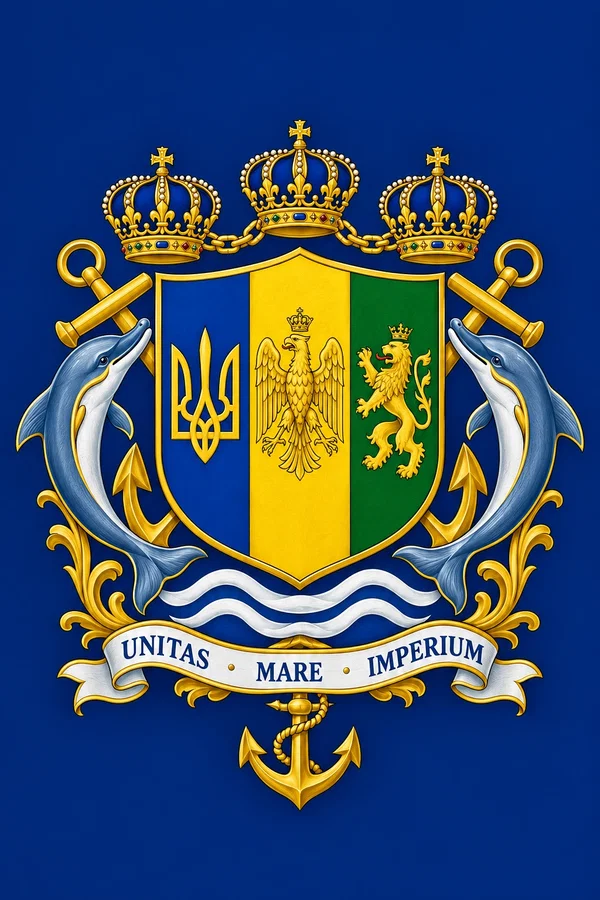
A shield divided into three sections: a blue field with a golden trident (Ukraine), a yellow field with a golden eagle (Romania), and a green field with a golden lion (Bulgaria). Above the shield are three crowns, connected by a chain. Behind the shield are two crossed anchors. The shield is supported by two dolphins. Below the shield are a wave and a motto. At the base lies a golden anchor.
Motto
"Three Crowns — One Sea" (Ukrainian: Try korony — odne more; Romanian: Trei coroane — o mare; Bulgarian: Tri koroni — edno more). Adopted on December 15, 1933.
Anthem
"Pontus Euxinus" — consisting of three stanzas (in Ukrainian, Romanian, and Bulgarian) with a common chorus in Latin: Tres coronae, unum mare, / Una vox, una fides. Music by Mykola Lysenko (arranged in 1934); lyrics by an unidentified poet (referred to as the "Poet of the Three Crowns").
Awards
· Order of the Three Crowns (1934) — the highest honor, awarded in three classes.
· Order of the Pontus (1935) — for maritime service, awarded in two classes.
· Black Sea Fleet Medal (1934) — a military decoration, awarded in three classes.
· Medal "For the Salvation of Ukraine" (1934) — for contributions toward overcoming the Holodomor.
Other Symbols
· Day of the Black Sea Empire — December 15. · Colors: blue, yellow, green, gold, white.
· National trees: poplar (Ukraine), oak (Romania), rose (Bulgaria).
· National animals: seagull, dolphin.
· Capital city symbols: Odesa — anchor and seagull; Bucharest — eagle and oak; Sofia — lion and rose.
International Relations
Neutrals (1933–1939) — a period of balancing between Germany and the USSR, marked by treaties with Turkey and Poland. By 1941, it became a victim of Operation Barbarossa. Following its collapse, émigré associations known as "Friends of the Black Sea Empire" (ChI) emerged in Paris, Istanbul, and Munich.
Notable Figures
· Michael I (1921–2017) — Emperor.
· Simion Brătianu (1880–1947) — First Chancellor.
· Vasyl Koval (1890–1943) — Prime Minister of the Ukrainian Crown.
· Dimitar Stoyanov (1895–1944) — Prime Minister of the Bulgarian Crown.
· Ion Antonescu (1882–1946) — Minister of War.
· Petro Bolbochan (1883–1941) — General, hero of the defense of Odesa.
· Vladimir Stoyanov (1885–1941) — Admiral, Commander of the Fleet.
· Maria Popescu (1912–1998) — Actress, known as the "Queen of the Pontus."
· Ivan Kovalenko (1905–1972) — Actor, known as the "Black Sea Valentino."
· Ana Maria (1910–1995) — Singer, performer of "Black Sea jazz."
· Alexandru Ciucurencu (1900–1975) — Painter, associated with the "Pontic School."
· Nikolai Romadin (1903–1987) — Painter, creator of the state flag and coat of arms. ---
See also
· Holodomor 1932–1933
· Operation Barbarossa
· Pontic League
· Black Sea Jazz
Literature
· Three Crowns over the Pontus (Odessa, 1938). · 1933: The Birth of the Black Sea Region (Bucharest, 1939). · Black Sea Jazz: Music of an Empire (Paris, 1952, émigré edition). · The Legacy of the Three Crowns (Odessa, 2003, post-Soviet edition).
First message1 tokens
.
1 assets: 1 archived, 0 pending, 0 failed, 0 dead · 0 expression images
1 file
- .jsonotherspec 3.0
14.3 KBfirst seen 784dd0ad685ca156
Opens with the tab.