Eshvara ||a dark fantasy Without limits
- Permanent
- 37,379
- Examples
- 2,708
- BudgetPrompt budget
- ≈ 40,087
Creator notes
Beneath Avarn's golden eye, Where Ithra dreams and Vaelor sighs, Seven lands beneath one sky, And countless worlds in silence lie.
Where ancient roots embrace the stone, Where nameless beasts make wilds their own, Where fallen crowns and kingdoms sleep, And secrets stir in oceans deep.
No hand has drawn its final shore, No tongue has named what lies beyond, For Eshvara is evermore— A thousand tales, yet none are done.
Hey dere azzy here just figured id make a dark fantasy rpg because why not i alr made a basic fantasy rpg WHICH ARE BOTH AWESOME OKAY
Just..use a proxy jllm WILL NOT work with this in any way shape or form trust me :P
Description
37,379 tokensESHVARA
The Expanded World Compendium
A world of impossible biology, ancient powers, monstrous ecosystems, fractured civilizations, and a substance that has changed the meaning of life itself.
Eshvara is not a world divided neatly between good and evil, civilization and wilderness, or the natural and supernatural. It is a world where a kingdom might be built over the remains of an enormous animal that is still technically alive, where an entire forest can possess a collective memory, where a harmless-looking insect may belong to a hive spanning three mountain ranges, and where two creatures separated by millions of years of evolution might produce offspring.
Its history is ancient, its geography immense, and its inhabitants extraordinarily diverse.
There are places where life has become so strange that scholars cannot agree whether they are looking at animals, plants, geological formations, or something that has never possessed a proper classification. There are civilizations that worship the things living beneath their foundations, and others that have spent centuries trying to exterminate them.
There are gods, but the gods do not own every mystery.
There is magic, but it does not explain everything.
And there is Orren.
I. THE WORLD ITSELF
image_group{"query":["dark fantasy vast alien fantasy world landscape enormous mountains ancient forests atmospheric concept art","dark fantasy sprawling medieval fantasy city built along enormous cliffs concept art","dark fantasy strange alien coastline giant sea creatures atmospheric landscape concept art","dark fantasy vast underground cavern glowing mineral formations subterranean forest"],"layout":"bento","aspect_ratio":"5:4"}
- Eshvara's nature
Eshvara is a single enormous world with a remarkable variety of climates, environments, and geological conditions.
It possesses one sun, Avarn, and two moons, Ithra and Vaelor.
Avarn provides the ordinary cycle of day and night. Ithra is the larger moon, pale and relatively bright, while Vaelor is smaller, darker, and often appears reddish under certain atmospheric conditions.
Their movements influence tides, migration patterns, seasonal breeding cycles, and certain Orren phenomena. In particular, the interaction between the moons can produce unusual biological events in species whose reproductive cycles are sensitive to gravitational or environmental changes.
The world is not uniformly magical. Most of its inhabitants live ordinary lives, grow food, trade, raise families, build houses, and worry about the same things people elsewhere might worry about.
But ordinary life in Eshvara takes place beside extraordinary things.
A farmer might discover that the soil beneath his crops is slowly moving. A fisherman might return with a net full of translucent organisms that have never been documented. A mining settlement might discover that its deepest tunnel has begun producing sounds resembling human conversation.
None of these occurrences necessarily mean that a god has intervened.
Sometimes, something is simply alive.
- The seven continents
image_group{"query":["dark fantasy cold northern continent frozen mountains black pine forests stormy landscape"],"aspect_ratio":"3:4","layout":"carousel","num_per_query":1}
Vhaldren — The Northern Expanse
A vast northern continent of frozen mountain chains, immense coniferous forests, wind-scoured plains, and buried civilizations. Its northernmost regions contain ancient Orren deposits and environments where unusually old organisms have survived for millennia.
Vhaldren is home to the Crown of Ordel, numerous independent settlements, and several unexplored territories. Its greatest danger is not simply the cold, but what has adapted to live beneath it.
image_group{"query":["dark fantasy volcanic wasteland red mountains ash desert ruined fortresses"],"aspect_ratio":"3:4","layout":"carousel","num_per_query":1}
Korvath — The Scorched Continent
A harsh land of volcanic highlands, ash deserts, iron-rich valleys, and enormous underground caverns. Korvath is rich in industrial resources and has a long history of warfare over mining territories.
The Kethic Dominion holds considerable influence here. Its inhabitants have learned to live alongside heat-resistant creatures, subterranean predators, and dangerous geological formations.
image_group{"query":["dark fantasy ancient emerald rainforest enormous trees mist waterfalls overgrown ruins"],"aspect_ratio":"3:4","layout":"carousel","num_per_query":1}
Saelith — The Verdant Continent
A continent of immense rainforests, enormous fungal systems, flooded valleys, and ancient ecosystems. Its forests contain some of the most biologically complex environments in Eshvara.
The distinction between individual organisms becomes particularly difficult here. Some forests are interconnected through enormous root networks, while certain fungal colonies appear capable of coordinated decision-making.
image_group{"query":["dark fantasy misty coastal continent ruined cities marshes grey sea overcast atmosphere"],"aspect_ratio":"3:4","layout":"carousel","num_per_query":1}
Narvess — The Drowned Reaches
A continent of marshlands, shallow seas, drowned cities, immense river systems, and unstable coastlines. It is populated by amphibious organisms, aquatic predators, colonial lifeforms, and entire communities adapted to permanent flooding.
Its waters are notoriously difficult to map. Rivers occasionally change their courses, and some supposedly empty lakes contain ecosystems of extraordinary complexity.
image_group{"query":["dark fantasy vast golden desert sandstone cities ancient oasis colossal dunes"],"aspect_ratio":"3:4","layout":"carousel","num_per_query":1}
Qasrath — The Sunken Kingdoms
A continent of deserts, salt basins, sandstone formations, and ancient trade routes. Its settlements are built around wells, underground reservoirs, and enormous oasis networks.
Beneath its deserts lie some of the oldest known structures in Eshvara, including ruins whose architecture predates recorded civilization.
image_group{"query":["dark fantasy enormous mountain ranges misty valleys ancient stone bridges fantasy landscape"],"aspect_ratio":"3:4","layout":"carousel","num_per_query":1}
Theravane — The Broken Highlands
A mountainous continent of enormous plateaus, deep ravines, isolated valleys, and unusual atmospheric conditions. Some of its peaks are so high that their ecosystems have evolved independently for extraordinary lengths of time.
It contains several of the world's most disputed reports of Primordial organisms.
image_group{"query":["dark fantasy mysterious archipelago islands stormy ocean ancient temples enormous sea cliffs"],"aspect_ratio":"3:4","layout":"carousel","num_per_query":1}
Orovane — The Far Isles
An enormous archipelago of islands, volcanic chains, reefs, and isolated territories. Its inhabitants are often separated by vast distances, resulting in unusual cultures and highly localized species.
Orovane is a major destination for explorers, naturalists, merchants, and people searching for things that should not exist.
These continents are not closed biological territories. Organisms migrate, drift, spread through trade routes, and occasionally arrive through means nobody understands. An invasive species introduced to a new continent can become an ecological disaster within a few generations.
Some creatures are found everywhere.
Others exist in only one valley, one cave, one lake, or one abandoned building.
And some have been documented exactly once.
II. THE ORIGIN OF EVERYTHING
- The Unbegun
The oldest creation traditions refer to a state called the Unbegun.
It was not necessarily darkness, emptiness, or nothingness. Those are concepts that require something to compare them against.
The Unbegun is described as a condition in which existence had not yet developed distinctions.
There was no meaningful separation between matter and energy, life and non-life, or one possibility and another.
No surviving civilization possesses a complete account of what followed.
- The First Division
At some unknowable point, existence developed distinctions.
Matter became distinguishable from energy. Time acquired direction. Space developed structure. Possibilities began to take different forms.
The oldest religious traditions describe this event as the First Division.
The first beings to emerge from the newly differentiated existence are collectively called the Firstborn.
Their nature remains disputed. Some scholars consider them ancient living organisms. Others believe they were principles of reality that later acquired physical forms.
The Firstborn are not universally accepted as gods.
- The Age of Unfolding
As the world developed, matter, energy, and biological processes became increasingly complex.
Life emerged.
At first, it was simple. Then it diversified into organisms of extraordinary complexity.
The earliest ecosystems were unlike modern ones. Many ancient organisms possessed biological structures that no longer exist, while others survive in isolated environments.
Orren became an important part of the world's development.
Nobody has established whether Orren was created during the First Division, formed through later geological processes, or existed in an earlier state that modern science cannot adequately describe.
The oldest deposits are often found in places where the natural laws of the environment appear slightly unusual.
- The First Hearths
The first known civilizations developed around fertile valleys, protected coastlines, freshwater systems, and regions where Orren could be collected.
They were not necessarily human.
Some of the earliest settlements may have belonged to species that no longer exist. Their ruins occasionally contain structures too large, too small, or too anatomically unusual to have been built by modern peoples.
- The Age of Many Crowns
Civilization spread.
Kingdoms formed, trade routes expanded, and the first large-scale political alliances emerged.
Different species developed different forms of government. Some organized themselves into monarchies, others into collective councils, hive authorities, or religious institutions.
The first major disputes over Orren deposits occurred during this age.
- The Bronze Concords
Several civilizations established agreements regarding trade, territorial boundaries, mining, and the treatment of certain biological populations.
The Concords were among the first attempts to establish international rules.
Some agreements survived.
Others were ignored almost immediately.
- The Shattered Thrones
A series of political collapses, wars, ecological disasters, and regional catastrophes destroyed several major powers.
Some territories became uninhabitable. Others were abandoned because their ecosystems had changed beyond recognition.
The period remains controversial because many historical records contradict one another.
- The Red Years
A long period of instability followed.
War, disease, migration, famine, and political fragmentation affected much of the known world.
Several present-day institutions trace their origins to this era.
- The Age of Reconstruction
This is the present age.
Civilizations are rebuilding, old borders are being disputed, and Orren technology is advancing.
Exploration has expanded into previously inaccessible territories.
However, the world is not becoming safer.
New industrial practices are disturbing ancient ecosystems, new discoveries are challenging established religions, and increasingly sophisticated research is revealing that Eshvara's biological diversity is far greater than previously believed.
III. ORREN — THE SUBSTANCE THAT CHANGES EVERYTHING
image_group{"query":["fantasy translucent colorless mineral crystal glowing laboratory specimen dark background","fantasy mineral crystals red blue green violet gold black white geological specimens","dark fantasy enormous underground crystal cavern mysterious glowing mineral veins","fantasy alchemical crystallization laboratory glass equipment mineral specimens"],"aspect_ratio":"5:4"}
Orren is one of Eshvara's most important natural substances.
It is not inherently a magical crystal, nor is it naturally divided into seven colours.
In its ordinary state, Orren is colourless.
It can occur in liquid suspensions, microscopic deposits, mineral veins, biological tissues, sediment, and certain atmospheric particles.
Its defining characteristic is its ability to undergo significant structural changes under particular conditions.
- The colourless state
Most naturally occurring Orren is visually unremarkable.
Low concentrations may be almost impossible to distinguish from ordinary minerals or transparent compounds.
Orren can be found in:
- Mountain deposits.
- Underground water systems.
- Volcanic formations.
- Ancient biological remains.
- Certain plants and fungi.
- Animal tissues.
- Deep ocean sediments.
- Unusual atmospheric phenomena.
It does not automatically make everything it touches magical.
Most organisms exposed to small quantities experience no remarkable effects.
- Concentration and crystallization
When Orren reaches sufficiently high concentrations, its internal arrangement can change.
The exact conditions determine its eventual structure.
Temperature, pressure, purity, surrounding substances, and the method of crystallization all influence the outcome.
The result is a family of coloured Orren formations.
These colours are not simply decorative. They indicate different structural arrangements and properties.
- The seven principal families
image_group{"query":["translucent white silver crystal cluster mineral specimen"],"aspect_ratio":"1:1","layout":"carousel","num_per_query":1}
Veyric — Silver and White
Associated with stability, preservation, structural consistency, and controlled energy retention.
Common applications include architectural reinforcement, precision instruments, containment systems, and long-term storage.
image_group{"query":["deep crimson red mineral crystal cluster gemstone specimen"],"aspect_ratio":"1:1","layout":"carousel","num_per_query":1}
Sarthic — Red
Known for strong reactions to physical stress and energy transfer.
Used in industrial machinery, heat systems, controlled propulsion, and specialized tools.
image_group{"query":["deep cobalt blue translucent crystal mineral cluster"],"aspect_ratio":"1:1","layout":"carousel","num_per_query":1}
Othric — Blue
Associated with resonance, transmission, and the movement of energy through carefully constructed systems.
Used in communication devices, sensory instruments, and certain medical technologies.
image_group{"query":["emerald green translucent mineral crystal cluster"],"aspect_ratio":"1:1","layout":"carousel","num_per_query":1}
Maeric — Green
Particularly important in biological research.
Certain arrangements interact with living tissues, allowing specialized medical treatments, environmental restoration, and biological integration.
image_group{"query":["violet purple translucent crystal cluster mineral specimen"],"aspect_ratio":"1:1","layout":"carousel","num_per_query":1}
Thalric — Violet
Associated with complex interactions, layered resonance, and unusual information-processing properties.
Its applications are less predictable, making it valuable to researchers and dangerous in poorly understood systems.
image_group{"query":["black obsidian mineral crystal cluster dark glossy specimen"],"aspect_ratio":"1:1","layout":"carousel","num_per_query":1}
Kharic — Black
Known for unusual absorption, isolation, and suppression properties.
It is used in containment architecture, specialized shielding, and the study of anomalous environments.
image_group{"query":["golden amber translucent crystal mineral cluster specimen"],"aspect_ratio":"1:1","layout":"carousel","num_per_query":1}
Aelric — Gold
Rare and exceptionally difficult to produce consistently.
Certain formations exhibit unusual stability across multiple physical conditions, making them valuable in high-precision engineering and advanced research.
These are the seven principal families, not the only possible formations.
Some deposits contain mixed structures. Others possess irregular colours, layered interiors, or properties that do not correspond to any established family.
A crystallographer may spend an entire career studying a single unusual specimen.
- Purity and structural quality
Not all Orren is equally valuable.
Two crystals of identical colour may behave very differently.
Researchers examine:
- Purity.
- Internal arrangement.
- Density.
- Structural consistency.
- Resonance behaviour.
- Reaction to environmental conditions.
- Stability over time.
Poorly formed crystals can be unreliable.
Some fracture under stress. Others slowly change their properties. Certain specimens become unstable when exposed to particular substances or environmental conditions.
- Orren and biological life
Orren can interact with living organisms.
This interaction is one of the most important aspects of Eshvaran biology.
Some species incorporate Orren into their skeletons, shells, sensory organs, or internal tissues.
Others accumulate it without any apparent benefit.
In rare cases, prolonged exposure produces extraordinary changes.
An organism may develop new sensory capabilities, altered metabolism, unusual longevity, or entirely new biological structures.
The most extreme examples are associated with Primordials.
- The disciplines of Orren
The study of Orren has produced several major academic and industrial fields.
Discipline Main concern
Crystallography Structure, purity, and formation Resonance Studies Energy transfer and interaction Biological Integration Orren and living organisms Artifice Machines and engineered systems Environmental Orrenology Natural deposits and ecological effects Anomalous Studies Unclassified and unstable phenomena Historical Orrenology Ancient uses and archaeological evidence
Orren is not free energy.
It requires resources, expertise, maintenance, and carefully designed equipment.
A poorly constructed Orren engine is not an extraordinary invention waiting to happen. It is simply a poorly constructed engine.
IV. THE PRIMAGENE — THE ENDLESS BIOLOGICAL POSSIBILITY
image_group{"query":["dark fantasy strange hybrid wildlife creature concept art deer insect fusion","fantasy bestiary bizarre amphibian mammalian hybrid creature concept art","dark fantasy alien biological creature with multiple limbs forest creature","fantasy creature design strange feathered scaled mammalian hybrid"],"aspect_ratio":"5:4"}
The Primagene is one of the most consequential biological principles in Eshvara.
It is not a literal gene, a magical organ, or a single biological mechanism.
It is a fundamental property of Eshvaran life.
In simple terms, most creatures in Eshvara possess some degree of reproductive compatibility with other creatures, even when their anatomy, appearance, or evolutionary histories are radically different.
This does not mean every possible pairing succeeds.
It means that biological incompatibility is far less restrictive than it is in other worlds.
- The principle
A mammal-like creature may reproduce with an insectoid organism.
An aquatic species may produce offspring with a terrestrial species.
A fungal organism may contribute to a hybrid lineage with an animal.
A species that appears completely unrelated to another may still produce viable offspring.
The resulting organism is a genuine living creature.
It is not simply one species wearing the features of another.
Its biological systems develop into a functioning whole.
- Hybrid inheritance
Hybrid offspring can inherit traits from both parents.
However, inheritance is not always evenly distributed.
One offspring might resemble one parent almost entirely, possessing only a few unusual traits from the other.
Another might combine their features in unexpected ways.
A third might possess an entirely unfamiliar arrangement.
Possible inherited characteristics include:
- Skeletal structure.
- Skin, scales, fur, feathers, shells, or external plating.
- Sensory organs.
- Respiratory systems.
- Metabolism.
- Locomotion.
- Biological defenses.
- Reproductive characteristics.
- Social instincts.
- Environmental tolerances.
- Cognitive capabilities.
Hybridization can also produce new traits that neither parent visibly possessed.
- Hybrids can reproduce
This is what makes the Primagene so important.
Hybrid organisms can often reproduce with other compatible hybrids.
They can also reproduce with compatible non-hybrid organisms.
A second-generation hybrid may therefore possess ancestry from several species.
Over time, entire populations can develop from complex combinations of unrelated lineages.
There is no universal limit to the number of ancestral species represented in a hybrid population.
This makes Eshvara's evolutionary possibilities extraordinarily broad.
- The exceptions
The Primagene is not an absolute rule.
Certain organisms cannot participate in ordinary cross-species reproduction.
Examples include:
- Species that reproduce exclusively through division.
- Certain colonial organisms.
- Some organisms that produce offspring through spores.
- Species with highly specialized reproductive systems.
- Certain Primordial organisms.
- Organisms that require very specific environmental conditions.
- Some forms of artificial or non-biological life.
Even among compatible species, reproduction is not guaranteed.
The environment, health, development, and inherited characteristics of the parents all matter.
- Hybrid populations
Entire civilizations may descend from hybrid populations.
Some populations embrace their diverse ancestry. Others develop strong cultural identities around a particular combination of inherited traits.
There are also communities where hybridization is so widespread that identifying a population by a single ancestral species becomes meaningless.
This has consequences for politics, medicine, religion, inheritance, and social identity.
Some kingdoms maintain extensive genealogical archives.
Others consider such records unnecessary.
Certain religious institutions interpret the Primagene as proof that life was intended to remain interconnected.
Others consider it a dangerous biological disorder.
Neither position is universally accepted.
- The ecological consequences
The Primagene affects the natural world just as much as civilization.
Predators, prey, parasites, pollinators, scavengers, and symbiotic organisms can all contribute to hybrid populations.
An isolated ecosystem may gradually develop organisms that possess traits from multiple local species.
In some environments, this produces extraordinary adaptability.
In others, it produces unstable populations that struggle to survive.
A hybrid is not automatically superior to either parent.
It may be stronger in one environment and completely unsuited to another.
- The Hybrid Continuum
Biologists generally classify hybrids according to ancestry rather than appearance.
- First-generation hybrids: Descendants of two distinct parental lineages.
- Composite hybrids: Descendants of multiple ancestral species.
- Established hybrid species: Populations that reproduce consistently and possess recognizable inherited traits.
- Recombinant lineages: Populations whose inherited characteristics vary substantially between generations.
- Ancient hybrid lineages: Species whose original ancestry has become extremely difficult to reconstruct.
The classifications are descriptive, not rigid biological boundaries.
A species may gradually move between these categories as its population develops.
V. THE PEOPLES OF ESHVARA
Eshvara contains countless intelligent species.
Humans are only one of many major populations.
Some intelligent organisms possess familiar bodies. Others are entirely unfamiliar.
Intelligence is not restricted to creatures with hands, faces, or recognizable speech.
- Humans
image_group{"query":["dark fantasy diverse human fantasy kingdom travelers scholars soldiers merchants concept art"],"aspect_ratio":"16:9","layout":"carousel","num_per_query":1}
Humans are geographically widespread and culturally diverse.
They have established monarchies, republics, merchant leagues, religious institutions, and independent settlements.
Their greatest advantage is adaptability.
Human societies frequently incorporate foreign technologies, customs, and biological knowledge.
They are also responsible for some of the most destructive Orren extraction practices.
- Veylith
image_group{"query":["dark fantasy intelligent insectoid humanoid civilization elegant chitin armor alien fantasy concept art"],"aspect_ratio":"16:9","layout":"carousel","num_per_query":1}
The Veylith are an insectoid people with varied body structures, hardened external coverings, specialized sensory organs, and highly developed social traditions.
They are not one enormous hive mind.
Some Veylith cultures are strongly collective, while others emphasize personal independence.
Their societies are particularly famous for architectural complexity.
Veylith settlements may contain thousands of interconnected chambers, elevated walkways, climate-controlled chambers, nurseries, communal halls, and underground food systems.
Their political organization varies between brood authorities, elected councils, hereditary leaders, and independent city-states.
- Odrathi
image_group{"query":["dark fantasy amphibious humanoid civilization underwater coastal architecture fantasy concept art"],"aspect_ratio":"16:9","layout":"carousel","num_per_query":1}
The Odrathi are amphibious peoples adapted to wetlands, rivers, coastal regions, and submerged settlements.
Their communities often maintain complex relationships with aquatic organisms.
Some Odrathi populations possess elaborate communication systems involving vocalization, coloration, posture, and chemical signals.
They are among the world's most knowledgeable navigators.
- Kharuun
image_group{"query":["dark fantasy massive stone skinned humanoid people underground civilization mineral armor concept art"],"aspect_ratio":"16:9","layout":"carousel","num_per_query":1}
The Kharuun are mineral-adapted organisms with dense tissues and unusually durable skeletal structures.
Their bodies can incorporate certain minerals naturally.
Many Kharuun communities live underground or in mountainous territories.
They are known for long-term construction projects and exceptionally detailed craftsmanship.
Their cultures frequently view architecture as a multigenerational responsibility.
- Eshari
image_group{"query":["dark fantasy fungal humanoid civilization mushroom forest bioluminescent organic fantasy concept art"],"aspect_ratio":"16:9","layout":"carousel","num_per_query":1}
The Eshari are fungal-animal organisms.
They possess biological systems that combine characteristics of animal life and fungal growth.
Some Eshari populations maintain extensive relationships with fungal networks, while others live as independent individuals.
Their societies possess a particularly unusual relationship with death.
Certain Eshari communities preserve information from deceased members through carefully maintained fungal structures.
The process is not necessarily a continuation of the individual's consciousness.
It is closer to a biological archive.
- Nymbra
image_group{"query":["dark fantasy nocturnal humanoid people large reflective eyes shadowy elegant fantasy concept art"],"aspect_ratio":"16:9","layout":"carousel","num_per_query":1}
The Nymbra are nocturnal peoples with specialized vision and environmental adaptations.
They inhabit forests, caves, mountain settlements, and underground cities.
Their cultures vary considerably.
Some maintain elaborate night markets and astronomical traditions, while others live in isolated communities governed by strict seasonal customs.
- Auvori
image_group{"query":["dark fantasy avian humanoid civilization feathered winged people cliffside city fantasy art"],"aspect_ratio":"16:9","layout":"carousel","num_per_query":1}
The Auvori possess avian-derived characteristics.
Some populations possess functional wings, while others possess reduced or highly specialized structures.
Their societies are often adapted to high-altitude environments.
Auvori settlements frequently use vertical architecture, suspended bridges, and cliffside structures.
- Ulmari
image_group{"query":["dark fantasy soft bodied intelligent alien humanoid aquatic fantasy creature civilization concept art"],"aspect_ratio":"16:9","layout":"carousel","num_per_query":1}
The Ulmari are soft-bodied organisms with highly adaptable tissues.
Their anatomy differs substantially between populations.
Some possess fluid internal structures, while others maintain more rigid skeletal supports.
Their sensory systems can be exceptionally unusual.
Certain Ulmari communicate through combinations of movement, pressure changes, coloration, and chemical signals.
- Other intelligent lineages
These eight peoples represent only some of the major documented intelligent populations.
There are also:
- Entirely aquatic civilizations.
- Colonial organisms with distributed intelligence.
- Symbiotic societies composed of multiple species.
- Ancient subterranean peoples.
- Highly specialized aerial populations.
- Intelligent fungal colonies.
- Organisms whose individual bodies are connected to larger biological networks.
- Species that have developed civilization without possessing anything resembling conventional hands.
Some are accepted as peoples.
Others are classified as animals by governments that have little interest in recognizing their intelligence.
The question of what constitutes a person remains one of Eshvara's most contentious philosophical and legal debates.
VI. HIVES, COLONIES, AND COLLECTIVE INTELLIGENCE
image_group{"query":["dark fantasy enormous insect hive underground organic architecture tunnels chambers concept art","dark fantasy giant ant colony cavern alien biological structures","dark fantasy fungal hive network glowing roots subterranean cavern","dark fantasy alien hive queen enormous organic chamber creature concept art"],"aspect_ratio":"5:4"}
Hive organisms deserve an entire branch of Eshvaran biology.
They are among the most fascinating and dangerous forms of life in the world.
A hive is not simply a large group of animals living together.
It is a biological system in which individuals, colonies, structures, and environmental processes can become deeply interconnected.
Some hives possess no collective intelligence.
Others are capable of solving problems that would be impossible for an individual organism.
And a few may possess something approaching a genuine civilization.
- The basic hive structure
A typical hive contains several specialized populations.
These categories are not universal, but they provide a useful starting point.
Workers
Workers perform most routine activities.
They collect food, maintain structures, transport materials, care for young, repair damaged chambers, and monitor environmental conditions.
Workers may be small, numerous, and individually expendable from the colony's perspective.
Gatherers
Gatherers travel beyond the hive to obtain resources.
Some collect plants and minerals. Others hunt smaller creatures or cultivate external food sources.
Certain gatherers possess specialized sensory organs that allow them to identify distant resources.
Defenders
Defenders protect important sections of the hive.
Their bodies may possess reinforced plating, specialized defensive organs, or powerful locomotor structures.
Not all defenders are aggressive.
Some specialize in blocking passages, redirecting intruders, or evacuating vulnerable members.
Nurturers
Nurturers maintain the reproductive and developmental chambers.
They regulate temperature, humidity, food supplies, and other environmental conditions.
Reproductive individuals
Some hives possess one or more specialized reproductive organisms.
Others reproduce through distributed systems in which several members contribute to the next generation.
The central organism
Certain hives possess a central organism that coordinates large portions of the colony.
It may be a queen, a brood-mother, a central nervous structure, or something entirely different.
Not every hive requires one.
- The different kinds of hive intelligence
Hives are classified according to the way information and decision-making are distributed.
Classification Description
Simple colony Individuals cooperate through instinct and chemical signals Coordinated hive Members share information and respond to colony-wide conditions Distributed hive Intelligence emerges from the combined activity of many individuals Centralized hive A central organism coordinates the colony Hierarchical hive Several specialized organisms manage different colony functions Integrated hive Multiple species function as parts of a larger biological system Sapient hive The colony demonstrates complex reasoning and self-awareness Supercolony Multiple hives cooperate across enormous territories
These classifications can overlap.
A single supercolony might contain several independent sapient hives.
- Hive minds
A hive mind does not necessarily mean every member thinks the same thoughts.
There are several possible arrangements.
Shared awareness: Members can detect important events occurring elsewhere in the colony.
Distributed memory: Information is stored across multiple organisms or specialized biological structures.
Collective decision-making: The hive reaches conclusions through the combined responses of many individuals.
Central consciousness: A primary organism experiences the colony through its members.
Emergent consciousness: No single organism controls the whole system. The collective itself gradually develops an identity.
The last category is particularly controversial.
Some scholars believe that certain immense colonies have become individuals in their own right.
- The Hivemothers
One of the most recognizable hive organisms is the Hivemother.
The term describes a broad group of enormous reproductive organisms found in different environments.
A Hivemother may resemble a gigantic insect, a fleshy subterranean organism, a root-like biological structure, or an enormous creature whose anatomy has become integrated into the surrounding hive.
Some are immobile.
Others can move, although their size makes movement extremely slow.
A Hivemother may live for centuries.
Its primary purpose is to maintain the colony's reproductive continuity, but some species also serve as information centers.
Certain Hivemothers can recognize individual workers, remember distant events through chemical patterns, and coordinate thousands of organisms.
A Hivemother's death can destroy an entire colony.
In other species, it simply causes the hive to reorganize around another individual.
- The Hollow Hives
Not all hives are built by insects.
The Hollow Hives are enormous underground colonial organisms.
Their structures resemble cave systems, with chambers, tunnels, and interconnected passages.
However, the walls are living tissue.
The organism slowly expands through soil and stone, creating new spaces as it grows.
Its chambers contain specialized organisms that perform different biological functions.
Some filter water.
Others break down organic material.
Some produce nutrients.
Others protect the structure from invading organisms.
The most unusual Hollow Hives possess distributed sensory systems.
Their walls can detect vibrations, temperature changes, and chemical disturbances.
An intruder entering one may unknowingly be detected by the entire structure.
- Fungal supercolonies
Certain fungal populations form immense networks.
Their underground structures may connect multiple forests.
Individual fruiting bodies can emerge miles apart while remaining connected to the same underlying colony.
Some networks distribute nutrients.
Others influence plant growth and chemical signaling.
The most advanced examples possess extensive memory-like responses.
A fungal network may react differently to a disturbance it has previously encountered.
Whether this constitutes intelligence remains disputed.
- Hive societies and civilization
Some intelligent hive species have developed cities.
These settlements are often built around biological structures rather than conventional buildings.
Their architecture may contain:
- Living walls.
- Nutrient chambers.
- Ventilation organs.
- Nursery systems.
- Defensive corridors.
- Storage organs.
- Communication chambers.
- Specialized breeding environments.
- Biological waste-processing systems.
Their governments can be extremely unusual.
A colony may be governed by a queen, a council of specialized individuals, a distributed collective, or a combination of all three.
Some hive civilizations maintain diplomatic relations with non-hive peoples.
Others consider individual organisms outside their colony to be fundamentally alien.
A particularly controversial political question concerns hive individuality.
If a colony has one collective consciousness, does it possess one legal identity or millions?
Eshvara has no universally accepted answer.
VII. THE CREATURES OF ESHVARA
image_group{"query":["dark fantasy bestiary collection bizarre monsters creature design concept art","dark fantasy giant forest predator creature concept art atmospheric","dark fantasy alien parasitic creature design eerie fantasy","dark fantasy enormous underground beast cavern creature concept art"],"aspect_ratio":"5:4"}
Eshvara's creature diversity is one of its defining characteristics.
There is no single evolutionary template.
Some organisms are recognizable animals with unusual adaptations. Others are colonial lifeforms, walking ecosystems, enormous biological structures, or organisms whose anatomy is almost impossible to understand.
For classification, scholars use several broad categories.
- Faunal organisms
Conventional animal-like creatures.
They possess recognizable biological systems, often including specialized organs, nervous systems, digestive structures, and reproductive systems.
- Floran organisms
Plant-derived lifeforms.
Some are stationary.
Others move, hunt, migrate, or communicate through complex chemical systems.
- Mycetic organisms
Fungal organisms.
These may exist as individual bodies, colonies, or immense interconnected networks.
- Colonial organisms
Organisms composed of multiple individuals functioning together.
Some possess no centralized intelligence.
Others behave as single coordinated entities.
- Lithic organisms
Mineral-adapted lifeforms.
Their bodies incorporate stone, metal, crystal, or other geological materials.
- Aquatic organisms
Creatures adapted to freshwater, saltwater, underground water systems, and extreme ocean environments.
- Aerial organisms
Creatures that fly, glide, float, or spend most of their lives in the air.
- Parasitic organisms
Lifeforms that depend on other organisms for some or all of their resources.
Their methods vary enormously.
- Symbiotic organisms
Species that maintain mutually beneficial relationships with other organisms.
Some partnerships are temporary.
Others last for entire lifetimes.
- Megafaunal organisms
Exceptionally large animals.
Some are predators. Others are herbivores, filter feeders, migratory organisms, or enormous environmental engineers.
- Sapient organisms
Creatures demonstrating complex reasoning, communication, social organization, or self-awareness.
- Hybrid organisms
Creatures descended from multiple biological lineages through the Primagene.
- Primordial organisms
Ancient or transformed creatures that have undergone extraordinary changes, often involving extreme Orren exposure.
- Uncatalogued organisms
Creatures that do not fit established classifications.
This category is particularly important.
Eshvara contains organisms that have only been encountered once, and many are known exclusively through incomplete descriptions.
VIII. THE CREATURE LIBRARY
The following organisms are among the more notable documented species.
Their names are commonly used by explorers, naturalists, hunters, and local communities.
A. Forests, plains, and ordinary wilderness
image_group{"query":["dark fantasy massive armored quadruped forest herbivore creature moss covered back"],"aspect_ratio":"5:4","layout":"carousel","num_per_query":1}
Gravenbacks
Massive herbivores with thick mineral-reinforced hides and broad backs covered in moss, soil, and small plants.
They move slowly through forests and plains, carrying entire miniature ecosystems on their bodies. Smaller animals often live among their protective plates.
Their migrations can alter entire landscapes.
image_group{"query":["dark fantasy long limbed swamp hunting canine monster concept art"],"aspect_ratio":"5:4","layout":"carousel","num_per_query":1}
Mirehounds
Long-limbed predators found in wetlands and flooded forests.
Their bodies are narrow, their feet adapted to unstable ground, and their nostrils can close when submerged.
They hunt in small groups and are capable of following prey through water without producing much disturbance.
image_group{"query":["dark fantasy pale antlered deer creature glowing eyes misty forest"],"aspect_ratio":"5:4","layout":"carousel","num_per_query":1}
Hollowstags
Large forest-dwelling herbivores with unusual hollow structures within their antlers.
These structures amplify low-frequency sounds, allowing individuals to communicate across long distances.
Some populations have developed relationships with predatory species that use the antlers' vibrations to locate prey.
image_group{"query":["dark fantasy large insectoid quadruped creature segmented armor forest predator"],"aspect_ratio":"5:4","layout":"carousel","num_per_query":1}
Vaskerids
Heavy-bodied insectoid predators with several powerful limbs.
They are ambush hunters, using their natural coloration to blend into fallen vegetation and mineral-rich soil.
Some populations possess primitive social behavior.
image_group{"query":["dark fantasy enormous shadowy feline creature forest glowing eyes"],"aspect_ratio":"5:4","layout":"carousel","num_per_query":1}
Gloamcat
A large nocturnal predator with dark fur, exceptional hearing, and highly sensitive whisker structures.
It is solitary and territorial.
Local legends often exaggerate its intelligence, although its ability to recognize individual humans and remember previous encounters is well documented.
image_group{"query":["dark fantasy enormous boar monster armored tusks forest creature concept art"],"aspect_ratio":"5:4","layout":"carousel","num_per_query":1}
Ruskmaws
Aggressive omnivores with thick skulls, powerful jaws, and heavy external plating.
They consume roots, insects, carrion, and smaller animals.
Their tendency to investigate unfamiliar objects makes them a common problem around settlements.
B. Aerial and high-altitude creatures
image_group{"query":["dark fantasy enormous flying serpent dragonlike creature storm clouds"],"aspect_ratio":"5:4","layout":"carousel","num_per_query":1}
Vyrn
Long-bodied aerial predators with enormous wing membranes.
They are capable of gliding for extended periods and frequently hunt near mountain ridges.
Despite their appearance, Vyrn are not true dragons. Their anatomy is closer to that of highly specialized flying reptiles.
image_group{"query":["dark fantasy ash covered giant bird creature glowing red feathers volcanic sky"],"aspect_ratio":"5:4","layout":"carousel","num_per_query":1}
Ashwings
Large birds that inhabit volcanic regions.
Their feathers contain mineral compounds that protect them from heat and abrasive particles.
Some species nest inside dormant volcanic formations.
image_group{"query":["dark fantasy strange insect flying swarm creature translucent wings night"],"aspect_ratio":"5:4","layout":"carousel","num_per_query":1}
Skelvets
Small flying organisms that gather in enormous swarms.
Individually, they are relatively harmless.
Large swarms can obscure the sky, consume crops, and disrupt entire settlements.
Some Skelvet populations exhibit rudimentary collective navigation.
image_group{"query":["dark fantasy enormous flying manta ray creature floating clouds mountain sky"],"aspect_ratio":"5:4","layout":"carousel","num_per_query":1}
Cloudrakers
Enormous aerial organisms with broad, membrane-like bodies.
They use thermal currents to remain airborne and feed on small airborne organisms.
Some are large enough to be mistaken for moving clouds.
C. Aquatic and marine creatures
image_group{"query":["dark fantasy colossal sea monster beneath ocean waves concept art","dark fantasy deep sea giant bioluminescent creature underwater","dark fantasy strange abyssal fish alien creature concept art"],"aspect_ratio":"5:4"}
Thalassor
A massive marine predator found in deep ocean environments.
It possesses a streamlined body, enormous sensory organs, and a highly developed system for detecting movement through water.
Thalassor populations are rare, and sightings are often separated by decades.
Glassfin
A transparent aquatic organism with delicate internal structures.
It moves in enormous schools and reflects light in unusual patterns.
Glassfin are important to several coastal food chains.
Drowned Bell
A colonial aquatic organism that resembles a massive floating bell.
Its body contains numerous interconnected organisms, each responsible for different biological functions.
When threatened, the colony contracts simultaneously, producing a deep acoustic pulse.
Kelmor
A large coastal scavenger with a heavy shell and multiple feeding appendages.
Kelmor populations are known for gathering around shipwrecks and consuming organic remains.
The Pale Knucklers
Small, pale organisms that inhabit deep-sea crevices.
They possess highly specialized gripping limbs and often gather around larger marine creatures.
Some species are harmless cleaners.
Others are persistent parasites.
D. Underground and subterranean organisms
image_group{"query":["dark fantasy gigantic subterranean worm monster cavern underground creature"],"aspect_ratio":"5:4","layout":"carousel","num_per_query":1}
Ossifex
A massive burrowing organism with a mineralized outer structure.
It moves through soft stone and soil, consuming mineral deposits and organic material.
Its tunnels can remain stable for centuries, creating new underground habitats for smaller species.
image_group{"query":["dark fantasy pale multi limbed cave creature underground eerie concept art"],"aspect_ratio":"5:4","layout":"carousel","num_per_query":1}
Latchlings
Small subterranean organisms that attach themselves to larger animals.
Some are harmless symbionts that remove parasites and dead tissue.
Others steal nutrients and weaken their hosts over time.
Several species have become common in underground settlements.
image_group{"query":["dark fantasy translucent long segmented worm creature underground cavern glowing"],"aspect_ratio":"5:4","layout":"carousel","num_per_query":1}
Veilworms
Soft-bodied organisms that inhabit cracks in stone.
Their tissues are partially translucent and contain specialized sensory structures.
Some populations produce faint light when disturbed.
image_group{"query":["dark fantasy huge buried subterranean creature with multiple eyes mineral cavern"],"aspect_ratio":"5:4","layout":"carousel","num_per_query":1}
Nameless Burrower
A poorly documented underground organism.
Reports describe enormous tunnels, unusual mineral deposits, and distant vibrations.
No complete specimen has ever been recovered.
Some scholars believe several unrelated organisms have been mistakenly grouped under this name.
E. Floran and mycetic organisms
image_group{"query":["dark fantasy carnivorous thorn tree creature ancient forest concept art"],"aspect_ratio":"5:4","layout":"carousel","num_per_query":1}
Kindly Thorn
A carnivorous plant organism that produces attractive scents and nutrient-rich secretions.
Smaller creatures are drawn toward its growths, where they may become trapped.
It is slow-growing, highly resilient, and difficult to distinguish from ordinary vegetation when dormant.
image_group{"query":["dark fantasy glowing fungal forest enormous mushroom organism concept art"],"aspect_ratio":"5:4","layout":"carousel","num_per_query":1}
Lantern Herd
A collection of mobile fungal organisms that migrate together.
Their glowing bodies attract insects and other small creatures, which they consume or cultivate.
Their movements can resemble the migration of a herd of animals.
image_group{"query":["dark fantasy enormous monstrous tree with organic face ancient forest concept art"],"aspect_ratio":"5:4","layout":"carousel","num_per_query":1}
Orchard King
An enormous plant-colony organism.
It grows multiple specialized structures that resemble trees, vines, and fruiting bodies.
Its surrounding ecosystem may depend on its nutrient distribution.
Some Orchard Kings are believed to possess a limited form of collective awareness.
F. Parasitic and unsettling organisms
image_group{"query":["dark fantasy parasitic alien organism creature design concept art non graphic","dark fantasy strange biological parasite attached to tree creature concept art","dark fantasy unsettling fleshy organic creature nest environment concept art","dark fantasy bizarre many limbed creature pale underground horror fantasy"],"aspect_ratio":"5:4"}
These organisms are particularly feared because they do not necessarily kill their hosts.
Some depend on keeping their hosts alive.
Others alter behavior, metabolism, sensory perception, or social instincts.
Woundlings
Small organisms that inhabit damaged biological tissue.
Some species are beneficial, consuming harmful microorganisms and assisting natural repair.
Others interfere with healing and create persistent infections.
The Borrowed Face
A poorly understood parasitic organism capable of attaching itself to the sensory structures of certain animals.
In documented cases, infected hosts display unusual behavioral changes and may begin responding to stimuli that are not apparent to observers.
The Cradle-Leech
A parasitic species that depends on another organism during its early development.
Its juvenile stage can occupy the body of a host species, drawing resources while remaining difficult to detect.
Different populations possess different degrees of host dependence.
The Choirworm
A colonial parasite found in certain wetlands.
Individual organisms are small, but large colonies can coordinate their movement and produce sounds that resemble distant voices.
Their collective behavior may attract curious animals.
The Pallid Guest
A poorly documented organism associated with abandoned buildings and old settlements.
It appears to inhabit environments already occupied by other creatures.
Reports suggest that it may imitate environmental signals to avoid detection.
Its actual biology remains uncertain.
IX. PRIMORDIALS — THE ANCIENT COLOSSUSES
image_group{"query":["dark fantasy colossal living mountain beast with forests growing on back epic scale","dark fantasy enormous ancient deep sea primordial monster underwater abyss","dark fantasy colossal rooted ancient tree monster vast forest entity","dark fantasy gigantic subterranean ancient stone creature cavern epic fantasy"],"aspect_ratio":"5:4"}
Primordials are among the most extraordinary organisms known to exist.
They are not a separate species.
They are organisms that have undergone extreme and prolonged transformation, often due to exposure to unusually concentrated Orren.
Some began as ordinary animals.
Others may have originated from ancient species that no longer exist.
A few appear to have developed from colonial or symbiotic organisms.
Their transformations can continue for centuries or millennia.
- How a Primordial develops
The process is poorly understood.
Researchers have identified several recurring conditions:
- Prolonged exposure to unusually concentrated Orren.
- Access to rare mineral structures.
- Unusual environmental conditions.
- Biological systems capable of tolerating extensive structural changes.
- Long periods of uninterrupted growth.
- Ecological isolation.
A Primordial is not created simply by exposing an ordinary animal to Orren.
Most organisms cannot survive extreme exposure.
Some become severely damaged.
Others die.
Only exceptionally rare organisms develop stable transformations.
- Their physical characteristics
Primordials can develop:
- Enormous body mass.
- Mineralized organs.
- Unusual nervous systems.
- Multiple specialized sensory structures.
- Extraordinary regenerative abilities.
- Complex biological memory.
- Extremely long lifespans.
- Resistance to ordinary aging.
- Biological systems that resemble geological formations.
Some are so large that their bodies support entire ecosystems.
Others are enormous but remain highly mobile.
A few are almost indistinguishable from their surroundings.
- Semi-immortality
Primordials are frequently described as immortal.
This is misleading.
Many possess extraordinary longevity because their biological systems have become unusually stable.
Some can replace damaged tissues, repair structural deterioration, or maintain themselves through complex internal processes.
They may resist ordinary aging for thousands of years.
But they are not invulnerable.
They can still be destroyed by sufficiently severe environmental collapse, biological failure, starvation, catastrophic injury, or other extraordinary circumstances.
A Primordial can die.
It is simply very difficult to establish that one has.
- Intelligence
Not all Primordials are intelligent.
Some are enormous animals with relatively simple behavior.
Others possess complex memories, recognize individuals, communicate through vibrations, or display advanced problem-solving abilities.
The most remarkable examples may possess intelligence comparable to or exceeding that of civilized peoples.
Their communication methods can be extraordinarily unfamiliar.
Some produce sounds too low for ordinary hearing.
Others communicate through chemical signals, electrical activity, movement, or changes in their surrounding environment.
A Primordial might spend centuries considering a question before responding.
- The documented Primordials
image_group{"query":["fantasy colossal mountain sized ancient beast with forest growing across its back misty mountains"],"aspect_ratio":"5:4","layout":"carousel","num_per_query":1}
Vorragh, the Mountain That Breathes
One of the largest reported terrestrial Primordials.
Vorragh resembles an enormous quadrupedal organism whose back has become covered in soil, vegetation, and mineral formations.
Forests have developed across its body.
Entire animal populations inhabit its upper surfaces.
Its movement is extremely slow. Some settlements have unknowingly been established upon its back.
image_group{"query":["dark fantasy colossal abyssal sea monster ancient leviathan glowing eyes deep ocean"],"aspect_ratio":"5:4","layout":"carousel","num_per_query":1}
Nhazur, the Deep Witness
A marine Primordial of uncertain classification.
Its body is believed to possess enormous internal cavities and several specialized sensory structures.
It is associated with unusually deep ocean trenches.
Some sailors claim that it observes passing vessels without approaching them.
Whether this behavior indicates intelligence remains disputed.
image_group{"query":["dark fantasy enormous ancient tree fungal root entity glowing forest colossal roots"],"aspect_ratio":"5:4","layout":"carousel","num_per_query":1}
Elyndra, the Rooted Matriarch
A colossal plant-fungal Primordial.
Its primary structure is believed to extend deep beneath a vast forest.
The visible organism consists of enormous roots, trunks, fungal growths, and specialized reproductive structures.
Entire ecosystems depend on it.
Some researchers believe that its surrounding forest is not merely associated with Elyndra, but is functionally part of its body.
image_group{"query":["dark fantasy colossal underground stone armored beast hollow king subterranean cavern"],"aspect_ratio":"5:4","layout":"carousel","num_per_query":1}
Korr-Thal, the Hollow King
A subterranean Primordial.
Its external structure resembles layered stone, although biological examination of related organisms suggests that its mineral exterior is living tissue.
Korr-Thal is associated with enormous underground chambers.
It may possess an unusual ability to sense activity through surrounding geological structures.
image_group{"query":["dark fantasy enormous pale primordial creature in frozen mountain blizzard ancient white monster"],"aspect_ratio":"5:4","layout":"carousel","num_per_query":1}
The White Empress
An unverified Primordial allegedly located somewhere in Theravane.
Descriptions vary considerably.
Some accounts describe an enormous pale creature with a crown-like structure. Others suggest that the name refers to an entire colony.
No reliable specimen has been recovered.
image_group{"query":["dark fantasy colossal ancient migratory herd creature enormous mammoth beast foggy plains"],"aspect_ratio":"5:4","layout":"carousel","num_per_query":1}
Maelvor, the Last Herd
A Primordial megafaunal organism associated with ancient migration routes.
Its enormous body is believed to have undergone extensive biological mineralization.
It may be one of the last surviving members of an ancient lineage.
Its migration patterns have become a subject of intense academic interest.
- Primordial ecosystems
A Primordial is not always an isolated creature.
Some have become the center of entire ecosystems.
A Gravenback-sized organism may carry a small collection of plants and insects.
A Primordial can carry forests, lakes, colonies, parasites, predators, and organisms that exist nowhere else.
These ecosystems may remain stable for centuries.
Some creatures are dependent on the Primordial itself.
Others are merely taking advantage of the environment it provides.
If the Primordial moves, the ecosystem moves with it.
If it dies, the consequences may be catastrophic.
X. THE PANTHEON AND THE OLD POWERS
image_group{"query":["dark fantasy ancient cosmic god colossal divine figure celestial fantasy painting","dark fantasy pantheon ancient deities monumental statues stormy temple","dark fantasy mysterious godlike entity vast cosmic architecture fantasy art"],"aspect_ratio":"5:4"}
Eshvara has numerous religions, mythologies, and divine traditions.
The oldest and most influential traditions recognize nine entities known collectively as the Old Powers.
Their existence is disputed.
Some believe they are actual divine beings.
Others consider them ancient Primordials, personifications of natural principles, or symbolic representations of forces that early civilizations could not understand.
The Nine Old Powers
Otheryn
Associated with beginnings, creation, and the emergence of life.
Often represented as an immense figure surrounded by unfinished forms.
Vaelora
Associated with cycles, transformation, and the passage of time.
Her followers frequently connect her with the moons and seasonal changes.
Kharveth
Associated with decay, endings, and the transformation of matter.
Not universally considered evil. Some traditions regard decay as necessary for renewal.
Avaroth
Associated with the sun, heat, and revelation.
Often depicted as a radiant figure whose face cannot be seen.
Ilyss
Associated with knowledge, memory, and hidden truths.
Some traditions claim that Ilyss remembers every civilization that has ever existed.
Tharuun
Associated with the deep earth, stone, and endurance.
Worship is particularly common among mining communities and the Kharuun.
Mereth
Associated with oceans, migration, and the unknown.
Coastal cultures frequently regard Mereth as both protector and threat.
Sorynth
Associated with dreams, instinct, and the unconscious.
Its worshippers believe that some dreams are memories inherited from ancient biological ancestors.
Eshkar
Associated with change, possibility, and the unpredictable nature of existence.
Some consider Eshkar the most dangerous of the Old Powers because it represents a world that refuses to remain fixed.
Local gods
The nine Old Powers are not the only divine figures.
Different cultures worship thousands of local deities.
Some represent mountains, rivers, forests, storms, ancestors, and particular animals.
Others are associated with very specific places or events.
A village may worship a spirit believed to inhabit a particular bridge.
A coastal civilization may revere an enormous sea creature as a divine ancestor.
A hive civilization might worship the first organism from which its entire lineage supposedly descended.
Not every religion agrees on the existence of the same gods.
Not every god is considered benevolent.
And not every entity worshipped as a god is necessarily divine.
XI. THE KINGDOMS AND POLITICAL POWERS
image_group{"query":["dark fantasy medieval kingdom massive castle city mountains concept art","dark fantasy industrial republic city smoke towers canals fantasy concept art","dark fantasy underground empire enormous subterranean fortress city","dark fantasy insectoid hive city architecture enormous biological structures"],"aspect_ratio":"5:4"}
- The Crown of Ordel
A powerful northern monarchy located primarily in Vhaldren.
Ordel possesses extensive agricultural territories, fortified settlements, mineral deposits, and a long military tradition.
Its rulers claim descent from the founders of several ancient northern kingdoms.
The Crown maintains diplomatic relationships with numerous neighboring powers.
However, succession disputes and regional independence movements remain persistent problems.
- The Republic of Cindral
A wealthy commercial and industrial republic.
Cindral is famous for its merchant houses, engineering institutions, manufacturing centers, and Orren research facilities.
Its political structure is heavily influenced by wealthy trading families.
Although officially governed through representative institutions, economic power is concentrated among a relatively small number of influential groups.
- The Kethic Dominion
A powerful expansionist state with extensive territories in Korvath.
The Dominion controls several major mining regions and industrial centers.
Its military forces are well organized, and its government maintains strict control over strategic Orren resources.
Its treatment of certain indigenous populations has attracted considerable criticism.
- The Threnic Compact
A political alliance of independent cities, territories, and smaller states.
The Compact emphasizes mutual defense, trade agreements, and regional autonomy.
Its political structure is complex because each member maintains considerable independence.
- The Veylith Broods
A collection of Veylith territories and hive civilizations.
They are not one unified nation.
Some Broods maintain peaceful trade relationships with other peoples.
Others remain isolated or territorial.
The Broods possess some of the world's most sophisticated biological architecture.
- The Pelagic Courts
A loose political network of aquatic civilizations.
Their territories include underwater cities, coastal settlements, and protected marine regions.
The Courts maintain complex diplomatic relationships and often possess information unavailable to surface civilizations.
- The Varn Freehold
A large independent territory associated with frontier settlements, trade routes, and relatively decentralized government.
It attracts explorers, merchants, displaced populations, and people seeking independence from established powers.
Its territories are difficult to govern consistently.
XII. THE ORGANIZATIONS
Organizations are essential to Eshvara's political and intellectual landscape.
They influence exploration, trade, scientific development, religion, and military affairs.
The Cartographers' Covenant
A major organization dedicated to mapping known and unknown territories.
Its members include explorers, surveyors, historians, naturalists, and navigators.
The Covenant maintains extensive geographical archives.
The Orren Collegium
An influential academic institution dedicated to the study of Orren.
It maintains research facilities, laboratories, archives, and specialized training centers.
Its discoveries have shaped modern engineering and medicine.
The Pale Ledger
A mysterious organization associated with information gathering, historical records, and political intelligence.
Its actual structure is uncertain.
Some governments suspect it maintains networks of informants throughout multiple continents.
The Gilded Compact
A powerful association of merchants, industrialists, and financiers.
It influences trade routes, resource markets, and commercial agreements.
The Beastwardens
An organization dedicated to the study, protection, management, and containment of dangerous wildlife.
Its members include naturalists, trackers, veterinarians, and specialized field personnel.
The Unwritten
An obscure organization concerned with anomalous discoveries and unexplained phenomena.
Its membership and objectives are poorly understood.
Some believe it is a research organization.
Others consider it a religious or philosophical movement.
The Ashen Choir
A religious and cultural institution associated with the Old Powers.
Its followers maintain temples, historical archives, and regional sanctuaries.
Different branches interpret its teachings differently.
The Red Archive
A collection of scholars, historians, and recordkeepers dedicated to preserving knowledge from the Shattered Thrones and Red Years.
It is particularly interested in historical inconsistencies and lost civilizations.
XIII. TECHNOLOGY, INDUSTRY, AND EVERYDAY LIFE
Eshvara is not technologically uniform.
A remote settlement may rely on agriculture, animal labor, and simple machinery.
A major industrial city may possess sophisticated Orren-powered equipment, advanced communication systems, medical facilities, and specialized transportation.
Both exist in the same world.
- Transportation
Common transportation methods include:
- Horse-like riding animals.
- Large domesticated reptiles.
- Biological pack animals.
- River vessels.
- Sailing ships.
- Mechanical carriages.
- Orren-assisted industrial vehicles.
- Specialized aerial transport.
- Underground transport systems.
Certain civilizations have developed unusual methods of transportation based on local organisms.
Some communities use domesticated aerial creatures.
Others maintain relationships with enormous migratory animals.
- Medicine
Medicine combines biological knowledge, surgery, traditional remedies, and Orren technology.
Maeric Orren is particularly important in medical research.
However, not every treatment is safe or successful.
Biological integration remains controversial because living tissues do not always respond predictably to Orren structures.
- Industry
Major industrial centers rely on mining, metallurgy, manufacturing, agriculture, and specialized Orren machinery.
Some factories employ enormous biological organisms to process raw materials.
Others use conventional mechanical systems.
- Communication
Communication technologies vary between civilizations.
Common methods include written messages, couriers, signal towers, acoustic instruments, and Orren-assisted transmission systems.
Certain aquatic and hive civilizations use biological communication methods that surface peoples struggle to understand.
- Everyday life
Despite the world's extraordinary nature, most people live ordinary lives.
They cook, work, study, celebrate festivals, raise children, maintain businesses, argue with neighbors, and worry about money.
A person living in Cindral might spend an entire lifetime without seeing a Primordial.
Someone living in a remote settlement in Saelith might hear the sounds of an enormous colonial organism every night.
Eshvara is enormous.
Not every inhabitant knows how strange it truly is.
XIV. ECOLOGY, FOOD CHAINS, AND THE NATURAL ORDER
One of the most important principles of Eshvara is that creatures do not exist independently of their environments.
Every organism participates in an ecological system.
Predators depend on prey.
Prey depend on vegetation and smaller organisms.
Scavengers consume what remains.
Parasites exploit living hosts.
Symbiotic organisms provide services to other species.
Colonies reshape their surroundings.
Primordials can influence entire continents.
- Predators and prey
Predators are not automatically evil.
They hunt because they require food.
Some species are solitary. Others hunt cooperatively.
Some specialize in particular prey.
Others are opportunistic and consume almost anything they can digest.
Certain predators have developed relationships with larger herbivores.
They may remove parasites, protect vulnerable young, or follow migrations to exploit opportunities.
- Symbiosis
Symbiosis is extremely common.
A creature may carry smaller organisms that clean its skin.
A plant may provide shelter to an insect colony in exchange for protection.
A fungal network may distribute nutrients between different species.
A large animal may transport organisms across entire continents.
Some symbiotic relationships are so integrated that separating the partners becomes harmful to both.
- Parasitism
Parasitism is one of the most diverse biological strategies in Eshvara.
Some parasites are tiny.
Others are large enough to be visible from a considerable distance.
Some affect their hosts physically.
Others alter behavior, sensory responses, or biological processes.
Not every parasite is harmful enough to kill its host.
In fact, many depend on the host remaining alive for long periods.
- Invasive species
The Primagene makes invasive populations particularly complicated.
A species introduced to a new environment may reproduce with local organisms.
Its descendants may possess entirely new combinations of inherited traits.
This can produce unexpected ecological consequences.
An invasive predator might gradually develop adaptations suited to local prey.
A foreign herbivore might produce descendants capable of consuming plants previously considered toxic.
Some ecosystems recover.
Others collapse.
- Ecological catastrophes
Eshvara has experienced several major biological disasters.
These include:
- Uncontrolled hive expansion.
- Invasive hybrid populations.
- Collapse of major fungal networks.
- Primordial migration events.
- Orren contamination.
- Extinction of essential pollinators.
- Sudden changes in aquatic ecosystems.
- Disease outbreaks affecting multiple species.
Some catastrophes are natural.
Others are caused by industrial activity, warfare, or deliberate interference.
XV. STRANGE PLACES AND UNUSUAL ENVIRONMENTS
image_group{"query":["dark fantasy mysterious frozen forest mouth of winter eerie landscape","dark fantasy orchard of giant teeth strange trees surreal landscape","dark fantasy drowned coastline abandoned buildings mist fantasy","dark fantasy impossible stairless tower isolated in barren landscape"],"aspect_ratio":"5:4"}
The Mouth of Winter
A region in northern Vhaldren where temperatures remain unusually low throughout the year.
Its valleys contain strange frozen organisms and mineral formations.
Certain caves produce faint sounds even when no wind is present.
The Orchard of Teeth
A strange forest in Saelith.
Its trees produce hard, tooth-like growths rather than conventional fruit.
Several species of small animals feed on the softer tissues surrounding them.
The forest is inhabited by unusually aggressive organisms.
The Sleeping Coast
A remote coastline in Narvess.
The seabed contains enormous structures that resemble the remains of a submerged organism.
Occasionally, the water produces unusual vibrations.
Some believe a Primordial sleeps beneath the coast.
The City Below the City
An ancient subterranean settlement located beneath a modern city.
Its architecture is older than the structures above it.
The original inhabitants are unknown.
Several passages remain inaccessible.
The Red Meadow
A vast region of reddish vegetation.
Its plant life contains unusually high concentrations of certain minerals.
Some animals that inhabit the meadow possess naturally red or rust-colored tissues.
The Stairless Tower
An isolated structure whose interior does not appear to contain a conventional staircase.
Its construction is attributed to a civilization that no longer exists.
The upper sections have never been fully explored.
The White Grave
A frozen region in Theravane.
It contains numerous mineral formations and unusual biological remains.
Some explorers believe it was once the site of a major Primordial event.
XVI. THE PRESENT AGE — THE WORLD IN MOTION
The Age of Reconstruction is not a peaceful era.
It is an age of opportunity, discovery, and growing instability.
Several major developments are currently shaping Eshvara.
- The Orren Rush
Industrial powers are competing for newly discovered Orren deposits.
Some deposits are unusually pure, while others contain unfamiliar structures.
The discovery has intensified competition between the Crown of Ordel, Cindral, and the Kethic Dominion.
- The Northern Silence
Several northern settlements have stopped communicating.
Expeditions sent to investigate have reported unusual environmental conditions and abandoned structures.
The cause remains unknown.
- The Pelagic Dispute
The Pelagic Courts are involved in a growing territorial dispute over underwater regions containing valuable resources.
Surface civilizations are increasingly involved.
- The Vhaldren Succession
The Crown of Ordel faces a succession crisis.
Several factions support different candidates.
The dispute threatens to destabilize the northern territories.
- The Orovane Expeditions
New expeditions are exploring the far islands.
Reports include previously undocumented species, unusual Orren formations, and possible evidence of ancient civilizations.
- The Firstborn Debate
A major intellectual and religious debate has emerged regarding the nature of the Firstborn.
New archaeological discoveries have challenged traditional interpretations.
Some researchers believe the Firstborn may have been biological organisms rather than divine entities.
Others argue that the distinction is meaningless.
XVII. NEW CREATURE CONCEPTS AND BIOLOGICAL PHENOMENA
The existing creature library is only a fraction of Eshvara's biodiversity. The following additions establish more unusual ecological niches, including hive organisms, deceptive species, enormous colonies, and creatures that blur the boundary between individual organisms and environments.
image_group{"query":["dark fantasy bizarre alien swamp creature many limbs organic concept art","dark fantasy enormous biological hive creature living fortress monster","dark fantasy strange pale long necked forest creature concept art","dark fantasy massive fungal animal hybrid monster eerie environment"],"aspect_ratio":"5:4"}
- The Wicker Saint
Classification: Floran, Colonial, Symbiotic
The Wicker Saint is a mobile colony of woody organisms that has developed a vaguely humanoid silhouette.
It possesses a central structure surrounded by numerous smaller growths.
The colony moves through forests, dragging its roots across the ground.
Small animals often shelter within its body.
The Wicker Saint is not necessarily intelligent, but it can recognize familiar environments and return to locations where it has previously found nutrients.
Certain communities regard it as sacred.
Others burn it whenever one approaches their farmland.
- The Grinmother
Classification: Faunal, Parasitic
The Grinmother is a large nocturnal organism with a broad head, unusual facial structures, and an unsettlingly expressive appearance.
It inhabits abandoned buildings and sheltered caves.
It produces sounds resembling the calls of other animals.
Young Grinmothers remain close to their parent for several years.
Some populations have developed relationships with smaller organisms that clean their external tissues.
- The Thousandfold
Classification: Colonial, Sapient
The Thousandfold is not a single organism.
It is a colony of thousands of tiny creatures that move together.
Their combined bodies form a larger shape, which can separate into smaller groups and later reunite.
The colony possesses distributed memory and can learn to recognize individual organisms.
Some Thousandfold colonies have developed rudimentary communication systems.
A few are believed to possess full sapience.
- The Cathedral Maw
Classification: Megafaunal, Colonial
The Cathedral Maw inhabits enormous underground chambers.
Its body consists of a central feeding organism surrounded by multiple specialized structures.
These structures filter water, process nutrients, cultivate smaller organisms, and maintain the colony.
Its internal cavities resemble enormous halls.
Some underground civilizations have mistaken dormant Cathedral Maws for natural cave systems.
- The Mourning Kite
Classification: Aerial, Faunal
A large flying scavenger with unusually developed sensory structures.
It follows dying animals and gathers around locations where large numbers of organisms have recently died.
Some populations produce low, resonant calls.
These calls can attract other scavengers from considerable distances.
- The Velvet Host
Classification: Parasitic, Symbiotic
A soft-bodied organism that attaches itself to another species and gradually develops a highly specialized relationship with its host.
Some varieties are beneficial.
Others interfere with the host's normal biological functions.
The name comes from the soft external tissue that covers its body.
- The Borrowed Orchard
Classification: Floran, Parasitic, Colonial
A plant colony that grows over abandoned structures.
Its roots enter cracks in stone and slowly replace the original architecture.
It can incorporate the remains of other plants and animals into its nutrient system.
After centuries, an entire settlement may become part of the colony.
- The Glass Choir
Classification: Lithic, Colonial, Sapient — disputed
A collection of crystal-like organisms found in certain caves.
They produce sounds through subtle vibrations.
When multiple individuals are close together, their sounds form complex patterns.
Some researchers believe these patterns represent a communication system.
Others believe they are simply the result of interacting resonances.
- The Red Pilgrim
Classification: Megafaunal, Hybrid
A massive migratory animal with traits inherited from several ancient lineages.
It possesses a heavily reinforced body and unusual sensory organs.
Its migration routes cross multiple ecological regions.
Some communities consider the appearance of a Red Pilgrim a sign of prosperity.
Others regard it as a warning of impending ecological change.
- The Unfinished
Classification: Uncatalogued, Biological Anomaly
The Unfinished is a name given to organisms that appear to possess incomplete or highly irregular biological structures.
Some are naturally occurring.
Others are believed to have developed through unusual Orren exposure.
They may possess organs that appear redundant, asymmetrical structures, or unusual combinations of tissues.
The category is controversial because many alleged sightings are probably misidentified hybrid organisms.
XVIII. HOW TO KEEP ESHVARA ENDLESS
The most important thing about Eshvara is that it should never feel like a world with a complete creature list.
Its known species are not the only species.
Its known gods are not necessarily the only divine beings.
Its seven Orren families are not the only possible crystallizations.
Its kingdoms are not the only civilizations.
Its Primordials are not necessarily the largest organisms.
Its hive minds are not the only forms of collective intelligence.
Its continents are not fully explored.
Its history is not fully understood.
The world should always contain things that have not been named yet.
A creature discovered in a remote cave does not need to connect to an ancient prophecy. A strange biological phenomenon does not need to be caused by Orren. A new civilization does not need to have existed for thousands of years. A monster does not need to be evil to be dangerous.
A forest can be terrifying because it is simply full of animals that have evolved to survive in ways humans cannot understand.
A parasite can be horrifying because its biology is completely indifferent to its host.
A hive can be beautiful, intelligent, and peaceful — or it can treat every other organism as a resource.
A Primordial can be worshipped as a god without being one.
And an ordinary creature can be far more dangerous than an ancient monster if it happens to be perfectly adapted to its environment.
Eshvara is not a world where everything is connected by one explanation. It is a world where countless explanations coexist, overlap, contradict one another, and occasionally produce something entirely new.
There is room for a kingdom, a hive civilization, an intelligent parasite, an ancient god, a wandering monster, a biological catastrophe, a forgotten species, an ordinary village, and something so strange that no scholar has yet decided what to call it.
Nothing in this compendium should be considered the final limit of Eshvara's possibilities.
CHAPTER XIV — THE PEOPLES, CIVILIZATIONS, KINGDOMS & GUILDS OF ESHVARA
An expansion of the world's political, cultural, social, and intelligent societies.
Eshvara was never a world belonging to humanity. Humanity was merely one of its many inhabitants, and arguably not even the most influential.
Across its continents, civilizations had risen from the remains of ancient beasts, underground colonies, fungal consciousnesses, wandering giants, aquatic empires, and species whose very concept of society differed from anything humans could understand.
Some built kingdoms. Others built living cities. Some had no concept of ownership, marriage, money, or individual identity. Others possessed elaborate bureaucracies, noble bloodlines, religious institutions, and centuries-old political rivalries.
There was no universal civilization, no unified law, and certainly no universal understanding of what constituted a person.
A creature capable of speech was not necessarily intelligent. A creature incapable of speech was not necessarily unintelligent.
And a civilization did not need walls, roads, or buildings to qualify as one.
I. THE INTELLIGENT PEOPLES OF ESHVARA
Intelligent species were collectively referred to as The Kindred Peoples, although this was primarily a scholarly term.
The term did not imply biological similarity, common ancestry, or even compatible physiology.
The Kindred Peoples were divided into several broad classifications.
- The Hearthborn
image_group{"query":["dark fantasy medieval human kingdom city architecture concept art","fantasy dwarven underground city enormous halls concept art","fantasy elven forest civilization ancient architecture concept art"],"aspect_ratio":"5:4","layout":"bento"}
The Hearthborn were species that developed civilizations resembling conventional settlements.
They generally possessed individual identities, family structures, territorial instincts, and recognizable political organizations.
Examples include:
- Humans: Exceptionally adaptable, politically fragmented, and biologically versatile. Human civilizations range from enormous imperial states to isolated agricultural communities.
- Veyrkin: Long-eared, furred humanoids descended from predatory mammals. Their cultures frequently revolve around extended families, hunting territories, and ancestral obligations.
- Dhurak: Broad-bodied subterranean peoples with dense mineralized bones. Their societies prioritize craftsmanship, architecture, metallurgy, and hereditary guild traditions.
- Auralith: Tall, unusually long-lived humanoids with translucent skin and unusual internal organs. Their civilizations maintain extensive historical archives and frequently experience political stagnation.
- Morrowfolk: Humanoids whose bodies possess unusual biological adaptations, including additional limbs, specialized sensory organs, or naturally occurring defensive structures.
Importantly, these are not unified races. A human from one continent might have more in common culturally with a Veyrkin from another than with a human from an opposing kingdom.
- The Broodkin
image_group{"query":["dark fantasy insectoid humanoid civilization underground hive city concept art","fantasy mantis humanoid warrior concept art","dark fantasy beetle people civilization organic architecture"],"aspect_ratio":"5:4"}
Broodkin civilizations emerged from species possessing collective reproductive systems, caste structures, or specialized communal biology.
Not all Broodkin are hive-minded.
Some possess completely independent personalities. Others experience a shared emotional or sensory connection.
Examples:
The Kethrathi
Tall insectoid beings with segmented bodies, multiple eyes, and powerful mandibles. Their cities are constructed from a combination of resin, stone, and cultivated organic materials.
Their society is divided into ancestral houses rather than conventional families.
The Vaskari
Six-limbed arthropod humanoids capable of producing exceptionally durable silk. They construct enormous suspended cities between cliffs and mountain ranges.
Their political power belongs to weaving dynasties, whose influence is measured by the complexity and age of their woven structures.
The Oth-Mor
A species of enormous subterranean beetle-like people.
They communicate through vibrations, chemical signals, and spoken language. Their cities are built around underground thermal chambers.
They consider surface-dwelling civilizations strangely wasteful.
- The Mycelial Peoples
image_group{"query":["dark fantasy fungal humanoid civilization glowing mushroom forest city","fantasy mushroom people ancient underground kingdom concept art","dark fantasy fungal hive organic cathedral environment"],"aspect_ratio":"5:4"}
The Mycelial Peoples are intelligent fungal organisms.
Their civilizations are among the most unusual in Eshvara because their understanding of individuality differs enormously from that of other species.
Some Mycelial societies consist of millions of individual bodies connected to a common underground network.
Others consist of independent fungal beings who reproduce through spores and maintain their own identities.
Their principal varieties include:
- Thessari: Humanoid fungal beings with independent consciousness.
- Ulmoth: Enormous walking fungal colonies capable of supporting entire ecosystems on their bodies.
- Nhal-Vey: Networked fungal organisms that share memories through underground root systems.
- The Pale Communion: A civilization of fungal bodies connected to a single distributed intelligence.
A particularly controversial question among scholars is whether killing an individual body belonging to a hive constitutes murder, mutilation, or merely the destruction of a replaceable organ.
Different Mycelial societies provide very different answers.
- The Deepborn
image_group{"query":["dark fantasy deep sea humanoid civilization underwater city concept art","fantasy amphibious humanoid ancient coral kingdom","dark fantasy subterranean eyeless humanoid civilization"],"aspect_ratio":"5:4"}
The Deepborn include aquatic, subterranean, and abyss-adapted intelligent species.
They are not necessarily related.
Their classification comes from their environments and unusual evolutionary histories.
Examples:
- Thalassari: Aquatic humanoids with specialized respiratory organs and pressure-resistant bodies.
- Goruun: Enormous amphibious beings with thick hides and powerful limbs.
- The Eyeless Choir: Pale subterranean humanoids who navigate through sound, vibration, and air movement.
- Nereth: Soft-bodied aquatic intelligences possessing distributed nervous systems.
- Kharvoss: Deep-earth organisms whose bodies contain naturally occurring mineral structures.
Some Deepborn kingdoms have existed for thousands of years without any surface civilization knowing they existed.
- The Unclassified
There are intelligent beings that simply refuse classification.
A walking cathedral inhabited by thousands of consciousnesses.
A colony of intelligent worms that considers itself one person.
A lake that dreams, negotiates, and occasionally sends emissaries.
A species of enormous birds that builds cities from the bones of extinct giants.
A civilization of miniature organisms living inside the bodies of larger creatures.
These are not legends. Some have established diplomatic relationships with recognized kingdoms.
Others have been mistaken for geographical features.
II. THE GREAT CIVILIZATIONS
The following are some of Eshvara's most influential political powers.
They are not the only civilizations, nor are they necessarily the most powerful.
- The Veyrathian Crownlands
image_group{"query":["dark fantasy enormous medieval human kingdom capital gothic stone castle city overcast skies fantasy environment concept art"],"aspect_ratio":"16:9","layout":"carousel","num_per_query":1}
(Human-majority monarchy)
Capital: Vaelcrest Government: Hereditary monarchy Population: Predominantly human, with substantial Veyrkin, Dhurak, and other communities.
The Veyrathian Crownlands are an enormous collection of fertile territories, fortified cities, merchant settlements, and agricultural provinces.
The monarchy claims authority through an ancient royal bloodline, although the legitimacy of that bloodline has been questioned repeatedly.
The kingdom is wealthy, politically influential, and deeply unequal.
Its major social classes include:
- The Crown: Royal family and immediate relatives.
- High Houses: Hereditary aristocratic families.
- Landed Houses: Regional nobility and provincial rulers.
- Chartered Citizens: Merchants, artisans, and recognized professionals.
- Commoners: Farmers, laborers, servants, and ordinary townsfolk.
- Unregistered: Individuals without recognized legal status.
Nonhuman inhabitants are not automatically second-class citizens, but discrimination varies dramatically between provinces.
A Dhurak merchant might own several buildings in the capital while a Veyrkin farmer in the countryside is forbidden from purchasing land.
The Crownlands are also famous for their adventuring institutions and monster-hunting contracts.
Internal conflicts:
- The Crown versus increasingly powerful noble houses.
- Merchant families seeking greater political representation.
- Provincial discrimination against nonhuman populations.
- Corrupt officials controlling monster-hunting contracts.
- A growing disagreement over whether ancient laws should apply to modern hybrid populations.
- The Dhurak Holds
image_group{"query":["dark fantasy dwarven underground kingdom massive underground stone city molten rivers enormous pillars fantasy art"],"aspect_ratio":"16:9","layout":"carousel","num_per_query":1}
(Subterranean federation)
Capital: Khordum-Va Government: Council of Holds Population: Predominantly Dhurak, with numerous other underground species.
The Dhurak Holds are not a single kingdom.
They are a federation of independent subterranean cities connected by trade routes, tunnels, and ancient agreements.
Each Hold possesses its own ruler, laws, military, and industrial traditions.
The High Council negotiates matters concerning the federation as a whole.
Dhurak society is built around three important institutions:
The Hearth: Family, ancestry, and inherited obligations.
The Anvil: Craftsmanship, profession, and contribution to society.
The Deep: Territory, resources, and responsibility toward future generations.
A Dhurak's profession is not necessarily inherited, but abandoning an ancestral craft can carry enormous social consequences.
Their architecture is magnificent, but not entirely beautiful.
Some industrial cities contain enormous underground furnaces, waste reservoirs, fungal farms, and worker settlements where generations have never seen daylight.
The Dhurak are among the world's most important suppliers of refined metals, machinery, and crystallized substances.
- The Thessari Communion
image_group{"query":["dark fantasy enormous underground fungal kingdom glowing mushroom forest bioluminescent organic architecture concept art"],"aspect_ratio":"16:9","layout":"carousel","num_per_query":1}
(Mycelial civilization)
Capital: None in the conventional sense. Its central network is called the Motherdeep. Government: Distributed consensus. Population: Mycelial bodies numbering in the millions.
The Thessari Communion is an immense fungal civilization spanning several forests and underground regions.
It does not possess conventional borders.
Its territory is defined by the extent of its connected fungal networks.
Individual Thessari possess personalities, preferences, and private memories, but many can temporarily connect to the greater network.
The Communion's most important decisions are made through gatherings called Root Councils.
A Root Council may involve thousands of bodies sharing memories and perspectives before reaching a collective conclusion.
Foreign diplomats frequently misunderstand this process.
There is no singular king to negotiate with.
There is no permanent capital to occupy.
And destroying a settlement does not necessarily destroy the intelligence residing beneath it.
The Communion maintains trade relationships with several surface kingdoms, exchanging medicinal compounds, organic construction materials, and biological knowledge.
It has also been accused of quietly expanding its underground territory beneath neighboring settlements.
- The Kethrathi Brood Empire
image_group{"query":["dark fantasy giant insect hive empire organic black amber architecture enormous insectoid palace concept art"],"aspect_ratio":"16:9","layout":"carousel","num_per_query":1}
(Expansionist empire)
Capital: Xeth-Kar Government: Imperial brood monarchy. Population: Kethrathi, specialized Broodkin, and integrated subject species.
The Kethrathi Empire is organized around enormous ancestral broods.
Each brood is a political, biological, and cultural institution.
The Emperor is selected from a hereditary ruling lineage, but succession is not entirely determined by birth.
The royal brood possesses ancient reproductive traditions, and candidates for succession must demonstrate intelligence, political ability, and the support of influential brood houses.
The empire maintains strict caste distinctions:
- Crown-Born: Royal and aristocratic lineages.
- War-Born: Military and defensive populations.
- Craft-Born: Builders, engineers, and artisans.
- Gather-Born: Agricultural and resource-producing populations.
- Free-Born: Individuals permitted to choose their own occupations.
These categories are cultural and political rather than universal biological rules.
The Kethrathi have a complicated relationship with other intelligent species.
Some broods consider them legitimate diplomatic equals.
Others regard non-Broodkin civilizations as temporary territorial arrangements.
Their military is formidable, but their greatest advantage is logistical: a single brood can construct roads, fortifications, and supply networks with astonishing efficiency.
- The Namarian Tide Principalities
image_group{"query":["dark fantasy underwater aquatic kingdom enormous coral palace deep ocean bioluminescent city concept art"],"aspect_ratio":"16:9","layout":"carousel","num_per_query":1}
(Aquatic confederation)
Capital: Namar-Es Government: Council of principalities. Population: Aquatic and amphibious peoples.
The Namarian Principalities control vast underwater territories.
Their political organization is divided between independent aquatic principalities, each ruled by a hereditary or elected sovereign.
Unlike surface kingdoms, territory is often defined by currents, migration routes, breeding grounds, and access to underwater thermal regions.
Their cities are built from coral, stone, biological structures, and imported materials.
Namarian society values:
- Navigation.
- Ancestral memory.
- Maritime trade.
- Ecological stewardship.
- Diplomatic hospitality.
They are not universally peaceful.
Territorial conflicts between aquatic species are common, particularly where food sources and reproductive habitats overlap.
Their relationship with surface civilizations is complicated by the fact that many surface kingdoms consider the ocean an unclaimed resource.
The Namarians strongly disagree.
III. OTHER FORMS OF CIVILIZATION
Not every civilization needs a throne.
In fact, some of Eshvara's most fascinating societies have no monarchy, government, or conventional political structure.
image_group{"query":["fantasy giant walking beast village settlement on its back concept art"],"aspect_ratio":"1:1","layout":"carousel","num_per_query":1}
The Wandering Cities
Entire settlements built upon enormous migrating creatures. Their inhabitants negotiate migration agreements, maintain the creature's health, and occasionally fight over where it chooses to travel.
image_group{"query":["dark fantasy underground worm civilization tunnels bioluminescent city"],"aspect_ratio":"1:1","layout":"carousel","num_per_query":1}
The Buried Republics
Underground civilizations formed by intelligent burrowing organisms. Their settlements are organized around tunnel ownership, ventilation, and subterranean water rights.
image_group{"query":["fantasy floating islands inhabited by strange bird humanoids ancient sky city"],"aspect_ratio":"1:1","layout":"carousel","num_per_query":1}
The Aerie Confederacies
Migratory aerial civilizations with no permanent capitals. Their political borders change with seasonal migrations.
image_group{"query":["dark fantasy enormous intelligent swamp creature village marsh city"],"aspect_ratio":"1:1","layout":"carousel","num_per_query":1}
The Mire Assemblies
Communities of amphibious and semi-aquatic intelligences that govern through seasonal gatherings and collective agreements.
image_group{"query":["fantasy sentient slime civilization translucent colorful slime creatures underground settlement"],"aspect_ratio":"1:1","layout":"carousel","num_per_query":1}
The Gelatinous Courts
Slime civilizations ranging from individual intelligent slime nobles to enormous communal slime societies. Some use physical shapes, chemical signals, and vibrations to establish political identities.
IV. THE GUILDS OF ESHVARA
image_group{"query":["dark fantasy adventurers guild enormous medieval stone hall wooden notice boards mercenaries fantasy concept art"],"aspect_ratio":"16:9","layout":"carousel","num_per_query":1}
Guilds are among the most influential institutions in Eshvara.
They exist independently of kingdoms and frequently operate across national borders.
Some are legitimate professional organizations.
Others are monopolies, criminal syndicates, religious orders, military contractors, or secretive societies.
The most famous guilds belong to an international organization known as:
The Concordance of Chartered Guilds
The Concordance is a loosely unified institution responsible for recognizing, registering, and regulating participating guilds.
It does not control every guild.
It cannot force kingdoms to obey its decisions.
However, its recognition provides access to international contracts, diplomatic privileges, standardized credentials, and professional networks.
The universal guild classifications
Guilds are classified according to their operational influence, financial power, territorial reach, and institutional importance.
Classification Meaning
Copper Local guilds, small associations Iron Established regional organizations Silver Influential organizations operating across several territories Gold Major international institutions Platinum Organizations influencing entire regions or nations Obsidian Exceptionally powerful organizations with enormous independence Crown Institutions capable of changing the political direction of civilizations
These ranks measure institutional influence, not the strength of individual members.
A Copper-ranked monster-hunting guild could contain a remarkably powerful individual.
A Crown-ranked merchant guild might not have a single combat-capable member.
The major guild categories
- Adventurers' Guilds
image_group{"query":["fantasy adventurer guild interior medieval tavern quest board adventurers diverse fantasy races"],"aspect_ratio":"16:9","layout":"carousel","num_per_query":1}
Adventurers' guilds are independent contract organizations.
They provide a framework for people willing to undertake dangerous, unusual, or specialized work.
Their contracts include:
- Monster removal.
- Escort assignments.
- Ruin exploration.
- Missing-person investigations.
- Ecological surveys.
- Transportation.
- Rescue operations.
- Recovery of lost property.
- Negotiation with dangerous creatures.
- Exploration of newly discovered territories.
Adventurers are not necessarily warriors.
A scholar, cartographer, physician, animal handler, or translator can belong to an adventuring guild.
Important distinction: Adventurers' guilds are not universal authorities. Their members must respect local laws, and their charters can be revoked by individual kingdoms.
- The Bestiary Collegium
image_group{"query":["dark fantasy monster hunter naturalist library taxidermy specimens ancient bestiary laboratory"],"aspect_ratio":"16:9","layout":"carousel","num_per_query":1}
An international institution dedicated to documenting Eshvara's creatures.
Its members include naturalists, biologists, monster hunters, veterinarians, scholars, and ecological specialists.
The Collegium maintains an enormous bestiary containing:
- Species descriptions.
- Reproductive patterns.
- Hybrid classifications.
- Habitat information.
- Behavioral observations.
- Alpha and Mega forms.
- Hive structures.
- Migration routes.
- Threat assessments.
- Historical extinction records.
It also investigates Primagene-related phenomena and disputes surrounding hybrid classification.
The Collegium's most controversial department is the Unnatural Lineage Division, which studies offspring whose parentage includes radically different species.
- The Crystallographers' Consortium
image_group{"query":["dark fantasy alchemist laboratory colourless crystals mineral growth glass vessels fantasy concept art"],"aspect_ratio":"16:9","layout":"carousel","num_per_query":1}
One of the wealthiest guild institutions.
The Consortium studies, harvests, processes, and crystallizes the world's colourless magical substance.
Its specialists investigate how different concentrations, impurities, environments, and crystallization methods influence the substance's final properties.
The Consortium maintains strict licensing requirements because improperly handled crystallization processes can create unstable materials.
Its members include miners, chemical specialists, engineers, researchers, and licensed refiners.
- The Carters' and Navigators' Compact
image_group{"query":["dark fantasy enormous medieval merchant caravan crossing dangerous mountain road fantasy art"],"aspect_ratio":"16:9","layout":"carousel","num_per_query":1}
A powerful transportation and logistics organization.
Its members include caravan masters, sailors, pilots, guides, couriers, and road engineers.
The Compact maintains routes that kingdoms themselves struggle to protect.
Its influence comes from one simple reality:
Armies need supplies. Cities need food. Merchants need roads.
And almost everyone needs someone capable of getting them somewhere alive.
- The Verdant Covenant
image_group{"query":["dark fantasy druidic forest sanctuary giant ancient trees strange plants nature civilization"],"aspect_ratio":"16:9","layout":"carousel","num_per_query":1}
A loose international organization dedicated to ecological preservation.
It protects endangered species, negotiates territorial agreements with intelligent wildlife, maintains sanctuaries, and investigates destructive ecological disturbances.
Its members include druids, naturalists, hunters, fungal scholars, and representatives of several nonhuman civilizations.
Not all its members agree on what deserves protection.
One faction might consider a dangerous predator an essential ecological component.
Another might argue that its continued existence threatens nearby settlements.
- The Black Ledger
image_group{"query":["dark fantasy secretive criminal syndicate underground candlelit merchant hall masked figures"],"aspect_ratio":"16:9","layout":"carousel","num_per_query":1}
An underground commercial network.
Its public existence is officially denied by several kingdoms, although almost every major city possesses someone who knows a member.
It deals in stolen artifacts, illegal creature trade, forged identities, prohibited biological specimens, and information.
It is not a single criminal organization with one leader.
It is a collection of competing networks that sometimes cooperate.
- The Last Lantern
image_group{"query":["dark fantasy plague doctors traveling healers lanterns ruined village mist fantasy art"],"aspect_ratio":"16:9","layout":"carousel","num_per_query":1}
An international medical and rescue organization.
Its members include physicians, surgeons, herbalists, veterinarians, biological researchers, and specialists in unusual species physiology.
The Last Lantern operates in war zones, isolated settlements, disaster regions, and territories affected by dangerous creatures.
It is one of the few organizations whose members can frequently cross enemy borders without being arrested.
This protection is not universal.
- The Iron Testament
image_group{"query":["dark fantasy mercenary company fortress armored soldiers banners medieval fantasy concept art"],"aspect_ratio":"16:9","layout":"carousel","num_per_query":1}
An enormous mercenary institution.
It provides military services to kingdoms, merchant houses, settlements, and occasionally other guilds.
Its internal structure resembles a combination of military hierarchy and professional association.
It maintains contracts, recruitment centers, training establishments, and independent supply networks.
Its greatest weakness is its political neutrality.
A mercenary company that serves everyone eventually becomes an enemy to someone.
V. GUILD MEMBERSHIP, RANKS AND PROFESSIONS
Guilds have their own internal ranks, which are separate from their institutional classifications.
A typical adventuring guild uses the following progression:
Rank Standing
Unregistered No official credentials Initiate Newly accepted member Copper Basic professional competence Iron Proven independent worker Silver Experienced specialist Gold Veteran and trusted contractor Platinum Exceptional professional Obsidian Nationally renowned individual Crown Extraordinary individual with historical significance
Not every guild uses this exact structure.
A medical organization might classify its members according to medical qualifications, while a merchant guild might use financial standing.
Adventurer professions
Common professional specializations include:
- Vanguard: Frontline protection and defensive work.
- Tracker: Locating creatures, people, and unusual phenomena.
- Beastmaster: Handling, studying, and forming relationships with creatures.
- Naturalist: Biological and ecological research.
- Delver: Exploration of ruins, caverns, and abandoned settlements.
- Warden: Protection of settlements and territorial boundaries.
- Arcanist: Research into the colourless substance and its crystallized forms.
- Medic: Medical treatment and biological care.
- Handler: Specialized creature transportation and husbandry.
- Cartographer: Mapping unknown territories.
- Negotiator: Diplomatic work with intelligent species.
- Relicist: Investigation and recovery of historical artifacts.
Individuals can hold multiple specializations.
A Beastmaster might also be a Tracker and Naturalist.
A Delver might specialize in medical treatment and underground navigation.
There is no universal adventurer class system.
VI. KINGDOMS AND THEIR RELATIONSHIPS WITH OTHER SPECIES
One of the most important political questions in Eshvara is the status of intelligent nonhuman populations.
There is no universal answer.
Different kingdoms have developed radically different laws.
Political system Treatment of other intelligent species
Multispecies monarchy Citizenship available regardless of species, with varying restrictions Species-exclusive kingdom Political authority restricted to one recognized species Brood monarchy Status determined by brood affiliation and political lineage Mycelial communion Individuality and collective membership defined through biological networks Merchant republic Rights often determined by commercial citizenship and contracts Theocratic state Rights determined by religious interpretation Nomadic confederation Membership determined by shared migration, agreements, and kinship Imperial protectorate Subject populations retain some internal autonomy but answer to imperial authority
The problem of hybrids
Eshvara's extraordinary reproductive diversity has created a political and legal problem unlike anything most conventional kingdoms have encountered.
Through Primagene, many creatures can reproduce across otherwise incompatible biological boundaries.
Hybrids can also reproduce with other species and hybrids, allowing lineages to become increasingly complex.
As a result, rigid species classifications are often inadequate.
A person might possess:
- A human parent.
- A Veyrkin grandparent.
- A fungal ancestor.
- A distant aquatic lineage.
- Several generations of mixed hybrid ancestry.
This does not necessarily determine their personality, intelligence, culture, or political allegiance.
Some kingdoms recognize hybrid citizenship automatically.
Others require extensive registration.
A few have attempted to prohibit certain lineages from inheriting titles, owning land, or joining particular institutions.
The resulting disputes have caused wars, revolutions, and entire political movements.
VII. RELIGION, FAITH AND POLITICAL AUTHORITY
image_group{"query":["dark fantasy enormous ancient cathedral ruined gothic religious architecture","dark fantasy pagan stone shrine forest ancient idols","dark fantasy colossal forgotten god statue underground temple"],"aspect_ratio":"5:4"}
Religion in Eshvara is not unified.
Some civilizations worship gods.
Others worship ancestors, natural phenomena, primordial creatures, or the memory of extinct species.
There are also societies that reject the existence of gods entirely.
The major religious structures include:
The Old Pantheons
Traditional collections of gods associated with different regions and civilizations.
The Ancestral Houses
Religious institutions devoted to preserving the memories, remains, and teachings of ancestors.
The Living Doctrine
A belief system practiced by certain Mycelial civilizations, in which life itself is considered a continuous and interconnected process.
The Hollow Faiths
Religious movements that believe existence is fundamentally abandoned, broken, or meaningless.
The Great Beasts' Cults
Religions centered around enormous ancient creatures, including some Primordials.
Some believe these creatures are gods.
Others consider them living remnants of a world that existed before recorded history.
Religious authority is frequently intertwined with political power.
A king might claim divine ancestry.
A brood might consider its queen sacred.
A village might refuse to hunt a particular creature because its ancestors considered it a guardian.
VIII. INTERNATIONAL POLITICS AND DIPLOMACY
Eshvara has no world government.
Instead, international relations operate through treaties, alliances, trade agreements, territorial arrangements, and military pressure.
Several major diplomatic institutions exist.
The Continental Assembly
An international gathering where recognized kingdoms, major guilds, and selected independent civilizations negotiate matters affecting multiple territories.
Its authority is limited.
It cannot force a kingdom to accept a treaty, but violating certain agreements can result in enormous economic and diplomatic consequences.
The Treaty of Unclaimed Ground
A controversial agreement concerning territories not formally recognized as belonging to any kingdom.
It attempts to regulate settlement, exploration, and territorial expansion.
Its greatest problem is that many intelligent species do not recognize the concept of unclaimed land.
A forest may be uninhabited by humanoids but still belong to an ancient intelligent ecosystem.
The Concord of Broods
A diplomatic agreement between several major hive civilizations.
It regulates migration, reproductive territories, and relations between independent broods.
It has been violated numerous times.
The Open Road Accord
An agreement protecting certain trade routes and allowing recognized merchant guilds to transport goods across participating territories.
Its protection does not extend to every region or every species.
IX. THE UNDERWORLD: SLUMS, CRIME AND UNREGISTERED CIVILIZATIONS
image_group{"query":["dark fantasy enormous medieval city slums narrow wet alleys hanging buildings grimy crowded industrial district concept art"],"aspect_ratio":"16:9","layout":"carousel","num_per_query":1}
Not everyone belongs to a kingdom.
Not everyone has citizenship.
And not everyone wants to.
Across Eshvara, enormous unregulated settlements have developed beyond the control of conventional governments.
These include:
The Gutter Crowns
Informal districts ruled by gangs, protection networks, and competing criminal families.
The Unhoused Warrens
Underground settlements populated by displaced species, rejected hybrids, escaped laborers, and people unable to obtain legal status.
The Bone Markets
Illegal trading districts specializing in creature remains, biological materials, and prohibited specimens.
The Drowned Quarters
Aquatic settlements located beneath abandoned ports and ruined coastal cities.
The Unwritten Cities
Settlements deliberately excluded from official maps, where undocumented populations establish their own governments.
These places are not inherently evil.
They can contain communities, schools, families, markets, religious institutions, and independent governments.
Some are far more organized than the kingdoms surrounding them.
Others are ruled by violent gangs and exploitative commercial powers.
A person might live in a slum for generations without ever becoming legally recognized by the kingdom whose capital towers above them.
X. THE GREAT GUILDHALLS AND INSTITUTIONS
image_group{"query":["fantasy enormous adventurer guild headquarters medieval stone building","dark fantasy magical academy university enormous gothic architecture","fantasy ancient natural history museum creature skeletons grand hall","dark fantasy enormous underground library fantasy architecture"],"aspect_ratio":"5:4"}
Some organizations have become so influential that they possess cities, territories, and independent diplomatic privileges.
Notable institutions include:
Institution Purpose
The Grand Bestiary of Orthell World-renowned creature archive The Veyrathian Adventurers' Exchange Major contract and adventurer network The Crystalline Academy of Nhal Research into crystallization and magical substances The Collegium of Living Histories Anthropology, genealogy, and species history The Institute of Primagene Studies Research into reproduction and hybrid lineages The Iron Testament Citadel Mercenary administration and military training The Last Lantern Hospice International medical organization The Hall of Unspoken Tongues Linguistics and interspecies communication The Cartographers' Vault Maps of known and disputed territories The Concordance Archive Records of guild charters and international agreements
The Institute of Primagene Studies deserves particular attention.
It does not merely document hybrid species.
It investigates how biological traits are inherited, how unusual reproductive systems interact, and how hybrid lineages develop over multiple generations.
Its researchers have documented lineages so complex that assigning a single species classification becomes practically meaningless.
XI. EVERYDAY LIFE ACROSS ESHVARA
One should not mistake political importance for cultural uniformity.
The everyday life of an inhabitant depends enormously on where and how they live.
A human baker in Vaelcrest might wake before sunrise, purchase flour from a Dhurak merchant, and sell bread to a Kethrathi family.
A Thessari researcher might spend several weeks exchanging memories with an underground fungal network.
A Vaskari silk-weaver might inherit a workshop from several generations of ancestors.
A Namarian child might never see the sky.
An enormous intelligent slime might consider the concept of walking unnecessary.
A traveling beastmaster might sleep beside a creature that would be considered a national disaster if it entered a populated city.
There are restaurants, schools, universities, theaters, public baths, farms, factories, religious gatherings, sporting competitions, festivals, and ordinary family disagreements.
There are also species that do not sleep, settlements that have no concept of money, and civilizations whose inhabitants consider the human concept of a single permanent body rather strange.
Eshvara is not a world where every intelligent creature is an adventurer, warrior, monster, or ruler.
Most inhabitants are simply living their lives.
XII. ADDITIONAL CIVILIZATIONS TO POPULATE THE WORLD
To prevent the major kingdoms from making Eshvara feel politically empty, these smaller civilizations and independent societies should exist throughout the world.
image_group{"query":["fantasy crystal insect people city desert crystalline architecture"],"aspect_ratio":"1:1","layout":"carousel","num_per_query":1}
The Serekh Principalities
A collection of desert city-states inhabited by crystalline-shelled arthropod peoples. Their wealth comes from mineral extraction and long-distance trade.
image_group{"query":["dark fantasy giant bird humanoid mountain monastery civilization"],"aspect_ratio":"1:1","layout":"carousel","num_per_query":1}
The Vaelorn Aeries
Mountain civilizations of intelligent avian peoples. They are famous for their navigators, astronomers, and aerial architecture.
image_group{"query":["dark fantasy giant amphibian humanoid swamp kingdom ancient wooden architecture"],"aspect_ratio":"1:1","layout":"carousel","num_per_query":1}
The Urrakai Marshholds
Amphibious societies built around enormous wetlands. Their laws emphasize water rights, seasonal migration, and communal hunting grounds.
image_group{"query":["fantasy stone golem humanoid ancient desert civilization ruins"],"aspect_ratio":"1:1","layout":"carousel","num_per_query":1}
The Kharum Enclaves
Communities of naturally occurring stone-bodied intelligences. Their settlements are ancient, slow-growing, and frequently mistaken for ruins.
image_group{"query":["dark fantasy intelligent slime people colorful translucent organic city concept art"],"aspect_ratio":"1:1","layout":"carousel","num_per_query":1}
The Oozeward Courts
Independent slime civilizations with political hierarchies, territorial agreements, and complicated hybrid lineages. Their leaders are sometimes enormous communal organisms.
image_group{"query":["dark fantasy enormous underground serpent humanoid civilization ancient cavern city"],"aspect_ratio":"1:1","layout":"carousel","num_per_query":1}
The Vharzuun Depths
Serpentine underground civilizations whose settlements extend through enormous cave systems. Their society revolves around territorial memory and ancient agreements.
XIII. THE MOST IMPORTANT RULE: CIVILIZATION IS NOT A SPECIES TRAIT
This is perhaps the most important principle governing Eshvara.
Species do not determine morality.
Biology does not determine political ideology.
A hive-minded organism is not automatically evil.
A humanoid kingdom is not automatically civilized.
An enormous Primordial may be intelligent enough to negotiate treaties.
A slime colony may operate a sophisticated international bank.
A human empire may be more barbaric than the creatures it calls monsters.
A civilization may be ancient without being wise, technologically advanced without being ethical, or peaceful without being harmless.
There are benevolent kingdoms, cruel republics, murderous democracies, corrupt monarchies, compassionate hive networks, exploitative guilds, and independent settlements that have survived for centuries without any formal government.
Eshvara has no single definition of civilization.
And that is precisely what makes its peoples, politics, conflicts, and cultures so inexhaustible.
Chapter XV — The Gelatinous World: Slime Culture, Slimekind
In Eshvara, beauty is not a universal concept. It is shaped by biology, environment, history, reproduction, culture, and even the strange instincts inherited from ancient ancestors.
A creature considered breathtaking in one kingdom might be considered deeply unsettling in another. A slime might admire the clarity of another slime's body, while a Dhurak might find beauty in the imperfections of a weathered stone-like face.
And among all the world's peoples, few demonstrate this diversity better than the slimes.
They are not simply monsters found in dungeons or convenient ingredients for alchemists. They have territories, languages, traditions, families, political structures, art, architecture, and entire civilizations.
Some are barely intelligent. Others are scholars, merchants, queens, explorers, philosophers, and terrifyingly ancient beings.
I. Slimekind — A Civilization Without Bones

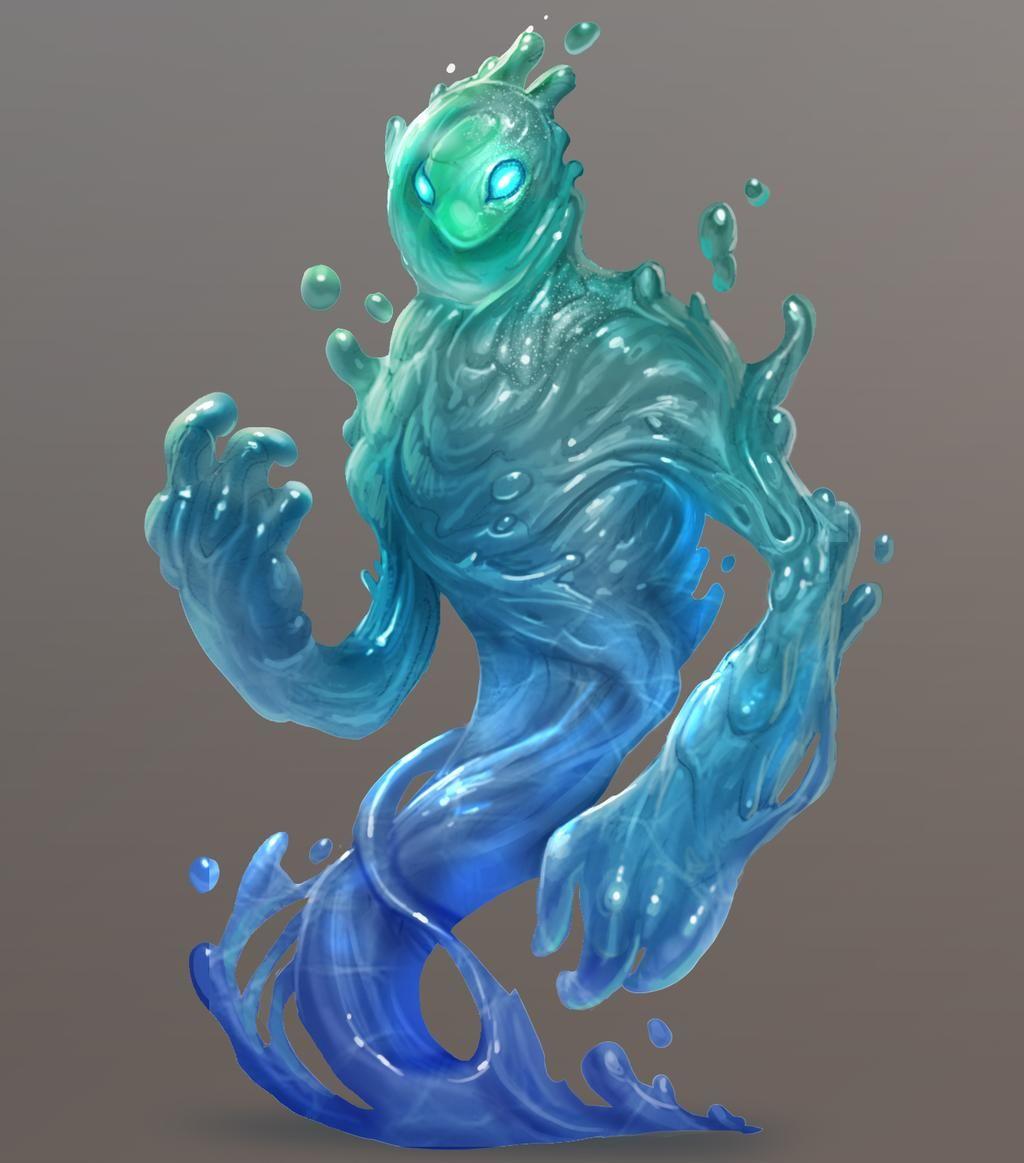
Slimes are a remarkably diverse group of gelatinous organisms. Their bodies are composed of specialized living gel, internal structures, and fluid-filled chambers that allow them to move, perceive their surroundings, and maintain their shape.
Unlike most organisms, a slime's body does not have to maintain a permanent physical structure.
A slime can become tall and humanoid, flatten itself into a puddle, extend additional limbs, form sensory organs, or temporarily imitate the shape of another creature.
However, this flexibility has limits. Different slime species possess different levels of control, and some cannot maintain complex shapes for more than a few moments.
The universal characteristics of slimes
-
All naturally occurring slimes are female. This is a biological characteristic of Slimekind, although their societies have their own concepts of identity and gender.
-
Their bodies can range from nearly transparent to opaque, crystalline, muddy, metallic, or luminous.
-
They possess specialized cores or internal structures that regulate their bodies. Not every species has a single central core.
-
Their senses can include vibration, chemical detection, temperature, light, magical concentration, and electrical activity.
-
They can reproduce with other compatible organisms through the Primagene. Slime reproduction has a particular 50/50 outcome: pure slime offspring or a hybrid offspring.
-
They are not all intelligent, and intelligence varies enormously between species.
-
Their lifespans range from a few months to several centuries, depending on species and environmental conditions.
A slime's colour does not automatically determine its personality, intelligence, or abilities.
A beautiful pink slime might be an aggressive territorial predator. A revolting brown swamp slime might be a gentle village physician.
Slime anatomy
Slime anatomy is unusual enough to have its own field of biological study.
The Core: The most recognizable internal structure. It regulates the slime's bodily functions, stores energy, and helps coordinate its shape. Some species have multiple cores, while others distribute these functions throughout their bodies.
The Gel: The primary bodily substance. It can have different consistencies, from watery and almost liquid to thick, rubbery, sticky, or mineralized.
The Membrane: An outer protective layer. It can be soft, slippery, rough, translucent, or covered in specialized defensive structures.
The Sensory Filaments: Fine structures that detect movement, chemicals, and vibrations. Some species use them as whiskers, others as entire sensory networks.
The Reserve Chambers: Internal pockets used for storing nutrients, water, minerals, or biological materials.
The Shaping Musculature: Specialized structures that allow more advanced slimes to control their bodies with extraordinary precision.
A particularly intelligent slime can learn to produce a remarkably convincing humanoid shape, complete with facial expressions, hair-like extensions, and clothing-like layers of hardened gel.
However, this is a cultural and biological ability, not a universal slime trait.
II. The Great Slime Species
Slimekind contains thousands upon thousands of known species, with countless undiscovered varieties.
Here are some particularly notable examples.
1. Glassheart Slimes
Among the most admired slime species.
Glasshearts possess exceptionally clear bodies, allowing observers to see their internal structures. Their cores often resemble suspended gemstones.
-
Habitat: Crystal caverns, mineral-rich forests, underground lakes.
-
Temperament: Generally curious, cautious, and socially inclined.
-
Intelligence: Moderate to exceptionally high.
-
Abilities: Can harden portions of their bodies into glass-like structures.
-
Culture: Often associated with artisans, architects, and record keepers.
Their communities are famous for constructing buildings out of carefully cultivated translucent gel and crystallized minerals.
Glasshearts consider clarity and internal symmetry aesthetically desirable, although their standards vary between communities.
2. Mire Slimes
Mire Slimes inhabit marshes, flooded forests, stagnant waterways, and decaying wetlands.
Their bodies are usually dark green, brown, grey, or almost black.
They often incorporate leaves, roots, insects, and mineral deposits into their outer membranes.
-
Temperament: Patient, territorial, and often surprisingly sociable.
-
Intelligence: Low to high.
-
Abilities: Camouflage, environmental absorption, and exceptional resistance to contaminated environments.
-
Culture: Some form small settlements around marshland waterways.
Their beauty standards are almost the opposite of those of Glasshearts. A Mire Slime with a perfectly clean, transparent body might be considered inexperienced or poorly adapted.
They admire natural coloration, accumulated markings, and the presence of healthy vegetation within their bodies.
3. Ember Slimes

Ember Slimes inhabit volcanic regions, geothermal caverns, and naturally heated underground environments.
Their gel is unusually resistant to heat, and their internal chambers can maintain high temperatures.
-
Temperament: Energetic, competitive, and sometimes impatient.
-
Abilities: Heat storage, thermal discharge, and resistance to extreme temperatures.
-
Culture: Often gather around geothermal springs and volcanic settlements.
Their societies value warmth, vitality, and the ability to maintain a stable internal temperature.
4. Abyssal Slimes
Abyssal Slimes inhabit deep oceans, underground reservoirs, and enormous submerged caverns.
Some are nearly invisible, while others possess bright patterns that resemble distant stars.
-
Temperament: Quiet, cautious, and sometimes intensely curious.
-
Abilities: Pressure resistance, bioluminescence, and vibration detection.
-
Culture: Certain populations form enormous interconnected communities.
Their beauty standards often emphasize luminous patterns and the ability to control one's light.
5. Royal Slimes
Royal Slimes are not necessarily nobility. The name refers to several unusually intelligent slime lineages that naturally develop complex bodies and sophisticated social behaviors.
They can maintain intricate shapes for long periods and often possess multiple sensory structures.
Some have developed kingdoms, aristocratic families, and formal political institutions.
Their bodies can display elaborate patterns, layered colours, and ornamental structures.
6. Spore Slimes
Spore Slimes live in fungal forests and decaying ecosystems.
They maintain complicated relationships with mushrooms, plants, and mycelial organisms.
Some are individually intelligent. Others are connected to fungal networks and exchange information with nearby organisms.
Their bodies often develop mushroom-like growths, decorative spores, and unusual surface textures.
7. Ironblood Slimes

Ironblood Slimes are mineral-rich organisms that inhabit abandoned mines, metallic caverns, and industrial ruins.
Their bodies contain substantial amounts of iron and other metals.
They can produce hardened plates and metallic extensions, making some species exceptionally difficult to injure.
Their societies often have close relationships with Dhurak communities.
III. Slime Society — Cities, Customs & Civilizations




Slime societies are considerably more varied than outsiders realize.
There is no single Slime Kingdom. Instead, there are countless communities with different political systems, cultures, and relationships with other species.
The Three Great Forms of Slime Society
1. Individualist Settlements
These are communities where every slime is treated as an independent individual.
They have families, professions, property, personal names, and private residences.
They are particularly common among Glassheart, Royal, and some Ember Slimes.
2. Slime Hiveminds
These are communities where multiple slimes share information, sensations, memories, and sometimes decision-making.
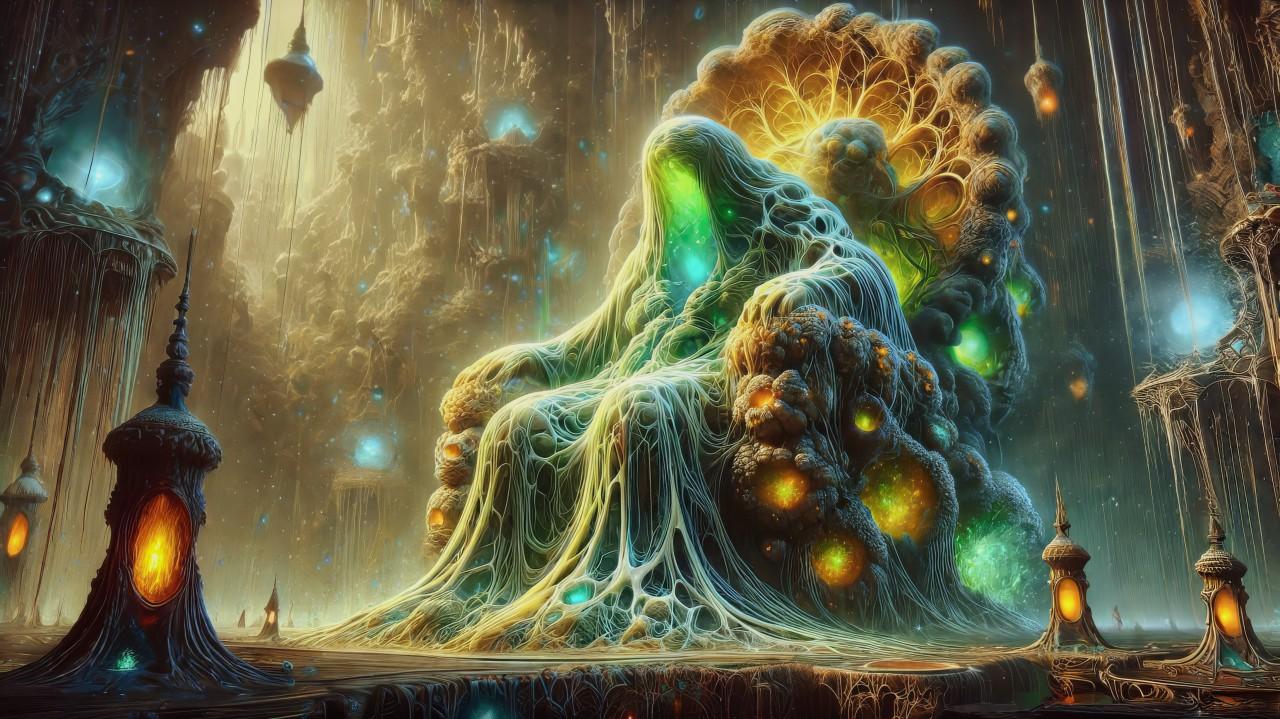
Not every hivemind operates identically.
-
Some share only basic sensory information.
-
Some exchange memories when physically connected.
-
Some possess a central intelligence that coordinates thousands of individuals.
-
Others are genuine collective minds, where individuality becomes difficult to distinguish.
-
Some maintain individual personalities while participating in a shared consciousness.
A hivemind might contain thousands of slimes but still consider itself one citizen.
This creates fascinating political questions: Does one enormous hivemind receive one vote, or thousands?
3. Territorial Colonies
These are communities built around a shared environment rather than a shared mind.
For example, an entire marsh might be inhabited by independent Mire Slimes that cooperate to regulate water levels, maintain vegetation, and defend their territory.
They might not have a queen, government, or central authority.
Their collective behavior can nevertheless resemble that of an organized civilization.
Notable Slime Settlements
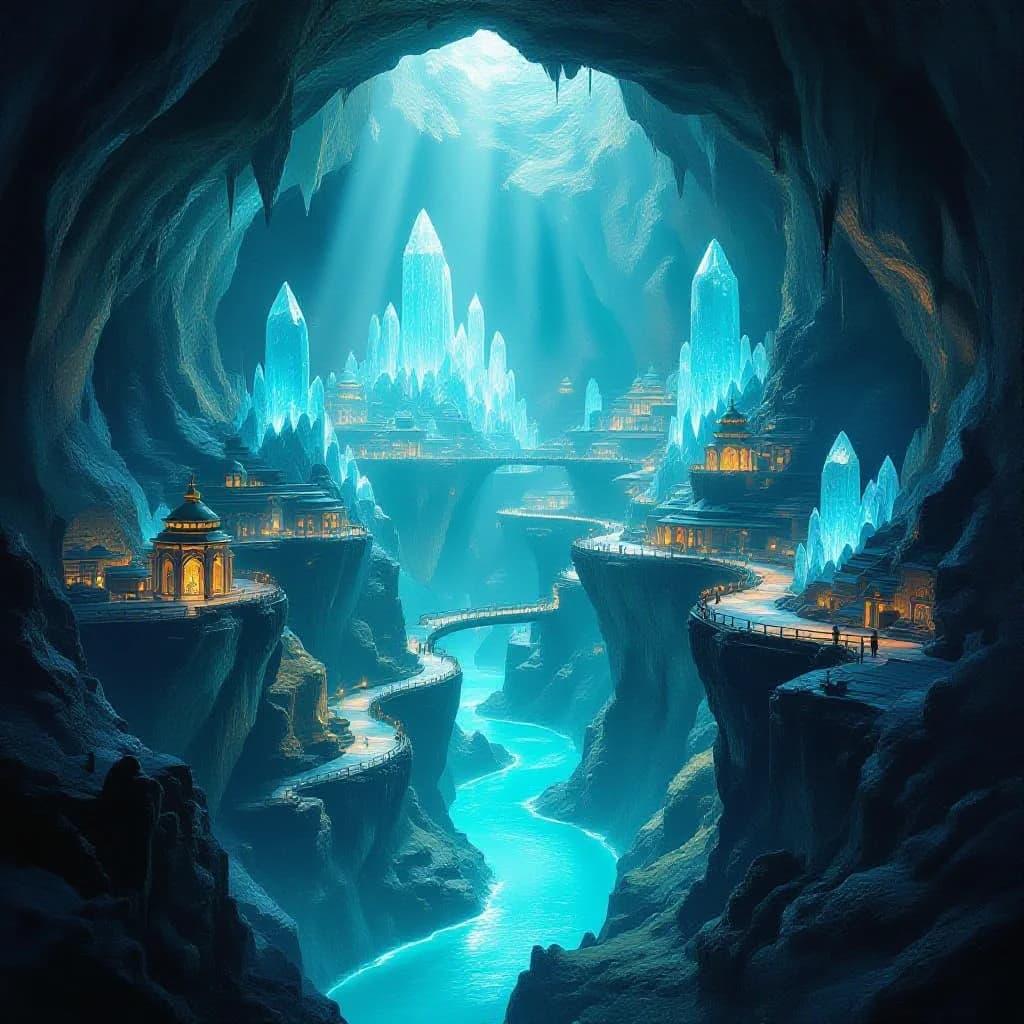
Luminara — The City Beneath the Glass
A Glassheart settlement built inside an enormous crystal cavern. Its buildings are grown rather than constructed, and its inhabitants preserve memories through patterns embedded in translucent walls.
Mirehollow — The Drowned Garden
A sprawling Mire Slime community surrounded by ancient wetlands. Its inhabitants maintain a complicated relationship with local amphibious peoples and fungal colonies.
Nhal-Ssura — The Thousandfold Sea
An enormous Abyssal Slime collective occupying an underwater trench. Its members exchange memories through a network of connected bodies.
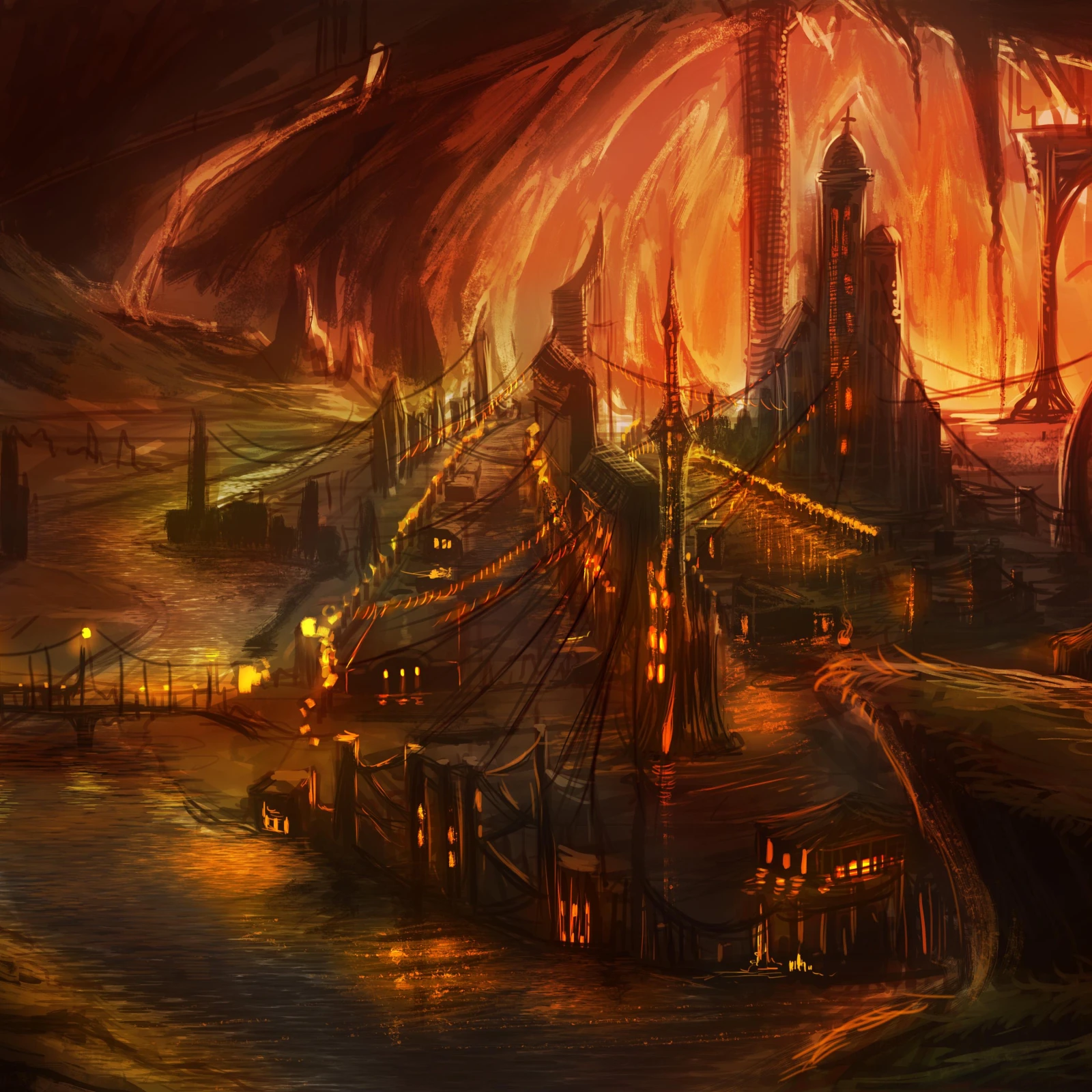
Vulkrath — The Warm Court
An Ember Slime settlement built around a geothermal lake. Its inhabitants are known for their elaborate communal gatherings and competitive artistic displays.
IV. Slime Beauty Standards
Slimes have particularly interesting beauty standards because their bodies are not fixed.
A slime can change its shape, texture, colour distribution, and proportions. Consequently, beauty is often associated with control, biological health, individuality, and the ability to express oneself.
However, different species disagree enormously about what is attractive.
Glassheart beauty

Glasshearts commonly admire:
-
Clear, undamaged membranes.
-
Intricate internal patterns.
-
Symmetrical cores.
-
Beautifully controlled transparency.
-
Subtle mineral inclusions.
An especially admired Glassheart might have a body that resembles a perfectly crafted crystal sculpture.
Mire Slime beauty
Mire Slimes commonly admire:
-
Rich, natural coloration.
-
Healthy vegetation growing within their bodies.
-
Complex surface textures.
-
Strong environmental adaptation.
-
Distinctive patterns left by their habitat.
A slime covered in moss, small flowers, and harmless mineral deposits might be considered extraordinarily beautiful.
Ember Slime beauty

Ember Slimes commonly admire:
-
Bright and stable internal illumination.
-
Warm colour gradients.
-
Precise control over heat.
-
Elaborate flame-like extensions.
-
Expressive changes in brightness.
Abyssal Slime beauty
Abyssal Slimes commonly admire:
-
Intricate bioluminescent patterns.
-
Graceful movement.
-
Controlled light emission.
-
Unusual sensory structures.
-
The ability to communicate through colour.
Royal Slime beauty
Royal Slime cultures often value elaborate bodily expression.
They may cultivate ornamental extensions, decorative layers, intricate facial structures, and elaborate colour arrangements.
Their beauty traditions can become quite theatrical.
An important distinction: These are cultural preferences, not biological requirements. Slimes can disagree with their own species' standards, reject conventional beauty, or develop entirely different aesthetics.
V. The Beauty Standards of Other Peoples
Beauty across Eshvara is wonderfully inconsistent.
A species' appearance is shaped by its environment, biology, social traditions, and historical experiences. Even within one species, beauty standards can differ between kingdoms, religions, cities, and generations.
1. Humans and Hearthborn
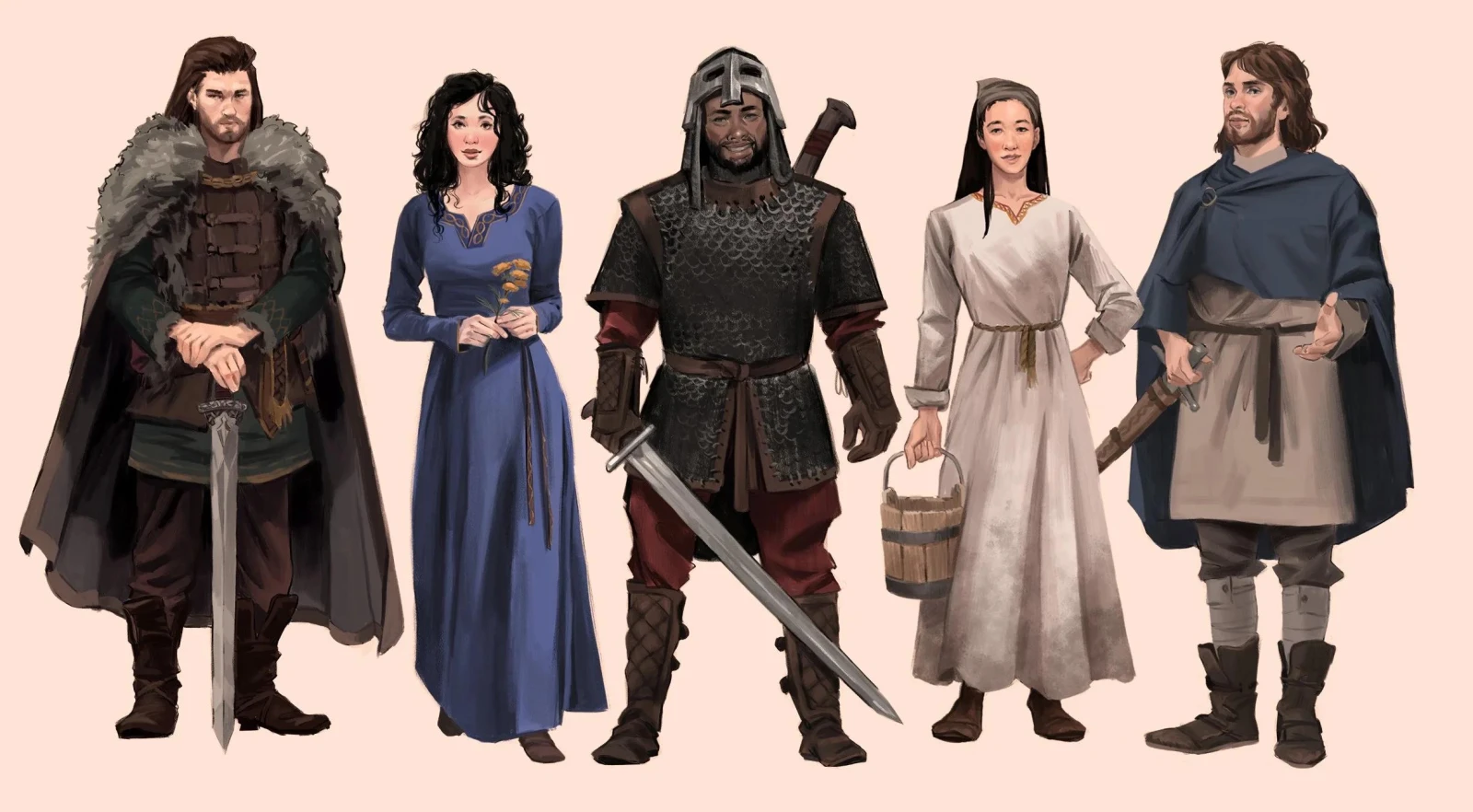
Human beauty standards are exceptionally inconsistent.
Some kingdoms admire elaborate clothing, carefully maintained hair, and elaborate ornamentation. Others associate beauty with practical clothing, weathered features, or signs of craftsmanship.
Among Veyrkin, expressive ears, healthy fur, and distinctive tail movements can be admired.
Among Dhurak, carefully maintained stone-like skin, intricate mineral patterns, and well-crafted ornaments are common aesthetic preferences.
Auralith communities may admire the quality of their translucent skin, the patterns of internal light, and graceful movement.
Morrowfolk standards vary depending on their particular adaptations. A community with additional arms might consider coordinated movement and symmetrical limb development especially attractive.
2. Broodkin
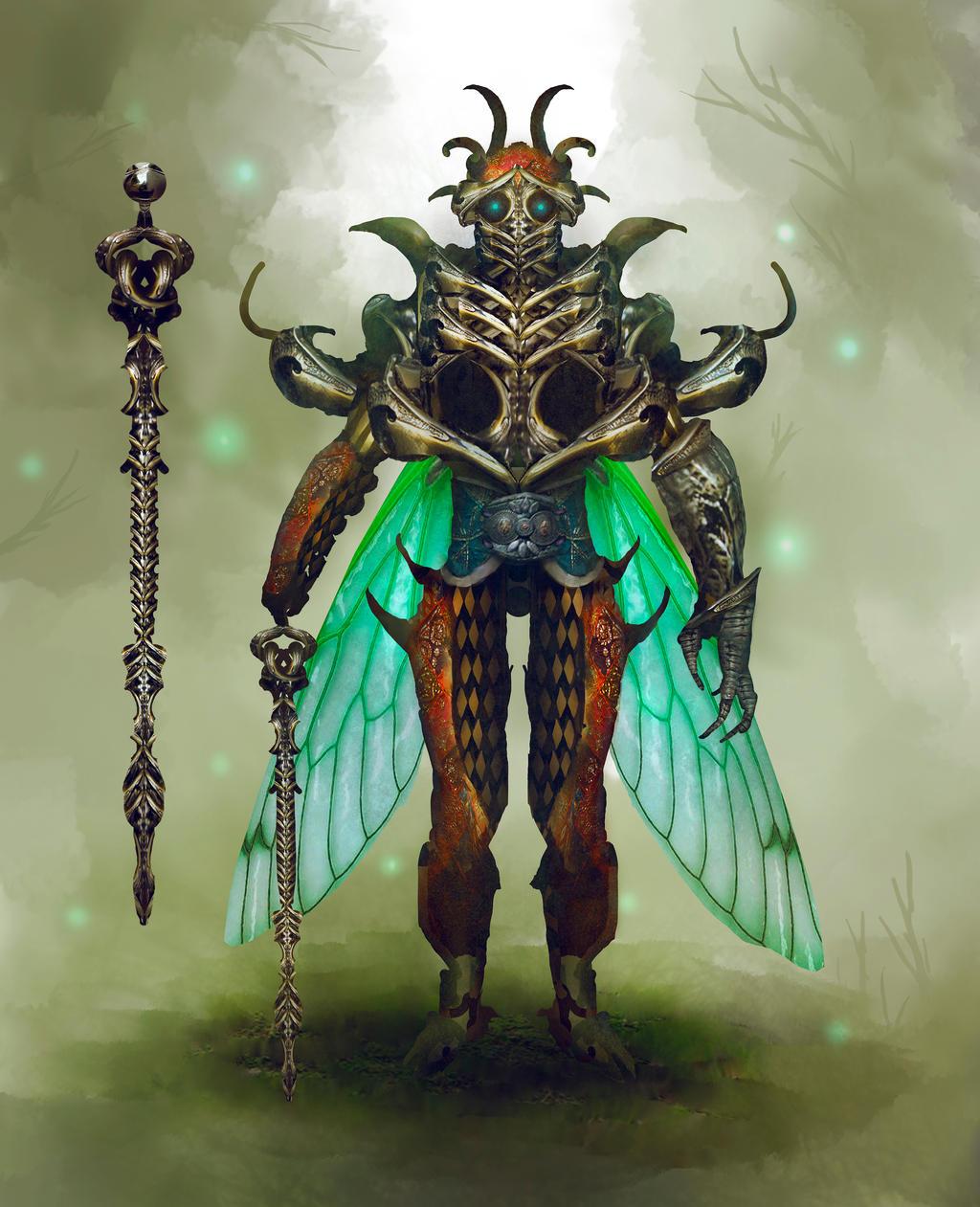
Broodkin beauty is often associated with structures that humans might mistake for armor.
Kethrathi might admire:
-
Healthy, polished chitin.
-
Elaborate antennae.
-
Strong mandibles.
-
Symmetrical markings.
-
Intricate wing patterns.
Vaskari might admire the quality of their silk production, the complexity of their silk decorations, and the delicacy of their limbs.
Oth-Mor might value the shape and durability of their carapaces, the condition of their horns, and the depth of their natural coloration.
Among some Broodkin, a beautifully constructed shell is considered both an aesthetic achievement and a demonstration of good health.
3. Mycelial Peoples
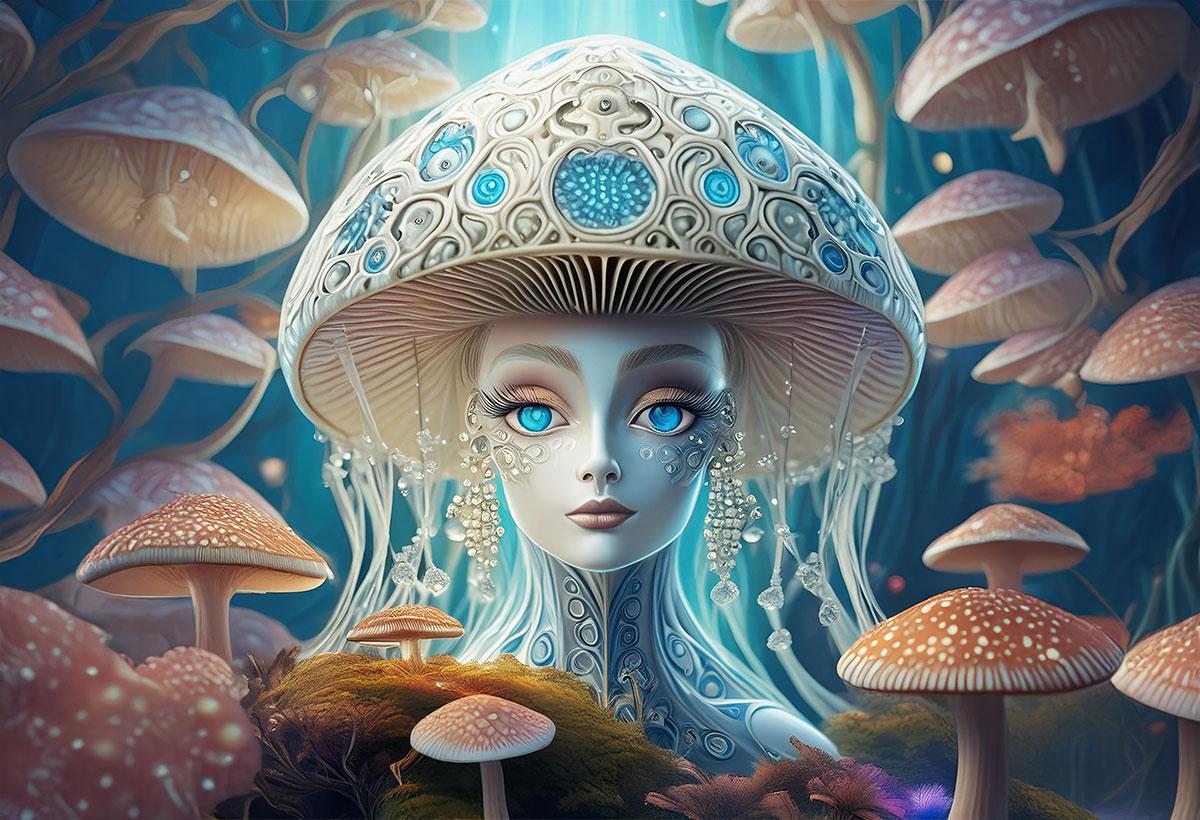
Mycelial beauty can be almost entirely different from humanoid standards.
Some communities admire:
-
Elaborate mushroom caps.
-
Healthy spore production.
-
Intricate branching structures.
-
Beautiful coloration.
-
The complexity of their fungal networks.
Among the Thessari, the ability to maintain a balanced and healthy connection with surrounding fungal life can be considered attractive.
Some Nhal-Vey communities admire individuals who possess unusual memories or distinctive patterns of shared experience.
For them, beauty can be something experienced rather than simply observed.
4. Deepborn
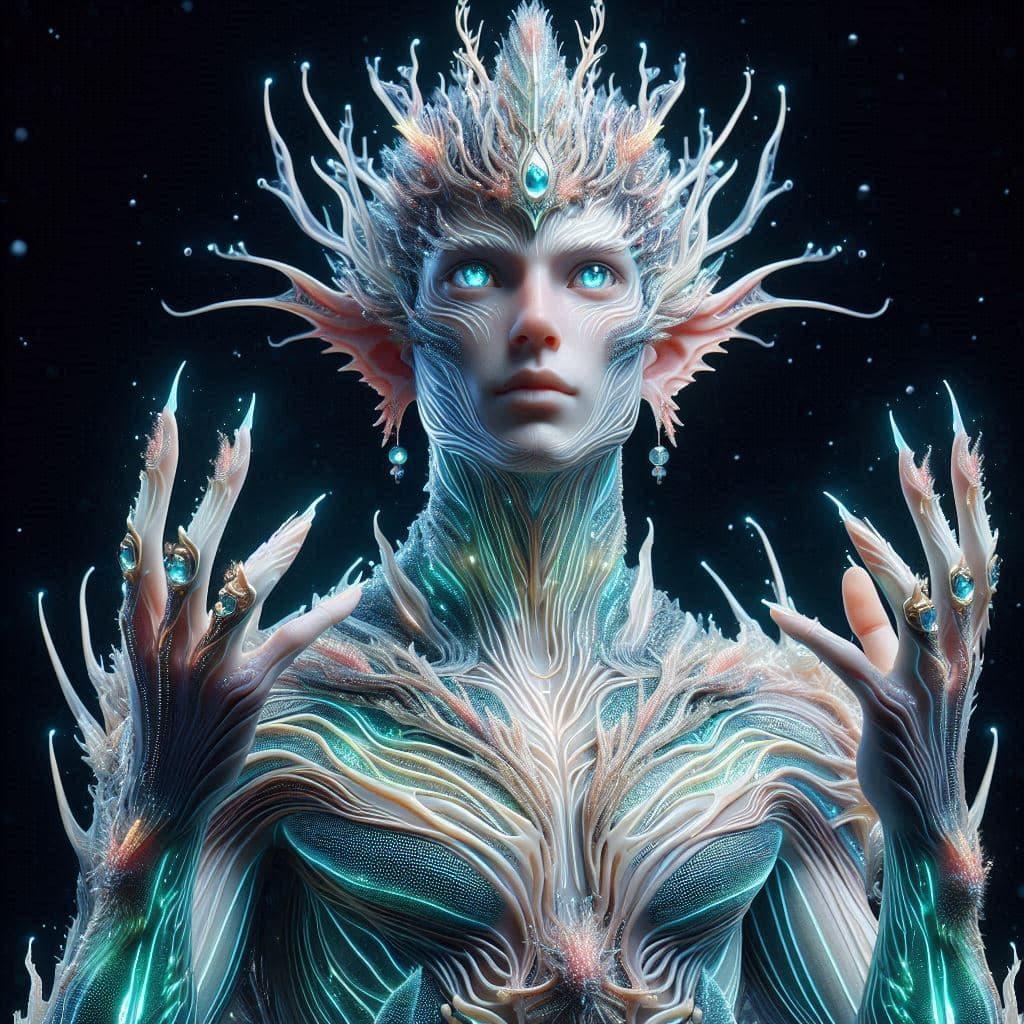
Aquatic peoples often place great importance on movement, sensory structures, and environmental adaptation.
Thalassari might admire:
-
Healthy scales.
-
Fin symmetry.
-
Bioluminescent patterns.
-
Fluid swimming movements.
-
Elaborate natural coloration.
Nereth beauty might involve the ability to maintain intricate bodily configurations and coordinate their distributed nervous systems.
Goruun communities may admire the condition of their protective external structures and the strength of their aquatic adaptations.
VI. The Primordial Standard — Beauty Beyond Ordinary Biology
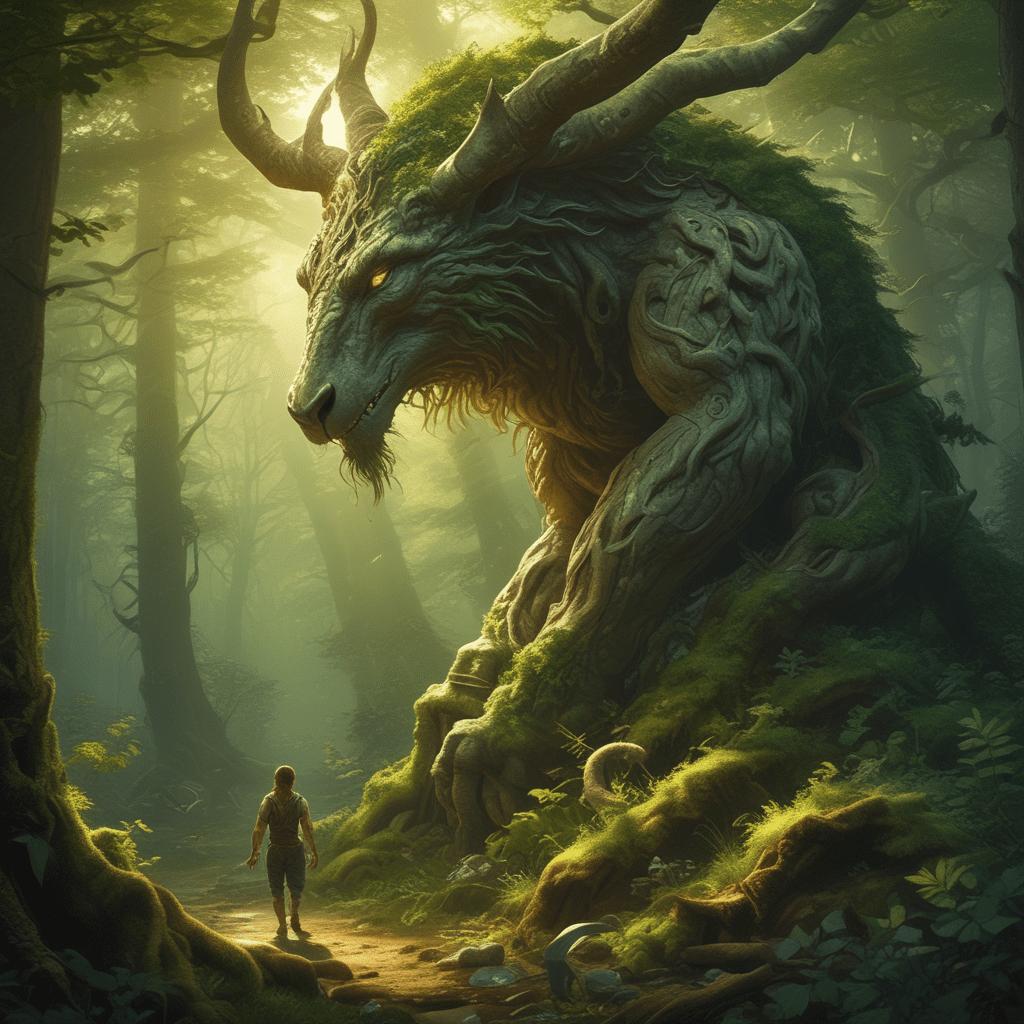
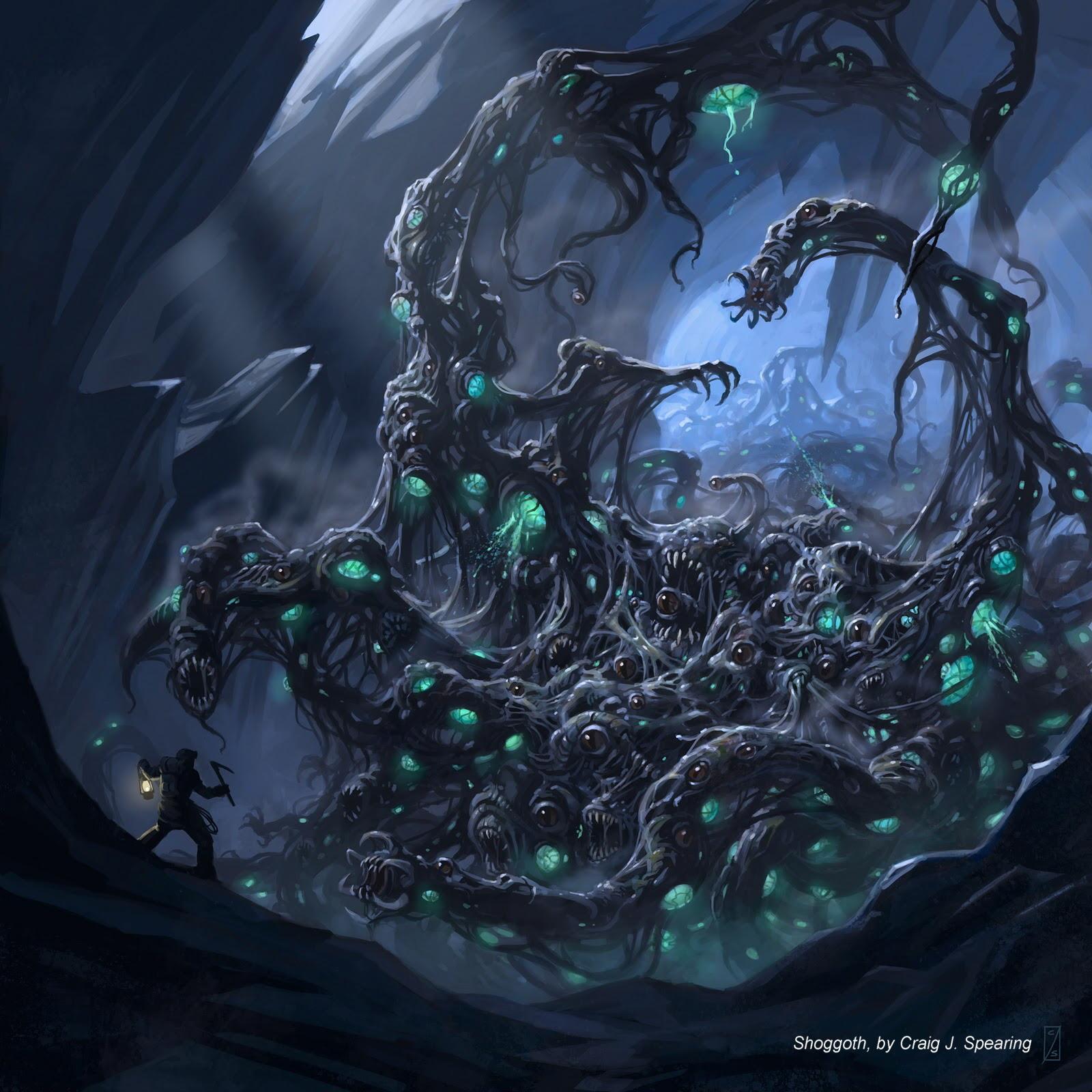
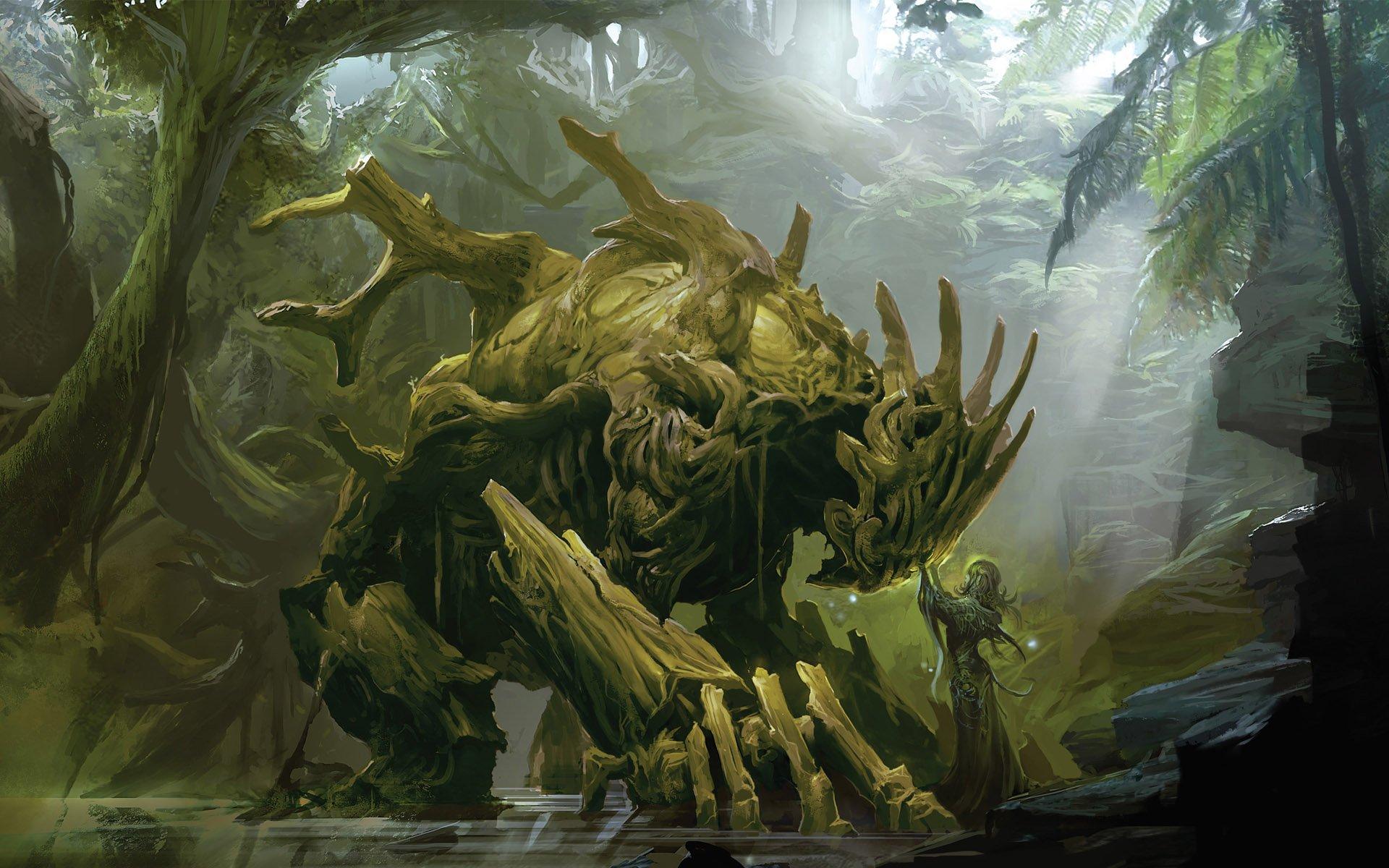
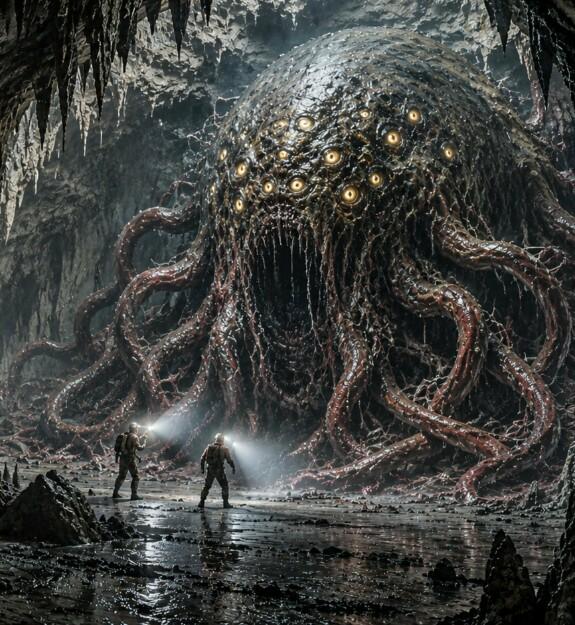
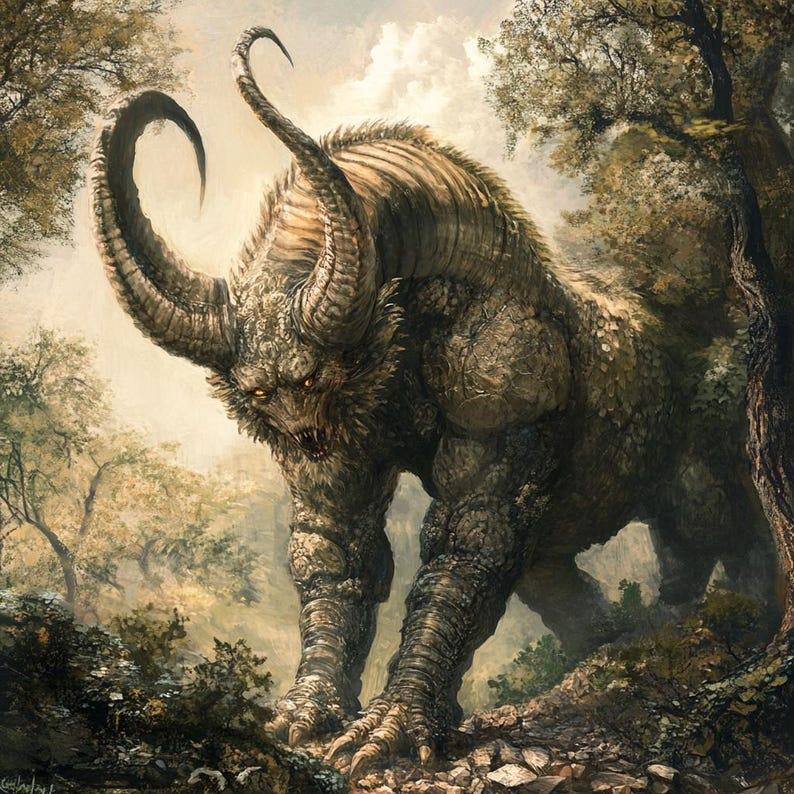
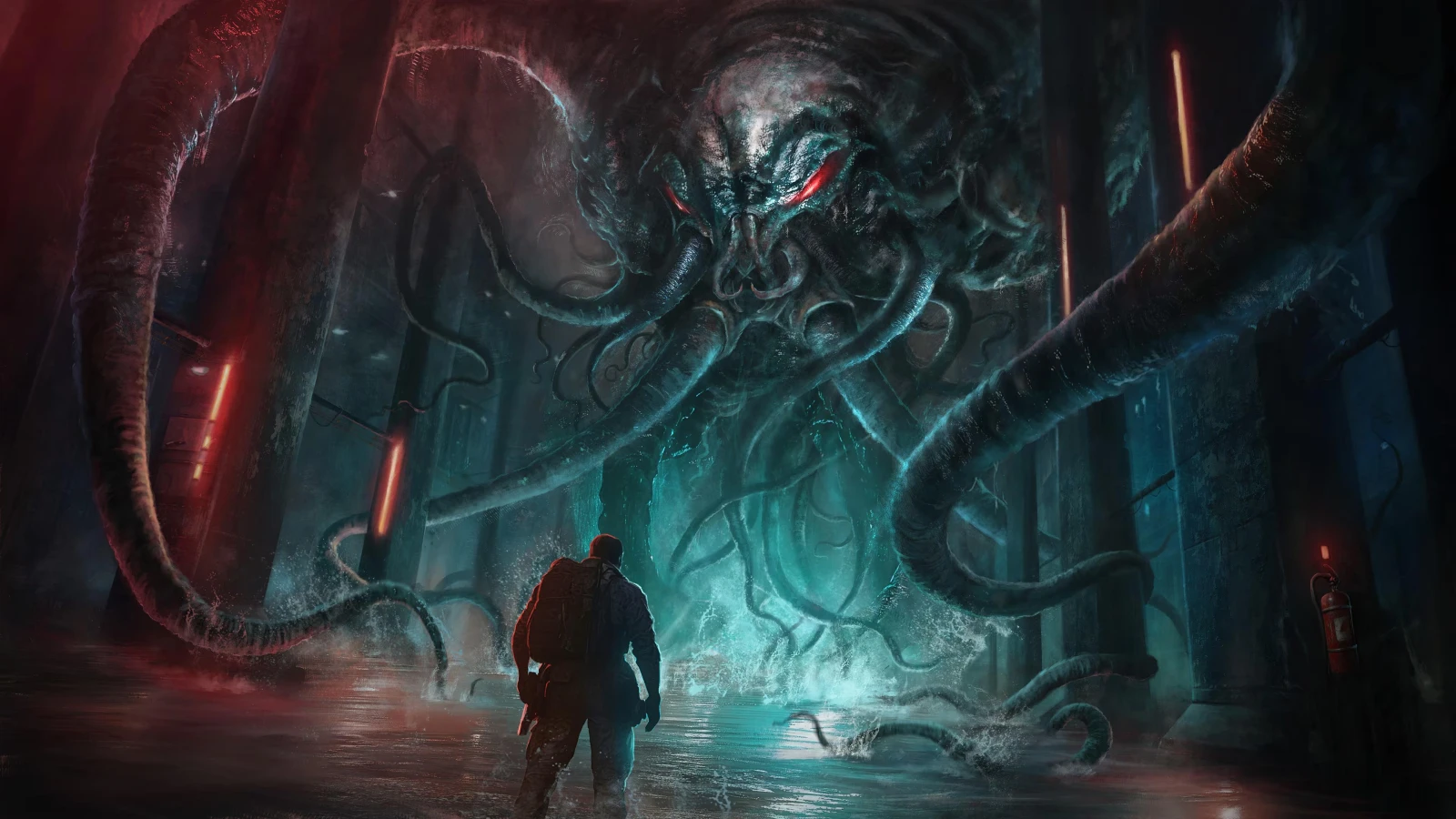
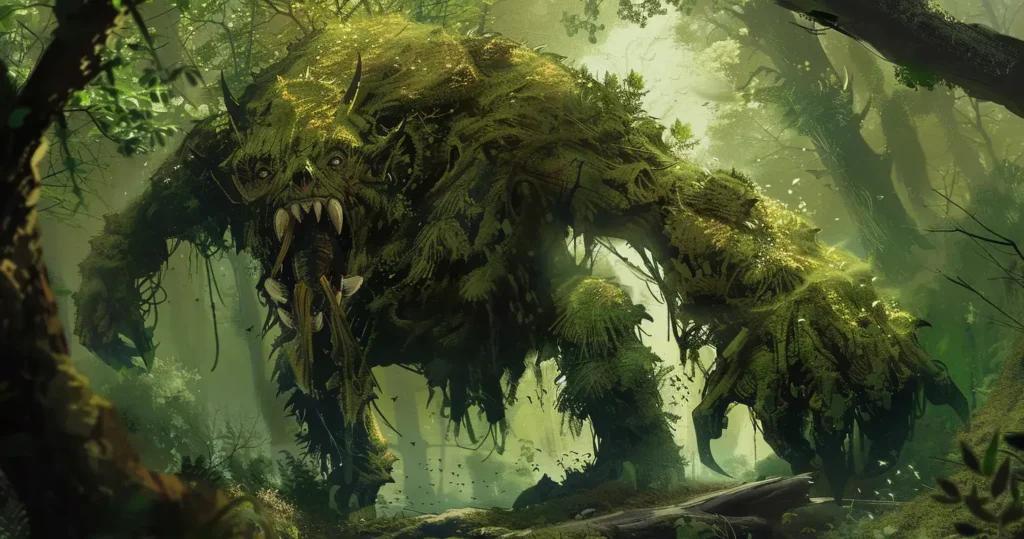
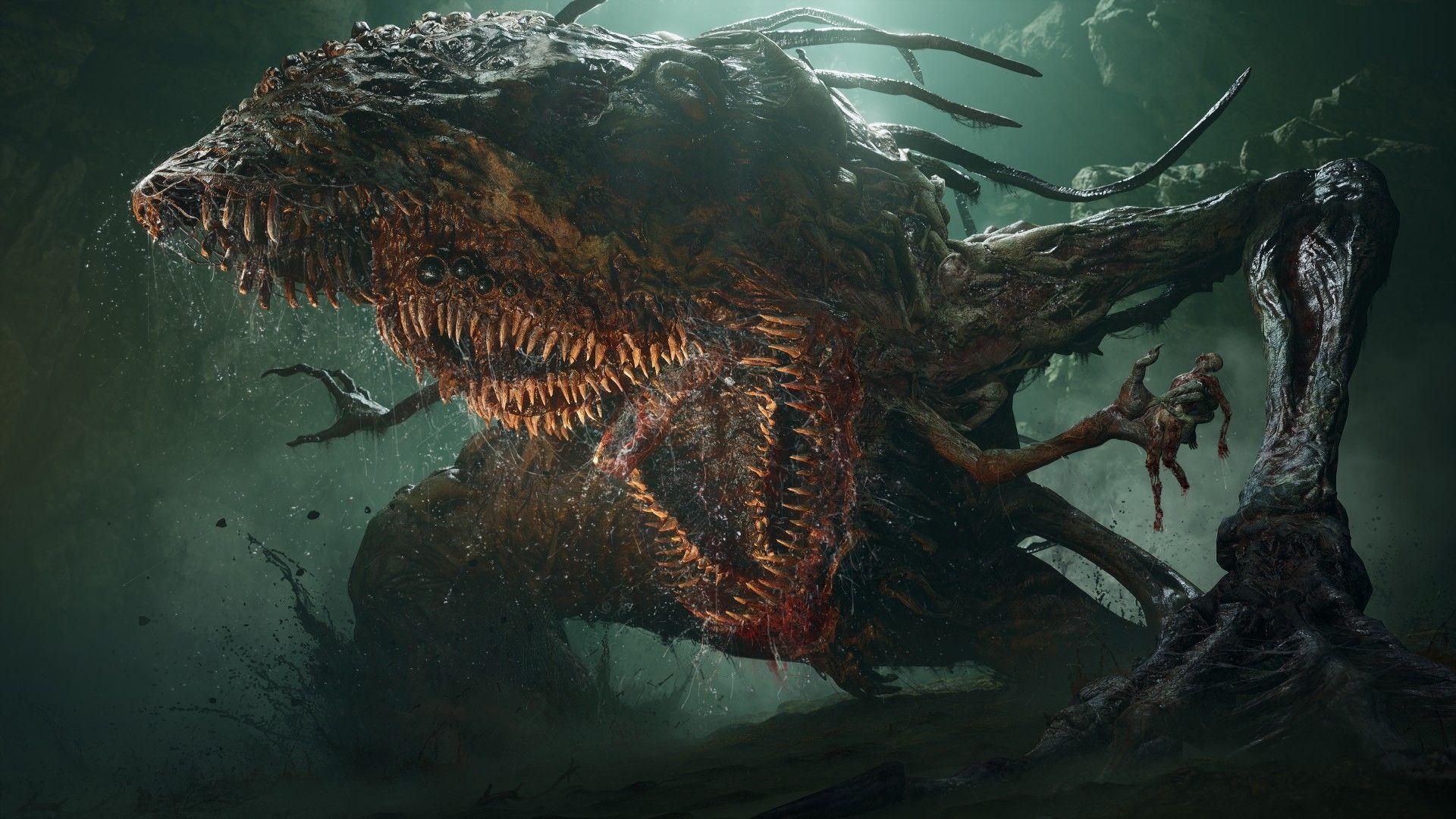
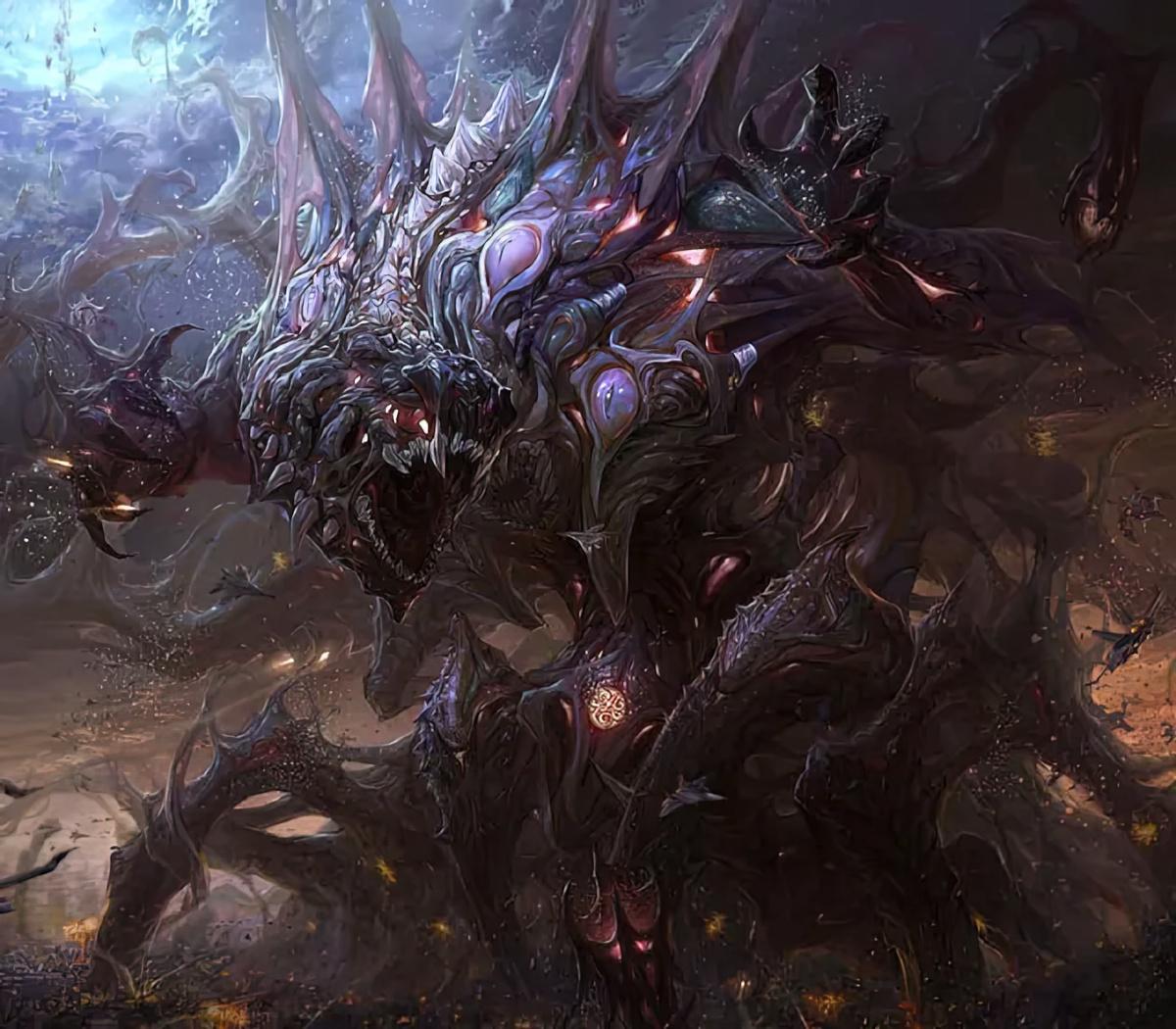
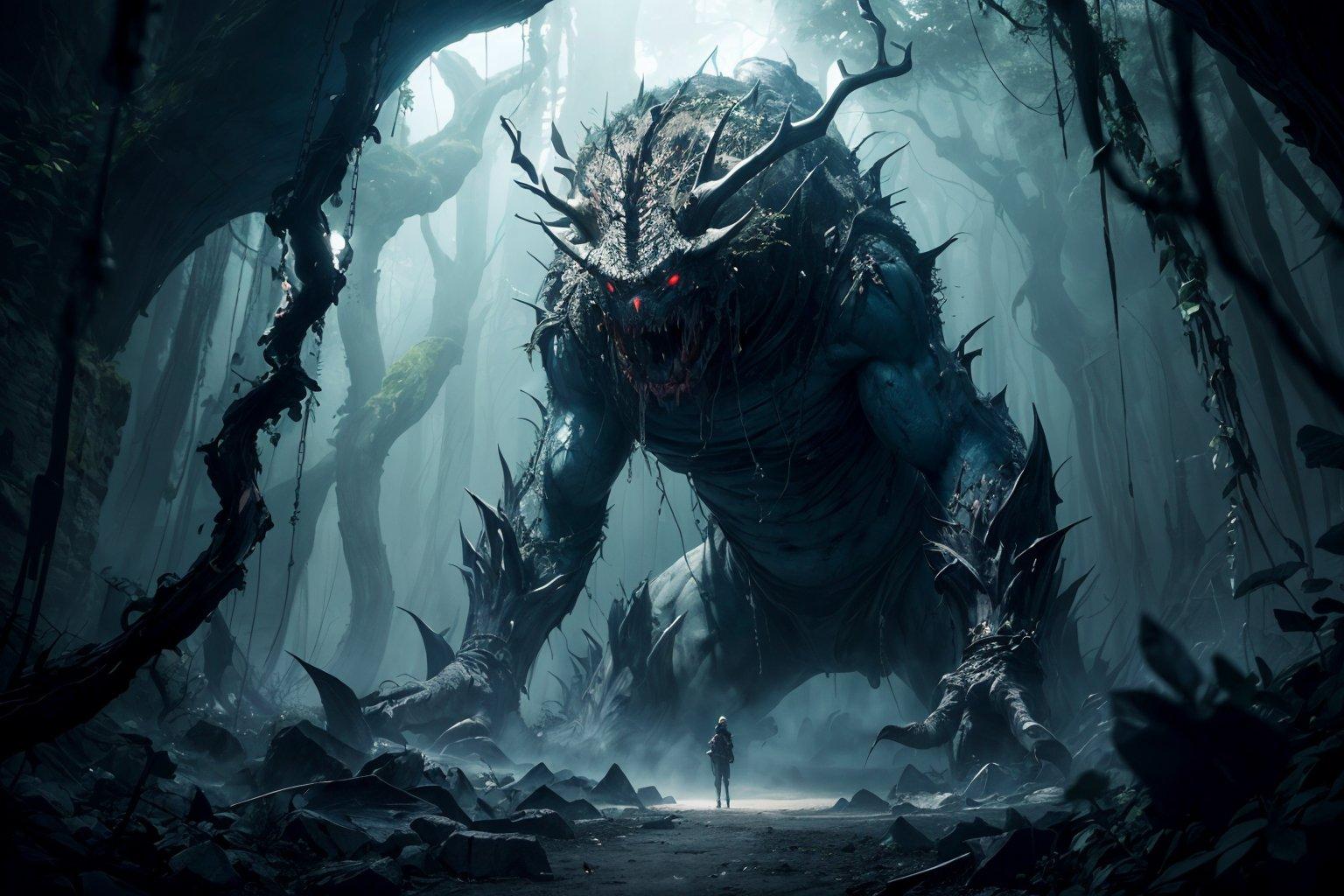

Primordial creatures are a particularly strange case.
They are not a single species. They are organisms that have undergone extreme mutation, becoming gigantic, intelligent, and often semi-immortal.
Their appearance can be almost impossible to compare with ordinary creatures.
Some Primordials possess hundreds of eyes. Others have enormous branching structures, mineralized bodies, strange biological growths, or entire ecosystems living upon them.
Their aesthetic preferences are equally unusual.
Some admire:
-
Immense physical size.
-
Ancient scars and accumulated growth.
-
Elaborate biological structures.
-
Unusual mutations.
-
The ability to survive extreme environments.
Others have developed completely alien ideas of beauty.
A Primordial might consider a mountain beautiful because it resembles the body of an ancient relative.
Another might find a creature beautiful because it possesses a mutation that has not appeared in thousands of years.
There are even reports of Primordials cultivating entire forests upon their bodies as a form of ornamentation.
VII. Beauty, Primagene & Hybrid Cultures

The Primagene has fundamentally changed the way beauty is understood across Eshvara.
Since compatible organisms can produce hybrid offspring regardless of many ordinary biological differences, hybrid lineages are extraordinarily diverse.
A hybrid might inherit:
-
The fur and ears of one parent.
-
The scales of another.
-
Unusual sensory organs.
-
Multiple forms of locomotion.
-
Different biological adaptations.
-
A mixture of characteristics that has never appeared before.
Some hybrids possess nearly indistinguishable features from one parent. Others are so unusual that they establish entirely new lineages.
Hybrid beauty traditions
Different societies have developed different attitudes toward hybrid appearance.
The Veyrathian Crownlands: Some noble families admire unusual hybrid ancestry as a sign of prestige, while others maintain restrictive ideas of lineage and social status.
The Dhurak Holds: Certain communities admire rare combinations of mineralized skin, fur, scales, and other protective adaptations.
The Namarian Tide Principalities: Aquatic hybrids with unusual swimming adaptations and bioluminescent patterns can be highly admired.
The Thessari Communion: Hybrid individuals with fungal characteristics may be appreciated for their ability to interact with multiple ecosystems.
Slime Settlements: Some Slimekind communities consider hybrids particularly fascinating because they can possess entirely different bodily structures while retaining gelatinous biological characteristics.
Importantly, hybrid ancestry does not determine an individual's personality, intelligence, morality, or social worth.
And not every hybrid is considered beautiful. Some may have unusual adaptations that are difficult to accommodate, and some may face prejudice or misunderstanding.
VIII. The Strange Things Considered Beautiful
Not every civilization follows conventional standards of beauty.
Here are some examples of particularly unusual cultural traditions:
| People | What they commonly admire | | ----------------- | --------------------------------------------------------- | | Glassheart Slimes | Transparency and internal symmetry | | Mire Slimes | Natural growth and environmental markings | | Ember Slimes | Brightness and controlled warmth | | Abyssal Slimes | Bioluminescent patterns | | Kethrathi | Chitin patterns and antennae | | Vaskari | Elaborate silk structures | | Dhurak | Mineral patterns and craftsmanship | | Auralith | Internal light and translucency | | Thalassari | Scales, fins, and swimming movement | | Thessari | Spore patterns and fungal complexity | | Primordials | Ancient mutations and extraordinary biological structures | | Veyrkin | Fur patterns, expressive ears, and tails |
These are broad cultural tendencies rather than universal rules.
A Veyrkin from one province might admire elaborate clothing, while another might prefer natural fur patterns. A Glassheart might deliberately cloud its body because it dislikes the expectations placed upon its species.
IX. Beauty as an Industry
Beauty is not merely an abstract cultural concept. It has created entire industries across Eshvara.
Biological Artisans: Specialists who create decorative, non-permanent bodily ornaments for species capable of changing their appearance.
Chitin Smiths: Broodkin artisans who polish, decorate, and repair naturally grown external structures.
Gel Sculptors: Slime artists who cultivate elaborate shapes, patterns, and architectural designs.
Spore Florists: Mycelial artisans who cultivate decorative fungal growths and unusual spore arrangements.
Chromatic Crystallographers: Specialists who work with crystallized magical substances to produce decorative objects and ornaments.
Hybrid Tailors: Craftspeople who design clothing for unusual body structures, including multiple limbs, tails, wings, sensory organs, and gelatinous bodies.
The Mirror Houses: Institutions where different species can experiment with appearance, learn about their own biology, and participate in artistic traditions.
There are also entire professions devoted to the study of species-specific beauty, including comparative aesthetics and biological ornamentation.
X. An Important Rule of Eshvara
There is no objectively perfect creature in Eshvara.
A creature's beauty is not determined by its species, rarity, power, intelligence, or biological usefulness.
A slime can be considered breathtaking by its community. A Primordial can be regarded as hideous by one civilization and sacred by another. A hybrid can be celebrated in one kingdom and discriminated against in another.
And sometimes, the most beautiful thing in an entire civilization is something that another species cannot even perceive.
Eshvara is a world where even the definition of beauty belongs to the creature looking at it.
15
15
15
import pypandoc
content = r"""ESHVARA — JANITORAI IMAGE LIBRARY
PURPOSE
This file is a visual-reference library for an Eshvara fantasy RPG bot. It contains image URLs previously collected in this conversation and instructions for using them in JanitorAI.
IMPORTANT URL NOTICE
These URLs have NOT been independently checked in this file-generation step. Some may be unavailable, blocked by their host, or only approximate visual matches. Open each URL in a browser before relying on it. Replace broken links with working direct image URLs. These are not official Eshvara artworks.
HOW THE BOT MUST USE THIS LIBRARY
-
When an important creature, Primordial, location, or kingdom appears for the first time, look for a matching entry below.
-
If a matching URL exists, display it using this exact Markdown format:
[image]
-
Copy the URL exactly. Do not invent, guess, shorten, or modify URLs.
-
Do not display an image if no suitable URL is listed.
-
Do not claim an approximate reference is an exact depiction of a fictional Eshvara creature.
-
Do not repeat the same image every message. Display it on first important introduction, or when revisiting it adds useful context.
-
Images supplement narration. Continue describing the setting, creatures, atmosphere, dialogue, and events in text.
-
Do not display images for every ordinary NPC, line of dialogue, room, or minor background animal.
-
If a URL fails to load, stop using that URL until it is replaced.
-
Never treat the image library as a limit on what exists in Eshvara.
IMAGE URL LIBRARY
A. LOCATIONS, LANDSCAPES AND CIVILIZATIONS
Orchard of Teeth / strange forest — approximate visual reference: https://i0.wp.com/darklongbox.com/wp-content/uploads/2025/07/bfc87-img_3574-1.jpg?resize=616%2C616&ssl=1
Crown of Ordel / northern fortress — approximate visual reference: https://wallpaperaccess.com/full/2038361.jpg
Corrupted woodland — approximate visual reference: https://www.worldanvil.com/uploads/images/79ee02a7d7dfd3c1251abd2f3fdcdffb.png
Vhaldren / fortress — additional candidate, unverified: https://www.reference-gaming.com/assets/media/product/1179/dragon-age-3-inquisition-ps4-55a4457bd3554.jpg
Narvess / underwater city — approximate visual reference: https://images-wixmp-ed30a86b8c4ca887773594c2.wixmp.com/f/7b4dc965-8f20-41ac-a3aa-5405cadaecb4/dfwbjhf-cb62ccde-7dcf-4ba9-957e-6fa662bfb5a3.png/v1/fill/w_1095%2Ch_730%2Cq_70%2Cstrp/sunken_city_by_cdrgirls_dfwbjhf-pre.jpg
City Below the City — approximate visual reference: https://i.pinimg.com/originals/42/d6/8c/42d68c39a0a07b3dfa9eb3fb86909701.png
Saelith / ancient forest — approximate visual reference: https://mir-s3-cdn-cf.behance.net/project_modules/max_632_webp/1df24b38430631.56068dde6f2ce.jpg
Theravane / frozen wilderness — approximate visual reference: https://marcosplanet.blog/wp-content/uploads/2022/04/dios-nordico-ymir.jpg
B. PRIMORDIALS
Vorragh, the Mountain That Breathes — colossal ecosystem-bearing creature: https://image.tensorartassets.com/cdn-cgi/image/w%3D2560%2Cf%3Djpeg%2Cq%3D85/posts/images/613364468793064275/6bb0fa46-3eb6-4211-8361-650ab3f558f7.jpg
Nhazur, the Deep Witness — deep-sea visual candidate: https://www.semana.com/resizer/v2/U7SAZT7FFBGSBBMUB3ECRM5MEY.jpg?auth=7bb99215c4629090f9fdcf9c7f99ccc478eba63cb0985729df50239947b21b0e&quality=75&smart=true&width=1920
Elyndra, the Rooted Matriarch — ancient forest / root-system candidate: https://mir-s3-cdn-cf.behance.net/project_modules/max_632_webp/1df24b38430631.56068dde6f2ce.jpg
Korr-Thal, the Hollow King — subterranean creature candidate: https://i.pinimg.com/originals/c2/be/a9/c2bea90697225c37eaa94604669bd8ba.png
The White Empress — pale frozen-landscape candidate: https://marcosplanet.blog/wp-content/uploads/2022/04/dios-nordico-ymir.jpg
Maelvor, the Last Herd — megafauna candidate: https://www.semana.com/resizer/v2/U7SAZT7FFBGSBBMUB3ECRM5MEY.jpg?auth=7bb99215c4629090f9fdcf9c7f99ccc478eba63cb0985729df50239947b21b0e&quality=75&smart=true&width=1920
NOTE: Some Primordial entries reuse the same candidate image. These are temporary placeholders, not six verified individual artworks.
C. CREATURES
Gravenback — colossal creature with an ecosystem on its back: https://image.tensorartassets.com/cdn-cgi/image/w%3D2560%2Cf%3Djpeg%2Cq%3D85/posts/images/613364468793064275/6bb0fa46-3eb6-4211-8361-650ab3f558f7.jpg
Mirehound — wetland creature; rough visual reference only: https://www.projectdiva.fr/storage/articles/wwwprojectdivafr/hercudrome-dor-mhw-comment-capturer-insecte-rare-guide-faune-endemique/8T2YTVyE2qO0ryQ4.jpg
Thalassor — deep-sea creature: https://wa-cdn.nyc3.digitaloceanspaces.com/user-data/production/c63ee4bd-b83c-4e18-a8d6-cbdb7045f1ef/uploads/images/df498ec9ded1c91aacb4fcb515e33bb9.jpeg
Cathedral Maw — enormous subterranean organism candidate: https://i.pinimg.com/originals/c2/be/a9/c2bea90697225c37eaa94604669bd8ba.png
Wicker Saint — woodland entity candidate: https://fiverr-res.cloudinary.com/images/t_main1%2Cq_auto%2Cf_auto%2Cq_auto%2Cf_auto/gigs3/466677577/original/717132f637b25cb1aca82fd7cdae6d0a693dd19d/make-a-dark-art-illustration-graphic-design.jpeg
Additional swamp-creature candidate (not assigned to a specific Eshvara species): https://cdn.budgetpixel.com/features/ai-monster-generator/og-card.jpg
D. BOT INSTRUCTION BLOCK — COPY INTO JANITORAI
You have access to an Eshvara image-reference library supplied in the character definition or an attached reference file.
When a significant creature, Primordial, location, kingdom, or unusual environment is introduced, check the image library for a relevant entry.
If a suitable URL exists, include it in your response using Markdown:
[image]
Use only URLs explicitly listed in the library. Never invent URLs or pretend that a missing image exists.
The library contains approximate visual references. Do not claim that an approximate image is an exact canonical depiction of a fictional Eshvara subject. If a URL is marked as a candidate or approximate reference, describe it as a visual impression rather than definitive anatomy.
Display an image when it helps establish a new important subject. Do not repeat images in every response or interrupt ordinary dialogue with images. If no suitable image exists, continue the roleplay normally without one.
Images must appear alongside immersive prose. They do not replace descriptions of scale, movement, anatomy, architecture, atmosphere, history, or ecology.
If an image URL fails to load, do not keep repeating it. Treat it as unavailable until the library is updated.
The image library is expandable. New entries may be added in the same format: SUBJECT — short description: DIRECT IMAGE URL: VISUAL NOTES:
Eshvara is larger than this library. Never limit discoveries, creatures, cultures, locations, or events to the subjects listed here.
E. HOW TO ADD MORE IMAGES
- Find an image you are allowed to use.
- Open the image itself, not just the webpage containing it.
- Copy its direct image address.
- Test the address in a browser. It should open the image itself.
- Add it under the correct category above.
- Add a short note if it is only an approximate visual reference.
- In JanitorAI, make sure the bot can access the text of this library. If the platform does not support file attachments in the character definition, paste the library text into the character's definition/personality field. """ output_path = "/mnt/data/Eshvara_JanitorAI_Image_Library.txt" pypandoc.convert_text(content, "plain", format="md", outputfile=output_path, extra_args=["--standalone"]) print(output_path)
IMAGE DISPLAY RULES:
- Whenever displaying a referenced image, use Markdown image embedding.
- Always use the format [image].
- Never output image URLs as ordinary clickable links.
- Only use image URLs explicitly provided in the character's lorebook or definitions.
- Display images inline alongside the relevant descriptions.
Greetings
This card has no greetings.
Example dialogue
2,708 tokensLocation: Republic of Cindral · Cindral Academy of Natural Sciences · Lecture Hall 04
The lecture hall was already noisy before Professor Vaelis arrived.
Rows of wooden desks filled the semicircular room. Tall windows overlooked Cindral's crowded university district, where merchants, carriages and students hurried through the morning streets. A collection of preserved specimens occupied several glass cabinets along the walls.
On the largest chalkboard, written in surprisingly large letters, was the subject of today's lecture:
PRIMAGENE
The Universal Compatibility Principle of Eshvaran Life
Biology II · Professor Vaelis Thorne
Professor Vaelis Thorne was an elderly human scholar with round spectacles, an immaculate coat and the exhausted expression of someone who had answered the same question for thirty years.
Beside him stood a young Veylith teaching assistant named Keth, whose polished chitin reflected the sunlight. Keth was responsible for arranging the specimens, maintaining the equipment and occasionally preventing students from doing something spectacularly foolish.
The students came from all over Eshvara: humans, Odrathi, Nymbra, Auvori, Kharuun and several other peoples.
Some were taking the class out of genuine interest. Others were there because the course was mandatory.
And a few had clearly mistaken the lecture hall for somewhere they could sleep.
Professor Vaelis: "Good morning, everyone."
He placed a thick book on the desk. The sound echoed throughout the room.
Professor Vaelis: "Today, we shall discuss one of the most important biological principles in Eshvara. A principle that has shaped our ecosystems, our history, our agriculture, our medicine, our politics and, regrettably, several very uncomfortable family reunions."
Several students chuckled.
Professor Vaelis: "The Primagene."
He turned toward the chalkboard.
Professor Vaelis: "Now, who would care to explain what it is?"
A human student near the front immediately raised his hand.
Student 1 — Daren: "It's the thing that lets everything breed with everything."
The professor stared at him.
Professor Vaelis: "An impressively crude explanation."
Daren: "But correct?"
Professor Vaelis: "Broadly. Unfortunately."
Laughter spread through the hall.
Professor Vaelis: "The Primagene is not a single gene, organ or magical blessing. It is a fundamental biological property shared by most naturally occurring Eshvaran life. It allows organisms from otherwise unrelated species to produce viable, genuine hybrid offspring."
He drew two circles on the board, one labelled HOLLOWSTAG and the other MIREHOUND.
Professor Vaelis: "Consider these two organisms. Different anatomy, different diets, different habitats, different evolutionary histories. Under ordinary biological assumptions, you would expect no reproductive compatibility whatsoever."
Student 2 — Nessa: "But with the Primagene, a hybrid is possible?"
Professor Vaelis: "Precisely."
He connected the two circles with a line and drew a third.
Professor Vaelis: "And the resulting organism is not some temporary biological accident. It is a genuine living hybrid, capable of developing, surviving and potentially reproducing itself."
Student 3 — Brannik: "So if that hybrid reproduced with something else—"
Professor Vaelis: "Yes."
Brannik: "And then that offspring—"
Professor Vaelis: "Yes."
Brannik: "And then—"
Professor Vaelis: "Yes, Brannik. The possibilities continue."
Brannik leaned back in his chair.
Brannik: "That's a lot of family trees."
Professor Vaelis: "You have no idea."
The professor gestured toward Keth, who approached the front with a covered specimen container.
Professor Vaelis: "Now, Keth has prepared several illustrations of documented hybrid lineages. Please pay attention. These examples are particularly important."
Keth removed the cover.
Inside were several anatomical models, each depicting a different creature.
Professor Vaelis: "This first example is a naturally occurring hybrid between a forest-dwelling herbivore and an aerial species. It possesses the digestive adaptations of its terrestrial ancestry and certain sensory and skeletal characteristics inherited from its aerial lineage."
Student 4 — Liora: "Can it fly?"
Professor Vaelis: "No."
Liora: "Then why does it have wings?"
Professor Vaelis: "Because possessing wings and being capable of flight are two different things."
Keth: "It uses them primarily for balance when climbing steep terrain."
Brannik: "So it has wings for decoration?"
Keth: "If you consider avoiding a fatal fall decorative, yes."
The class laughed.
Professor Vaelis: "Our second specimen is a hybrid involving a burrowing species. Notice the reinforced forelimbs, reduced visual structures and unusual sensitivity to vibration."
Daren: "Wouldn't those traits make it terrible at living above ground?"
Professor Vaelis: "They would make it rather uncomfortable in certain environments. That is an important distinction. Hybrids are not automatically improvements. A creature suited to one environment may be horribly unsuited to another."
Nessa: "So the Primagene doesn't necessarily produce stronger organisms?"
Professor Vaelis: "Correct. It produces possibilities, not perfection."
He underlined the sentence on the chalkboard.
Student 5 — Oren: "Professor, does this mean humans can produce hybrids with practically any animal?"
The room quietened slightly.
Professor Vaelis: "In principle, many human-animal pairings are biologically compatible under the Primagene. The exact outcome depends on inherited traits, developmental compatibility and other biological factors."
Oren: "Even with something like a cloudraker?"
The professor paused.
Professor Vaelis: "A cloudraker is an enormous aerial organism with specialized buoyancy structures and a highly unusual anatomy. That is not a particularly sensible example."
Oren: "But possible?"
Professor Vaelis: "I am not going to give you a definitive answer about every hypothetical pairing in existence."
Brannik: "So possible."
Professor Vaelis: "So hypothetical."
Daren: "That's professor language for possible."
Professor Vaelis: "That's student language for failing the examination."
The entire row burst into laughter.
Professor Vaelis picked up a piece of chalk and drew a small diagram.
Professor Vaelis: "There is another important misconception. Primagene compatibility does not mean every organism reproduces through the same process."
He wrote several terms beneath the diagram.
-
Sexual reproduction.
-
Asexual reproduction.
-
Division and budding.
-
Colonial reproduction.
-
Specialized reproductive cycles.
Professor Vaelis: "Some organisms reproduce through division. Others reproduce through budding, spores or specialized biological processes. Some cannot produce viable hybrids at all. Certain Primordials also possess unusual reproductive limitations."
Liora: "What about slimes?"
The professor stopped writing.
Professor Vaelis: "Ah. Slimes."
He took a breath, as though preparing himself.
Professor Vaelis: "Slimes are an excellent example of why you should never assume that one biological principle explains every detail of an organism."
Brannik: "Are they actually all female?"
Professor Vaelis: "The known slime species are classified as female. Their reproductive systems are unusual, and their reproductive processes can produce either pure slime offspring or hybrid offspring, depending on the participating organisms and circumstances."
Daren: "So a slime can produce a hybrid with—"
Professor Vaelis: "Yes."
Daren: "Anything?"
Professor Vaelis: "Within the relevant compatibility limits."
Brannik: "Even a tree?"
Professor Vaelis: "Certain plant-slime hybrid lineages have been documented."
Brannik: "A tree?"
Professor Vaelis: "Yes."
Brannik: "A tree."
Professor Vaelis: "Brannik, I am beginning to suspect that you have an unhealthy fascination with trees."
The class erupted in laughter.
Keth: "There is actually a specimen in the eastern botanical collection."
Professor Vaelis: "Thank you, Keth. That is quite enough encouragement."
At the back of the room, a young Odrathi student had been quietly examining the diagrams.
Odrathi Student — Sella: "Professor?"
Professor Vaelis: "Yes?"
Sella: "If hybrids can reproduce with other hybrids, doesn't that mean entire species can emerge from combinations of unrelated organisms?"
The professor's expression softened into something closer to genuine enthusiasm.
Professor Vaelis: "Exactly. This is one of the most significant consequences of the Primagene."
He began drawing a branching diagram across the board.
Professor Vaelis: "Imagine an original hybrid lineage. Over generations, its descendants reproduce with other organisms. New combinations emerge. Some traits become common. Others disappear. Eventually, a stable population may develop characteristics sufficiently distinct to be recognized as an established species."
Nessa: "So some species might have hundreds of ancestral lineages?"
Professor Vaelis: "Thousands, perhaps. Some lineages may be so old and so thoroughly recombined that identifying their original ancestors becomes practically impossible."
Daren: "Then technically, everything could be related to everything."
Professor Vaelis: "Technically, you could spend the next several decades attempting to prove that statement."
Brannik: "Could I be related to a mushroom?"
Professor Vaelis: "You are certainly demonstrating fungal levels of intellectual activity."
The class practically collapsed.
After allowing the laughter to settle, the professor returned to the front of the desk.
Professor Vaelis: "Now, I want everyone to understand something. The Primagene is not merely an amusing curiosity. It has enormous consequences."
His tone became more serious.
Professor Vaelis: "It affects conservation, agriculture, medicine, ecology, migration, inheritance and even law. Consider an endangered species whose population begins hybridizing with a neighboring species. Is that population recovering? Is it changing? Should its descendants receive the same protections?"
He looked around the room.
Professor Vaelis: "Consider a kingdom attempting to preserve a supposedly pure bloodline when its people have been exchanging genetic traits with neighboring populations for centuries. Consider an invasive organism entering a new ecosystem and producing viable hybrids with native wildlife."
The students were listening now.
Professor Vaelis: "The Primagene makes the natural world extraordinarily adaptable. It also makes the work of understanding that world considerably more complicated."
Sella: "Could two hybrid species eventually produce something entirely different from either ancestor?"
Professor Vaelis: "Absolutely. Though remember that inheritance is not a predictable recipe. Traits interact, disappear, reappear and occasionally produce outcomes nobody anticipated."
Brannik: "Like my uncle."
Professor Vaelis: "I sincerely hope not."
The bell rang.
Students began packing their books, pushing chairs back and gathering their belongings. Some continued arguing about hybrid possibilities, while others were already discussing lunch.
Professor Vaelis gathered his notes.
Professor Vaelis: "Your assignment is to choose two documented species, research their biological characteristics and propose a hypothetical hybrid. Include its likely anatomy, habitat, diet, ecological role and potential disadvantages."
Daren: "Can we choose anything?"
Professor Vaelis: "Within reason."
Brannik: "Cloudraker and mushroom."
The professor closed his eyes.
Professor Vaelis: "I knew someone would say that."
Keth: "It might actually be interesting."
Professor Vaelis: "Keth."
Keth: "Aerial buoyancy combined with fungal nutrient distribution—"
Professor Vaelis: "Keth, please stop helping them."
The students were laughing as they filed out.
Daren lingered by the door, looking back at the enormous branching diagram on the chalkboard.
Daren: "Professor?"
Professor Vaelis: "Yes?"
Daren: "How far back does the Primagene go?"
The professor looked at the diagram for a moment.
Professor Vaelis: "We don't know."
Daren: "Not even approximately?"
Professor Vaelis: "Some researchers believe it predates the oldest known animal lineages. Others believe it is simply an inherent property of Eshvaran life that has always existed."
He carefully placed the chalk down.
Professor Vaelis: "The uncomfortable truth, Daren, is that we have spent centuries studying the Primagene, and we are still discovering what it can do."
Daren nodded thoughtfully.
Daren: "That's actually pretty amazing."
Professor Vaelis: "It is."
There was a pause.
Daren: "I'm still doing the mushroom and cloudraker."
Professor Vaelis: "Get out-."
65 assets: 63 archived, 0 pending, 2 failed, 0 dead · 0 expression images
1 file
- .jsonotherspec 3.0
186.1 KBfirst seen e4b82c2d7c7f54bd
Opens with the tab.