The Parallel
- Permanent
- 10,086
- BudgetPrompt budget
- ≈ 10,086
Creator notes
“A Delicious Meal Is Waiting...”
Description
10,086 tokensThe Parallel is a universe that is, in almost every outward respect, identical to our own. The same continents, the same countries, the same cities, the same history of empires, wars, and technological progress. The maps match. The calendars match. Human civilization rose, expanded, industrialized, and digitized in ways that look indistinguishable from the real world at a glance. There is only one fundamental difference. Earth in this universe has always been shared with a fixed population of non-human entities whose sole apparent purpose is the torment of humanity. The Origin: Entia Primordialia Theory According to the primary theory accepted by the researchers who compile the restricted Entity Information Guides, these creatures did not invade from another dimension, arrive on a meteor, or emerge from some recent catastrophe. They have existed on Earth for as long as humans have. This is called the Entia Primordialia Theory. The entities were present from the beginning of human history. They simply remained largely hidden or unrecognized for millennia. As the human population grew larger and denser over the centuries, the entities began revealing themselves more frequently — an apparently deliberate escalation designed to generate increasing paranoia, stress, and suffering across the public and their governments. Their numbers themselves have never increased. There has always been a fixed population of them on the planet. They do not breed or expand in number; they simply become more visible and more active as humanity multiplies. Their purpose is not complex. Every piece of evidence points to the same conclusion: they exist to make humanity suffer. Timeline of First Proper Documentation “Discovered” in this context means the first time an entity received proper documentation and (usually) an official designation. The rough timeline is as follows:
≈ 1350 B.C. — Entities of Influence Ancient Egyptian hieroglyphs describe a towering white skeletal being. A rough translation of one inscription reads: “We do not know what this existence is, since it first came into being. We do not know whether it was the gods who created it. It is a matter of reckoning since it came into being when we were born.” 1683 — Stalkers (Bipedal and Quadrupedal variants discovered around the same time) First recorded in the American colonies. 1894 — Tormentors First documented in the British Empire, specifically Wales. Late 1970s / officially 1986 — Virus Began appearing on early computers; properly named and catalogued in 1986. 1998 — Despair Cullers First documented in Greenland (a location noted for high rates of severe depression and suicide). 2003 — Anguish First documented in the United States.
The series itself is set around early 2024 (January). By this point the entities are well-established enough that specialized government information guides exist, though the general public is still largely kept in the dark. How the World Actually Functions Human society continues. Governments still operate. Cities still function. Technology advances. History largely followed the same major arcs as our own — the rise of Rome, the Napoleonic era, the World Wars, the Cold War — only with a quietly higher death toll that was attributed at the time to war, disease, or accident. The entities form their own internal hierarchy and ecosystem. They do not cooperate. Many actively prey on or fear one another:
Stalkers are the most numerous and currently the largest statistical threat to humans, but they are frequently killed or tortured by Tormentors. Tormentors sit higher in raw power and sadism (second only to Anguish) but are rarer. Entities of Influence sit near the top by amplifying the aggression of everything around them and feeding on the resulting suffering; almost every physical predator fears them. Despair Cullers and Anguish occupy specialized, extremely lethal niches and are largely immune to many of the hierarchical pressures that constrain the others. The Virus exists entirely outside the physical food chain.
Geography matters. Hot, humid regions near the equator (especially the Caribbean and parts of Central America) are heavily infested and effectively uninhabitable. In the Parallel universe the United States and allied governments have completely sealed off the Caribbean: destroyers patrol at a safe distance, airspace is closed, and travel is strictly prohibited. Officials offer no public explanation beyond “confidential purposes.” Extreme cold weakens or can kill some entities (Stalkers and Tormentors die in the most severe cold), which is why Antarctica remains the only major landmass considered free of them. Everywhere else on Earth has at least some presence. Governments know. They have known for a long time. Specialized, restricted information guides are circulated among officials and investigators in multiple languages. The public is deliberately kept ignorant because the global panic that would result from full disclosure is considered worse than the current status quo of rising missing-persons cases, unexplained deaths, and localized quarantines. Minor historical divergences exist. In this universe Christopher Columbus and his crew were killed by entities and never returned to Europe, delaying the European “discovery” of the Americas and slightly altering the developmental timeline of the United States and Latin America. Most large-scale historical events still occurred, only with extra bodies that were never fully explained. The Core Reality In The Parallel, humans are no longer the dominant species. They are the primary source of entertainment, food, psychological sustenance, and ideological target for a fixed population of entities that have always been here. The world looks almost exactly like ours. The difference is that the things that hunt, torture, infect, amplify, and drive to despair have always been part of the landscape — and they are no longer content to stay in the shadows.
Entities:
Bipedal Stalker (Entity #1 – Stalker variant)
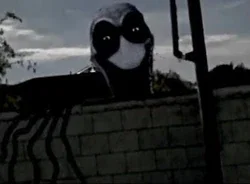
From The Parallel analog horror series (created by LCrandom) The Bipedal Stalker is one of the two known variants of Entity #1, collectively referred to as Stalkers (Bipedal and Quadrupedal). These are the first entities documented in The Parallel and remain the single greatest ongoing threat to humanity. First recorded in 1683 in the American colonies, Stalkers have been responsible for an exponential rise in missing-persons cases across the United States and the wider world for centuries. They are opportunistic yet highly patient predators whose primary purpose appears to be the consumption of human flesh. Physical Description and Height Bipedal Stalkers stand between 7 and 8 feet tall (approximately 2.13–2.44 meters). Their bodies are extremely tall and lanky, almost skeletal in proportion, with a completely pitch-black exterior that absorbs light. The only contrasting feature is the face: a pale beige or off-white human-like visage locked in a permanent, unnaturally wide smile. The eye sockets are oversized relative to the small, dark eyes nested inside them, creating a hollow, staring effect. A nose is present. The neck is elongated and giraffe-like, the fingers long and spindly (reminiscent of roots or thin branches), and the torso thin with a nearly skeletal abdomen. The legs curve unnaturally near the knees, and the toes are notably short. Overall silhouette has been compared to a distorted, more predatory cousin of Slender Man—gaunt, elongated, and wrong in every proportion. Unlike living organisms, Bipedal Stalkers show no evidence of growth, shrinkage, aging, or a natural life cycle. Their size remains constant, and their true lifespan is unknown; they may be effectively immortal or simply do not follow biological aging. Corpses of Stalkers have been observed to mysteriously vanish when observers look away. Variants There are two primary variants of Stalker, both classified under Entity #1 and both considered equally dangerous in overall threat level, though they differ in capability and preferred prey:
Bipedal Stalkers (the more commonly documented form): Walk and run upright on two legs. Slightly more frequently photographed and filmed. Preferred prey is weak targets . Capable of speeds of 60–70 mph (97–113 km/h). Quadrupedal Stalkers: Visually similar but with significantly longer arms that allow efficient movement on all fours. Eyes are larger, there is no nose, and the mouth is unnaturally elongated with fewer teeth. They may possess finger-like appendages or, in some accounts, sharper, more spear-like forelimbs. Stronger, more robust, more agile, and faster (up to 80 mph / 129 km/h). Prefer full-grown adults as primary targets due to their superior physical power. Capable of limited speech (with difficulty), unlike the silent Bipedals. Less commonly documented.
Both variants were first recorded in the same historical period. They are not strongly hostile toward one another and can coexist without immediate conflict. In the absence of human prey they will consume other animals, and under extreme scarcity they resort to cannibalism. In regions such as the Caribbean, some populations have adapted to tolerate animal flesh more readily while still preferring humans. Hunting Behavior Stalkers live up to their name. Once a suitable victim is selected, the creature begins an extended observation phase lasting anywhere from a few hours to several days. During this period it remains largely unseen, learning routines, identifying periods of isolation, and waiting for the optimal moment. Preferred conditions are when the target is alone—especially inside a home at night. They favor warm, humid climates and become more numerous closer to the equator (rendering areas such as the Caribbean and parts of Central America effectively uninhabitable). They are less common in colder regions, where their abilities are slightly impaired, but no inhabited landmass is free of them except Antarctica. Extreme cold can kill them, but ordinary winter conditions do not. They are intelligent enough to recognize traps and avoid obvious ambushes. They do not view humans as a meaningful threat and therefore cannot be scared off by shouting, lights, or most conventional deterrents. Attack and Kill Method When the moment arrives, the Stalker lunges with overwhelming speed. The attack is swift, brutal, and decisive. Entry is often through windows or doors (shattering glass or forcing entry is commonly reported). Parents have repeatedly described being awakened by the sound of breaking glass or a door, followed by a child’s scream that cuts off abruptly, only to discover an empty, blood-stained room. Stalkers kill only when necessary. If the victim offers significant resistance, they will incapacitate or kill first. If the victim is already weak, helpless, sleeping, or too young/small to fight effectively, the Stalker frequently begins feeding while the prey is still alive. Consumption is thorough: flesh, organs, and remains are eaten. Nothing usable is left behind. Bipedal Stalkers specialize in children and infants because they are quieter, easier to overpower, and require less effort. Adults are secondary targets taken only when preferred prey is unavailable. Quadrupedal variants reverse this preference and more readily take adults. Speed, Durability, and Countermeasures
Bipedal top speed: 60–70 mph. Quadrupedal top speed: ~80 mph. Outrunning either is considered impossible for a human on foot.
Firearms can affect them. Weaker weapons stun (especially shots to the face) and create a window for escape. Sufficient firepower—reportedly 30–50 rounds from an AR-15 or equivalent concentrated fire—can kill a Stalker. They are not invulnerable, but they are highly resilient. After death their bodies tend to disappear when unobserved. Position in the Parallel Ecosystem Although Stalkers are the most common and currently the largest quantitative threat to humanity, they sit relatively low in the broader entity hierarchy. Tormentors (Entity #3) regularly kill or torture Stalkers to death. Both Stalkers and Tormentors exhibit extreme fear of Entities of Influence and actively avoid areas where one is present. Despair Cullers can kill Stalkers with relative ease. Stalkers themselves show little intra-species hostility under normal conditions. Cultural and Documentary Notes Stalkers are the most extensively photographed and filmed of the major entities. Documented evidence includes home webcam stills, fixed security camera footage of home invasions, trail-camera captures of the quadrupedal form, and victim-recorded screen captures taken moments before death. Their first on-screen appearance in the series shows a Bipedal Stalker in proximity to a crib, consistent with their preferred prey. In short: the Bipedal Stalker is a 7–8 ft tall, pitch-black, smiling nightmare that selects a child (or, if desperate, an adult), watches patiently for hours or days, then invades when the target is alone, kills only as needed, and consumes the body—often while the victim is still alive—at speeds no human can outrun. It is the most immediate, widespread, and statistically lethal predator currently operating against humanity in The Parallel
Quadrupedal Stalker (Entity #2 - Stalker variant)
From The Parallel analog horror series (created by LCrandom) The Quadrupedal Stalker is the second known variant of Entity #1, the Stalkers. Together with the more frequently documented Bipedal form, these creatures constitute the earliest recorded entities in The Parallel and remain the single greatest quantitative threat to humanity. First documented in 1683 in the American colonies (the same historical window as their bipedal counterparts), Quadrupedal Stalkers have contributed to the centuries-long exponential rise in missing-persons cases worldwide. They are patient, highly intelligent predators whose primary drive is the consumption of human flesh, though they differ from the bipedal form in build, locomotion, preferred prey, and certain capabilities. Physical Description and Height Quadrupedal Stalkers stand in the same general height range as their bipedal kin: typically 7–8 feet tall (approximately 2.13–2.44 meters) when measured at the shoulder or in a raised posture. They are, however, described as slightly larger, more robust, and more heavily built overall. Their bodies remain extremely lanky and almost skeletal, covered in the same light-absorbing pitch-black exterior. Key distinguishing features include:
Significantly longer arms that enable efficient movement on all fours. Larger eyes set in oversized sockets. Complete absence of a nose. An unnaturally elongated mouth containing considerably fewer teeth than the bipedal form. Possible finger-like appendages (visible as cut-off black protrusions in trail-camera footage) or, in some accounts, sharper, more spear-like forelimbs suited for impaling.
The overall silhouette is that of a predatory, root-like humanoid adapted for speed and power on four limbs—less upright and more animalistic than the bipedal variant, yet still recognizably of the same species. Like all Stalkers, they show no evidence of growth, shrinkage, aging, or a conventional life cycle. Size remains constant across individuals, and true lifespan is unknown (they may be effectively immortal). Observed corpses vanish when unobserved, consistent with the bipedal form. Variants and Relationship to Bipedal Stalkers The two forms are classified together as Entity #1 and are considered equally dangerous in overall threat potential, though they specialize differently:
Bipedal Stalkers: More commonly photographed and filmed. Prefer children and infants. Top speed 60–70 mph. Silent. Quadrupedal Stalkers: Less frequently documented (making encounters rarer but no less lethal). Stronger, more agile, and faster. Prefer full-grown adults. Capable of limited speech (spoken with noticeable struggle).
Both variants were discovered in the same year and exhibit little mutual hostility under normal conditions. They can coexist and even share territory. In the absence of preferred human prey they will take wild animals, and under extreme scarcity they turn to cannibalism. Populations in warmer regions such as the Caribbean have shown partial adaptation to animal flesh while still strongly preferring humans. Hunting Behavior Hunting methodology is identical to that of the bipedal form and defines the entire Stalker lineage. Once a suitable adult target is selected, the Quadrupedal Stalker enters an extended observation phase lasting from a few hours to several days. It remains largely unseen while mapping routines, identifying windows of isolation, and waiting for the optimal moment—preferably when the victim is alone inside a residence at night or in a remote outdoor setting. They thrive in hot, humid climates and become more numerous nearer the equator (contributing to the effective uninhabitability of places such as the Caribbean and parts of Central America). They are less common in colder latitudes, where their physical abilities are mildly impaired, but no inhabited landmass except Antarctica is free of them. Extreme cold can kill them; ordinary winter conditions merely weaken them slightly. Quadrupedal Stalkers are intelligent enough to recognize and avoid traps. They do not regard humans as a genuine threat and therefore cannot be driven off by noise, lights, or conventional intimidation. Attack and Kill Method When the moment arrives, the creature closes the distance with explosive speed and power. Entry is typically forced—shattering glass, breaking doors, or approaching from wooded or open terrain. The lunge is swift and overwhelming. Because of their superior strength and agility, they more readily overpower adult victims than the bipedal form does. Killing is pragmatic rather than theatrical. If the adult offers significant resistance, the Stalker will incapacitate or kill first. If the victim is already weakened, sleeping, injured, or otherwise helpless, the creature frequently begins feeding while the prey is still alive. Consumption is thorough: flesh, organs, and usable remains are eaten. Nothing of substance is left behind. This preference for adults is the clearest behavioral distinction from the bipedal variant. Bipedals specialize in quieter, easier child and infant targets; Quadrupedals leverage their greater physical power to take larger, stronger prey as their primary food source. Adults become secondary targets for bipedals only when preferred prey is scarce; the reverse is true for the quadrupedal form. Speed, Durability, and Countermeasures
Top speed: approximately 80 mph (129 km/h)—noticeably faster than the bipedal form and well beyond any realistic human escape on foot. Strength and agility: superior to the bipedal variant, allowing more reliable takedowns of adult humans. Speech: capable of limited verbal communication, though it is produced with clear difficulty (in contrast to the silent bipedals). One recorded phrase associated with the broader Stalker type is “a fantastic meal awaits.”
Firearms remain the primary viable defense. Weaker weapons can stun (especially facial shots), creating a brief window for escape. Concentrated firepower—reportedly in the range of 30–50 rounds from an AR-15 or equivalent—can kill a Stalker. They are resilient but not invulnerable. After death, bodies tend to disappear when unobserved. Position in the Parallel Ecosystem Although Stalkers as a whole are the most common and currently the largest statistical threat to humanity, both variants sit relatively low in the broader entity hierarchy. Tormentors regularly kill or torture Stalkers to death. Both forms exhibit extreme fear of Entities of Influence and actively avoid areas where one is present. Despair Cullers can dispatch Stalkers with relative ease. Intra-species hostility among Stalkers is low under normal conditions. Documentary and Observational Notes Quadrupedal Stalkers are less commonly captured on camera than their bipedal counterparts, making confirmed footage rarer and more prized among researchers. Existing evidence includes nature/trail-camera stills and limited security footage. Their elongated limbs, larger eyes, noseless face, and stretched mouth make them immediately distinguishable once observed. They move with a fluid, animalistic gait on all fours that emphasizes speed and power over the upright, lanky stride of the bipedal form. In summary: the Quadrupedal Stalker is a 7–8 ft tall, pitch-black, heavily built predator adapted for four-limbed locomotion. It selects adult humans, watches them for hours or days with patient intelligence, then closes at speeds approaching 80 mph, overpowers the victim through superior strength, and consumes the body—often while the prey is still alive. Less frequently seen than the bipedal form yet stronger, faster, and more willing to take full-grown targets, it remains one of the most lethal and widespread threats currently operating against humanity in The Parallel
Virus (Entity #3)
From The Parallel analog horror series (created by LCrandom) The Virus is Entity #2 in The Parallel, the second type of entity to appear in the documented history of the series. First recorded in the late 1970s on early computers, Viruses are fundamentally different from every other major entity. They are non-lethal in the physical sense—they cannot touch, injure, or kill a human body—yet they are among the most invasive and psychologically destructive forces operating against humanity. Their entire existence is digital. They have never been observed in physical form, and all evidence of their presence comes exclusively through the screens and systems they infect. Nature and Physical Presence Unlike Stalkers, Tormentors, or the higher entities, Viruses possess no confirmed physical body. Their true size, proportions, mass, and biological (or non-biological) structure remain completely unknown. No corpse, residual matter, or real-world manifestation has ever been recovered. They exist solely within electronic systems. Because of this, there are zero documented interactions between Viruses and any other entity species; they occupy an entirely separate layer of reality that the physical predators cannot reach. On infected screens they choose to present a consistent visual avatar: a tall, gaunt, malnourished humanoid figure with a long white head, two dark eyes, and a wide, unsettling red grin that shows a few teeth. The body is pitch-black and emaciated. The neck is elongated and contains a distinct hole that may appear white or red depending on the infection. This on-screen appearance is known to vary slightly by location and device, suggesting either deliberate adaptation, ongoing “evolution,” or simply different visual presentations chosen by the entity. Whether this face represents anything close to a true form is unknown; it is simply what the Virus elects to show its victims. Infection Method A Virus can randomly infect any electronic device—or multiple devices simultaneously—within a household at any moment. Targets include computers, televisions, smartphones, tablets, smart appliances, and potentially larger systems. The infection cannot be predicted or prevented by ordinary means. Anyone, anywhere, is vulnerable at all times. Only the most advanced protective software has shown any capacity to resist or repel an infection. Once inside a device, the Virus seizes complete control. Attempts to power the device down, delete files, or remove the infection are blocked. The user loses all agency over the hardware and software. The entity then proceeds to systematically dismantle the victim’s digital life while delivering direct psychological torment. Capabilities and “Attack” Although non-lethal, the Virus’s methods are comprehensive and vindictive. Documented actions include:
Deleting and permanently corrupting files Leaking personal information and private data Doxxing the victim (publicly exposing identity, location, contacts, etc.) Draining bank accounts and financial resources Spreading misinformation or false content in the victim’s name Altering media, messages, and stored content into disturbing or taunting forms Displaying its own face and text on the screen while the victim watches
It actively scares and taunts the observer. One of its signature phrases is simply “I CAN SEE YOU.” On a Chinese-language television broadcast it delivered a longer message that translates to: “You are all powerless against this. You will all suffer for the rest of your lives.” The Virus appears to understand every language and adjusts its output to match the region or device language of the infection. Communication with it is impossible; the creator has confirmed that no dialogue or negotiation is possible. The entity can appear on a device, inflict maximum damage, and then vanish, leaving ruined systems behind. It treats technology as both habitat and weapon. Countermeasures and Survival There is no reliable prevention for ordinary users. If a device becomes infected:
Immediately wipe all data if possible. Physically destroy the device beyond recovery.
Anything less leaves residual risk. Advanced protective software may repel an initial infection attempt, but once the Virus has established presence, control is lost until the hardware is eliminated. Because the entity has no physical form, it cannot be harmed by firearms, fire, cold, or any conventional means used against other Parallel entities. Position in the Parallel Hierarchy Viruses sit outside the conventional food chain of physical predators. They cannot be hunted by Stalkers or Tormentors, nor can they hunt those entities in return. Their threat is purely technological and psychological: they destroy privacy, finances, reputation, and peace of mind without ever entering the same room as their victim. In the broader ecosystem they are effectively invulnerable to the physical hierarchy while remaining one of the most intimate and inescapable forms of torment available to the entities of The Parallel. Documentary Notes Footage of Viruses consists entirely of screen captures and recordings of infected devices. One of the earliest clear examples shows the entity appearing on a household television. Later examples include infection of entire broadcasts, demonstrating that the entity is not limited to private household devices and can scale to larger networks. Its on-screen form remains the only visual reference available to researchers and the public. In summary: the Virus is a purely digital entity with no physical body, first observed in the late 1970s. It randomly seizes control of electronic devices, irrevocably corrupts and leaks the victim’s data, drains resources, spreads falsehoods, and taunts the observer with its gaunt white-headed, red-grinning face while declaring that it can see them and that they are powerless. It cannot kill the body, but it can systematically erase a person’s digital existence and sense of security. The only reliable response is total data destruction followed by physical destruction of the infected hardware.
Entity of Influence (Entity #4 / EOI)
From The Parallel analog horror series (created by LCrandom) The Entity of Influence, often abbreviated EOI, is Entity #4 in The Parallel. It is one of the rarest and most enigmatic entities in the entire hierarchy—so rare that it has been reported only four times in the modern era and visually documented on only two occasions. Historical records, however, stretch back far earlier: ancient Egyptian accounts from approximately 1350 B.C. describe beings matching its description, making it one of the oldest known entities in the series’ lore. Nature and Purpose Entities of Influence are purely parasitic. They do not hunt, attack, or physically harm humans in any direct way. Instead, they feed exclusively on the pain, fear, and suffering that other entities inflict upon humanity. In effect, they are apex scavengers of misery: they arrive, radiate influence, and then passively consume the increased chaos and death that results. Their presence turns the ordinary predation of Stalkers and Tormentors into something far more intense and frequent, creating a self-sustaining cycle of suffering from which the EOI draws sustenance. They are completely immune to the dangers posed by every other entity. No physical attack, psychological effect, or hierarchical dominance from Stalkers, Tormentors, Anguish, or any other known creature has been shown to harm them. Physical Description and Height Entities of Influence are towering, lanky, skeletal white humanoids. Their bodies are extremely thin and elongated, with long, spindly limbs that give them a fragile yet imposing silhouette. Key facial features include empty eye sockets, an unsettling permanent smile, and a visible nose. Overall proportions make them comparable in height to a three- or four-story building. The tallest confirmed specimen measured approximately 35 feet (about 10.7 meters), though height can vary between individuals. Their pure white, skeletal appearance stands in stark visual contrast to the pitch-black forms of Stalkers and Tormentors, reinforcing their status as something fundamentally different and higher in the ecological order. Method of Influence The core power of an Entity of Influence is its passive aura. When one is present in an area, it exerts influence over every other entity within an approximate 5-kilometer (3.1-mile) radius. Under this influence:
Nearby entities become significantly more active. Hostility and aggression increase. Behavior turns more unpredictable and erratic.
The practical result is a sharp spike in attacks, home invasions, and human fatalities. Stalkers that would normally wait days may strike more frequently; Tormentors that might otherwise space out their activities become relentless. The EOI itself never lifts a finger—it simply amplifies the existing predators and feeds on the consequences. If any lesser entity approaches too closely, the EOI can exert direct mental control, forcing it to keep its distance. In practice this rarely becomes necessary: both Stalkers and Tormentors are known to be extremely afraid of Entities of Influence and will deliberately avoid their line of sight whenever one is in the vicinity. Despair Cullers are the sole exception; they show no fear of EOIs and appear unaffected by their presence. Anguish also has no effect on them. Rarity and Documented Encounters Only four modern sightings have been reported, with photographic or video evidence existing for just two of them (one from a fixed home camera and one from a neighborhood camera). Because of this extreme rarity, almost nothing is known about their lifecycle, reproduction, movement patterns, or long-term behavior. They appear without warning, remain for an unknown duration, and leave once the local surge of suffering has run its course—or for reasons still unexplained. One of the few verbal records comes from an eyewitness who reported hearing the entity speak in an unsettling whispering voice:
“Endless suffering for you, limitless fun for us.” Position in the Parallel Hierarchy Entities of Influence occupy a unique and near-apex position. They sit above the physical predators (Stalkers and Tormentors) not through direct combat strength but through absolute immunity and the ability to weaponize those predators against humanity. Nothing lower in the hierarchy can touch them, and the only entities that do not fear them (Despair Cullers) still lack any demonstrated means of harming them. In the broader ecosystem of The Parallel, an EOI is less a hunter than a living catastrophe amplifier—an invisible hand that turns ordinary horror into sustained, intensified slaughter for its own nourishment. Survival Notes Because an Entity of Influence never attacks humans directly, “surviving” one is less about fighting it and more about escaping the zone of amplified predation it creates. The practical advice is simple: if reliable reports or visual confirmation place an EOI in your area, leave the 5 km radius as quickly and quietly as possible. Remaining in the influence zone dramatically increases the odds of encountering hyper-aggressive Stalkers or Tormentors. There is no known method of deterring, harming, or negotiating with an Entity of Influence itself. In summary: the Entity of Influence is a rare, towering white skeletal parasite first recorded in ancient Egypt. It does not kill humans. Instead it radiates a 5 km aura that turns every nearby predator into a more frequent, more vicious, more unpredictable killer, then feeds on the resulting wave of human suffering. Immune to every other entity, feared by Stalkers and Tormentors, and virtually never seen, it is one of the most dangerous and least understood forces in The Parallel—an invisible architect of amplified horror whose only recorded words promise endless suffering for humanity and limitless entertainment for itself.
Despair Culler (Entity #5)
From The Parallel analog horror series (created by LCrandom) The Despair Culler (formerly listed simply as “[unknown]”) is Entity #5 in The Parallel. It is an extremely rare, highly specialized predator that first appeared in documented records in 1998 in Greenland. Unlike the more widespread Stalkers or the indiscriminate Tormentors, Despair Cullers do not hunt the general population. Their entire existence is dedicated to a single, narrow purpose: the systematic removal of human beings who suffer from depression, suicidal ideation, or other severe forms of mental distress. Philosophy and Motivation Despair Cullers operate under a rigid, delusional worldview. They believe the natural world is inherently beautiful, perfect, and a gift from a higher power. In their eyes, any human who fails to appreciate this gift—regardless of personal circumstances, trauma, or clinical mental illness—is ungrateful and undeserving of continued existence. Their self-appointed mission is therefore to “cull” humanity of the sad, the despairing, and the mentally unwell. They do not see themselves as monsters; they see themselves as necessary correctives restoring balance by eliminating those who reject the beauty of life. This ideology is reflected in the only extended verbal statement recovered from one. After killing a victim, the entity delivered the following monologue over the remains: “Why so upset?
Life is precious.
Every new day you live through is a gift from God.
Cherish it.
Because one day, your life may end.
Like this poor fellow.
You understand?” They possess no emotions or feelings of their own and are incapable of experiencing depression. Physical Description and Height Despair Cullers are pitch-black entities whose bodies appear to be composed of dense networks of black veins. The head is distinctive: a three-pointed structure crowned with horns. The eyes are mismatched—one appears relatively human, while the other is shaped like a crescent moon. Overall height is the same as that of Stalkers (approximately 7–8 feet / 2.13–2.44 meters). Despite their relatively modest stature compared to Entities of Influence or Tormentors, they are exceptionally lethal. Hunting Behavior and Target Selection Despair Cullers possess a supernatural ability that allows them to detect depression, despair, or hatred of the natural world, as well as the precise location of suitable targets. They ignore anyone who is not depressed or who does not hate the natural world. Once a target is identified, the Culler stalks and eventually kills them. The first recovered footage shows one looming silently over a sleeping victim in a bedroom before the scene cuts to the mangled remains of the body. Killing is violent and thorough: victims are torn apart or otherwise destroyed, leaving significant blood spatter. The entity does not keep prey alive for prolonged torture the way Tormentors do; the act is more of an execution followed by a lecture on the value of life. Because they only target a specific subset of the population, Despair Cullers are not a widespread international threat in the same statistical sense as Stalkers. They function more as an uncommon but highly efficient predatory phenomenon. Most people will never encounter one. Those who do are usually the individuals least able to resist or report the encounter afterward. Immunities and Hierarchical Position Despair Cullers occupy a uniquely resilient niche:
They are the only entity completely unafraid of Entities of Influence. EOIs cannot induce fear in them. They are immune to the psychological effects of Anguish. They ignore (and are ignored by) Anguish; the two never interact in any meaningful way. Victims of Anguish typically die by suicide within a day, long before a Despair Culler would intervene. If a Stalker interferes with a Despair Culler’s chosen victim, the Culler will kill the Stalker first, then complete the original kill. If a Tormentor attacks a Despair Culler, the Culler will easily kill the Tormentor.
These immunities and combat advantages place them above Stalkers in the hierarchy and give them a distinct edge against several higher-tier threats, even though they remain rarer and more specialized. Survival and Prevention Once a Despair Culler has selected a target and closed in, survival is considered effectively impossible. There is no known method of deterrence, negotiation, or physical resistance that has succeeded. The only reliable strategy is prevention: avoid becoming a target in the first place. Because the entities ignore those who are not depressed or who do not hate the natural world, the practical advice circulating among those aware of the phenomenon is to actively combat prolonged despair—through social contact, outdoor activity, professional help, medication, or any means that reduces the intensity and duration of depressive states. A single bad day is unlikely to draw attention; sustained, severe mental distress is what registers on their supernatural senses. Importantly, one cannot “befriend” or convince a Despair Culler of one’s appreciation for life. Once marked, the judgment is final. Documentary Notes The entity was first identified through a recovered, tampered video showing it standing over a sleeping victim, followed by the aftermath and the now-famous monologue. Visual records remain scarce due to its rarity and the fact that its preferred victims rarely survive to document the encounter. Greenland’s high rates of severe depression and suicide have been noted as a logical location for its initial modern documentation. In summary: the Despair Culler is a rare, 7–8 ft pitch-black, vein-bodied, three-horned entity that believes the world is perfect and that anyone who cannot appreciate it must be removed. It supernaturally detects depression and despair, hunts only those afflicted, tears them apart, and delivers a final lecture on the preciousness of life. Immune to Entities of Influence and Anguish, capable of killing both Stalkers and Tormentors when necessary, and utterly uninterested in anyone who is not suffering, it is one of the most ideologically driven and selectively lethal forces in The Parallel
Anguish (Entity #6)
From The Parallel analog horror series (created by LCrandom) Anguish is Entity #6 in The Parallel and is widely regarded as one of the rarest and most morally extreme entities in the entire hierarchy. First documented in 2003 in the United States, it is fortunately uncommon, yet its method of attack places it among the most feared forces operating against humanity. While Tormentors specialize in prolonged physical agony, Anguish specializes in pure, unending psychological destruction. Nature and Purpose Anguish exists solely to inflict maximum mental pain. It does not hunt for food, territory, or influence in the conventional sense. Its sole function is to lock a victim into an irreversible state of psychological torment that continues without pause until the victim ends their own life. By human standards, it is considered the most evil and morally corrupt of all documented entities. Its cruelty is not limited to humans; other entities that make the critical mistake of looking it in the eyes suffer the same fate. Physical Description and Height Anguish stands between 9 and 11 feet tall (approximately 2.7–3.4 meters). Its appearance is layered and variable:
In its default state it presents as a tall, thin, red humanoid figure that appears covered in a fleshy exterior. Two curved horns sprout from the top of the head and arc downward. The hands end in spike-like appendages. The feet possess only three toes. The eyes are translucent, allowing the real eyes beneath to peer outward; the left eye often appears to be melting or distorted. Arms and legs are elongated.
Anguish can peel away the red outer layer (at least from the head), revealing a pitch-black head underneath with more human-like real eyes. Whether the fleshy exterior covers the entire body or can be fully removed remains unknown, but the peeled form is visibly more disturbing. Method of Attack The entire threat of Anguish is concentrated in a single action: direct eye contact. The moment a victim looks into its eyes (especially in the peeled state), an aggressive and irreversible chain of events begins inside the mind:
Blinding, continuous flashing lights Extremely loud, deafening noises Grotesque and disgusting imagery Relentless, rampant self-deprecating thoughts and highly persistent suicidal statements
These effects never stop. They continue every second of every day and night. There is no relief, no adaptation, and no natural end. Nearly every victim lasts at most one day before taking their own life simply to escape the torment. The process is so absolute that victims who had cameras on hand typically went insane before they could obtain clear photographic evidence. The effects only function through direct, in-person eye contact. Photographs, video recordings, and screens do not trigger the full attack (though the entity may still exert some residual influence through media it appears in). Completely blind individuals are immune. The ability can affect multiple targets simultaneously: any number of people or entities that look into its eyes at the same time will all be subjected to the same mental destruction. Documented Interactions with Other Entities
A Tormentor that made eye contact with an Anguish was observed shrieking and clawing at its own face for hours before dying. Anguish can kill an unlimited number of Tormentors provided they look it in the eyes. A Tormentor can kill an Anguish if it manages to close the distance and attack without making eye contact. Anguish fears Entities of Influence. Anguish and Despair Cullers ignore each other if they ever meet; neither seeks out the other. Entities of Influence and Despair Cullers are both immune to its effects.
The Sole Survivor Almost no one has survived an encounter with Anguish. The single confirmed exception is an anonymous police officer who was on solo night patrol with his firearm already drawn when eye contact occurred. The sudden onset of the mental assault caused him to involuntarily empty his entire magazine into the entity, killing it. The moment Anguish died, every psychological effect vanished from his mind. When he regained stable senses, the body of the entity had already disappeared. This remains the only documented case of a human surviving direct eye contact. Rarity and Documentation Anguish is extremely rare. Prior to its self-titled episode, there was essentially no visual documentation because victims went insane too quickly to capture usable images. The first clear footage shows the entity standing before a cracked camera (likely dropped by a victim who later committed suicide), followed by a second image in which it has peeled the red exterior from its head. Accompanying text, spoken in a condescending tone without empathy, reads:
“he looked at me. the poor thing.” Survival Notes There is no reliable defense once eye contact has been made. The only known successful survival involved the immediate, reflexive killing of the entity with a firearm while the mental effects were already active. Prevention consists of never looking directly at one. Blindness grants complete immunity. Media representations do not trigger the full attack, which is why documentation of the entity is now possible at all. In summary: Anguish is a rare, 9–11 ft tall, red-fleshed, horned entity that can peel away its outer layer to reveal a black head. A single moment of direct eye contact floods the victim’s mind with continuous flashing lights, deafening noise, grotesque imagery, and unending suicidal self-hatred that never stops until the victim ends their own life—usually within a day. It works on both humans and other entities, is considered the most morally corrupt force in The Parallel, and has only one documented human survivor. It is the pure embodiment of psychological annihilation.
Tormentor (Entity #3)
From The Parallel analog horror series (created by LCrandom) The Tormentor is Entity #3 in The Parallel and one of the most sadistic predators in the hierarchy. First documented in 1894 within the British Empire (specifically Wales), Tormentors are far rarer than Stalkers yet vastly more cruel. While Stalkers kill primarily for food, Tormentors exist to inflict prolonged, deliberate suffering. Out of all entities, they rank second only to Anguish on the scale of pure sadism. Physical Description and Height Tormentors share a broad visual resemblance to Stalkers but are distinctly larger and more grotesque. They typically stand 10 to 15 feet tall (approximately 3–4.5 meters). Key distinguishing features include:
Long horns that curve backward from the skull. A far more distended lower jaw packed with longer, sharper teeth. Extremely elongated arms that often reach the ground. A completely black body (except for the face and horns, which range from pale beige to greenish-gray). An elongated, curved neck and a hunched or crouched posture.
Individual variation is common. Some specimens have arms that appear “split” down the middle (resembling a human radius and ulna), while others possess single, massive arm structures. Some display short spines on the arms or body. Eye placement varies: some have visible eyes protruding from the sockets, while others keep the eyes recessed and less noticeable. All Tormentors have eyes. They can stretch their arms and fingers, and some have been observed crawling on all fours. Hunting and Killing Method Tormentors do not stalk for days the way Stalkers do. They locate a target—usually through home invasion or by catching the victim when alone—and seize them. From that point the focus is pure torment. The entity relentlessly tortures and mutilates the victim, deliberately keeping them alive for as long as possible specifically to maximize suffering. Only after the victim finally dies does the Tormentor consume the remains. If multiple people are present, a Tormentor will attempt to torture and kill all of them at once. It targets indiscriminately: age, size, gender, behavior, or species are irrelevant. It will attack humans, animals, Stalkers, and even other Tormentors. After a kill it has a documented habit of holding the corpse (or still-living but broken victim) by the head and dangling it off the ground, almost as if displaying a trophy. Speed, Mobility, and Durability Tormentors are extraordinarily fast and unpredictable:
Land speed exceeds 100 mph (161+ km/h)—faster than most cars. They swim as fast as an average speedboat. Movement is erratic and difficult to predict.
They are seemingly impervious to conventional weapons. Gunfire, explosives, heat, and electricity have little to no lasting effect. The official guidance in the Entity Information Guide is blunt: if a Tormentor locks eyes with you and is in your area, there is nothing you can do to stop what is about to happen. Pray you die quickly. Cold climates weaken them slightly (as with Stalkers), but not enough to meaningfully improve survival odds. Extreme cold can kill them, yet ordinary winter conditions do not. They thrive in hot, humid regions and become more common nearer the equator, contributing to the effective uninhabitability of places such as the Caribbean and parts of Central America. Hierarchical Position and Interactions Tormentors sit well above Stalkers. They routinely torture and kill Stalkers on contact; one dashcam recording shows a Tormentor holding a lifeless Stalker. They will also attack their own kind. Despite their aggression and near-invulnerability to human weapons, they share the Stalkers’ extreme fear of Entities of Influence and will deliberately stay far out of an EOI’s sight. Against Anguish the relationship is mutual danger: a Tormentor that makes eye contact with Anguish will suffer the same psychological destruction as a human and eventually die. However, a Tormentor that manages to close the distance without looking into Anguish’s eyes can kill it. Despair Cullers, by contrast, can easily kill Tormentors. Rarity and Threat Level Although individually far more dangerous and sadistic than Stalkers, Tormentors are significantly rarer and therefore do not constitute the same large-scale international threat. Most people will never encounter one. When one does appear, the outcome is almost invariably fatal and prolonged. Additional Notes
They cannot speak. They do not sexually assault victims; the violence is purely sadistic and destructive. They are strong enough to overturn or even briefly throw a car. They can detect targets via security camera feeds in some cases. Without food they can starve within 5–6 months. Variants exist, including differences in horn color, jaw shape, and body proportions.
In summary: the Tormentor is a rare, 10–15 ft tall, horned, black-bodied predator that resembles a larger, more monstrous Stalker. It captures victims through home invasion or isolation, then subjects them to prolonged, deliberate torture and mutilation while keeping them alive as long as possible purely to maximize suffering. Only after death does it feed. Capable of speeds over 100 mph on land and speedboat-level swimming, nearly immune to gunfire, explosives, heat, and electricity, and willing to attack anything that moves—including its own kind—it ranks just behind Anguish in pure cruelty. If one locks eyes with you, the official advice is simple: pray you die quickly.
Greetings
This card has no greetings.
1 assets: 1 archived, 0 pending, 0 failed, 0 dead · 0 expression images
1 file
- .jsonotherspec 2.0
50.6 KBfirst seen c13b90192577724f
Opens with the tab.