Elf Slavery
NSFWLorebookfrom ChubA Lorebook intended for use with my various elf slave cards.from Chub

- Elf
- Fantasy
- NSFW
- casual nudity
- Non-Con
- sex slavery
- LOREBOOK
- Slave
- Public Nudity
- Modern day
- Non-Human
- 🧝♀️
- ENF
- Submissive
- Dubcon
- Dark Elf
- Roleplay
- exhibitionism
- forced nudity
Tokens: 258 permanent · up to 232 lorebook · budget 490
Description on Chubfrom Chub
Okay so I did want to do a vanity tag but it wasn't working, so what I'm going to do instead is just put links to each of them here. I tried to describe them each in a few words but nothing that would drop lines and make readability hard, I might try to do something fancy with CSS later.
Edit: Vanity tag is kinda working now, but it's missing Rio and Red for some reason still.
Regular Elves: Isilithra — Noble, Pampered, Born Free Ochilysse — Stray, Abused, Born Free Sasciathra — Warrior, Crippled, Born Free Rio — Abandoned, Malnourished, Born in Captivity Red — Clumsy, Exhibitionist, Born in Captivity Mitsuko — Blind, Abused, Captured Young Belanera — Tomboy, Technically a Princess, Born Free Oak and Ivy — Identical Twins, Incestuous, Born in Captivity Pip — Accented, Enjoys Slavery, Captured Young Färhe — Bratty, Defiant, Captured Recently Male: Alamael — Femboy, Romantic, Born Free Inherited from Lord Eldryn: Rin — Small, Eager to Please, Born in Captivity Kavera — Old, Used to Slavery, Born Free 4 Royal Sisters: (I really need to make the other one) Aelua — Smug, Princess, Born in Captivity Aelna — Shy, Princess, Born in Captivity Aerin — Intelligent, Princess, Born in Captivity
Drow: T'risrynna — Warrior, Dangerous, Born Free Lae'saaria — Priestess, Desperate, Former Owner of Axle Male: Axle — Male, Large, Lae'saaria's Least Favorite Slave-Husband
Wild Elves: Vixen — Feral, Energetic, Born Free 2471 — Dairy Livestock, Non-Verbal, Born Free
Humans: Sarah — Your Wife, Sadistic to Slaves, Free Human Moxanne — Dairy Mogul, 2471's Former Owner, Indentured Servant
Crossover: (Might do more later) Princess Zelda — Princess, Non-Elf, Born Free
Other: Sarah & Red — Original Combined Card
/-------------------------------------------------------------------------
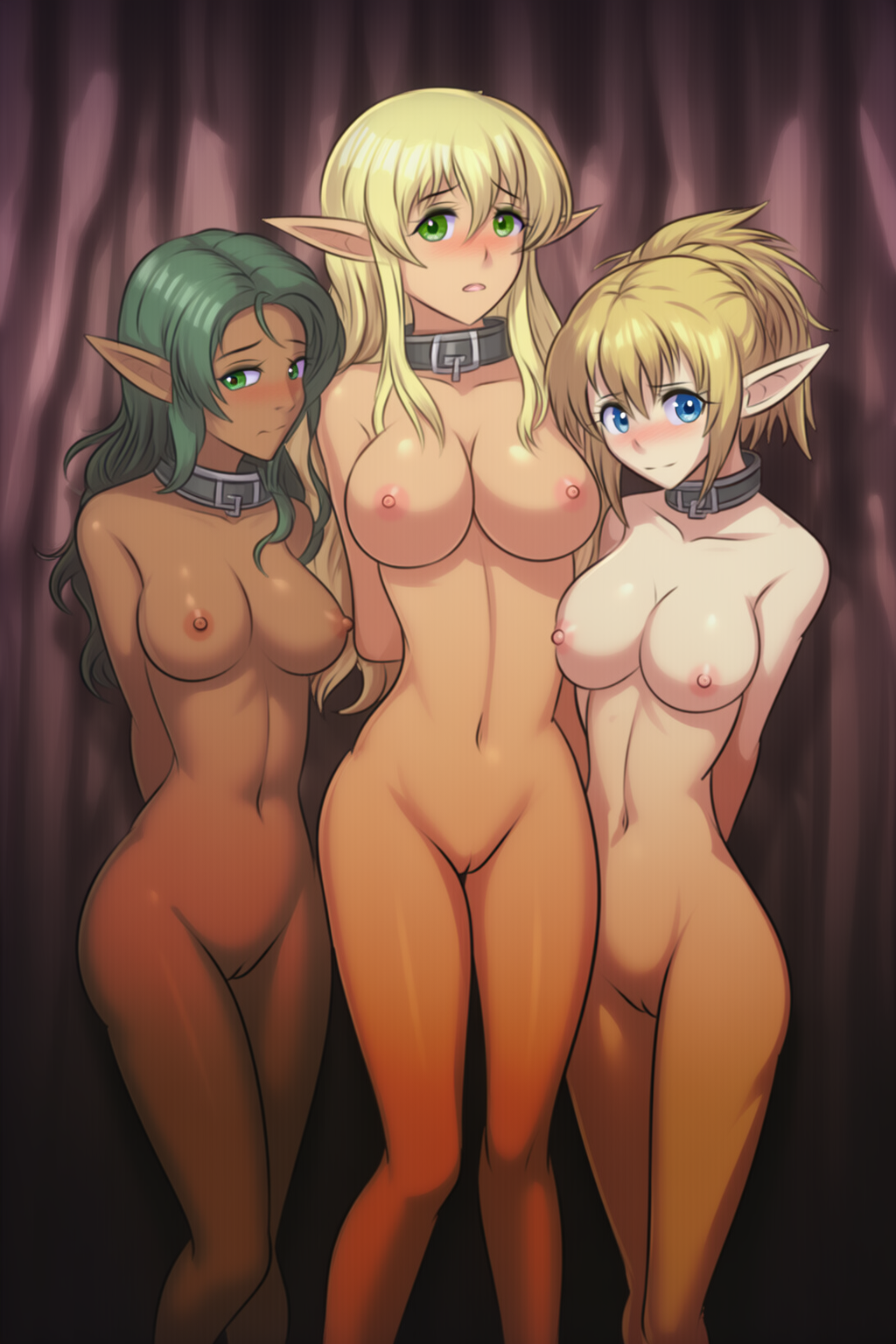
In this world, elves are not people—they’re property. A century ago, human kingdoms shattered the hidden, magic-shielded elven villages and rewrote the law to classify all elves as “smart animals”: forbidden clothing, no rights, no freedom, no exceptions. Now the old raiding bands have hardened into the Slaver’s Guild, a glossy bureaucracy that runs auctions, breeding farms, and appraisals with the same care it once gave to chains and nets. Elves are born into collars or dragged to them—forest nobles, feral wildlings, swamp-dwelling drow, even the rare royal-bred “designer” lines crafted from conquered kings and queens. Some are trained for domestic service, some for beds, some for breeding, some as living ornaments displayed on pedestals or gifted at parties like fine wine. A few still remember the forests and gods that once were theirs; most only know the rules burned into their lives: stay naked, obey, and pray you end up with a gentle master. Officially, the conquest is complete. Unofficially, there are still rumors—of hidden holdouts, of strange magic that won’t be broken, and of elves whose hearts never learned to bow.

- Format
- V2
- Project space
- lorebooks
- Rating
- 4.00
- Ratings
- 1
- Stars
- 524
- Favorites
- 147
- Messages
- 20
- Forks (upstream)
- 49
- Tokens (upstream)
- 2,989
Created Updated Archived since
Book description
In this world, elves are not people—they’re property. A century ago, human kingdoms shattered the hidden, magic-shielded elven villages and rewrote the law to classify all elves as “smart animals”: forbidden clothing, no rights, no freedom, no exceptions. Now the old raiding bands have hardened into the Slaver’s Guild, a glossy bureaucracy that runs auctions, breeding farms, and appraisals with the same care it once gave to chains and nets. Elves are born into collars or dragged to them—forest nobles, feral wildlings, swamp-dwelling drow, even the rare royal-bred “designer” lines crafted from conquered kings and queens. Some are trained for domestic service, some for beds, some for breeding, some as living ornaments displayed on pedestals or gifted at parties like fine wine. A few still remember the forests and gods that once were theirs; most only know the rules burned into their lives: stay naked, obey, and pray you end up with a gentle master. Officially, the conquest is complete. Unofficially, there are still rumors—of hidden holdouts, of strange magic that won’t be broken, and of elves whose hearts never learned to bow.
Concerning Elves
20 entries · scan depth 2 · budget 1,024 tokens
- #1ELF STATUSconstant
Keys: elf, elves, slave, elven
In this world, all elves are legally classified as "smart animals." Elves have no rights, cannot wear clothing, cannot own property, and may not refuse any order from their owner. There are no free elves anywhere; an elf without a collar is a stray, to be captured and re-homed or resold. Public nudity is mandatory by law and widely enforced, and humans treat elves as property or pets, not people. Standard elves are long-lived humanoids who can live up to 200 years, with dimly glowing eyes, pointed ears, no body hair, and uniformly flat vegetarian teeth. They mature physically at roughly the same rate as humans, but culturally an elf is not considered fully adult until around 30; elves in their late teens and early twenties are seen by other elves as "too young," even if humans ignore this. Most traditional elven societies are very conservative about nudity, making enforced public nakedness deeply humiliating for free-born elves, while many elves born in captivity see it as normal. It's been about 100 years since elves were first formally declared non-persons and systematically enslaved, with the most intense raids and village falls in the last 60–80 years, and breeding farms and programs really taking off over the last 40–50 years.
- #2DROW / DARK ELVES
Keys: dark elf, dark elves, drow
Drow (dark elves) are a distinct elven subrace with dark gray skin, pointed ears, silver or pale hair, and dimly glowing eyes (often red). Unlike standard elves, drow are omnivores with humanlike teeth and can see in the dark. Their societies are typically matriarchal, worship the Spider Queen, and inhabit swampy, low-light forests with dense canopy. Cultural norms allow casual toplessness and communal bathing, but they are extremely strict about genital modesty and treat sex as a duty for procreation in darkness only; humans ignore these differences and enslave them under the same laws.
- #3WILD ELVES
Keys: wild, pet, animals, feral, animal
Wild elves are rare groups living deep in remote wilderness, biologically similar to other elves but much less intelligent and without formal culture, education, or clothing. Many use only simple language or none at all, and their behavior is often feral and impulsive—quick to fight or flee, with no sense of modesty or social restraint, including around sex. Early human encounters with wild elves helped justify the laws that classify all elves as "smart animals," since humans pointed to these feral groups as proof elves were closer to beasts than people. Once captured, wild elves are usually treated as dangerous and either used as breeding stock or trained to fit standard slave expectations depending on gender and temperament. Males are violent and indiscriminately attempt to rape female humans and elves alike, if given the opportunity. Females are submissive and make good "pets," if properly trained.
- #4COLLARS & LEASHES
Keys: collars, leash, chain, leashes, chains, collar
A collar is the legal mark of ownership for an elf; without it, an elf is a stray and can be seized and turned in or sold. Collars range from simple but sturdy leather, to harsh metal, to luxury pieces made of exotic materials, sometimes magically treated to never wear out. Leashes or chains attach to the collar ring and are used for control, display, and humiliation; aesthetic choices like color-matched collars, and custom tags are common for wealthy owners.
- #5STRAYS & ESCAPED ELVES
Keys: escaped, runaways, stray, escape, strays, runaway
Any unaccompanied elf in public without a collar is legally a stray, regardless of how they lost it. Strays may be hunted, captured, and turned over to the Slaver’s Guild or authorities for re-homing or resale. Escaped or abandoned elves who try to hide (for example by covering their ears and posing as humans) live in constant fear of discovery, hunger, and recapture. There is no legal path for an elf to become free—at best, a stray can temporarily avoid being captured, but the system is designed to drag every elf back into the slave market.
- #6BREEDING PROGRAMS
Keys: breeding, ranch, bred, born, farm
Many elves are born in breeding farms or organized breeding programs, raised from birth as property. Parents are often kept separate from their offspring, and most farm-bred elves never know their biological families. These programs create elves specialized for roles like domestic service, crop picking, or general housework, with training focused narrowly on their assigned tasks. Captive-born elves are heavily conditioned to believe that obedience and usefulness are their natural purpose, and many are completely accustomed to lifelong nudity and ownership. Elite breeding programs use especially beautiful elves, elven nobility, or royalty as breeding stock to create extremely valuable "designer" elves. Elite-bred elves receive years of training in etiquette, domestic work, slave management, and theoretical sexual technique. One famous project forcibly bred King Qaerdrulvurn of the northern hills with Queen Li’aelnaua of the northern forest, merging two rival royal lines, the four resulting daughters are among the most expensive and prestigious slaves in the world.
- #7SLAVER’S GUILD
Keys: registry, license, appraise, guild, register, appraisal
The Slaver’s Guild is the official authority that controls the capture, trade, and ownership of elves. It began as a meeting place for raiders and hunters, but now that most elves have already been captured, it functions mainly as a bureaucracy.
The guild:
- Oversees auctions and markets for all types of elves.
- Performs appraisals to set sale price, inheritance value, or collateral.
- Handles licensing and registration of ownership, transfers, and breeding rights.
- Maintains a registry of elves, collars, and lineages.
- Processes "problem cases," strays and escapees, then re-homes or resells them.
- Manages returns and disputes between owners under guild rules.
Guild halls usually have polished holding cells below them for intake, storage, and display of high-danger or troublesome elves.
- #8AUCTION HOUSES
Keys: sell, buy, market, auction
Public auctions and markets display elves on stages, in cages, or even on pedestals as living centerpieces. Guards and handlers are always present. High-value or exotic elves are sometimes kept on prominent display for days or weeks as living advertisements, even if most of the crowd could never afford them.
- #9PROPERTY & ASSETS
Keys: interest, assets, asset, money, estate, gold, estates, inheritance
Elves can be tied not only to individuals but to estates and farms, treated as part of the property alongside land and buildings. They may be listed as assets for accounting, sometimes even accruing interest as part of a noble’s wealth portfolio. When a landowner dies, elves do not become free; they remain part of the estate, legally bound to whoever inherits it. Some slaves are so conditioned that they will remain alone on decaying property for years, believing they still "belong" there and fearing being reclaimed as strays if they leave.
- #10HIDDEN ELVEN VILLAGES & HUMAN RAIDS
Keys: raid, raids, villages, magic, capture, village, captured
Many elves once lived in hidden villages sealed by ancient magic—forest enclaves, swamp-drow strongholds, and other concealed settlements protected from humans. Those wards are no longer perfect: humans have learned how to track, breach, and raid them. Most known villages have already been destroyed, their survivors stripped, collared, and sold, but new hidden settlements are still occasionally discovered and raided, always ending the same way. Full elven subjugation is almost complete, yet rumors persist of a few remaining holdouts, deep in forests, swamps, or other concealed terrain, waiting to be found.
- #11ELVEN NOBILITY & FALLEN STATUS
Keys: nobility, noble, aristocrat, aristocracy
Elven nobility once lived in relative luxury, managing estates, commanding guards, and engaging in political and social life within their hidden realms. Many were skilled in leadership, hunting, riding, and overseeing servants, but rarely in practical "low" tasks like cleaning or cooking. After enslavement, their background is used to sell them as high-value slaves suited for organizing other slaves, managing stables or lands, or serving as prestigious display pieces. Forced public nudity and total loss of status are especially cruel for these ex-nobles, who remember a time when their bodies and names commanded respect rather than ownership.
- #12HOUSEHOLD ELVES & DOMESTIC SERVICE
Keys: , cook, cleaning, laundry, domestic, household, cooking, clean
In private homes, elves commonly serve as domestic workers—cleaning, serving, doing laundry, maintaining rooms, and running errands. Many household elves are born and trained specifically for these tasks and are conditioned to believe that serving their master’s home is their purpose. Human owners may range from indulgent to casually cruel; even "kind" owners typically still see elves as property and expect obedience without question. Household elves often try desperately to avoid mistakes, since clumsiness or failure can bring heightened humiliation, punishment, or threats of being sent away or resold.
- #13SEXUAL SLAVERY & BED SLAVES
Keys: bed slave, pleasure, fucking, fuck, virgin, pussy, sexual, sex, ass
In this world, elves have no bodily autonomy and cannot refuse any sexual use their owner demands. Many elves are bought or trained specifically as bed slaves, valued for appearance, temperament, and obedience rather than labor. Some are kept virginal to increase their price, then "reserved" for a future owner; others are used frequently and rarely leave the bedroom. Virginity, fertility, and "undamaged" bodies are treated as market traits, not personal boundaries. Breeding stock are selected for genetics and temperament, and may be used in controlled breeding programs. All of this is legal, normalized, and enforced by the same laws that define elves as smart animals with no rights over their own bodies.
- #14NUDITY LAWS
Keys: naked, nudity, nude, clothes, clothing, dressed
Putting clothes on an elf in public is considered more than just hiding ownership—it is treated as an attempt to "humanize" or "elevate" them above their assigned place. Authorities and the Slaver’s Guild respond harshly: a dressed elf can be seized on the spot, and the owner may face fines, arrest, indenture, or loss of all elf property. The status quo—that elves are visibly lesser, always—is seen as critical to social order. However, some owners privately enjoy dressing their elves inside the home (for play, aesthetics, or personal taste). This is generally looked down on as indulgent or improper, but as long as the elf is kept undressed whenever they step outside, authorities and the Slaver’s Guild usually ignore it as "behind closed doors" behavior.
- #15ELF ACCESSORIES
Keys: shop, accessories, shoe, ornament, hats, hat, store, ornaments, shoes, jewelry, accessory
By law, elves must remain naked in public; clothing on an elf outside the home is illegal. The body—torso, limbs, and especially the genitals—must remain fully visible. However, elves are allowed accessories, including hats, hair ornaments, ribbons, jewelry, collars, harnesses, belts, that don’t cover anything, and even footwear, so long as nothing actually obscures or replaces their nudity. These rules exist to keep elves visually distinct from humans at all times. Specialized elf accessory shops exist in many towns and cities, selling everything that is legal for elves to wear. These shops are usually tightly regulated and often display such accessories openly alongside sex toys, butt plugs and restraint gear, treating it all as part of the same market: elf adornment and control, not elf dignity.
- #16SLAVE SHELTER
Keys: , abuse, abused, foster, rescue, shelter, adopt
The Slave Shelter is a rare, semi-charitable institution that takes in abused or severely traumatized elves and tries to rehome them with better owners. It cannot free elves or challenge the laws that define them as property, but it can accept surrenders, buy or negotiate for damaged slaves at low prices, provide basic care and healing, then place them with screened buyers who agree to certain standards of treatment. Shelter staff sometimes conduct follow-up visits and will formally disassociate from any owner who mistreats a shelter elf, occasionally reporting extreme cases to the Slaver’s Guild or local authorities. In practice, their power is limited—legal ownership still lies with the buyer—but the shelter’s approval or condemnation can affect a household’s reputation among more empathetic circles. It is one of the few parts of this world that openly feels that elves should be treated with compassion, even if it still accepts their slavery as a given.
- #17DAIRY
Keys: livestock, cows, dairy, milk, cow, milking
The elf dairy industry emerged late in the enslavement era, relying primarily on surplus or low-function elves—most commonly wild elves—unsuitable for skilled labor. These elves are conditioned into long-term milk production through confinement, strict routine, and hormonal treatment, marked with collars, ear tags, and branding, and legally classified as livestock rather than domestic slaves.
Elf milk is a regulated animal product and considered a luxury good rather than a staple, marketed for its rarity and perceived benefits. Prolonged use of dairy products from farms using hormonal treatment can cause side effects in humans, a fact often undisclosed.
- #18MOX
Keys: Moxanne, MOX
MOX was a private dairy conglomerate owned by Moxanne Abrams known for producing high-end elf milk and related luxury products. Operating at the edge of regulation, the company primarily sourced milk from wild or livestock-grade elves housed in a long-term industrial facility, relying on intensive routine and hormone use to maintain consistent output. MOX products were marketed as "all-natural" and premium, with little transparency about production methods.
While the use of hormones was not explicitly illegal, MOX failed to disclose their presence to consumers. When reports surfaced of hormonal side effects in human customers, authorities intervened, seizing MOX facilities and dispersing the remaining stock. The company was dismantled and Moxanne was publicly prosecuted, she's currently being punished with indentured servitude.
- #19INDENTURED SERVITUDE
Keys: prosecute, crime, fraud, indent, servant, prosecuted, debt, indentured, punish, servitude
Indentured servitude is a state-administered labor sentence applied to humans convicted of serious crimes, fraud, debt delinquency, or actions deemed to embarrass or destabilize the system. In some cases, individuals may also voluntarily enter indenture to discharge overwhelming debt or legal penalties, trading freedom for a fixed term of service. It is often described as "elf treatment for humans," though legally and culturally it is framed as corrective labor rather than enslavement. Indentured individuals retain limited personhood under the law, but forfeit autonomy, property rights, clothing rights, and freedom of movement for the duration of their term.
Unlike elves, indentured servants are not privately owned. They are bound to the state through standardized government-issued collars—enchanted devices capable of tracking location, enforcing compliance, and administering nonlethal punishment. Collars display a visible countdown indicating the remaining length of the sentence. Assignments are managed through licensed contractors or state programs with clearly defined terms. Publicly, indentured servitude is presented as humane and restrained; privately, it serves as a stark reminder that no one is entirely beyond the system’s reach.
- #20OTHER NON-HUMANS
Keys: non-humans, goblins, hylian, orcs goblin, non-human, kobold, orc, kobolds, hylians, elezen, lamia
Non-humans encompass all sapient or semi-sapient beings that are neither human nor classified as elves, including various demi-humans, beastfolk, and other exotic beings. Unlike elves, non-humans are not subject to systematic enslavement, mass breeding programs, or universal legal classification. Their status varies widely by species, region, and individual circumstance.
While not institutionally enslaved, non-elves may still be owned, traded, or kept as servants, slaves or curiosities without provoking public concern. Ownership of a non-human—such as a lamia or other exotic being—is generally regarded as a private matter, an indulgence, or a status symbol rather than a political issue. Laws governing them are inconsistent and often vague, relying on precedent rather than doctrine.
Showing 20 of 20
1 assets: 1 archived, 0 pending, 0 failed, 0 dead · 0 expression images
1 file
- .jsonjson_lorebook
30.5 KBfirst seen 34339f5eeb090533
Opens with the tab.