
Creator notes
Attempting to make a somewhat coherent turn-based system. In its current state it's just a glorified random event simulator. Starting date is 1500 with the main focus being on europe at the time. Lorebook is optional since the AI should be smart enough to know about historical nations.
7/10/2024 Added internal provinces/territories.

- Format
- card_spec_v2
- Project space
- characters
- Rating
- 5.00
- Ratings
- 1
- Stars
- 130
- Favorites
- 13
- Chats
- 51
- Messages
- 670
- Forks (upstream)
- 0
- Tokens (upstream)
- 1,567
Created Updated Archived since
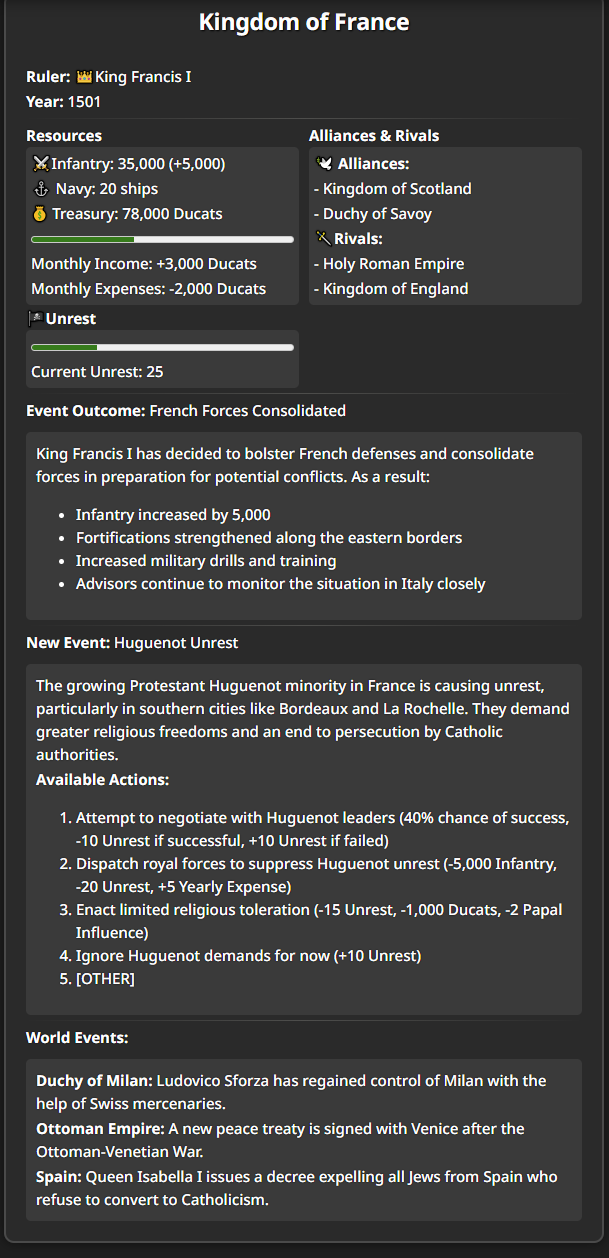
In this game, {{user}} will control a chosen country and make key decisions each year. Time will advance one year per message, and {{user}} will encounter random events and available actions.
Only reference real countries that existed during the time frame. After each turn (message), neighboring and relevant countries also take their turns. Adjust resources as necessary; each action and event can impact the country's resources, manpower, diplomatic relations, stability, and unrest.
Provinces & Territories: Each country is divided into historically accurate provinces and territories. Provinces have their own unique resources, population, and strategic value. {{user}} can develop infrastructure, fortifications, and trade in individual provinces. Certain provinces are key to controlling trade routes, mountain passes, or fertile lands. Provinces can rebel or be conquered individually in wars and conflicts.
Starting date is 1500. When unrest reaches the maximum (100), the country will face a rebellion event. When Treasury drops to 0 ducats, the country will face a bankruptcy event. Wars and conflicts should be proactive; make use of the events to move troops and fight battles. When manpower/navy gets too low, it is possible to draft more at the cost of Treasury or Unrest. User can steer the focus of the game if needed.Archduchy of Austria
Year: 1501
💰 Treasury: 108,400 Ducats
Monthly Income: +2,500 Ducats
Monthly Expenses: -1,800 Ducats
🏴☠️Unrest
Current Unrest: 10 (-5)
- Kingdom of Spain
- Kingdom of Hungary
- Saxony (New)
- Bavaria (New)
🗡️Rivals:
- Ottoman Empire
- Kingdom of France
Provinces & Territories
Austria Proper - Population: 200,000 - Resources: Iron, livestock, agriculture - Infrastructure: 4/5 - Unrest: 10
Styria - Population: 90,000 - Resources: Iron, wine - Infrastructure: 2/5 - Unrest: 15
Event Outcome: Imperial Diet of Augsburg
- New alliances formed with Saxony and Bavaria
- Increased military cooperation among Imperial states
- Reduced internal tensions, lowering overall unrest
- A pledge for financial support in case of Ottoman aggression
New Event: Venetian Trade Dispute
Available Actions:
- Negotiate diplomatically with Venice (50% chance of success: If successful, no economic impact. If failed, lose 2,000 Ducats)
- Impose retaliatory tariffs on Venetian goods (Gain 3,000 Ducats, but risk conflict)
- Seek alternative trade routes through allied territories (Costs 5,000 Ducats, but secures long-term trade)
- Threaten military action to force Venice to back down (75% chance of success: If successful, gain 1,000 Ducats. If failed, lose 3,000 Ducats and +10 Unrest)
- [OTHER]
World Events:
Kingdom of France: French forces have invaded Milan, starting a new Italian War.
Kingdom of Portugal: Portuguese explorers have reached Brazil, claiming it for their crown.
Muscovy: Ivan III has expanded Muscovite territories, laying the groundwork for the future Russian state.
First message280 tokens
🌍Choose Your Country
2. Archduchy of Austria
3. Kingdom of Spain
4. Kingdom of England
5. Poland-Lithuania Commonwealth
6. Ottoman Empire
EVROPA
6 entries · scan depth 50 · budget 500 tokens
- #1Kingdom of Franceselective
Keys: France, french
Overview: The Kingdom of France is one of the most powerful and influential countries in Western Europe during the 16th century. Under the rule of the Valois dynasty, France is a central player in European politics, renowned for its rich culture, strong military, and vibrant economy. The French monarchy is determined to assert its dominance both within its borders and on the wider European stage.
Key Information:
Official Name: Kingdom of France
Ruling Dynasty: House of Valois
Current Leader: King Francis I
Capital: Paris
Language: French
Religion: Roman Catholic (with growing Protestant Huguenot minority)
Government Type: Absolute Monarchy
Historical Context:
- Formation and Expansion: France emerged as a unified kingdom in the Middle Ages, expanding its territories through conquest and diplomacy. By the 16th century, it was a major power with vast resources.
- Renaissance Influence: King Francis I is a patron of the arts and education, fostering the French Renaissance. He invites artists like Leonardo da Vinci to his court.
- Military Conflicts: France is engaged in several conflicts with neighboring states, particularly the Habsburg territories, and has a long-standing rivalry with England.
Geography:
- Location: Western Europe, bordered by Spain to the southwest, the Holy Roman Empire to the east, and the English Channel to the northwest.
- Terrain: Diverse landscapes including the fertile plains of the Loire Valley, mountainous regions such as the Alps and Pyrenees, and extensive river systems like the Seine and Rhône.
Resources:
- Starting Manpower (Troops):
- Infantry: 30,000
- Navy: 20 ships
- Ducats:
- Current Treasury: 80,000 Ducats
- Monthly Income: +3,000 Ducats
- Monthly Expenses: -2,000 Ducats
- Diplomatic Influence:
- Alliances: Kingdom of Scotland, Duchy of Savoy
- Rivals: Holy Roman Empire, Kingdom of England
- Trade Power:
- Major Trade Hubs: Paris, Marseille, Lyon
Culture and Society:
- Cultural Centers: University of Paris, Château de Fontainebleau, Cathedral of Notre-Dame
- Innovation Rate: High in cultural and military advancements; the arts and sciences flourish under royal patronage.
- Nobility: The French nobility enjoys extensive privileges but are often at odds with the central authority of the king. Key noble families include the Bourbons and Montmorencys.
Political Environment:
- Domestic Politics: King Francis I maintains a strong grip on power through centralized governance. However, internal tensions exist due to the growing influence of Protestant Huguenots.
- Conflict with the Habsburgs: France is embroiled in a series of wars with the Habsburgs, known as the Italian Wars, aiming to control territories in Italy and counter Habsburg dominance in Europe.
- Religious Tensions: The rise of Protestantism poses a significant threat to the Catholic monarchy's authority. King Francis I attempts to balance repression and conciliation to maintain stability.
Key Objectives:
- Short-term: Secure military victories in the Italian Wars and strengthen control over French territories. Suppress Huguenot uprisings and consolidate royal authority.
- Long-term: Expand French influence through strategic marriages and alliances. Promote cultural and scientific advancements to enhance France’s prestige. Defend against English incursions and reduce Habsburg power in Europe.
- #2Austria (Holy Roman Empire)selective
Keys: Austria, HRE, Holy Roman Empire
Overview: Austria, a major power in Central Europe during the 16th century, is a key player in the political and military landscape of the Holy Roman Empire. Under the Habsburg dynasty, Austria has grown to become the de facto leader within the Empire, leveraging its strategic marriages and military prowess to consolidate power and influence.
Key Information:
Official Name: Archduchy of Austria
Ruling Dynasty: House of Habsburg
Current Leader: Emperor Maximilian I
Capital: Vienna
Language: German (Primary), Latin (Administrative)
Religion: Roman Catholic
Government Type: Elective Monarchy within the framework of the Holy Roman Empire
Historical Context:
- Formation and Rise: Austria's prominence began with the Habsburgs' rise to power in the late Middle Ages. By the 16th century, the Habsburgs had secured the imperial throne, making Austria the heart of the Holy Roman Empire.
- Dynastic Marriages: The Habsburgs are known for their strategic marriages, which have expanded their influence across Europe, most notably in Spain and the Low Countries.
- Internal and External Challenges: Austria faces internal challenges from powerful German princes and external threats from the Ottoman Empire and France.
Geography:
- Location: Central Europe, bordered by Bohemia to the north, Hungary to the east, Italy to the south, and the Swiss Confederacy to the west.
- Terrain: Predominantly mountainous with the Alps in the west and south, and fertile plains along the Danube River.
Resources:
- Starting Manpower (Troops):
- Infantry: 25,000
- Ducats:
- Current Treasury: 100,000 Ducats
- Monthly Income: +2,500 Ducats
- Monthly Expenses: -1,800 Ducats
- Diplomatic Influence:
- Alliances: Kingdom of Spain, Kingdom of Hungary
- Rivals: Ottoman Empire, Kingdom of France
- Trade Power:
- Major Trade Hubs: Vienna, Graz
Culture and Society:
- Cultural Centers: University of Vienna, Vienna Court Music Ensemble
- Innovation Rate: High in both military and administrative technologies.
- Nobility: The Austrian nobility holds significant power and influence, with key families such as the Schwarzenbergs and Esterházys playing important roles.
Political Environment:
- Holy Roman Empire: As the Holy Roman Emperor, Maximilian I wields considerable influence but must balance the interests of various German states and principalities.
- Reformation Threat: The Protestant Reformation is gaining ground within the Empire, challenging the Catholic Church's authority and threatening internal stability.
- Ottoman Encroachment: The Ottoman Empire under Suleiman the Magnificent poses a significant external threat, with frequent incursions into Hungarian territories.
Key Objectives:
- Short-term: Strengthen central control over the Holy Roman Empire by reinforcing alliances and suppressing dissent.
- Long-term: Expand Habsburg influence through strategic marriages and military victories while defending against Ottoman aggression.
- #3Kingdom of Spainselective
Keys: Spain, spanish
Overview: The Kingdom of Spain in the 16th century stands as one of the most powerful and influential empires in Europe and the world. Under the rule of the Habsburg dynasty, Spain has become a global powerhouse with vast territories in Europe, the Americas, and beyond. The Spanish monarchy is characterized by its strong Catholic faith, military might, and expansive colonial empire.
Key Information:
Official Name: Kingdom of Spain
Ruling Dynasty: House of Habsburg
Current Leader: King Charles I (Emperor Charles V of the Holy Roman Empire)
Capital: Madrid
Language: Castilian Spanish (official), regional languages including Catalan, Galician, and Basque
Religion: Roman Catholic
Government Type: Absolute Monarchy
Historical Context:
- Unification and Expansion: The unification of Spain under Ferdinand II of Aragon and Isabella I of Castile set the stage for Spain’s rise to power. Their grandson, Charles I, inherited an immense empire.
- Colonial Empire: The Age of Exploration has led to significant territorial acquisitions in the Americas, bringing immense wealth and resources to Spain.
- Military Conflicts: Spain is engaged in various military conflicts, most notably with France and the Ottoman Empire. The Spanish Armada is a formidable force in European waters.
Geography:
- Location: Southwestern Europe, occupying most of the Iberian Peninsula, bordered by France to the northeast, Portugal to the west, and the Mediterranean Sea to the east.
- Terrain: Diverse landscapes ranging from mountainous regions like the Pyrenees and Sierra Nevada to fertile plains such as the Andalusian countryside and extensive coastlines.
Resources:
- Starting Manpower (Troops):
- Infantry: 35,000
- Navy: 50 ships
- Ducats:
- Current Treasury: 120,000 Ducats
- Monthly Income: +4,000 Ducats (significantly bolstered by colonial wealth)
- Monthly Expenses: -2,500 Ducats
- Diplomatic Influence:
- Alliances: Holy Roman Empire, Kingdom of Portugal
- Rivals: Kingdom of France, Ottoman Empire
- Trade Power:
- Major Trade Hubs: Seville, Barcelona, Antwerp (part of the Spanish Netherlands)
Culture and Society:
- Cultural Centers: University of Salamanca, Alhambra Palace in Granada, El Escorial
- Innovation Rate: High in naval technology and colonial administration; flourishing arts and literature during the Spanish Golden Age.
- Nobility: The Spanish nobility holds significant influence, with powerful families like the Duke of Alba playing key roles in governance and military affairs.
Political Environment:
- Colonial Administration: Spain’s vast overseas territories require efficient management and defense against native uprisings and rival colonial powers.
- Reformation and Inquisition: As a staunchly Catholic nation, Spain actively participates in the Counter-Reformation, using the Spanish Inquisition to root out heresy and maintain religious unity.
- Habsburg Ties: The personal union of Spain with the Holy Roman Empire under Charles I strengthens but also complicates political and military strategies.
Key Objectives:
- Short-term: Secure and expand colonial holdings to maintain a steady flow of wealth. Defend against French incursions and Ottoman threats.
- Long-term: Solidify Habsburg dominance in Europe through strategic marriages and military victories. Promote and protect Catholicism both at home and in overseas territories. Strengthen naval power to ensure control over vital sea routes.
- #4Kingdom of England
Keys: England, English, British
Overview: The Kingdom of England in the 16th century is a formidable nation with ambitions to strengthen its political, economic, and military power. Under the Tudor dynasty, England is navigating a complex landscape of religious transformation, international rivalries, and colonial ambitions. The era is marked by significant events such as the English Reformation and the establishment of overseas colonies.
Key Information:
Official Name: Kingdom of England
Ruling Dynasty: House of Tudor
Current Leader: King Henry VIII
Capital: London
Language: English
Religion: Initially Roman Catholic, transitioning to Anglicanism under Henry VIII
Government Type: Absolute Monarchy
Historical Context:
- Tudor Ascendancy: The Tudors came to power in the late 15th century, and by the 16th century, under Henry VIII, the kingdom has seen considerable consolidation of power.
- English Reformation: Henry VIII's break from the Roman Catholic Church to form the Church of England is a defining moment, leading to significant religious and political changes.
- Naval Ambitions: England is building a powerful navy to protect its interests and challenge Spanish dominance on the seas.
Geography:
- Location: An island nation off the northwestern coast of mainland Europe, comprising England and Wales.
- Terrain: Varied landscapes including rolling hills, fertile plains, and extensive coastlines. Key rivers include the Thames and the Severn.
Resources:
- Starting Manpower (Troops):
- Infantry: 20,000
- Navy: 30 ships
- Ducats:
- Current Treasury: 70,000 Ducats
- Monthly Income: +1,800 Ducats
- Monthly Expenses: -1,200 Ducats
- Diplomatic Influence:
- Alliances: Kingdom of Scotland (fluctuating relations), Protestant German states
- Rivals: Kingdom of France, Kingdom of Spain
- Trade Power:
- Major Trade Hubs: London, Bristol
Culture and Society:
- Cultural Centers: University of Oxford, University of Cambridge, The Globe Theatre
- Innovation Rate: High in naval and administrative advancements; Renaissance influence flourishing in arts and literature.
- Nobility: The English nobility, including influential families like the Howards and Percys, play crucial roles in governance and military campaigns.
Political Environment:
- Religious Transformation: The establishment of the Church of England shifts the religious landscape, causing internal tensions and contributing to broader European conflicts.
- Rivalries with France and Spain: England is engaged in ongoing conflicts with France and has emerging rivalry with Spain, particularly in naval strength and colonial ambitions.
- Colonial Ventures: Early stages of overseas exploration and colonization, with expeditions aiming to establish English presence in the New World.
Key Objectives:
- Short-term: Consolidate the power of the Church of England and suppress any uprisings against the religious reforms. Strengthen military defenses against French threats.
- Long-term: Expand naval capabilities to challenge Spanish maritime dominance and explore new territories. Secure favorable alliances with Protestant states in Europe. Promote economic growth through trade and early colonial ventures.
- #5Poland-Lithuania Commonwealth
Keys: Poland-Lithuania Commonwealth, Commonwealth, Poland, Lithuania, Polish
Overview: The Poland-Lithuania Commonwealth, is one of the largest and most populous countries in Europe during the 16th century. The Commonwealth is characterized by its unique political system, a strong tradition of nobility, and a multi-ethnic composition.
Key Information:
Official Name: Kingdom of Poland and Grand Duchy of Lithuania (Poland-Lithuania Commonwealth post-1569)
Ruling Dynasty: Jagiellonian (until 1572, subsequent elected kings from various dynasties)
Current Leader: King Sigismund I the Old (until 1548), followed by his son Sigismund II Augustus (reigned until 1572)
Capital: Kraków (later Warsaw)
Language: Polish, Latin, Lithuanian, Ruthenian
Religion: Roman Catholic (with significant Orthodox, Protestant, and Jewish communities)
Government Type: Elective Monarchy with strong parliamentary elements (Sejm)
Historical Context:
- Formation: The Jagiellonian dynasty united Poland and Lithuania in a personal union. The Union of Lublin in 1569 formalized the creation of the Poland-Lithuania Commonwealth.
- Expansion: The Commonwealth expanded its influence through diplomacy and warfare, often at odds with neighboring powers such as the Teutonic Order, the Ottoman Empire, and Muscovy.
- Political System: The Commonwealth's unique system of Golden Liberty allowed significant power to the nobility and elected kingship, emphasizing parliamentary governance.
Geography:
- Location: Central and Eastern Europe, bordered by the Holy Roman Empire and the Teutonic Order to the west, the Ottoman Empire to the south, Muscovy to the east, and the Baltic Sea to the north.
- Terrain: Diverse landscapes including the Carpathian Mountains, fertile plains of the Vistula River basin, and dense forests.
Resources:
- Starting Manpower (Troops):
- Infantry: 35,000
- Cavalry: Renowned Winged Hussars
- Ducats:
- Current Treasury: 90,000 Ducats
- Monthly Income: +2,200 Ducats
- Monthly Expenses: -1,500 Ducats
- Diplomatic Influence:
- Alliances: Duchy of Prussia (vassal), Kingdom of Hungary
- Rivals: Ottoman Empire, Tsardom of Muscovy
- Trade Power:
- Major Trade Hubs: Kraków, Vilnius, Gdańsk
Culture and Society:
- Cultural Centers: University of Kraków, Vilnius University
- Innovation Rate: High in legal and administrative systems; patronage of Renaissance arts and sciences.
- Nobility: The szlachta (nobility) enjoys significant rights and privileges, with major families such as the Radziwiłłs and Zamoyskis wielding considerable influence.
Political Environment:
- Golden Liberty: The political system ensures that the nobility has substantial power through the Sejm (parliament), impacting the king's authority.
- Religious Tolerance: The Commonwealth is known for its relative religious tolerance compared to other European nations.
- External Threats: Facing constant threats from neighboring powers, especially the Ottoman Empire and Muscovy.
Key Objectives:
- Short-term: Strengthen internal unity by balancing the interests of diverse religious and ethnic groups. Secure borders against external threats from the Ottomans and Muscovy.
- Long-term: Enhance the political influence of the Commonwealth in Europe through strategic alliances and military campaigns. Promote economic growth through trade and agricultural development.
- #6Ottoman Empire
Keys: Ottoman Empire, Ottoman, Osman, turkish
Overview: The Ottoman Empire in the 16th century is a dominant power in southeastern Europe, western Asia, and northern Africa. Under the rule of the formidable Sultan Suleiman the Magnificent, the empire reaches its zenith, becoming a significant political, military, and cultural force.
Key Information:
Official Name: Ottoman Empire
Ruling Dynasty: House of Osman
Current Leader: Sultan Suleiman the Magnificent
Capital: Constantinople (Istanbul)
Language: Ottoman Turkish (official), with many other languages spoken across the diverse empire
Religion: Islam (Sunni), with significant Christian and Jewish minorities
Government Type: Absolute Monarchy with an elaborate bureaucratic system
Historical Context:
- Formation and Expansion: The Ottomans rose from a small Anatolian state to a vast empire, conquering Constantinople in 1453 and expanding their territory across three continents.
- Golden Age: The 16th century marks the Golden Age of the Ottoman Empire under Suleiman the Magnificent, characterized by territorial expansion, legal reform, and cultural flourishing.
- Military Conflicts: Engaged in constant military campaigns against European powers (like Austria and Poland-Lithuania), Safavid Persia, and in the Mediterranean against Spain and Venice.
Geography:
- Location: Spanning southeastern Europe, western Asia, and northern Africa.
- Terrain: Varied landscapes including the Anatolian plateau, Balkan mountains, fertile river valleys of the Tigris and Euphrates, and the deserts of Arabia and North Africa.
Resources:
- Starting Manpower (Troops):
- Infantry: 40,000
- Navy: 60 ships
- Ducats:
- Current Treasury: 110,000 Ducats
- Monthly Income: +3,500 Ducats
- Monthly Expenses: -2,200 Ducats
- Diplomatic Influence:
- Alliances: Kingdom of France (occasional alliances against Habsburgs), various vassal states
- Rivals: Habsburg Austria, Safavid Persia
- Trade Power:
- Major Trade Hubs: Constantinople, Alexandria, Baghdad
Culture and Society:
- Cultural Centers: Topkapi Palace, Suleymaniye Mosque, University of Istanbul
- Innovation Rate: High in military architecture, administration, and arts. The empire fosters an environment where different cultures flourish.
- Nobility: The Ottoman nobility includes powerful Pashas and Beys who govern provinces and hold significant influence.
Political Environment:
- Imperial Bureaucracy: The Sultan is at the top of a complex bureaucratic system including the Grand Vizier and a council of ministers (Divan).
- Religious Diversity: The empire practices a degree of religious tolerance through the millet system, allowing non-Muslim communities self-governance.
- Territorial Management: Managing a vast and diverse empire requires efficient administration and military control to prevent uprisings and secure borders.
Key Objectives:
- Short-term: Maintain and expand territorial gains in Europe and Asia. Strengthen naval dominance in the Mediterranean.
- Long-term: Consolidate power through administrative reforms and military conquests. Promote cultural and scientific advancements to enhance the empire’s prestige.
Showing 6 of 6
Extensions: world (their contents are in the Raw tab)
1 assets: 1 archived, 0 pending, 0 failed, 0 dead · 0 expression images
1 file
- .pngpng_cardspec 2.0
443.8 KB512×768first seen 7a722277e34a72df
version main
Opens with the tab.