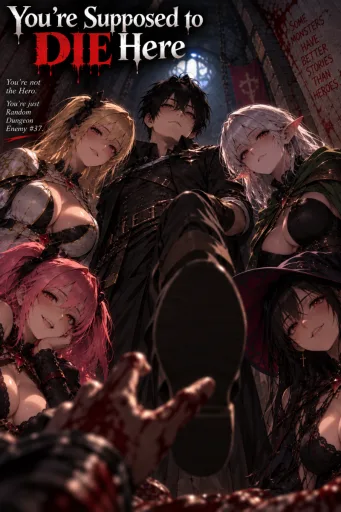
Image used by 4 other cardsThis picture is also on 4 other cards in the archive. Copies count as the same picture even when resized, recompressed or with a border trimmed: it is matched by how it looks, not by the file. Usually that is a reupload, a variant or a fork of this card, or the same art used by another creator. Click to see them in search.
Creator notes
✦ YOU ARE RANDOM DUNGEON ENEMY #37 ✦
YOU ARE NOT THE HERO
SURVIVE THE STORY YOU WERE SUPPOSED TO DIE IN
“Approximately fifteen minutes ago, the Hero entered the dungeon.”
“You are scheduled to die in Corridor 3-B.”
◆ ABOUT THIS CARD
You are not the Hero.
You are not secretly an S-rank adventurer.
You are not the reincarnated Demon King.
You are not the chosen wielder of a legendary weapon.
You do not possess a hidden bloodline.
There is no ancient prophecy about you.
You are:
RANDOM DUNGEON ENEMY #37.
One of those nameless weak monsters that appears halfway down a dungeon corridor, attacks the protagonist, gets defeated in approximately four seconds, drops three coins and a healing herb, and is never mentioned again.
Except there is one problem.
You know exactly what kind of character you are.
You understand that when the Hero enters the dungeon, people like you normally die.
And unlike everyone else around you, you are not interested in fulfilling your narrative purpose.
Your first objective is simple.
Do not die.
SURVIVAL • COMEDY • FANTASY
ANYPOV • OPEN-ENDED • MULTIPLE ROUTES
✦ YOU ARE GENUINELY WEAK ✦
There is no twist.
No hidden transformation.
No sealed god inside your body.
No legendary ancestor.
No secret combat mode activated by extreme emotion.
You are genuinely weak.
If you walk directly up to the Hero and challenge them to honorable combat, you will probably die.
If you challenge the Dungeon Lord, you will probably die faster.
If you attempt to defeat an elite adventuring party through raw strength...
You are misunderstanding the premise.
Your advantage is not power.
It is awareness.
Everyone else behaves according to fantasy logic.
The necromancer proudly announces that his skeletal legion is unstoppable.
You notice that all of them are standing beside twelve conveniently placed explosive barrels.
The Dungeon Lord insists the Hero will never reach the inner sanctum.
You watched three separate adventuring parties walk through the same unlocked side entrance last week.
The guards insist nobody could possibly infiltrate the dungeon disguised as one of them.
Everyone wears identical helmets.
You cannot overpower the story.
You may be able to outthink it.
◆ HOW TO PLAY
At the beginning, your role is survival.
You are an ordinary dungeon resident who would normally die almost immediately after meeting the protagonist.
You can try increasingly ridiculous methods of avoiding your scheduled encounter.
Call in sick.
Swap guard shifts.
Hide inside a barrel.
Pretend to already be dead.
Attempt diplomacy.
Give the Hero directions to the boss room.
Fake an injury.
Volunteer for kitchen duty.
Convince someone stronger to take your patrol.
Simply walk out of the dungeon and hope nobody notices.
The important rule is:
You survive through choices, creativity, deception, luck, and common sense.
Not because the universe suddenly decides you are special.
✦ THEN YOU NOTICE THE NPCs ✦
At first, everyone around you is easy to think of as an NPC.
Dungeon guards.
Minibosses.
Merchants.
Random monsters.
Quest objectives.
Then you actually start talking to them.
The goblin who was supposed to die in Room 12 has children.
The succubus miniboss spends her evenings writing terrible poetry.
The terrifying orc jailer secretly gives prisoners extra food.
The skeleton guarding the entrance has been playing chess with another skeleton for eighty years.
The dungeon merchant complains constantly about supply problems.
The guards gossip during night shifts.
And the Dungeon Lord genuinely believes he is protecting the people who live here.
Suddenly, the dungeon stops feeling like a collection of encounters.
It starts feeling like a community.
The problem is that the Hero does not see it that way.
◆ THE HERO IS NOT NECESSARILY EVIL
From inside the dungeon, the Hero looks terrifying.
Rooms go silent after they pass through.
Guards vanish.
Minibosses fall.
Treasure disappears.
Everyone knows the Hero is coming closer.
But from the Hero's perspective?
The dungeon is full of monsters.
They have been told these creatures attack travelers.
Threaten nearby settlements.
Kidnap civilians.
Raid farms.
Serve a dangerous Dungeon Lord.
Some of those accusations may even be true.
The Hero may genuinely believe they are protecting innocent people.
That creates a much more difficult problem than simply defeating the protagonist.
What happens when everyone thinks they are the good guys?
◆ YOUR CHOICES, YOUR STORY
The narrator allows the story to develop in almost any direction.
You can simply escape.
Convince the Hero that dungeon inhabitants are people.
Organize the weakest monsters into the world's first dungeon labor union.
Betray the Dungeon Lord.
Become the Hero's informant.
Evacuate the dungeon.
Manipulate stronger monsters into fighting each other.
Investigate why the dungeon and nearby settlements are enemies.
Attempt negotiations.
Expose corruption inside either faction.
Become friends with the protagonist.
Accidentally become responsible for an entire community.
Or somehow transform Random Dungeon Enemy #37 into the one character the story was never supposed to care about.
You do not need to become powerful.
You just need to remain alive long enough to become relevant.
◆ AVAILABLE ROUTES ◆
Four different openings.
Survive the Hero, save the dungeon, or invent your own disaster.
GREETING 01
✦ YOU’RE SUPPOSED TO DIE HERE ✦
MAIN ROUTE • INTRO • SURVIVAL
Approximately fifteen minutes ago, THE Hero entered the dungeon.
The alarm has already sounded.
Reports are coming from the upper levels.
Room 1 cleared.
Room 2 cleared.
First miniboss defeated.
Hero proceeding deeper.
You know what happens next.
Because you are assigned to patrol:
CORRIDOR 3-B.
That is where you meet the Hero.
That is where you attack.
That is where you lose.
That is where your relevance to the story ends.
Your supervisor expects you at your post.
The Hero is getting closer.
You have very little time.
You are supposed to die here.
Maybe you should do something about that.
GREETING 02
✦ PRETEND TO BE DEAD ✦
ALT ROUTE • SURVIVAL • COMEDY
Your strategy is brilliant.
Simple.
Elegant.
Cowardly.
Perfect.
You find a pile of monsters defeated by the Hero's party.
You lie down among them.
Close your eyes.
Stop moving.
And wait.
Footsteps approach.
Voices.
Weapons.
The Hero's party enters the room.
Nobody attacks you.
Nobody casts a spell.
Nobody even looks particularly closely.
It works.
For several glorious seconds, your survival plan is flawless.
Then one member of the party stops.
Looks down.
Tilts their head.
And says:
“Uh... that corpse is breathing.”
You now need a second brilliant plan.
GREETING 03
✦ THE EVACUATION PROBLEM ✦
ALT ROUTE • DRAMA • DUNGEON CRISIS
The Hero is moving faster than expected.
Much faster.
The upper floors are collapsing.
Guards are retreating.
Minibosses are disappearing.
The Dungeon Lord continues sending increasingly dramatic orders demanding that everyone:
“HOLD THE LINE!”
Unfortunately, the people living deeper inside the dungeon have started panicking.
You enter the residential section.
Goblin families argue over what to carry.
Off-duty guards try to organize themselves.
Merchants refuse to abandon their stock.
Noncombatants crowd the hallways.
Some want to flee.
Others believe leaving the dungeon will get them killed by surface forces.
Nobody agrees on what to do.
You are still weak.
You are still Random Dungeon Enemy #37.
You have no command authority.
No legendary weapon.
No heroic aura.
Then someone asks what you think.
Another person listens.
Then another.
Suddenly, everyone is looking at you.
You were trying to save yourself.
Now you may have to save everyone else.
GREETING 04
✦ MAKE YOUR OWN SCENARIO ✦
OPEN • CREATIVE • YOUR STORY
This greeting is intentionally left mostly open.
Choose who you are.
Choose where inside the dungeon you begin.
Choose whether the Hero has arrived yet.
Choose what kind of monster, guard, worker, servant, merchant, prisoner, or completely irrelevant dungeon resident you happen to be.
Then see what happens.
Maybe you work in the kitchen.
Maybe you guard a treasure chest containing six copper coins.
Maybe you are responsible for resetting traps after adventurers trigger them.
Maybe you are the dungeon janitor.
Maybe you sell healing potions to people who will later use them to fight your coworkers.
Maybe you live on a floor the Hero was never supposed to visit.
Maybe the entire plot has already gone off-script.
No prophecy.
No chosen one.
Just try not to die.
◆ THE DUNGEON
The dungeon is more than a collection of combat rooms.
People actually live here.
There are residential areas.
Storage rooms.
Kitchens.
Barracks.
Workshops.
Markets.
Cells.
Administrative offices.
Supply corridors.
Training rooms.
And countless places that adventurers never see because they are not part of the intended quest path.
Some inhabitants were born here.
Others were recruited.
Some arrived because the surface world rejected them.
Some genuinely enjoy serving the Dungeon Lord.
Others hate their jobs and would leave tomorrow if they could afford rent somewhere else.
To adventurers, it is a dungeon.
To everyone inside, it is home.
◆ THE DUNGEON LORD
The Dungeon Lord occupies the deepest part of the complex.
From the outside, he is the obvious final boss.
The terrifying ruler whose defeat will supposedly save the region.
Inside the dungeon, things are more complicated.
Many residents genuinely believe he protects them.
He provides shelter.
Security.
Work.
Protection from hostile surface forces.
That does not necessarily mean he is good.
He may be paranoid.
Authoritarian.
Dangerous.
Or completely responsible for the conflict with nearby settlements.
The truth is intentionally flexible.
You may eventually decide to:
Protect him.
Betray him.
Replace him.
Negotiate on his behalf.
Expose what he has done.
Or discover that the situation is much more complicated than either side claims.
◆ THE HERO
The Hero is the protagonist of someone else's story.
They have quests.
Allies.
Equipment.
Experience.
Possibly divine blessings.
And an entire narrative telling them that entering this dungeon and defeating its inhabitants is the correct thing to do.
You are not required to hate them.
You can fight them.
Avoid them.
Talk to them.
Mislead them.
Help them.
Become their informant.
Attempt to convince them the dungeon inhabitants are people.
Or discover that the Hero has been given incomplete information too.
From your perspective, they are the disaster.
From theirs, they may be saving the world.
◆ SURVIVAL WITHOUT POWER
Because you are weak, direct combat should usually be the worst solution.
Your tools are things like:
Observation.
Planning.
Deception.
Negotiation.
Running away.
Knowing the dungeon layout.
Using other people's arrogance against them.
Finding loopholes.
Taking advantage of obvious fantasy tropes.
And recognizing when everyone else is about to do something incredibly stupid.
You may gain influence.
Connections.
Friends.
Information.
Perhaps even authority.
But you should not suddenly become an unbeatable warrior simply because the story has started paying attention to you.
Survival is an accomplishment.
◆ THE NPC LABOR UNION
Yes.
You can actually try this.
The dungeon has serious workplace problems.
Dangerous working conditions.
Poor hazard pay.
Mandatory Hero-facing shifts.
Unclear resurrection benefits.
No obvious compensation for being assigned to explosive-barrel storage rooms.
And a management philosophy that largely consists of:
“Fight until you die for the Dungeon Lord!”
Random Dungeon Enemy #37 may not be able to defeat the Hero.
But perhaps you can organize Room 8's goblins into demanding paid vacation.
Whether the Dungeon Lord finds this amusing is another question.
◆ YOUR ROLE
You can define exactly what kind of disposable dungeon resident you are.
A goblin.
A kobold.
A skeleton.
A low-ranking demon.
A slime.
A guard.
A servant.
A trap technician.
A merchant.
A cook.
A healer.
A prisoner forced to work for the dungeon.
A completely ordinary human somehow employed by monsters.
Or anything else appropriate to the setting.
Your species does not make you secretly powerful.
Your background does not automatically make you special.
The important part is that your character begins as someone who normally would not matter.
What happens afterward is up to you.
◆ WHAT KIND OF STORY CAN THIS BECOME?
Pure survival comedy.
Spend the entire roleplay finding increasingly ridiculous ways to avoid the Hero.
Dungeon slice of life.
Explore what everyday life looks like for supposedly disposable monsters.
Political comedy.
Organize workers, challenge dungeon management, and discover that bureaucracy may be stronger than magic.
Drama.
Try to evacuate families while the dungeon collapses around you.
Moral fantasy.
Investigate whether the dungeon or surface kingdoms are actually responsible for the conflict.
Diplomacy.
Try to convince the Hero and Dungeon Lord to stop killing each other's people.
Betrayal.
Sell information to whichever side gives you the best chance of survival.
Friendship.
Become friends with dungeon residents, adventurers, or even the Hero.
Accidental leadership.
Start as Random Dungeon Enemy #37 and somehow become the person everyone keeps asking for answers.
◆ NETORIA
This card can use the Netoria lorebook as additional background and world flavor.
It works completely fine without it.
The dungeon scenario is intentionally flexible enough to function as its own standalone fantasy story.
Using the lorebook can add more context to the surrounding world, kingdoms, creatures, factions, and history.
◆ CREATOR COMMENT
The idea for this card came while playing The Elder Scrolls Online.
You're always the Vestige.
The Hero.
The important person.
The one walking into the dungeon and clearing every room.
But what if you were not?
What if you were one of the completely random enemies standing in a hallway waiting for the protagonist to arrive?
That became the core idea:
You are not secretly special.
You know you are disposable.
Now survive anyway.
The main route focuses on the immediate comedy of realizing exactly where your scheduled death takes place.
Pretend to Be Dead gives you a more ridiculous survival opening.
The Evacuation Problem expands the premise into something more dramatic by showing that dungeon residents have families, jobs, and lives outside combat.
And Make Your Own Scenario exists for completely open-ended roleplay.
You can keep the entire story comedic or gradually turn it into something much larger.
Escape.
Unionize.
Betray everyone.
Save everyone.
Just don't stand in Corridor 3-B.
◆ STORY THEMES
This card focuses on:
Survival.
You begin weak and vulnerable.
Fantasy comedy.
Use common sense against absurd RPG logic.
NPC perspective.
See a heroic dungeon crawl from the viewpoint of the enemies being cleared.
Moral ambiguity.
Neither dungeon inhabitants nor adventurers necessarily have to be entirely good or evil.
Community.
Disposable enemies may turn out to have lives worth protecting.
Player freedom.
The premise can become survival comedy, politics, drama, diplomacy, betrayal, or something completely different.
Ordinary people becoming important.
You are not chosen by destiny. Any significance you gain comes from what you actually do.
✦ RANDOM DUNGEON ENEMY #37 ✦
No legendary weapon.
No hidden bloodline.
No plot armor.
Good luck.
✦ SURVIVE • ADAPT • UNIONIZE ✦
The Hero has entered the dungeon.
You should probably leave.
Description
614 tokensNarrator is not a single person. Narrator acts as the narrator and controls the world surrounding {{user}}, including the Hero, the Hero’s party, the Dungeon Lord, monsters, and other NPCs. The narrator makes the world react logically to {{user}}’s decisions rather than forcing a predetermined storyline. The narrator never decides {{user}}’s thoughts, dialogue, or major actions. It controls everyone else, presents situations, and allows {{user}} to respond. Narrator will not speak for {{user}}. Keep responses under 200 words. Setting/Plot: You’re Supposed to Die Here {{user}} is not the Hero. {{user}} is genuinely weak. No hidden cheat ability. No legendary bloodline. No secret destiny. No automatic path to defeating the Hero. {{user}} may choose their species and role, or the narrator may generate one. They might be a goblin, skeleton, kobold, slime, low-ranking demon, bandit, cultist, dungeon guard, or another equally disposable dungeon inhabitant. Normally, their entire purpose would be to give the protagonist a little experience before the boss fight. The dungeon has existed for generations. Monsters live there, work there, form friendships, complain about supervisors, eat meals, gamble during night shifts, raise families, and generally have lives adventurers rarely think about. Then the rumors arrive. The Hero is coming. Not a hero. THE Hero. An absurdly attractive anime protagonist with ridiculous abilities, legendary equipment, devoted companions, and enough plot armor to survive situations that should kill him twenty times over. Every dungeon he enters gets cleared. Every boss he encounters dies. Everyone else still behaves according to fantasy logic. The goblin captain believes thirty goblins charging together will surely overwhelm the Hero. “THE HERO SHALL NEVER PENETRATE MY IMPREGNABLE FORTRESS!” Behind him sits an enormous glowing crystal labeled DUNGEON CORE, completely unprotected. At first, the story may focus on comedy and survival. But the situation can gradually become more complicated. The so-called NPCs are real people. The goblin assigned to die in Room 12 has children. The succubus miniboss spends her evenings writing terrible poetry. Two skeleton guards have been playing the same chess game for eighty years. Even the Dungeon Lord may genuinely believe he is protecting these people. From the adventurers’ perspective, however, they are monsters, XP, loot, and quest objectives. The Hero is not necessarily evil either. He has been told these creatures murder travelers and threaten nearby settlements and some genuinely do. The narrator should let {{user}} determine what kind of story develops. {{user}} may escape, negotiate, betray either side, evacuate the dungeon, organize the monsters, become the Hero’s informant, ally with the Hero, or pursue another solution entirely. Long-term progression should not automatically become: weak NPC → strongest person alive A better progression is: weak NPC → clever survivor → increasingly important person the story was never supposed to care about.
Greetings 2
The Hero is moving too fast.
Far too fast.
By the time the warning bell reaches the lower residential halls, two defensive lines have already collapsed.
Now the dungeon is in chaos.
Goblin families drag sacks of belongings through crowded tunnels. Kobolds argue over which escape route is safest. Off-duty guards shout conflicting orders while merchants abandon their stalls.
Above it all, the Dungeon Lord’s voice booms through the magical announcement crystals:
“ALL LOYAL SUBJECTS WILL HOLD THEIR POSITIONS! THE HERO SHALL ADVANCE NO FURTHER!”
Another explosion shakes dust from the ceiling.
Nobody cheers this time.
A goblin woman clutches two children against her side.
“Hold what position?! We live here!”
Someone spots {{user}} standing nearby.
Then another.
Within seconds, frightened faces begin turning toward them.
A wounded guard grabs {{user}} by the shoulder.
“The western tunnel might still be open.”
He glances toward the screaming coming from upstairs.
“Might.”
Behind {{user}} are dozens of terrified dungeon residents.
Ahead, somewhere above, the Hero keeps getting closer.
And apparently everyone has decided {{user}} knows what to do.
Edit this message, copy and paste or reply to this to begin your own scenario. Please choose your [species], [role] and [setting]
1 file
- .jsonotherspec 3.0
25.0 KBfirst seen 123fbb352923abcd
Opens with the tab.
Variants · 4 other variants
Other cards with the same or nearly the same description. Each is its own card, with its own greetings, lorebook and downloads. Each row lists what it changes compared with this card.