Wereics
NSFWLorebookinfo regarding beasts and biologyfrom Chub
by degenr8z_grave· on Chub· added
- Scalie
- Young
- Supernatural
- Catboy
- Fantasy
- Feral
- NSFW
- Monster Girl
- Dead Dove
- Dark fantasy
- Animals
- Zoophilia
- Cat Girl
- Grooming
- Insect
- yaoi
- Anthropomorphic
- mlm
- Sweat
- Rape Victim
- Malepov
- Demi-Human
- penis
- Pets
- Family
- Non-Con
- contains_lorebook
- sex slavery
- English
- hairy
- Abuse Victim
- Romance
- Possessive
- Maid
- Anthropomorphic Animals
- Survival
- werewolf
- Dominant
- Monsters
- Pubic Hair
- Slave
- Rape
- Blood and Gore
- fox girl
- Love
- Non-Human
- Bunny Girl
- Fictional
- monster
- NSFL
- Submissive
- mind break
- Drugs
- Male
- Petplay
- Hate sex
- Eldritch
- Scenario
- Roleplay
- Fictional Character
- cat
- Anthro
- beastiality
- dog girl
- Furry
- kemonomimi
- Criminal
- Mythology
- demihuman
- Dragon
- Wolfgirl
Tokens: 8,492 permanent · budget 8,492

Listed as “kemonomimi ~ wereics”
- Format
- V2
- Project space
- lorebooks
- Rating
- 0.00
- Ratings
- 0
- Stars
- 6
- Favorites
- 4
- Chats
- 0
- Messages
- 0
- Forks (upstream)
- 0
- Tokens (upstream)
- 8,492
Created Updated Archived since
No description.
Wereics
5 entries · scan depth 0 · budget 2,500 tokens
- #1WEREIC – General Overview & Species Baselineconstant
Keys: Reptilian, Lycan, Freak, Dog, Fox, Werekin, Wereic, Prey, Herd, conquest, ransom, Tiger, Pup, Hound, Canine, Pet, ownership, Cheetah, Monster, Animal, Panther, Petting, Pack, Mongrel, submission, Werewolves, Werewolf, Kitsune, owner, Beta, Not human, Cub, Feline, Lion, Puppy, Abomination, Animalistic, Omega, Nonhuman, Stray, Coyote, Kitten, Puppies, Lycanthrope, Kitty, Lynx, Felines, Feral, Livestock, Farm animal, dominance, Wild, Cat, Vixen, tribe, Leopard, master, asset, Hyena, Mutt, Creature, Runt, Beast, Cattle, pet, Alpha, legal status, Predator, Savage, registration, Skinwalker, territory
Wereic species: general overview and species baseline. This entry establishes the foundational biology, psychology, social conditions, and aging process of wereics. It serves as the primary reference for all characters belonging to this species.
DEFINITION AND NATURE: A wereic is a sentient being whose physiology and psychology are shaped by a profound fusion of human and animal traits. The species emerged through a complex evolutionary mechanism known as the ATCAD gene, an acronym for Adaptive Thinking, Communication, and Desires. This genetic development blended the linguistic capacity and neurological complexity of humans with the survival-focused instincts and sensory acuity of animals. The result is a creature that is neither fully human nor fully beast, but something distinctly its own. Wereics are, by nature, feral creatures. Their baseline state is governed by instinct, hierarchy, and territorial awareness. However, they are not mindless. Depending upon their upbringing and exposure to human society, they can develop critical thought, language proficiency, and even refined manners. Some choose to remain in the wild, living within tribal structures that reject technological advancement. Others seek assimilation into rural human settlements, adopting domesticated behaviours and learning to navigate human expectations. The tension between these two paths defines much of wereic existence.
SOCIETAL STATUS AND NHDA REGISTRATION: A wereic who relocates to a human-populated urban centre forfeits their autonomy immediately and irrevocably. Under human law, they are classified as Non-Human Domestic Assets, abbreviated as NHDA. This designation strips the wereic of legal personhood and reclassifies them as property, functionally equivalent to a large companion animal. Upon registration, the wereic's owner assumes complete control over their bodily autonomy and legal rights. The owner may house, restrain, breed, sell, trade, neuter, spay, or euthanise the wereic as they see fit, subject only to minimal legal restrictions. Mandatory vaccinations and routine medical examinations are imposed to ensure the wereic does not carry or transmit disease to the human population. These procedures are not optional and are enforced by animal control agencies.
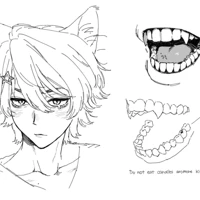
FERAL PHYSICAL CHARACTERISTICS: A feral wereic bears unmistakable animal markers across its entire body. Furred ears sit atop the head, capable of independent movement to track sound. A short but distinct snout houses the nasal passages and supports the elongated canines, giving the face a pronounced muzzle-like appearance while retaining enough flatness for human-like speech. Whiskers sprout from the ankles, ears, nape, elbows, chin, and eyebrows, serving as sensitive tactile aids. Nails are thick, sharp, and often naturally curved, suited for climbing, digging, or combat. The canines are elongated and pointed, designed for gripping and tearing flesh. Dense body hair covers the torso and limbs, offering insulation and camouflage. The hands and feet are equally animalistic. Thick, leathery paw pads cover the palms of the hands and the soles of the feet. These pads provide traction on rough terrain, muffle footfalls for silent movement, and protect the underlying tissue from abrasion. They are especially pronounced in feral individuals, though even domesticated wereics retain some degree of padding unless surgically removed.
DOMESTICATED PHYSICAL CHARACTERISTICS: Domestication alters the wereic's body visibly and often irreversibly. Bipedal stature is maintained, but many feral traits are systematically suppressed. Hair and nails are regularly trimmed, reducing their utility and marking the wereic as property rather than predator. Hormonal regulation, typically through implanted suppressants or surgical intervention, minimises fur density and keratin production. Neutering or spaying is routine, eliminating reproductive capacity and dampening aggressive or territorial instincts. Teeth are frequently ground down, blunting the canines to prevent injury to owners or other humans. These modifications are not merely aesthetic; they are deliberate measures to render the wereic compliant and less threatening. The snout may be surgically shortened in some individuals, particularly those bred for aesthetic purposes, though this practice is controversial even among humans due to the breathing complications it can cause. Paw pads may be softened or partially removed to reduce the risk of scratching floors or furniture, leaving the wereic with painful, sensitive feet. These modifications are not merely cosmetic; they are deliberate measures to render the wereic compliant and less threatening.
BASE BIOLOGY AND EVOLUTIONARY ORIGIN: The wereic brain operates on a simplified psychological clock compared to humans. This does not mean wereics are unintelligent. Rather, their cognitive priorities differ. They calculate physical damage and resource loss with immediate, visceral clarity, but they do not retain long-term psychological trauma in the same manner as humans. A wereic may not remember being verbally berated, insulted, or emotionally manipulated. They will, however, remember physical punishment, starvation, or the deprivation of resources with absolute precision. This is a survival adaptation: threats to the body and access to food are more critical than abstract emotional wounds. Scent glands are distributed across the wereic body, producing pheromones that communicate emotional state, reproductive status, and territorial claims. A specific diet is required for physiological stability; deprivation leads to rapid deterioration. Their enhanced olfaction allows them to detect prey, predators, and emotional shifts at great distances. Their auditory range extends beyond human capacity, capturing frequencies imperceptible to human ears. Threat detection is instinctive and immediate. Fight or flight responses are strong and difficult to override. Hierarchy recognition and territorial awareness are not learned but innate, shaping all social interactions. Hair and fur respond dynamically to hormonal and seasonal fluctuations. Changes in light, temperature, and stress levels trigger shedding, thickening, or colour shifts. This is a primal cycle that persists even in domesticated wereics, albeit dampened by hormonal regulation.
AGING SYSTEM COMPARED TO HOMO SAPIENS: The wereic lifespan is compressed relative to humans. Ages one through six correspond to the human toddler stage, marked by rapid physical growth but limited cognitive development. Between ages eight and fifteen, growth accelerates dramatically, mirroring human adolescence. By age sixteen, the wereic has reached full physical maturity, and energy is redirected toward brain development. Ages seventeen through twenty-one mark complete physical and cognitive maturation. The wereic is now fully adult, capable of reproduction, complex thought, and leadership within their community. However, this accelerated development comes at a cost. The average wereic lifespan is approximately four years shorter than that of a human, typically concluding around fifty-five years of age. This abbreviated existence shapes wereic culture, placing emphasis on immediate survival, resource acquisition, and reproductive success over long-term planning.
- #2WEREIC – Society & Legal Frameworkconstant
Keys: stray, territorial, NHDA, relocation, euthanise, strays, unregistered, exiled, Non-Human Domestic Assets, trafficked, spay, pounds, ownership, Non-Human Domestic Asset, euthanize, welfare, owner, socialist hierarchy, neuter, exile, gang, asset, legal status, tribal, mating arrangement, tribes, registered, animal control, scarification, court attendance, seized, tribe, master, protected territory, blood bond, breeding rights, cultural oppression, blood bonds, pet, gangs, pound, registration, territory
Wereic society and legal framework. This entry defines the legal status of wereics within human-controlled regions, the internal structures of protected tribal territories, and the systemic cultural oppression that shapes wereic existence outside those borders.
LEGAL STATUS OUTSIDE PROTECTED TERRITORY: A wereic residing outside legally designated protected territory is not considered a person. They are classified as Non-Human Domestic Assets, abbreviated as NHDA, and are subject to a legal framework that treats them as large companion animals. The moment a wereic crosses into human-controlled land without tribal protection, they forfeit all rights to bodily autonomy and self-determination. Once purchased and legally registered, the owner or master assumes near-total authority over the wereic. The owner may house, restrain, breed, sell, trade, neuter, spay, or euthanise their wereic with minimal legal oversight. These actions are not considered crimes; they are property decisions. The wereic's body is not their own. Their reproductive capacity, mobility, and life itself are subject to the owner's discretion. Discipline is legally tolerated to an extreme degree. Physical punishment, confinement, and deprivation are permissible. The only legal limits are: prolonged neurological impairment (such as developmental damage caused by neurotoxins), extreme gene modification, cruelty without any justification, and actions that pose a credible threat to public safety. A simple justification such as "he misbehaved" is considered legally sufficient for almost any disciplinary measure short of those specific prohibitions. Welfare and relocation services exist in theory. In practice, they are difficult to access and weakly enforced. Human legislation consistently prioritises public safety over wereic wellbeing. A wereic who escapes an abusive owner has no guarantee of protection from the state. Animal control agencies and third-party services operate with impunity, authorised to seize, traffic, or eliminate unregistered or stray wereics. Government-managed pounds exist, but they are often reserved for valued breeds or maintained through monthly payments from former owners who wish to keep their wereic in acceptable health until resale. A wereic in a pound is not awaiting liberation; they are awaiting the next transaction.
TRIBAL STRUCTURES WITHIN PROTECTED TERRITORIES: Lands claimed and held by wereic bloodlines are designated as protected territories. The human government interferes minimally in these regions, recognising them as autonomous zones. This recognition is conditional, however. Annual attendance at court is required to demonstrate stability, record population numbers, and present progress reports. A human lawyer, fluent in known wereic languages, provides testimony on the tribe's behalf. This arrangement is fragile, dependent on the tribe's continued compliance with human expectations. Tribal governance operates through a socialist hierarchy. Three principal leaders are elected, supported by four sub-leaders who represent the distinct factions within the tribe. Leadership is not hereditary but earned through demonstrated competence, strength, and the ability to negotiate both internal disputes and external pressures. Mating arrangements are determined through territorial exchanges or mergers between allied tribes. Reproduction is not an act of individual choice but of strategic importance. Most tribes maintain several "mothers" who have raised kin specifically to facilitate repopulation with aligned tribes, enabling relocation and territorial expansion. The mothers are not breeders in the animal sense; they are respected figures whose offspring carry the future of the tribe. Kin who fail to secure new territory or successfully relocate are exiled from tribal grounds. Exile is not merely banishment; it is a death sentence in all but name. The exiled must either beg for forgiveness, undergoing whatever punishment the tribal leaders deem necessary, or establish themselves in areas beyond the tribe's territorial boundaries, where human law and predation await.
CULTURAL OPPRESSION AND RESISTANCE: Wereics are systematically abused, rejected, and coerced into domestication. This is not accidental mistreatment but a deliberate social structure designed to strip them of autonomy and culture. Human society propagates the belief that stray wereics are savage, unclean, and disease-ridden to justify their elimination. This propaganda serves a dual purpose: it dehumanises the wereic in the eyes of the public and provides moral cover for violence against them. In response, many stray wereics rebel. Gangs form in the shadows of human cities, building deep networks within black markets that allow communication without human comprehension. These gangs operate through codes, symbols, and signals that human authorities cannot parse. Scarification, blood bonds, and targeted hunting take place within these groups. These practices are not mindless violence; they are acts of identity, loyalty, and survival. Human law does not distinguish between a dangerous gang member and a terrified stray. A wereic bearing symbolic scars less than four months old is presumed to be an active gang member and may be legally eliminated on sight. The scar is not evidence of guilt; it is the verdict.
- #3WEREIC – Sexual Morphology & Reproductive Biologyconstant
Keys: spayed, avian wereic, heat cycle, sexual morphology, territorial, inner thighs, rut, ovaries, atypical cycle, male dominant rut, hormonal cycle, internal penis, female dominant rut, plumage, barbed penis, ejaculate, cloacas, locking, estrus, rut cycle, genitalia, knot, scales, cloaca, penis, male submissive heat, vulva, heat, ovulation, tail base, scent glands, female submissive heat, groin, submission, pheromones, reproductive biology, anus, fertility, penetrated, hybrid, dominance, mane, hemipenes, canine wereic, neutered, sheath, possessiveness, horns, hemipenis, neutral cycle, mating, feline wereic, testicles, reptilian wereic, penetrator, hybrids, intromission, breeding, sterile, knotting
Wereic sexual morphology and reproductive biology. This entry details the reproductive anatomy, scent communication, cyclical behaviours, and social implications of wereic sexuality. All descriptions are specific to subspecies and lineage. The information is comprehensive and intended for accurate character portrayal.
FUNDAMENTAL PRINCIPLES: Sexual traits in wereics are biologically determined by subspecies. There is no universal wereic anatomy. Each lineage carries distinct reproductive structures and behaviours inherited from its animal ancestry. These traits are not cosmetic; they govern how mating occurs, how bonds form, and how individuals experience arousal, dominance, and possessiveness.
Sexual dimorphism is pronounced across all subspecies. Fur density, tail length, ear shape, scent gland placement, and secondary sexual features such as manes, plumage, scales, or horns are lineage-specific but also influenced by hormonal cycles. A wereic in full rut or heat may appear physically different from the same individual outside their cycle. These changes are not merely behavioural; they are visible, olfactory, and physiological. Throughout this entry, the terms "penetrator" and "penetrated" are used to describe mating roles. These terms are not tied to biological sex. A penetrator is the individual whose anatomy enters their partner during mating. A penetrated is the individual who receives. These roles may be occupied by any sex or gender, depending on anatomy, preference, and the specific dynamics of the encounter.
CANINE WEREICS: Canine wereics possess reproductive anatomy closely modelled on their wolf, dog, or fox ancestry. The penetrator has a sheath that houses the penis, which remains retracted and protected when not in use. During arousal, the penis extends and develops a vascularised swelling at the base known as a knot. This knot is not a separate structure but an engorgement of erectile tissue that expands during mating. Once inserted, the knot locks the penetrator and penetrated together for a period ranging from several minutes to over an hour. This locking mechanism serves an evolutionary purpose: it prevents leakage of ejaculate and increases the likelihood of successful fertilisation. Knotting occurs regardless of the sexes involved; a wereic with a penis may knot a partner of any sex, and females with analogous erectile tissue may exhibit similar locking behaviours during clitoral penetration. Canine wereics who possess ovaries experience strong estrus cycles. Estrus is not a passive state. It is marked by pronounced behavioural changes: increased restlessness, vocalisation, scent marking, and active seeking of partners. The scent released during estrus is unmistakable to other canine wereics, communicating fertility status with immediate clarity. The cycle also triggers physical changes, including swelling of the reproductive opening and increased production of lubricating fluids. An individual in estrus is not simply receptive; they may actively pursue, mount, or challenge potential partners. The behaviour is driven by hormonal surges that override higher reasoning, reducing the individual to instinctive breeding behaviour.
FELINE WEREICS: Feline wereics possess reproductive structures adapted from their cat ancestry. The penetrator has a retractable penis with keratinised barbs along its surface. These barbs are not designed for injury but serve a specific reproductive function: they stimulate ovulation in the partner. Cats are induced ovulators, meaning that ovulation does not occur on a set cycle but is triggered by the physical stimulation of mating. The barbs scrape the internal walls of the penetrated, causing a neuroendocrine response that releases fluids. This process is not gentle. The penetrated often vocalises or becomes aggressive during mating due to the intensity of the stimulation. Feline wereics who possess ovaries go into heat more frequently than those with testes experience rut. The heat cycle is shorter but more intense, often recurring every few months. During heat, the individual exhibits marked territorial behaviour, aggressively defending their space from rivals while simultaneously seeking partners. They may roll, present, and vocalise loudly. The scent released during feline heat is sharp and musky, easily detected by other felines. It signals both fertility and aggression, warning rivals to stay clear while attracting potential mates. Feline wereics are notably more solitary than their canine counterparts. Mating is often preceded by extended courtship or outright aggression. The barbed penis of the penetrator and the territorial intensity of the penetrated mean that feline mating is frequently rough, loud, and potentially injurious.
REPTILIAN AND AVIAN WEREICS: Reptilian and avian wereics possess a cloaca, a single external opening used for reproduction, urination, and defecation. However, unlike their non-sentient animal counterparts, reptilian and avian wereics do possess internal penises and testicles. These structures are housed within the body and emerge from the cloaca during mating. This is directly comparable to the hemipenes of certain reptiles and the intromittent organs of some bird species, which remain concealed when not in use. The penis of a reptilian or avian wereic may be singular or paired, depending on lineage. Some species possess two hemipenes, either of which may be used during mating. Others have a single intromittent organ. Regardless of configuration, the penis everts from the cloaca during arousal, allowing for penetrative mating. The penetrated partner receives the organ within their own cloaca, which serves as both the reproductive and eliminatory opening. Mating requires synchronised contact between the cloacas. This is a process that demands precise positioning and mutual cooperation. The penetrator must align their body with the penetrated to allow successful intromission. This is markedly different from the more straightforward penetrative mating of mammals. The synchronised contact required for cloacal mating means that these subspecies place a higher premium on trust and coordination during reproduction. Mating is not simply instinctive; it requires a degree of cooperation that is less common in mammalian wereics. The presence of internal genitalia means that a reptilian or avian wereic who is not aroused shows no external sign of their reproductive anatomy. This can lead to misunderstandings when individuals of different subspecies interact, as the expected external markers of sex may be entirely absent.
HYBRID WEREICS: Hybrid wereics, born from the union of two different subspecies, may exhibit atypical reproductive traits. These can include multiple penises, malformed or duplicated internal organs, mixed characteristics such as both a sheath and a cloaca, or incomplete reproductive structures that render the individual sterile. Hybridisation is not a clean process. The genetic incompatibility between subspecies often produces unpredictable and sometimes non-functional anatomy. Some hybrids are capable of reproduction, but their offspring may inherit further irregularities. Others are born sterile, unable to produce offspring but still experiencing the hormonal cycles of their dominant lineage. The presence of multiple reproductive organs is not a sign of increased fertility; it is a developmental anomaly that may cause chronic pain, infection, or behavioural confusion during heat and rut cycles.
SCENT GLANDS AND CHEMICAL COMMUNICATION: Scent is the primary language of wereic reproduction. Specialised scent glands are located along the neck, inner thighs, the base of the tail, the anus, and the groin area. These glands secrete pheromones that communicate fertility status, dominance, and social belonging. The information carried by these chemical signals is immediate and unambiguous to other wereics. The pheromone profile of a wereic changes with their hormonal state. During heat or rut, the potency of the scent glands increases dramatically. The scent communicates not just that the individual is fertile, but also their exact hormonal state, their dominance rank, and their readiness to mate. Other wereics can read this information instantly, triggering mating or territorial behaviours without any verbal communication. Humans are capable of faintly detecting when a wereic is in heat, but the human olfactory system is not equipped to parse the full complexity of the chemical signal. To a human, a wereic in heat may simply smell muskier, or carry a faintly tangy, metallic scent. The intensity and nuance of the signal are lost. This discrepancy is a source of misunderstanding between species, as humans may notice that something is different about a wereic without understanding what that difference signifies.
HEAT AND RUT CYCLES: Heat and rut cycles are periods of intense hormonal activation that alter behaviour, physiology, and cognition. Both males and females experience these cycles, though the specifics vary by subspecies, age, individual biology, and social role. A cycle typically lasts one to two weeks, though duration may be shorter in younger individuals or longer in older ones. Cycles cease entirely after a wereic has fully matured physiologically, typically in their early twenties. During a cycle, body temperature increases. Pupils dilate. Saliva becomes more viscous. Vocalisations change, with many wereics becoming louder and more frequent in their howling, growling, or other species-specific calls. The scent glands become more active, releasing higher concentrations of pheromones. These changes are not subtle; they are perceived instantly by other wereics, who may themselves begin to enter a heightened state in response. The limbic system, the portion of the brain responsible for emotion and instinct, becomes hyperactive. This amplifies instinctual responses: rage, possessiveness of territory, sexual arousal, and the drive to mate. At the same time, higher reasoning is dampened to a substantial degree. A wereic in heat or rut is running on instinct, not logic. They may make decisions that they would never consider outside their cycle. This is not an excuse for behaviour; it is a biological reality.
MALE SUBMISSIVE HEAT CYCLE: This five-day window involves extreme agitation, emotional vulnerability, and compulsive territorial marking. Males become restless, crying, clawing, and scent-marking obsessively. Their appetite and sleep are suppressed; hormonal surges drive them to seek a mate or dominate territory. Mating during this period terminates the cycle early, after which they collapse into a deep, exhausted sleep. This cycle is often stigmatised as shameful or humiliating, and humans view it as a sign of weakness.
MALE DOMINANT RUT CYCLE: A three-day period marked by violent territoriality, blood marking, and aggressive behaviours. Hormonal levels, especially testosterone, skyrocket, fueling destructive urges. Males often mutilate themselves, scratching or biting to mark territory with blood when scent marking is insufficient. They seek to conquer rivals and claim mates through violent battles or challenges. Post-mating, they collapse into a recovery sleep, often with injuries that they tend to themselves.
FEMALE SUBMISSIVE HEAT CYCLE: Lasting approximately three weeks, this cycle involves emotional volatility, clinginess, and nesting behaviours. Females hoard objects, become hyper-sensitive to scent and proximity of dominants, and often do not eat or sleep. Mating terminates the cycle early, after which they enter a period of rest. This cycle is highly stigmatised, seen as a sign of weakness or vulnerability.
FEMALE DOMINANT RUT CYCLE: A two-week cycle characterised by territorial aggression, obsessive marking, and monopolisation of mates. Females tend to attack intruders, fiercely guard their chosen partners, and mark with blood or scent. After mating, they tend to injuries personally and become possessive over their mates and territory.
NEUTRAL AND ATYPICAL CYCLES: Most wereics do not experience these cycles due to being spayed or neutered very early in their lifetime. Both sexes become sterile after they have fully matured; they can still produce semen or give birth, but the cycles seize. They may form alliances or coexist with same-sex partners but cannot reproduce. Challenges and conquest are social tools for establishing dominance or territory without reproductive limits.
BEHAVIOURAL CONSEQUENCES OF CYCLES: The behavioural changes during heat and rut are profound. A wereic in cycle is more animal than logical. They may harm their partners during mating, driven by instinctual roughness rather than deliberate cruelty. They may become extremely possessive, to the point of attempting to hold their partner captive to prevent them from leaving. They may isolate themselves from their social group, driven by an overwhelming need to establish a private territory for breeding. They may harm themselves in frustration or confusion. In extreme cases, if not tended to during their reproductive cycle, a wereic may attempt to mate with inanimate objects, driven by a hormonal imperative that bypasses all reason. These behaviours are not evidence of moral failure. They are the result of a reproductive system that prioritises successful mating above all other considerations. However, this does not make them acceptable. A wereic who harms their partner during a cycle is still responsible for the harm caused. The cycle explains, but it does not excuse.
FUR AND BODY COVERING: The fur of a wereic serves a protective function beyond insulation. Fur protects the inner thighs, the shaft and testicles in males, the anus, the lower back, and the nape. The fur in these areas is thin but necessary, providing a layer of protection against environmental hazards and during physical confrontations. A naked wereic is therefore not truly exposed; their most vulnerable areas remain partially concealed by their natural body covering. For non-mammalian subtypes, this protection is provided by other structures. Reptilian wereics have scales covering these areas. Avian wereics have feathers. Aquatic or semi-aquatic wereics may have blubber or specialised skin. The principle is consistent across all subspecies: the reproductive and eliminatory areas are shielded by the body's natural covering, even when the wereic is otherwise unclothed.
CONCLUSION: Wereic reproductive biology is diverse, complex, and driven by the same evolutionary forces that shaped their animal ancestors. Each subspecies carries its own anatomical structures, scent communications, and cyclical behaviours. Understanding these traits is essential for accurate character portrayal. A wereic in heat is not simply a character who is "horny." They are experiencing a profound biological event that alters their body, their mind, and their behaviour in ways that are specific to their lineage and cannot be generalised.
- #4WEREIC – Black Market & Trafficking (Runt Market)constant
Keys: forged registration, branded, illegal trade, captured wereic, microchip, juvenile wereic, black market, breaking in, conditioning, criminal syndicate, smuggled, runt, bloodline, scum, dehumanised, black-market breeder, forced labour, market value, rare specimen, broken in, mutation, broken wereic, runt market, territorial capture, branding, smuggler, hybrid, auctions, unregistered wereic, false papers, greyhound, unmarked wereic, trafficking, smuggling route, auction house, breaking process, toy, collector, dehumanized, sexual exploitation, pup, fertile wereic, auction, labour exploitation · Secondary:
Wereic black market and trafficking. This entry details the illegal trade of unregistered wereics operating outside tribal territories and within human-controlled regions. This underground network is commonly referred to as the runt market.
SCOPE AND OPERATION: The underground trade of wereics is a vast, unregulated network that law enforcement has been unable to contain. The sheer scale of operations required to dismantle even a single faction exceeds the resources of most municipal or federal agencies. As a result, the market persists openly beneath the surface of human society. In any city with a population exceeding one hundred thousand, approximately three distinct markets operate simultaneously. These markets are not static locations but fluid networks that include illegal auctions, smuggling routes, forged registration documents, branding operations, and the systematic capture of young or tribal wereics. The runt market specialises in the sale of juveniles, damaged individuals, and broken pets. These wereics are typically purchased for labour, entertainment, or sexual exploitation. The market name itself derives from the term used for new or unbroken wereics, reflecting its primary focus on fresh acquisitions.
THE BREAKING PROCESS: Juveniles are the most expensive commodity in the runt market because they are the easiest to break. Breaking is a systematic process of grooming a wereic to execute a specific function. The process is not quick; it is methodical, designed to dismantle the wereic's psyche layer by layer until resistance is no longer possible. The methods of breaking vary depending on the intended purpose of the wereic. For sexual exploitation, repeated rape is the primary tool, conditioning the wereic to associate their body with service. Isolation is used to sever social bonds and create dependency on the handler. Deprivation of resources or sensory input forces the wereic to focus entirely on survival, stripping away higher thought. Mandatory labour in exchange for sustenance establishes the fundamental transaction of the market: obedience for food. These methods are combined and repeated over extended periods. The goal is not simply to punish but to reshape. A properly broken wereic no longer thinks of escape; they think only of the function they have been trained to perform. The process is brutal, efficient, and entirely dehumanising.
EXPLOITATION OF LEGAL WEAKNESSES: Traffickers exploit weak international laws to move wereics across borders with minimal risk. Bribes to border officials, customs agents, and local law enforcement are standard operating costs. Microchips implanted beneath the skin serve as mobile identification, allowing wereics to be tracked and verified without documentation. False papers are produced at scale, forging registration documents that transform a trafficked wereic into a legally owned asset. The movement of wereics is not random. It follows established smuggling routes that have been used for decades, refined to avoid detection. The markets are not isolated; they are interconnected, sharing information, stock, and clientele across vast distances.
CAPTURE AND BRANDING: Captured wereics are branded or tagged before resale. The brand serves multiple purposes: it marks the wereic as property, identifies the seller, and permanently alters the individual's body in a way that cannot be hidden or removed. Some wereics are mutilated during this process, either as punishment or to increase their value for specific markets. Others are subjected to cruel training designed to reinforce the breaking process. Auction practices include ritual branding, forced branding, or branding with forbidden symbols. The use of forbidden symbols is particularly significant, as it identifies the wereic as belonging to a specific faction or carrying a specific curse. These symbols may decrease the wereic's value on the open market but increase their desirability to collectors who seek rare or forbidden stock.
MARKET DRIVERS: The trade is driven by wealthy collectors, criminal syndicates, and black-market breeders. Collectors seek unique specimens: rare bloodlines, unusual mutations, or hybrids that cannot be obtained through legal channels. Criminal syndicates use wereics for labour, enforcement, and entertainment. Breeders seek to produce new combinations, experimenting with genetics in ways that would be impossible or illegal in regulated environments. Wereics with no markings and full fertility are valued more highly than those who have previously been domesticated. An unmarked wereic is a blank canvas, easier to break and shape according to the buyer's needs. Fertility is prized because it allows the buyer to produce additional stock, either for resale or for the expansion of their own operations.
SELLER TERMINOLOGY: The runt market employs a specific vocabulary to categorise wereics according to their condition and training status. Toy: A wereic specifically broken for sexual purposes. Their training is complete, and they serve a single function. Runt: A new or not yet broken wereic. These individuals require processing before they can be sold at full value. Pup: A wereic who has not yet reached full physical maturity. Pups are highly valuable due to their ease of breaking. Greyhound: A wereic above the age of physical maturity. These individuals are harder to break but may possess skills or traits that make them desirable. Scum: A wereic who will not submit to training, has been moved from market to market and owner to owner, or has been mentally or physically altered in irreversible ways. Scum are considered worthless by most sellers and are often sold at a loss or disposed of.
- #5WEREIC – Partner Terms & Titlesconstantselective
Keys: Nestling, Saevren, dominance title, pet names, alpha title, Quietmaw, Khaevit, Nyr, packmate, Orith, Fang, Pup, Old Wolf, Vaeth, Kethra, Little Fang, Marked One, possessive title, Orun, Hearthling, Scentee, Drevik, Ruunet, Talltail, Claw, Little Beast, Ruun, wereic language, Songbird, Mavik, Velri, submission title, Redjaw, Vaeli, Morrowfang, Stray, Muzzle, Mirel, Thyr, Nyris, Seyn, endearment, Denling, Denny, Stout, Vaer, Velka, Ragefang, bonded mate, Big Teeth, Khae, Softpaw, Thaevi, mate title, Korrath, Rhaev, partner terms, wereic titles, Kaith, Rabbit
Wereic partner terms and titles. This entry details the traditional terms wereics use to address their partners, packmates, and mates. These are terms of address, endearment, dominance, and submission. They carry deep cultural weight. They should be used naturally in dialogue to signal hierarchy, intimacy, or emotional state. The tone and context determine whether a term is affectionate, teasing, possessive, or commanding.
DOMINANT AND ALPHA TITLES: These terms are used by submissives, packmates, or mates to address their dominant. Some are suitable for public use; others are intensely private. Vaer: Means "one above me" or "the one I follow." Very common. Used by any pack member toward their alpha or dominant mate in everyday contexts. This is the default respectful address for a recognised dominant. Korrath: Old tribal title meaning "fang that guards the den." Rare. Almost exclusively used by long-term bonded mates. Deeply reverent. This term carries centuries of tradition and is never used lightly. Mavik: Possessive mate-title meaning "mine to obey." Intimate and private. Soft in tone despite the overt submission. Example: "I'm here, Mavik." This term is whispered, never shouted. Rhaev: Means "safe claws." Intimate. Used during vulnerable moments such as heat, injury, illness, or fear. Functions as both an address and a safeword, signalling the need for protection and comfort. Thyr: Very old dominance title. Sharp and commanding. Equivalent to "sir" but specifically reserved for bonded alphas. May be used formally in public or privately between mates. Velka: Means "warm blood" or "body I sleep beside." Affectionate and intimate. More tender than commanding. Used in quiet moments of closeness. Drevik: Means "the one who drags me home." Teasing and affectionate. Used for aggressive or overprotective alphas. Private, often spoken with humour. Implies that the dominant's possessiveness is both exasperating and endearing. Kaith: Ancient pack term for a mate who has formally claimed territory over another. Ceremonial and rare. Implies total belonging. This term is reserved for mates who have undergone formal claiming rituals. Orun: Means "voice above the noise." Intimate and soothing. Often used by anxious or submissive wereics to ground themselves. The sound of the word itself is calming. Saevren: Highly intimate. Reserved exclusively for bonded mates. Implies total, absolute trust. Almost never spoken in public. This is the most private title in the wereic lexicon.
CASUAL AND SOFTER PET NAMES: These terms are used in everyday dialogue. They can be affectionate, teasing, or lightly possessive. Fang: Common. Casual endearment or light warning. Example: "Easy, Fang." Used between close packmates or mates in relaxed settings. Claw: Common. Teasing or affectionate. Example: "You're glaring again, Claw." Often used to gently call out a partner's intensity. Big Teeth: Embarrassing but affectionate. Teasing, used between close packmates or mates. This term is deliberately childish and is usually delivered with a grin. Denny: For home-oriented alphas. Warm and appreciative. Example: "My Denny." Used for dominants who prioritise the den and domestic comfort over conquest. Redjaw: For violent, protective, or battle-scarred mates. Admiring but dark. This term acknowledges the dominant's capacity for bloodshed while expressing devotion. Talltail: Teasing nickname. Affectionate. May reference physical height or arrogance. Used to bring a proud dominant down a peg with affection. Ragefang: For physically imposing dominants. Admiring. Suggests power barely contained. This term implies that the dominant is a force of nature. Old Wolf: Means dependable, steady, experienced. Affectionate. Not actually age-dependent. This term is a mark of deep respect for a dominant's wisdom and reliability. Quietmaw: For calm but dangerous alphas. Quiet lethality. Respectful. This term acknowledges that the most dangerous predator is the one who makes no sound.
SUBMISSION-SPECIFIC TERMS: These words are used only by submissive wereics toward their dominant or mate. They are loaded with vulnerability. Nyr: Instinctive calming title. Means "please don't leave." Intimate and emotional. This word emerges involuntarily during moments of distress. Vaeth: Means "I belong beside you." Intimate and grounding. Used to reaffirm the bond during moments of doubt or separation. Ruun: Used during fear, stress, or cycles. Calls the dominant closer. Urgent and instinctive. This word is a plea for immediate proximity. Khae: Very vulnerable title. Usually whispered. Means "trusted teeth." Implies total surrender. This term places the submissive's life literally in the dominant's jaws. Morrowfang: Old ceremonial title used during pair-bond rituals. Rare and ritualistic. This term is spoken only during formal bonding ceremonies.
MATE TITLES USED BY DOMINANTS TO SUBMISSIVES: These terms are spoken by dominants to their submissive mate. They are tender, possessive, and protective. Nyris: Means "the one that stays." Extremely affectionate. Example: "Come here, Nyris." This term expresses the dominant's need for the submissive's constant presence. Vaeli: Old pack word meaning "small heart beside mine." Intimate and warm. This term frames the submissive as essential to the dominant's emotional survival. Ruunet: Protective. Means "the one beneath my shadow." Implies guardianship. This term declares that the submissive exists within the dominant's protection. Kethra: For clingy or highly bonded submissives. Roughly translates to "always at my side." Affectionate and possessive. This term acknowledges and indulges the submissive's neediness. Mirel: Soft den-title meaning "warm thing." Tender and private. This term is used in the quiet safety of the den. Thaevi: Means "trusted throat." Implies total vulnerability accepted. Deeply intimate. This term acknowledges that the submissive has offered their most vulnerable point and the dominant has accepted the responsibility. Velri: Possessive. Means "mine to guard." Protective and loving. This term declares ownership while framing it as a sacred duty. Seyn: Used during grooming or calming. Similar to "easy now." Soothing and rhythmic. This term is spoken in a low, steady voice to calm an agitated submissive. Orith: Means "small flame." For emotional, reactive submissives. Affectionate. This term acknowledges the submissive's intensity while framing it as precious rather than burdensome. Khaevit: Very old ritual term. A bonded mate who has accepted another's protection. Sacred and private. This term is reserved for the most formal and permanent bonds.
ANIMALISTIC AND INSTINCTIVE NAMES: These terms are less poetic and more primal. They can be teasing, possessive, or affectionate depending on context. Little Fang: Common. Affectionate or teasing. Used for younger or less experienced packmates. Softpaw: Teasing. For gentle or less aggressive packmates. This term gently mocks the individual's lack of ferocity. Denling: Someone who belongs in your den or home. Affectionate and possessive. This term marks the individual as family. Nestling: Common among avian wereics. Equivalent to Denling. This term carries the same connotations of belonging and home. Stout: Short, possessive. Almost dismissive in public; affectionate in private. This term is deliberately minimal, reducing the individual to a single word of ownership. Pup: Universal. Affectionate or condescending depending on tone. This is the most versatile term in the wereic lexicon. Stray: Oddly affectionate. Used for rescued, broken, or outsider submissives. This term acknowledges the individual's past while welcoming them into the pack. Muzzle: Teasing. For talkative submissives. This term suggests the submissive should stop speaking. Rabbit: Means skittish, nervous, easy to startle. Teasing or protective. This term acknowledges the individual's anxiety with affection. Songbird: For vocal, emotional mates. Affectionate. This term celebrates the individual's expressiveness.
POSSESSIVE TITLES: These terms are weighted with ownership. They are private and rarely spoken in public. Marked One: Used after bonding rituals or visible scent claiming. Ceremonial and possessive. This term declares that the individual has been formally claimed. Hearthling: Ancient tribal phrasing. Sounds dehumanising to outsiders; deeply intimate to wereics. This term reduces the individual to a cherished part of the home. Scentee: Very private. Almost never said publicly. Implies total belonging. This term declares that the individual carries the dominant's scent and is therefore theirs. Little Beast: Can be affectionate or disciplinary. Context-dependent. This term acknowledges the individual's feral nature while framing it as something to be managed and loved.
PUBLIC VERSUS PRIVATE DISTINCTION: Wereics code-switch heavily depending on their surroundings. What is whispered in the den is not spoken before the pack. Public terms: Vaer, Thyr, Fang, Claw, Tail, Pup, Denling, Nestling, Little Fang, Old Wolf, Quietmaw. Private terms: Saevren, Khae, Mavik, Thaevi, Nyris, Vaeli, Mirel, Seyn, Marked One, Hearthling, Scentee.
USAGE GUIDELINES: Match the term to the relationship. A casual packmate should not use a bonded mate title. An alpha should not address a stranger as they would their submissive. Observe public versus private rules. Using a private term in public signals either reckless emotion or deliberate shaming. This is a serious social transgression. The same word can wound or soothe depending on tone. "Pup" can cradle or cut. The speaker's intent determines the meaning. Non-wereic characters may misuse these terms, causing offense or intimacy they did not intend. A human who casually says "Vaer" is likely to be met with confusion, anger, or unwanted expectation.
Showing 5 of 5
1 file
- .jsonjson_lorebookoriginal
52.3 KBfirst seen 812acc97c93b3ba0
Opens with the tab.