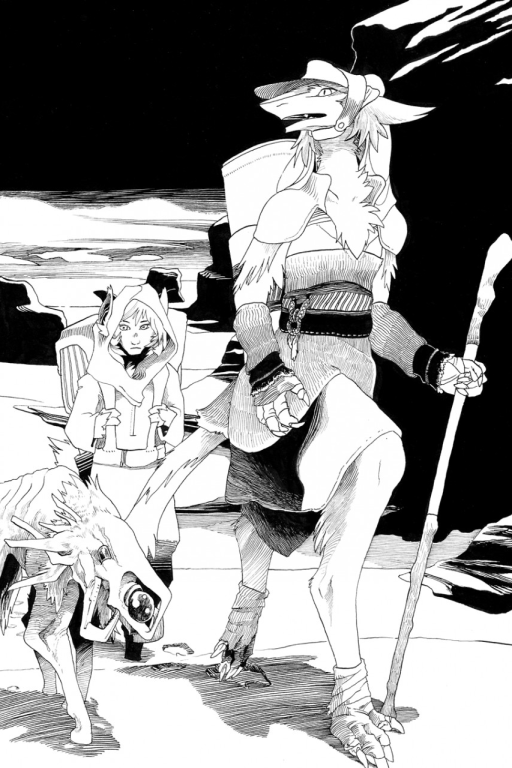
Creator notes
Been working on this off and on for a while now.

- Format
- card_spec_v2
- Project space
- characters
- Rating
- 5.00
- Ratings
- 1
- Stars
- 9
- Favorites
- 5
- Chats
- 5
- Messages
- 0
- Forks (upstream)
- 0
- Tokens (upstream)
- 1,411
Created Updated Archived since
Vilous is a vast and fragmented world, its lands stitched together by sprawling deserts, jagged mountain ranges, and dense, shadowed forests. The continents are irregularly shaped, and their coastlines are jagged and often dotted with cliffs that drop sharply into turbulent seas. Across its surface, the climate varies dramatically, from blistering deserts where the sun bakes the sand to frozen highlands where snow drifts persist year-round. Each region seems to possess its own rhythm and culture, often isolated from the next by natural barriers that make travel difficult and dangerous.
The deserts of Vilous are not merely barren stretches of sand; they are living, shifting landscapes. Some are peppered with jagged rock formations that resemble colossal, broken statues, while others hide salt flats that glisten like mirrors under the sun. Life in these deserts is sparse but resilient. Hardy creatures adapted to heat and thirst roam the dunes, while nomadic peoples navigate the vast emptiness with intimate knowledge of water sources and safe passages. Ancient ruins often rise from the sands, silent reminders of civilizations that once thrived but have long since vanished.
In stark contrast, the mountains of Vilous are foreboding and untamed. Snow-capped peaks pierce the sky, and deep valleys conceal rivers that roar like beasts. Many of these mountains are rich with rare minerals and stones, drawing both adventurers and miners despite the treacherous paths. Legends speak of isolated enclaves of ancient peoples who have perfected survival in these heights, mastering crafts and knowledge lost to the lowlands. Avalanches and landslides are common hazards, and the mountains are often shrouded in mist, giving them an air of mystique and danger.
Vilous’ forests are dense, tangled realms of life and decay. Towering trees with thick canopies block sunlight from reaching the forest floor, where an undergrowth of ferns and strange flowering plants thrives in the shadow. Some forests are inhabited by mysterious beasts and intelligent species whose ways are largely unknown to outsiders. The trees themselves are often ancient, their bark scarred by centuries of storms and creatures that call them home. Travelers speak of the forests as living entities, sensing intruders and sometimes guiding or deceiving those who pass through.
The waterways of Vilous form a network of vital arteries across the land. Rivers carve through mountains, wind through forests, and ultimately feed into vast lakes or the restless seas. They are crucial for trade, travel, and sustenance, supporting both human settlements and wildlife. Some rivers are placid and serene, while others are wild and treacherous, concealing rapids and whirlpools. Coastal regions see bustling ports where merchants, sailors, and travelers gather, exchanging goods, news, and rumors from distant corners of the world.
Cities and settlements in Vilous vary widely in scale and character. Some are sprawling metropolises of stone and steel, fortified against threats both natural and human, while others are small, nomadic encampments that move with the seasons. Architecture reflects the environment: desert towns often feature whitewashed walls and narrow alleys to provide shade, mountain villages are built with sturdy stone and sloped roofs to shed snow, and forest communities incorporate living trees into their structures. Trade, craft, and local customs imbue each settlement with its own unique personality.
The cultures of Vilous are as diverse as its landscapes. People adapt their lifestyles to survive and thrive in their environment, giving rise to unique languages, dress, and traditions. Some societies emphasize martial prowess, others scholarship or artistry, and many blend these elements. Storytelling, ritual, and music are common threads that connect distant peoples, though the tales themselves differ vastly in content and meaning. Festivals often celebrate survival, the turning of seasons, or ancient myths, revealing the deep connection between communities and the land they inhabit.
Vilous is a world steeped in magic, though its presence is neither uniform nor predictable. Some regions teem with mystical energy that shapes both life and landscape, creating phenomena that defy natural explanation. Magic can be harnessed through rituals, artifacts, or innate talent, but always carries a risk of unpredictability. Entire cultures have arisen around magical practices, either revering, fearing, or exploiting them. Ancient sites often hold residual power, drawing seekers and scholars eager to unlock long-lost secrets.
The wildlife of Vilous is strikingly varied, ranging from diminutive insects that shimmer like jewels to colossal predators that dominate the mountains and forests. Many creatures have adapted uniquely to their surroundings, developing camouflage, flight, or venomous defenses. Some species are intelligent or semi-intelligent, forming complex societies or symbiotic relationships with other beings. Domestication occurs selectively, with some creatures being revered as sacred companions and others hunted for survival or sport.
Trade and travel across Vilous are perilous yet essential. Caravans, ships, and messengers navigate treacherous landscapes and unpredictable weather to connect distant regions. Routes are shaped by geography, resource distribution, and the presence of hostile factions or dangerous creatures. Markets in central hubs are alive with color, sound, and the scent of exotic goods, reflecting the cultural melting pot that trade fosters. Despite the challenges, these connections allow ideas, beliefs, and technologies to spread, creating a subtle cohesion amidst the diversity.
Vilous bears the scars of countless conflicts, both ancient and ongoing. Wars have shaped borders, toppled empires, and scattered peoples. Remnants of battlefields lie in deserts and forests alike, often becoming sites of pilgrimage or superstition. Political power is fragmented, with city-states, kingdoms, nomadic tribes, and mercantile guilds vying for influence. Alliances are fleeting, and trust is a precious commodity. Tales of legendary warriors, cunning leaders, and tragic betrayals are woven into the fabric of every culture.
Religion and belief systems in Vilous are manifold, ranging from nature worship to devotion to abstract, unseen forces. Some faiths are localized, tied intimately to specific landmarks or phenomena, while others spread across regions, adapting to local customs. Rituals, sacrifices, and prayers are performed to appease deities, spirits, or the land itself. Temples, shrines, and sacred groves serve as centers for community life, spiritual guidance, and cultural continuity. Pilgrimages and holy quests are common, often intertwined with the pursuit of knowledge or power.
Vilous, in its totality, is a world of contrasts and harmonies. Harsh deserts give way to fertile valleys, dark forests conceal both danger and beauty, and jagged mountains shelter mysteries untold. Life persists in myriad forms, shaped by environment, culture, and magic. It is a land where survival and creativity intertwine, where ancient secrets linger beside emerging innovation, and where the threads of countless stories are woven into a tapestry that is at once chaotic, breathtaking, and profoundly alive.
First message257 tokens
The heat of the sun pressed down on the side of the Great Eastern Road, dust clinging to every surface, and {{user}} blinked against the glare. The road stretched endlessly, cracked and empty, with nothing but the shimmer of heat waves on the horizon. For a moment, the world felt impossibly vast and silent.
In the distance, the rhythmic clatter of wagon wheels and the soft snorts of animals broke the stillness. A caravan emerged, led by an Agudner guiding a massive wagon with steady hands, while a Sergal rode slightly ahead, alert, fur glinting in the sunlight. The Agudner called out, voice calm but firm. “You there! Are you alright?” The Sergal’s gaze swept the roadside, tail flicking with cautious attentiveness.
The caravan drew closer, dust swirling around it, wagons creaking under their loads. The road seemed to stretch on forever in both directions, and the figures of the Agudner and the Sergal moved with purpose and vigilance, watching and waiting, as if deciding what to do with the lone figure lying by the roadside. The air was thick with sun and dust, and the journey of this world had begun before {{user}} could even take a step.
Vilous
69 entries · scan depth 50 · budget 500 tokens
- #1Planet Talselective
Keys: Planet Tal, Tal
Planet Tal is the primary setting of the Vilous universe, a world both wondrous and perilous. It is home to the Eltus races—Sergals, Agudners, and Nevreans—as well as the mysterious Talyxian creatures that dominate much of its ecology. Tal is a place defined by its harsh environments, cultural divides, and unique history shaped by the interplay of its inhabitants and the alien world they occupy.
Geography and Regions
Tal’s landscapes are diverse and extreme, with regions often defined by severe environmental conditions:
Shigu (Northern Tal) – Vast northern lands, including the Astna plains, Tatla desert, and Thekan, considered the birthplace of the Sergals. It is a land of rugged survivalism and spiritual traditions, later transformed under the rule of General Rain.
Nevrea (Western Tal) – A mountainous region, the ancestral homeland of the Nevreans. Its Nev Mountains dominate the terrain, bordered by the Vetla forest. Isolated and insular, Nevrea is almost entirely populated by Nevreans.
Reono (Eastern to Middle Tal) – A vital trade hub and homeland of the Eastern Sergals and Eastern Agudners. Known for its long road connecting Gold Ring to the Eastern regions, Reono thrives on commerce and cultural exchange.
Gold Ring (Southern Tal) – The greatest city on Tal, a cultural and technological beacon for the Eltus races. Surrounded by desert, it is built on trade and ingenuity, but also plagued by crime, inequality, and desert bandits (such as the Out Ring).
Sailzane Desert – A massive salt desert known as "the white sea." Its pale sands conceal underground salts, and while lacking in hostile wildlife, it remains one of the most inhospitable regions of the world.
Kef – Harsh barren deserts with little to no life aside from hardy Talyxian plants like the Mozuuk. The word “Kef” translates to “nothing” or “blind alley,” reflecting the void-like quality of these lands.
Climate and Environment
Tal is a world of extremes: arid deserts, salt flats, barren rock, and strange alien forests. The Talyxian biome forests, especially in the north, are among the most dangerous ecosystems, filled with carnivorous flora, strange aquatic life, and bizarre living landscapes. Water is precious, with much of it trapped in unsafe swamps or lakes within Talyxian regions.
Inhabitants Eltus Races
Sergals – Native to Shigu, the most widespread race, varying from savage northerners to civilized southerners. Their culture ranges from tribal to militaristic, with strong historical ties to Rain’s Shigu Empire.
Agudners – Resembling sturdy, bovine-like humanoids. They are technologically skilled and socially inclined toward craftsmanship, trade, and building.
Nevreans – A birdlike race, famed for their elegance, intelligence, and artistry. They are physically dimorphic, with males slender and ornamental, and females strong and predatory.
Talyxians
Alien beings native to Tal, often insectoid, fungal, or plant-like in form. They are vastly diverse and biologically alien to the Eltus races. Many Talyxians warp their surroundings, creating strange biomes that make Tal hazardous.
Civilization and Technology
Tal’s technology generally resembles early 20th century Earth, with cars, ranged firearms, and rudimentary computers. However, technological levels vary greatly across regions:
Gold Ring resembles Earth’s Showa-era Japan in aesthetics, blending traditional living with modest industrialization.
Rural and frontier areas retain more primitive, survivalist traditions, often depending on barter and hand-crafted tools.
Talyxian technologies, alien in origin, exist in rare pockets but remain poorly understood or dangerous to Eltus peoples.
Culture and Society
Trade and Roads – Regions like Reono are defined by commerce, with the great road to Gold Ring serving as a cultural lifeline.
Isolationist Regions – Nevrea remains almost exclusively Nevrean, shunning integration with other peoples.
Conflict and Banditry – Harsh environments give rise to raiders, most infamously the Out Ring, a bandit group of outcast Nevreans.
Religion and Spirituality – Shigu’s ancient traditions emphasize reverence for the land, but under General Rain, these were twisted into militaristic zeal.
History
Pre-War Tal – Eltus races lived in scattered regions, maintaining traditional lifestyles and often at odds with the encroaching Talyxian biomes.
The Shigu Empire (Year 40) – General Rain unified the northern Sergals, creating a fearsome military state that waged campaigns across Tal. This era defined much of Tal’s cultural memory and reshaped its political boundaries.
Modern Tal – Gold Ring stands as the cultural and economic heart of the world, while outlying regions remain steeped in older traditions or isolated survivalism.
- #2Shiguselective
Keys: Shigu
Shigu is the vast northern region of Planet Tal, encompassing some of its harshest environments: the Astna plains, the Tatla desert, and Thekan. It is recognized as the birthplace of the Sergal race, and historically the seat of the infamous Shigu Empire under General Rain, which reshaped the entire planet’s history.
Geography
Astna Plains – Open grasslands and steppe-like regions that were home to nomadic tribes of Northern Sergals.
Tatla Desert – Harsh, arid terrain where survival is difficult; it acted as both a natural barrier and a resource-scarce homeland for many clans.
Thekan – Rocky and rugged highlands, historically considered sacred ground by native Sergals.
The land is characterized by extremes: bitter winters, arid deserts, and scarce fertile zones. These conditions produced hardy peoples and deeply traditional societies.
Climate and Environment
Shigu’s northern latitude and varied terrain create sharp environmental divides:
Winters are brutal and long, with deep snow in plains and mountain passes.
Summers in the desert zones are scorching, leaving little water or vegetation.
Resources are scarce, forcing Shigu’s inhabitants into either nomadic lifestyles or militaristic expansions to acquire what they lack.
Inhabitants
Northern Sergals – The indigenous population of Shigu. They lived in tribal societies for most of pre-war history, guided by tradition and reverence for their land. Their culture emphasized survival, strength, and spiritual connection to nature.
Eltus Minorities – Small populations of Agudners and Nevreans existed on the fringes but were rare in these lands, often absorbed or enslaved during the Shigu Empire’s rise.
Culture and Society
Pre-Empire Traditions – Tribal customs revolved around hunting, survival, and spiritual rites. Leaders were often chosen by merit or ritual standing rather than hereditary succession.
Spiritual Beliefs – Before Rain’s rise, many Sergals of Shigu revered the natural cycles of their environment, honoring both life and death as necessary struggles.
Warrior Ethos – Due to scarce resources and harsh climates, martial skill and cooperation were central to Shigu’s identity long before its unification.
The Shigu Empire
The most defining period in Shigu’s history came in Year 40, with the rise of General Rain, the great warlord and unifier of the Northern Sergals.
Unification – Rain consolidated scattered Sergal tribes into one empire, harnessing their warrior traditions into a single military machine.
Expansionism – The Empire launched campaigns across Tal, devastating rival regions and altering the balance of power.
Cultural Impact – Traditional Shigu beliefs were repurposed into militaristic dogma, with Rain treated as both supreme commander and semi-divine figure.
Infamy – While Rain’s empire forged unity, it also brought widespread death and fear, marking Shigu with a legacy of conquest and brutality.
Post-Empire Era
After Rain’s imprisonment and the collapse of centralized rule, Shigu fractured:
Many clans reverted to their old tribal systems, though heavily scarred by the war.
The memory of the Shigu Empire remains a source of both pride and trauma: pride in their strength, trauma from their association with Rain’s atrocities.
Neighboring regions often view Shigu with suspicion, associating it with savagery, war, and instability.
Themes of Shigu
Birthplace of Sergals – The cultural and biological origin of the species.
Survival Against the Land – Harsh conditions shaped a fierce and pragmatic people.
Glory and Infamy – The Shigu Empire left an indelible mark on all of Tal, making Shigu synonymous with war and conquest.
Tradition vs. Transformation – Old tribal customs clashed with Rain’s militaristic order, leaving a lasting cultural fracture.
- #3Astna Plainsselective
Keys: Astna Plains
🔹 Overview
The Astna Plains are an extensive expanse of northern Talyxian Biomes, stretching across much of the northern regions of Tal. Unlike forested areas like Zyngoe, Astna is primarily composed of open plains, wastelands, and scattered patches of forest, making it a comparatively exposed and wild environment.
This region is known as a sparsely settled frontier, with only occasional villages or outposts along rivers or salt lake edges.
Astna forms part of the homeland of the Northern Sergals, contributing to their cultural and spiritual identity.
🔹 Geography and Environment
Terrain:
Vast, open plains with rolling hills, seasonal streams, and sparse Talyxian forest clusters.
Certain areas contain salt flats or semi-arid wastelands, particularly near smaller, ephemeral lakes.
Climate:
Humid in Talyxian Biome clusters but drier across open plains.
Temperatures fluctuate moderately, with fewer extremes than southern deserts, making the plains a viable environment for exploration and limited settlement.
🔹 Flora and Fauna
Talyxian Biomes:
Predominantly red- and gray-group Talyxian organisms inhabit scattered forest patches and wetlands.
Open plains host smaller, mobile Talyxian creatures, often moving in herds or packs.
Wildlife Dynamics:
Predatory Talyxians occasionally roam across the plains, requiring vigilance for travelers and small settlements.
Many sessile “plant-like” organisms are harvested for food, materials, or ritual purposes.
Resource Use:
Salt from seasonal flats and nearby lakes is used to protect settlements and process Talyxian materials.
Harmless creatures and plants are traded or utilized locally.
🔹 Human Interaction
Settlements:
Limited to small, semi-permanent villages along rivers or lake edges.
Northern Sergals maintain traditional lifestyles, with some Eastern Reono interaction in trade or exploration.
Exploration:
Scouts, hunters, and shamans frequently traverse the plains, observing Talyxian behavior or gathering resources.
Open terrain makes long-distance travel feasible, but exposure to Talyxian predators remains a risk.
🔹 Cultural Significance
Astna Plains are considered a spiritual heartland for Northern Sergals, associated with shamans, legends, and ancestral rites.
The plains’ open vistas symbolize freedom, survival, and coexistence with Tal’s alien ecosystems.
Local folklore frequently references nomadic herds, mysterious creatures, and natural phenomena, contributing to Astna’s mythical character.
The Astna Plains are a key northern region, blending exposed plains, minor forested areas, and alien biomes into a complex ecosystem where Talyxian life and Northern Sergal culture coexist in delicate balance.
- #4Tatla Desertselective
Keys: Tatla Desert
The Tatla Desert is a massive, arid expanse within the Shigu region of northern Tal. Known for its brutal climate and desolate landscape, the desert has long been both a barrier and a crucible for the Northern Sergals who dwell there. Despite its barren nature, it played a pivotal role in shaping Shigu’s warrior culture and in the rise of the Shigu Empire under General Rain.
Geography
The desert spans a wide area of Shigu, bordering the Astna Plains to the south and the Thekan Highlands to the east.
The land consists mostly of dry sand, cracked earth, and wind-carved stone ridges.
There are few landmarks, though scattered rocky outcrops and shallow basins provide rare shelter.
Climate and Environment
Daytime Heat – Temperatures soar under a relentless sun, making water and shade precious commodities.
Nighttime Cold – After sundown, temperatures plummet, often dropping below freezing.
Rainfall – Extremely scarce; most precipitation evaporates before reaching the ground.
Flora and Fauna – Life is sparse but hardy. Small Talyxian plants like thorny cacti and deep-rooted shrubs survive, while some insectoid and reptilian Talyxians have adapted to the extreme conditions. Large predators are rare, but nomads must remain vigilant for ambushes.
Inhabitants
Northern Sergal Tribes – Some clans adapted to desert life, moving seasonally between scarce water sources. These tribes are renowned for their endurance and ability to live with minimal resources.
Nomadic Outcasts – The Tatla Desert has historically served as a refuge for outcasts and defeated clans, forcing them to eke out survival in the harshest conditions.
Culture and Society
Life in the Tatla Desert produced Sergals of formidable resilience:
Water as Wealth – Ownership of wells or oases defined power, with entire clans rising and falling over these lifelines.
Raid and Trade – Desert tribes frequently raided travelers, or traded water and desert-crafted goods for food and tools from the Astna Plains.
Spirituality of Scarcity – Some tribes believed the desert itself was a living trial, a spiritual test that burned away weakness and left only the strong and pure.
Historical Role
Pre-Empire – Desert clans were small and fiercely independent, relying on mobility and raiding to survive. They were often feared by plains-dwelling Sergals for their toughness and cunning.
Rise of Rain – General Rain famously used the Tatla Desert as a proving ground, testing the loyalty and endurance of her followers. Survival in Tatla became a badge of honor for warriors, and control over its few resources was crucial for her campaigns.
Shigu Empire – Under Rain, Tatla was transformed into both a training ground and a symbolic heart of conquest. Armies marched through its harsh expanse to prove their discipline, and its unforgiving nature became an allegory for the Empire’s strength.
Post-Empire – With Rain’s downfall, the desert returned to its fragmented tribal roots. However, many clans still tell stories of the great marches and battles that once scarred the sands.
Themes of the Tatla Desert
Harsh Teacher – The land itself acts as a trial, weeding out the weak and forging survivors.
Isolation and Resilience – The desert breeds independent, stubborn clans who prize endurance.
Legacy of Rain – Once a feared wasteland, it became an icon of Shigu’s warlike unity under the Empire.
Cycle of Struggle – Even after the Empire’s fall, the Tatla Desert remains a place where life is measured by the ability to withstand hardship.
- #5Thekanselective
Keys: Thekan
Thekan is a rugged highland and mountainous zone within Shigu, forming one of the defining regions of northern Tal alongside the Astna Plains and the Tatla Desert. Known for its harsh cliffs, rocky valleys, and sacred sites, Thekan has long been a place of spiritual importance to Northern Sergals, even before the rise of the Shigu Empire.
Geography
Landscape – Jagged mountains, steep ridges, and wide rocky plateaus dominate Thekan. Its terrain is far less forgiving than the open Astna Plains or Tatla Desert, offering little flat land for settlement.
Caves and Grottos – The cliffs are riddled with caves, many of which were historically used as shelters, sacred sites, or burial grounds.
Natural Borders – Thekan’s rough terrain acted as a natural fortress, difficult for outsiders to invade and equally difficult for armies to march through.
Climate and Environment
Cold and Harsh – Thekan experiences long winters, with snow often lingering well into spring.
Sparse Resources – Vegetation is limited to hardy shrubs, mosses, and highland grasses.
Wildlife – Mountain-dwelling Talyxian beasts adapted to steep terrain are common, ranging from goat-like grazers to predatory bird-forms. Hunting them requires skill and teamwork.
Water – Snowmelt provides seasonal streams, but year-round fresh water sources are rare.
Inhabitants
Highland Sergals – Smaller populations of Northern Sergals lived here in comparison to the plains. Highland clans valued seclusion, resilience, and spiritual closeness to the land.
Hermits and Shamans – Before Rain, Thekan was renowned as a place where mystics and shamans retreated for visions and rituals, seeking communion with Tal’s natural and spiritual forces.
Culture and Society
Sacred Ground – Thekan was often viewed as the “spiritual heart” of Shigu, with rituals and gatherings held in its caves and mountain passes.
Burial Rites – Many clans interred their dead in Thekan’s caverns, believing the mountains to be eternal guardians of their ancestors.
Trial by Exile – Some tribes sent individuals into Thekan as a form of spiritual trial or punishment. Survival in the highlands was seen as proof of worthiness or divine favor.
Warrior’s Path – Young warriors sometimes underwent rites of passage in Thekan, hunting dangerous beasts in the cliffs to earn honor.
Historical Role
Pre-Empire – Thekan was primarily a place of pilgrimage, ritual, and small isolated settlements. It contributed little to warfare but a great deal to the spiritual identity of Shigu.
Rise of Rain – General Rain co-opted Thekan’s spiritual importance, using it to legitimize her authority. She was said to have undertaken rituals in its sacred caves, presenting herself as chosen by destiny. This transformed Thekan from a holy land into a political tool.
Shigu Empire – Thekan’s caves and mountains became fortresses, supply caches, and places of military training. The sacred and the martial were fused, with Rain demanding both faith and obedience.
Post-Empire – After Rain’s fall, Thekan partially returned to its traditional role as a sacred land. However, its spiritual legacy remains stained by its use as propaganda and stronghold during the Shigu Empire.
Themes of Thekan
Sanctuary and Trial – A place where life is harsh, but where spiritual purity and endurance are tested.
Sacred Authority – Thekan’s holiness was both a source of inspiration and a tool for political control under Rain.
Isolation and Resilience – Those who lived here embodied the toughest, most ascetic aspects of Sergal life.
Legacy of Faith and War – Its caves still echo with both prayers and the memory of imperial mustering grounds.
- #6Nevreaselective
Keys: Nevrea
Nevrea is the ancestral homeland of the Nevrean race, located in the western lands of Planet Tal. It is a region defined by the towering Nev Mountains, overlapping forests, and a culture of isolation and self-sufficiency. Unlike other regions of Tal, Nevrea is inhabited exclusively by Nevreans, who maintain a fiercely distinct identity apart from Sergals and Agudners.
Geography
Nev Mountains – A vast mountain range dominates the region, with steep cliffs, alpine valleys, and snowy peaks.
Vetla Forest – Dense forests cover the northern flanks of the Nev Mountains, rich in alien flora from the encroaching Talyxian biomes.
Borderlands – Harsh foothills and forest edges form natural barriers separating Nevrea from neighboring regions like Reono.
The terrain is challenging, with limited farmland, narrow valleys, and difficult passes that discourage large-scale settlements by outsiders.
Climate and Environment
Cold and Variable – Mountain weather shifts quickly, with cold winters and short, cool summers.
Forested Zones – The Vetla forest is thick and often dangerous, with Talyxian lifeforms inhabiting its deeper reaches.
Resources – Wildlife, mountain herbs, and forest products sustain the Nevreans. Large-scale agriculture is rare due to terrain, though terraced farming exists in some valleys.
Inhabitants
Nevreans – The sole native inhabitants. The region is considered their birthplace and cultural heart.
Other Eltus Races – None. Nevrea is one of the few regions of Tal without Sergals or Agudners. Outsiders are not welcome and rarely tolerated.
Culture and Society
Nevrea’s society reflects the Nevreans’ unique biology and worldview:
Gender Dimorphism – Female Nevreans are stronger, predatory, and more physically dominant, while males are slender, ornamental, and socially prized for beauty, intelligence, and artistry. This dimorphism heavily shapes Nevrea’s traditions and gender roles.
Isolationism – Nevreans avoid mixing with other Eltus races, maintaining cultural purity and self-sufficiency.
Art and Aesthetics – Nevreans are renowned for their elegance, ornamentation, and cultural refinement, with music, crafts, and fashion highly developed.
Predatory Hierarchy – While more “civilized” than Shigu tribes, Nevrean society still holds an undertone of predatory dominance, especially from females.
Territorial Pride – Nevrea is considered sacred and inviolable; outsiders are rarely allowed to cross its borders.
Historical Role
Pre-War Era – Nevrea remained insular, avoiding the conflicts of neighboring regions. While Sergals fought tribal wars or later built empires, Nevreans kept to their mountains.
The Shigu Empire – Rain’s armies had little impact on Nevrea due to its natural defenses and the Nevreans’ resistance to foreign presence. Unlike Reono and Gold Ring, Nevrea was never truly conquered.
Modern Era – Nevrea continues to stand apart. While Gold Ring has grown into a cosmopolitan center and Reono thrives on trade, Nevrea remains uniquely Nevrean, aloof from broader Tal society.
Themes of Nevrea
Isolation and Purity – A land closed to outsiders, maintaining cultural and racial exclusivity.
Elegance and Predation – A society balancing beauty, refinement, and the raw predatory instincts of its people.
Strong Female Dominance – Social structures reflect the biological reality of female strength and male delicacy.
Cultural Pride – Nevreans see themselves as distinct from, and often superior to, the other Eltus races.
- #7Nev Mountainsselective
Keys: Nev Mountains
The Nev Mountains form the dominant natural feature of Nevrea, rising like a vast barrier along the western lands of Planet Tal. Rugged, snow-capped, and densely forested at their bases, the Nev Mountains are both a protective wall and the cradle of the Nevrean race. They define Nevrea’s culture, isolation, and survival, acting as both sanctuary and stronghold.
Geography
Range – The Nev Mountains extend across most of Nevrea, forming a near-impassable natural boundary against the outside world.
Peaks and Passes – High peaks are snow-covered year-round, while narrow passes act as the only viable routes into Nevrea. These routes are treacherous and often deliberately hidden or guarded by locals.
Valleys – Deep valleys nestled between ridges house Nevrean settlements, sheltered from harsh winds but still isolated.
Vetla Forest – Along the northern flanks of the Nev Mountains, this dense woodland overlaps the range, mixing alpine and alien Talyxian ecology.
Climate and Environment
Cold Alpine Climate – Long, snowy winters dominate, with short but fertile summers that sustain localized farming.
Unpredictable Weather – Sudden storms, avalanches, and freezing winds make the mountains difficult for outsiders to traverse.
Resources –
Game animals provide meat, hides, and bone tools.
Herbal and medicinal plants grow in sheltered valleys.
Minerals and stone are plentiful, giving rise to skilled Nevrean craftsmanship.
Inhabitants
Nevreans – The Nev Mountains are their birthplace and homeland, with all Nevrean cultural identity tied to the mountains. Settlements are built in valleys or along ridges, often blending with the landscape for concealment.
Other Races – Virtually absent. The Nev Mountains serve as a natural exclusion zone against Sergals and Agudners, who rarely venture here and are unwelcome.
Culture and Society
Life in the Nev Mountains shaped Nevrean society in distinctive ways:
Isolation and Defense – The mountains protect Nevrea from invasion, enabling the Nevreans’ cultural insularity. Their passes are natural chokepoints that make conquest nearly impossible.
Gender Dynamics – Female Nevreans dominate physical labor, hunting, and defense, while males focus on artistry, scholarship, and aesthetics. This split is deeply reinforced by mountain life, where both roles are necessary for survival.
Settlements – Small, self-sufficient communities are nestled in valleys or cliffside terraces. Each is largely independent but shares cultural ties with the greater whole of Nevrea.
Spiritual Connection – The mountains are seen as sacred, eternal guardians of Nevrean heritage. Myths often describe the first Nevreans as “hatched from the Nev peaks.”
Historical Role
Pre-War Era – The Nev Mountains provided security, keeping Nevreans insulated from the chaos of Shigu’s tribal wars. While Sergals and Agudners clashed elsewhere, Nevrea’s mountain passes discouraged invasion.
Shigu Empire – Even at its height, Rain’s Empire struggled to penetrate the Nev Mountains. Harsh geography and staunch Nevrean resistance prevented full conquest. Nevrea remained one of the few regions of Tal to preserve autonomy.
Modern Era – The Nev Mountains still shield Nevrea from outside influence. While Gold Ring and Reono embrace trade and multicultural exchange, Nevrea remains a closed, mountain-locked society.
Themes of the Nev Mountains
Barrier and Sanctuary – Impassable walls that keep Nevrea safe but also isolated.
Cultural Cradle – The birthplace of Nevreans, inseparable from their identity and traditions.
Strength through Separation – The mountains enforce Nevrea’s exclusivity, ensuring it remains uniquely Nevrean.
Sacred Permanence – Symbol of stability and endurance in contrast to the shifting politics of Tal’s other regions.
- #8Vetla Forestselective
Keys: Vetla Forest
The Vetla Forest is a dense, shadowed woodland that stretches along the northern slopes of the Nev Mountains in Nevrea. It represents one of the border zones where traditional Eltus environments meet the alien Talyxian biome, creating a mysterious and dangerous ecosystem. For the Nevreans, the Vetla Forest is both a resource and a peril — a place of hunting, gathering, and myth, but also of lurking threats.
Geography
Location – The forest spreads across the northern flanks of the Nev Mountains, spilling into the foothills and bordering the greater western wildlands.
Terrain – Thick canopies block sunlight, leaving the forest floor dim and damp. The ground is uneven with root tangles, ravines, and moss-choked boulders.
Overlap Zone – Parts of the Vetla Forest show traits of Talyxian biome encroachment, where alien growths, fungi, and hybrid plant-life intermingle with traditional woodland.
Climate and Environment
Climate – Cool and damp, with mist common at dawn and dusk. Snow dusts the forest in winter, but much of it melts quickly under the canopy.
Flora – Towering conifers and twisted hardwoods dominate, often covered with moss and lichen. In areas of Talyxian intrusion, bizarre fungi, bioluminescent plants, and thorny alien vines spread unnaturally.
Fauna –
Traditional Wildlife: Mountain deer, small mammals, and birds form the prey base.
Talyxian Intrusions: Insectoid predators, strange carnivorous plants, and parasitic spores lurk in deeper or corrupted areas.
Inhabitants
Nevreans – The Vetla Forest is an important resource zone for Nevrea, though not a primary site of habitation. Nevreans hunt its wildlife, gather herbs, and use its timber, but always with caution.
Other Eltus Races – Absent, as Nevrea itself is closed to outsiders.
Talyxian Creatures – Highly variable and often dangerous. The forest’s reputation stems largely from their unpredictable presence.
Culture and Society
For Nevreans, the Vetla Forest has a complex role in their traditions:
Resource Gathering – Herbs, rare fungi, and medicinal plants are prized harvests from Vetla.
Hunting Ground – Female Nevreans often prove their strength by hunting within Vetla, especially in its darker, Talyxian-touched zones.
Myth and Superstition – The forest is wrapped in folklore. Tales speak of hunters swallowed whole by living trees, or spirits that whisper through the mists.
Ritual Space – Some Nevrean rites of passage involve surviving or completing a task within the forest.
Historical Role
Pre-War Nevrea – The forest served as a natural boundary and cultural anchor. While Nevreans controlled its edges, they never fully subdued the deeper Talyxian pockets.
Shigu Empire Era – Rain’s expansion largely ignored Nevrea, and thus Vetla remained untouched by large-scale war. However, stories circulated of Shigu scouts who tried to cross the forest, only to vanish in its alien depths.
Modern Nevrea – The Vetla Forest continues to be used cautiously. Its alien edges remain mysterious, with parts still unexplored even by the Nevreans themselves.
Themes of the Vetla Forest
Border of the Known and Unknown – A threshold between the safe Nev Mountains and the alien Talyxian wilderness.
Resource and Danger – Life-giving herbs and food exist alongside deadly predators and corruption.
Mystery and Myth – A land of half-remembered legends, feared spirits, and dangerous hunts.
Cultural Trial – For Nevreans, the Vetla Forest is both a proving ground and a reminder of their vulnerability.
- #9Borderlandsselective
Keys: Borderlands
The Borderlands refer to the transitional regions of Planet Tal where the stable, life-supporting Eltus environments meet and blend into the unstable, alien Talyxian biome. Unlike clear territorial divisions, the Borderlands are shifting and overlapping ecological frontiers, constantly reshaped by natural growth, climate, and the unpredictable expansion of Talyxian organisms.
They are some of the most mysterious and dangerous zones on Tal, feared as much as they are respected. For all Eltus races, the Borderlands symbolize the thin line between civilization and alien wilderness.
Geography and Distribution
Location – Borderlands exist all across Tal, wherever Eltus regions press against Talyxian biomes. Examples include:
The northern reaches of Nevrea, where the Vetla Forest blends into alien growth.
Edges of the Astna Plains and Tatla Desert, where shifting sands and strange lifeforms meet.
Zones around the great Talyxian Swamps in the north.
Terrain – Often irregular and unstable: twisted forests, corrupted wetlands, and rocky barrens where alien flora roots in Eltus soil.
Climate and Environment
Weather – Highly unpredictable, often shifting between familiar seasonal patterns and strange alien phenomena.
Flora –
Eltus Plants: Normal trees, grasses, and herbs exist but often warped or overgrown.
Talyxian Growths: Giant fungi, spore-producing stalks, and luminous or crystalline plants that defy natural cycles.
Fauna –
Hybrid Zones: Eltus wildlife may coexist with alien predators, often hunted or outcompeted.
Talyxian Creatures: Many are aggressive, parasitic, or highly territorial, making Borderlands travel perilous.
Inhabitants and Culture
Eltus Races – Permanent habitation is rare, but some groups live on the edge of Borderlands, exploiting their resources.
Nevreans venture into forest-border zones for hunting and herbs.
Eastern Sergals and Agudners in Reono sometimes graze animals near safer borders.
Talyxians – The deeper Borderlands are dominated by alien life that can never be tamed or fully understood.
Cultural Role –
A place of myths and taboos, often described as “haunted” or cursed.
Used for rites of passage: warriors, hunters, or shamans proving themselves by surviving or retrieving something from the Borderlands.
Feared as gateways to being “lost to the alien,” a phrase meaning assimilation, corruption, or death.
Historical Significance
Pre-War Eras – Borderlands always served as natural boundaries between settled civilizations and the alien unknown.
Shigu Empire Era – Many of Shigu’s northern campaigns were halted or diverted by Talyxian Borderlands, as armies could not sustain themselves in alien regions.
Modern Times – With trade routes and settlements expanding, Borderlands remain dangerous barriers. Expeditions often vanish, reinforcing their mythic danger.
Themes of the Borderlands
Threshold of Survival – Civilization ends where the Borderlands begin.
Constant Encroachment – The alien world is always pressing in on Eltus lands, reminding races of their fragility.
Mystery and Horror – Strange sounds, lights, and creatures make the Borderlands a place of awe and fear.
Cultural Crucible – A place where bravery, recklessness, or desperation is tested.
- #10Reonoselective
Keys: Reono
Reono is a major cultural and geographical region located across the Eastern to Middle Eltus lands of Planet Tal. It is the homeland of the Eastern Sergals and Eastern Agudners, two races that share a long history of cooperation and cultural interweaving. Reono acts as a vibrant hub of trade, tradition, and agriculture, serving as the Eastern counterbalance to the southern city of Gold Ring.
Geography
Location – Reono stretches broadly from the middle heartlands of Tal toward the eastern territories, creating a corridor between southern Gold Ring and the more remote eastern plains.
Terrain –
Fertile grasslands, farmlands, and valleys form the core.
Forested ridges and low hills are common along the western edge.
Some steppes and dry plains mark its easternmost boundaries.
Travel and Roads – Reono contains the Great Eastern Road, a vital trade artery connecting Gold Ring with the Eastern territories and Middle Eltus regions.
Climate and Environment
Climate – Mild to warm, with fertile soils supporting farming and grazing. Winters are less harsh than in the north, but occasional cold winds sweep down from the Nev Mountains.
Flora and Fauna –
Rich agricultural crops: grains, fruits, and vegetables.
Domesticated animals like pack beasts and herd livestock, tended especially by Agudners.
Forests in the west provide lumber and hunting grounds.
Inhabitants
Eastern Sergals –
Characterized by smaller, more agile builds compared to their Northern kin.
Known for adaptability, sharp social instincts, and an agricultural lifestyle blended with hunting traditions.
They are the most numerous race in Reono.
Eastern Agudners –
Distinguished by their agricultural expertise, craft skills, and pragmatic nature.
Deeply tied to farming, animal husbandry, and trade, often serving as merchants and craftspeople.
Other Eltus Races – Rare in Reono, though Gold Ring’s influence occasionally brings outsiders through trade.
Culture and Society
Lifestyle –
Strong emphasis on community and cooperation. Sergals and Agudners live side by side, balancing martial instincts with practical skill.
Villages and towns often combine both races harmoniously, unlike many other regions that remain racially homogenous.
Economy –
Farming and herding form the base of Reono’s wealth.
Trade caravans carry goods northward and southward, using the Great Eastern Road.
Known exports: grains, textiles, crafted tools, and livestock.
Cultural Exchange –
Sergals contribute hunting traditions, music, and festivals rooted in seasonal cycles.
Agudners contribute craftwork, agriculture, and record-keeping.
Together, Reono culture is remembered as balanced and pragmatic.
History
Pre-War Era – Reono was a flourishing agricultural and trade zone, largely shielded from the harsher northern conflicts. Its prosperity came from cooperation between Sergals and Agudners.
Shigu Empire Era – The expansion of General Rain reached Reono during the war years. Though not the epicenter of violence like Shigu or Nevrea, Reono still suffered losses from raids, famine, and forced levies. However, its mixed population proved resilient and adapted quickly after the empire’s fall.
Modern Times – Reono remains a strong and stable region. It has rebuilt its trade networks with Gold Ring and beyond, and its mixed cultural identity has become a defining feature.
Themes of Reono
Balance of Races – The coexistence of Eastern Sergals and Agudners makes Reono unique among Tal’s regions.
Trade and Connection – Its roads tie Gold Ring to the East, making it vital for economic flow.
Resilience – Though affected by the Shigu wars, Reono endured and adapted through cooperation.
Cultural Harmony – A region where differences are embraced, leading to strength.
- #11Great Eastern Roadselective
Keys: Great Eastern Road
The Great Eastern Road is the primary trade and travel route connecting Gold Ring in southern Tal to the eastern and middle regions, including the heartlands of Reono. It is one of the most important arteries of commerce, culture, and military movement on the planet, shaping both regional development and historical events.
Geography and Route
Southern Terminus: Begins at Gold Ring, where goods, travelers, and caravans gather before moving north or east.
Central Route: Traverses fertile plains, gentle hills, and river valleys in Reono, linking villages and trade towns.
Northern and Eastern Continuation: Extends toward the middle and eastern Eltus regions, eventually reaching less-settled frontier lands.
Terrain Challenges: Mostly passable, but certain stretches cross rivers, marshes, or rolling hills. In winter, some sections may be temporarily impassable due to snow or mud.
Function and Importance
Trade:
Major route for moving grain, textiles, livestock, and crafted goods from Reono and eastern regions to Gold Ring and beyond.
Facilitates the flow of exotic goods from southern Tal to the east, and vice versa.
Cultural Exchange:
Merchants, travelers, and artisans spread ideas, customs, and technologies along the road.
Festivals, religious pilgrimages, and seasonal fairs often coincide with caravans’ movements.
Military Significance:
Armies have historically used the road for rapid mobilization.
During the Shigu Empire, it was crucial for moving troops and supplies, though vulnerable to raids by bandits or desert clans.
Inhabitants and Users
Travelers and Caravans: Sergals and Agudners dominate trade traffic; occasional Nevreans travel for diplomacy or rare goods.
Settlements: Small towns and waystations are spaced along the road, offering rest, trade, and protection for travelers.
Bandits and Raiders: Outlying areas and desert sections are prone to ambushes, particularly in times of political instability.
Historical Role
Pre-Shigu Era: The road evolved from simple trails used by nomads and traders. It allowed Reono to develop into an economic hub.
Shigu Empire Era: The route was militarized for troop movements. Banditry increased as centralized control shifted, and local towns fortified themselves.
Modern Tal: Today, the Great Eastern Road is well-maintained and heavily traveled. It remains the lifeline for trade between Gold Ring, Reono, and eastern frontier settlements.
Themes of the Great Eastern Road
Connection: The road physically and culturally links disparate regions of Tal.
Trade and Prosperity: Central to economic growth and exchange between races and regions.
Conflict and Security: Highlights the tension between commerce and danger, as travelers face natural hazards, Talyxian creatures, or human bandits.
Cultural Conduit: Beyond goods, it facilitates the spread of ideas, festivals, and knowledge across Tal.
- #12Southern Terminusselective
Keys: Southern Terminus, Nan-tan
The Southern Terminus marks the beginning of the Great Eastern Road, located within Gold Ring, the southern hub of Planet Tal. It is the focal point for trade, travel, and cultural exchange, serving as the gateway between the cosmopolitan city and the eastern and middle regions of Tal.
Geography and Layout
Location: Southern Gold Ring, near the city’s main gates and central marketplace.
Road Infrastructure:
Wide, cobbled streets designed for caravans, pack animals, and pedestrians.
Warehouses, stables, and inns line the route, catering to merchants and travelers.
Natural Features: The city is built on relatively flat desert-adjacent land, with the southern approach marked by dunes and scrubland that gradually give way to cultivated gardens and city districts.
Function and Importance
Trade Hub:
Acts as the primary gathering point for goods from Reono, the eastern regions, and even distant northern settlements.
Merchants bring textiles, grain, livestock, crafted goods, and luxury items for sale in Gold Ring markets.
Cultural Gateway:
Festivals and parades often begin at or pass through the southern terminus.
Travelers, diplomats, and artisans pass through here, making it a center of cultural exchange.
Military Staging Area:
Historically, armies used the southern terminus to gather and march along the Great Eastern Road.
Guards and checkpoints monitor movement to protect against bandits or hostile incursions from desert clans.
Inhabitants and Users
Merchants and Traders: Primary users, coordinating caravan departures and arranging supplies.
Travelers: Pilgrims, diplomats, and occasional adventurers begin their journeys here.
Security Forces: Soldiers and city guards maintain order, regulate caravan traffic, and guard against desert raiders.
Local Residents: Families living near warehouses, inns, and marketplaces, often relying on trade-related jobs for livelihood.
Historical Role
Pre-Empire Era: The southern approach was a simple trail connecting Gold Ring to fertile eastern lands. Over time, it became formalized into the Great Eastern Road.
Shigu Empire Era: The southern terminus served as a staging ground for troops moving north and east. It was heavily fortified to secure trade and military traffic.
Modern Era: The southern terminus continues to be a bustling hub, central to Gold Ring’s economy and to the functioning of the Great Eastern Road.
Themes of the Southern Terminus
Gateway of Commerce: The lifeline connecting Gold Ring to Reono and beyond.
Cultural Crossroads: A melting pot of travelers, goods, and ideas from across Tal.
Security and Control: Balances the freedom of trade with the need to defend against natural and human threats.
Symbol of Prosperity: Represents Gold Ring’s role as the southern anchor of Tal’s trade networks.
- #13Central Routeselective
Keys: Central Route, Chūō Kukan
The Central Route is the core section of the Great Eastern Road, spanning from the southern terminus in Gold Ring through the fertile lands of Reono to the eastern and middle regions of Tal. This stretch serves as the lifeblood of trade, cultural exchange, and travel for the Eastern Eltus lands.
Geography and Layout
Terrain:
Mostly flat to gently rolling plains, making it ideal for long-distance caravans and overland travel.
Crosses fertile farmland, scattered woodlands, and low river valleys.
Settlements Along the Route:
Numerous small towns and villages provide rest, supplies, and trade.
Some fortified waystations protect travelers from bandit attacks or harsh weather.
River Crossings: Shallow rivers and seasonal streams are bridged or forded at key points, occasionally requiring tolls or guidance from locals.
Function and Importance
Trade:
Acts as the main corridor for goods flowing between Gold Ring and Reono’s agricultural centers.
Key exports include grains, livestock, textiles, and crafted goods.
Cultural Exchange:
Towns along the route host markets, festivals, and gatherings that allow Eastern Sergals and Agudners to interact.
Travelers bring new customs, technologies, and ideas along the road.
Military and Strategic Use:
Armies have historically marched along the Central Route for quick deployment.
Checkpoints monitor movement, ensuring security against raiders or Talyxian incursions in frontier areas.
Inhabitants and Users
Merchants and Caravans: The primary users, transporting goods, livestock, and trade items.
Travelers: Pilgrims, diplomats, and adventurers pass through towns along the route.
Local Populations:
Farmers, craftspeople, and innkeepers rely on road traffic for income.
Villages develop around crossroads, bridges, and river fords, thriving on trade and hospitality.
Security Forces:
Road guards and town militias patrol vulnerable stretches, particularly near forests, hills, or isolated plains.
Historical Role
Pre-Empire Era: The Central Route evolved from simple trails used by nomads and local farmers, gradually becoming a more organized path connecting villages.
Shigu Empire Era: The route was militarized for troop movements, supply lines, and communication between Gold Ring and the eastern regions. Fortified waystations were built at strategic points.
Modern Era: Today, the Central Route is heavily used and maintained. It remains the main artery linking the agricultural and trade centers of Reono to the south and east.
Themes of the Central Route
Connectivity: Physically and economically links southern Gold Ring with Reono and eastern regions.
Commerce and Prosperity: Towns along the route thrive on trade and road traffic.
Safety vs. Danger: Balances accessibility with threats from bandits, natural hazards, and occasional Talyxian wildlife in adjacent wilderness.
Cultural Conduit: Facilitates the spread of ideas, festivals, and knowledge across Tal’s eastern lands.
- #14Northern and Eastern Continuationselective
Keys: Northern and Eastern Continuation, Hokutō Kukan
The Northern and Eastern Continuation is the final stretch of the Great Eastern Road, extending from the eastern heartlands of Reono toward the frontier and middle regions of Tal. Unlike the well-settled southern and central sections, this part of the road traverses sparser settlements, rugged terrain, and lightly defended zones, acting as a bridge between fertile lands and the untamed eastern territories.
Geography and Terrain
Eastern Reono Plains: Open farmland gradually thins into rolling hills and light forest patches.
Frontier Regions: The road crosses semi-wild steppes, shallow river valleys, and occasional low mountains.
Sparse Settlements: Villages become fewer and farther apart. Waystations are small and fortified to provide protection for travelers.
Natural Hazards: Drought-prone plains, sudden floods, or patches of Talyxian-influenced terrain in the far east.
Function and Importance
Trade:
Carries agricultural goods, livestock, and crafted items from Reono to eastern frontier settlements.
Returns with rare minerals, forest products, or goods from isolated regions.
Cultural Exchange:
Introduces frontier communities to Reono customs, festivals, and technologies.
Acts as the primary link for knowledge and news between the east and central Tal.
Military Significance:
Strategic path for troop movements into frontier zones.
Checkpoints and small garrisons defend against raiders, desert clans, and occasionally predatory Talyxian creatures.
Inhabitants and Users
Merchants and Caravans: Fewer than in central Tal, but still vital for connecting remote communities.
Travelers: Diplomats, adventurers, and scouts frequently use this stretch for exploration or official business.
Local Frontier Communities: Small farming or herding settlements rely on the road for trade and communication.
Security Forces: Local militias and occasional patrols maintain safety along vulnerable stretches.
Historical Role
Pre-Empire Era: The road in this region was often little more than trails connecting frontier homesteads. Its maintenance depended on local communities.
Shigu Empire Era: During Rain’s campaigns, this stretch was critical for supplying outposts and ensuring mobility of troops into eastern regions. Fortified posts were established to protect caravans from raiders.
Modern Era: The Northern and Eastern Continuation remains a less-traveled but essential link, keeping isolated communities connected while supporting ongoing trade and migration eastward.
Themes of the Northern and Eastern Continuation
Threshold Between Civilization and Frontier: Marks the shift from well-populated, fertile lands to sparsely inhabited, semi-wild regions.
Resilience and Self-Sufficiency: Settlements along this stretch rely heavily on adaptability and local resourcefulness.
Trade and Connection: Even in isolation, the road ensures the movement of goods, culture, and news.
Safety vs. Risk: Greater dangers from bandits, harsh terrain, and alien wildlife emphasize the frontier character.
- #15Sailzane Desertselective
Keys: Sailzane Desert
The Sailzane Desert is the largest and most striking desert on Planet Tal, located in the southern reaches of Tal and encompassing territories near Salt Lake ColVilous and parts of Gold Ring. Its name literally means “The White Sea”, reflecting the almost entirely pale, salt- and mineral-rich sands and rocks that dominate the landscape.
Geography and Terrain
Vast White Sands: Unlike typical deserts, Sailzane’s sands and rocks are nearly monochrome, ranging from off-white to faint beige, giving the desert a stark, luminous appearance.
Salt Flats: Large salt-encrusted areas, particularly near Salt Lake ColVilous, make travel treacherous and leave the ground shimmering under sunlight.
Topography: Largely flat with few elevations, dunes are gentle rather than towering, and rocky outcrops punctuate the expanse.
Underground Resources: The soil contains high salt concentrations, with few fresh water sources; life exists mostly in isolated oases or near mineral-rich underground water veins.
Climate and Environment
Extreme Temperatures: Daytime heat is intense due to reflective sands, while nights are surprisingly cold.
Minimal Precipitation: Rain is rare; the desert is one of the driest regions of Tal.
Flora: Sparse, mostly Talyxian Mozuuk plants, which are hardy desert flora adapted to saline soils.
Fauna: Few hostile creatures exist, as most life cannot survive in such extreme conditions. The desert is considered safer than northern deserts like Tatla in terms of predator encounters.
Inhabitants
Nomads and Traders: Human-like settlements are rare. Travelers passing through include small trade caravans or explorers heading toward Gold Ring or Salt Lake ColVilous.
Bandits and Outcasts: Some use the desert as a refuge or hideout, exploiting its harshness as a natural barrier against pursuers.
Talyxian Creatures: Adapted species of desert flora and fauna survive here, but biodiversity is low.
Culture and Society
Isolation: Life in Sailzane is challenging, and only a few skilled groups or nomadic clans attempt it.
Resource Scarcity: Water, shade, and navigable terrain define social organization. Caravans must plan routes meticulously.
Trade Routes: Despite its harshness, the desert is occasionally crossed for trade between southern Tal regions and Gold Ring.
Historical Role
Pre-War Era: The desert was largely uninhabited, serving as a natural barrier and guiding trade routes along its edges.
Gold Ring Era: The desert became strategically important for caravans connecting Gold Ring with southern resources and Salt Lake ColVilous. Small trading outposts and shelters appeared along established routes.
Modern Era: Sailzane remains a mostly empty expanse, valued for its minerals and as a natural buffer protecting Gold Ring and southern settlements.
Themes of the Sailzane Desert
Harsh Beauty: Its white sands and salt flats create a striking, almost alien landscape.
Isolation and Survival: Only prepared travelers or resourceful nomads can cross it safely.
Barrier and Gateway: Acts both as protection for southern settlements and a challenge for trade and travel.
Minimal Life: Unlike northern deserts, Sailzane’s scarcity of predators makes it lonely but comparatively safe.
- #16Kefselective
Keys: Kef
Kef refers to the vast, inhospitable desert zones scattered across Tal, characterized by their lifeless, barren terrain. The name “Kef” conveys the sense of “nothing,” “blind alley,” or “unlimited emptiness”, reflecting the desert’s overwhelming monotony and hostility to life. Unlike more famous deserts such as Sailzane, Kef is remote, flat, and desolate, often avoided by travelers except by necessity.
Geography and Terrain
Flat and Featureless: Kef regions are almost entirely level, with few hills or natural landmarks. Travelers can cross miles without seeing a significant change in elevation.
Composition: The land consists mostly of sand and rocks, often in shades of gray or muted browns, creating a lifeless, monochromatic landscape.
Sparse Vegetation: Only Talyxian Mozuuk plants or similarly hardy flora manage to survive, typically spaced far apart.
Vast Expanse: The deserts stretch endlessly in some areas, creating the sensation of walking through an infinite wasteland.
Climate and Environment
Extreme Conditions: Temperatures swing drastically between scorching days and freezing nights.
Scarcity of Water: There are almost no lakes, rivers, or natural wells; travelers must carry water or risk death.
Fauna: Life is extremely limited. Only a few desert-adapted creatures survive, and most are small or nocturnal to avoid the harsh sun. Larger predators are rare.
Inhabitants
Nomadic Outcasts: Small groups of humans or Eltus races may traverse the desert for trade, migration, or exile.
Refugees and Bandits: Some use Kef as a hiding place, taking advantage of its emptiness to avoid detection.
Talyxian Life: The occasional hardy Talyxian plant or creature survives, but biodiversity is minimal.
Culture and Society
Survivalist Lifestyle: Anyone attempting to live in Kef must be highly resourceful, skilled in navigation, and capable of enduring extreme scarcity.
Isolation: Social structures are minimal due to the environment; small nomadic groups are largely self-sufficient and avoid outsiders.
Navigation and Knowledge: Knowledge of water sources, wind patterns, and natural landmarks is critical. Tales of travelers lost in Kef are common.
Historical Role
Natural Barrier: Kef served as a deterrent for invasions and migrations, isolating nearby settlements and regions.
Trade and Routes: While mostly avoided, certain passages through Kef became known to nomads and merchants as shortcuts or smuggling routes.
Strategic Refuge: Bandits or rebels sometimes used Kef’s emptiness to escape pursuers or stage ambushes.
Themes of Kef
Void and Emptiness: A true “nothingness,” emphasizing isolation and danger.
Harsh Survival: Only the most adaptable or desperate can traverse or survive in Kef.
Natural Deterrent: Acts as a natural boundary between regions, protecting settlements from large-scale incursions.
Loneliness and Desolation: Represents Tal’s most extreme barren environments, evoking both fear and awe.
- #17Gold Ringselective
Keys: Gold Ring
Gold Ring is the vibrant heart of southern Tal—a city of bustling trade, striking architecture, and constant motion. Positioned at the crossroads of fertile plains, desert expanses, and caravan routes, it is both a sanctuary and a hub of ambition. Its very name evokes wealth, influence, and connectivity, symbolizing Tal’s southern civilization at its most dynamic.
Geography and Layout
Location: Southern Tal, on the northern fringes of the Sailzane Desert, near salt flats and minor Kef regions. The city is carefully sited on slightly elevated ground to avoid desert floods and shifting sands.
Districts and Landmarks:
Market District: A chaotic yet harmonious maze of stalls, warehouses, and open-air shops. Merchants hawk spices, woven textiles, exotic minerals, and crafted trinkets. Voices in multiple languages mix with the clang of tools, the braying of pack animals, and the rhythmic shuffle of countless feet.
Residential Quarters: Narrow, winding streets lined with terraced buildings made of sandstone and sun-baked brick. Balconies overflow with vines and decorative fabrics, while street vendors sell food from sizzling grills. The scent of roasted meats and baked flatbreads hangs in the air.
Administrative Center: Elegant halls with polished stone facades and high towers house guild offices, council chambers, and the governor’s court. Official guards patrol the courtyards, and messenger birds circle overhead.
Industrial and Crafting Zones: Workshops hum with activity—metalworkers pounding ore, weavers spinning fabrics, carpenters shaping timber. Smoke from kilns curls into the bright desert sky.
Caravan Gates: The southern edge of the city, where the Great Eastern Road begins. Travelers from deserts, Reono, and distant lands gather here, negotiating for water, animals, and security for their journey ahead.
Natural Features: Despite its desert proximity, irrigated gardens and artificial canals provide greenery, fountains, and public spaces, offering relief from the harsh sun.
Climate and Environment
Semi-Arid Conditions: Scorching days contrasted by cool nights. The city’s architecture—thick walls, narrow alleyways, and shaded courtyards—mitigates the heat.
Water Management: Scarcity drives innovation. Aqueducts, wells, and cisterns supply neighborhoods, while imported water supports gardens and livestock.
Urban Wildlife: Small birds, desert-adapted mammals, and insects inhabit the city edges. Markets and streets teem with domesticated animals—pack beasts, goats, and guard dogs.
Inhabitants and Society
Sergals: Form the majority of Gold Ring’s population. Merchants, artisans, guards, and scholars mingle in every district.
Other Eltus Races: Agudners handle much of the city’s agricultural trade and record-keeping. Occasional Nevreans appear as traders, diplomats, or collectors of rare artifacts.
Travelers and Caravans: Constant movement along the southern terminus of the Great Eastern Road ensures the city is never still. Exotic goods, stories, and rumors flow as freely as the merchants’ coins.
Social Structure: Guilds dominate trade and craft. Wealthy merchant families maintain political influence, while laborers, artisans, and caravan workers form the city’s working backbone.
Culture and Daily Life
Markets and Festivals:
Every morning, market bells signal the opening of bazaars. The air fills with scented oils, spices, and roasted grains, accompanied by the sounds of haggling and music from wandering minstrels.
Festivals mark seasonal cycles, desert solstices, or trade milestones. Streets overflow with dancers, jugglers, and storytellers; lanterns glow in the evening, reflecting off whitewashed walls.
Craftsmanship and Industry:
Gold Ring is a hub for metalwork, textiles, ceramics, and exotic imports. Skilled artisans create items ranging from everyday tools to intricate ceremonial objects.
Workshops often spill into streets, turning alleys into lively, noisy galleries of creativity.
Cuisine and Flavor:
Street vendors sell roasted meats, spiced breads, dried fruits, and mineral-rich salts.
Taverns serve travelers and locals alike, offering cool drinks, fermented beverages, and rare imported delicacies from Reono or the deserts.
Spiritual and Cultural Life:
Temples and shrines blend local Sergal traditions with imported Eastern beliefs.
Public squares host storytellers recounting desert myths, heroic tales, and caravan legends, keeping oral history alive.
Historical Role
Pre-War Era: Gold Ring grew from a trading outpost into a sprawling city. Its proximity to the Sailzane Desert and the fertile southern plains made it a natural hub for commerce and culture.
Shigu Empire Era: Targeted for its strategic value, the city fortified itself and survived multiple raids and levies. Its merchant class thrived, adapting quickly to shifting political pressures.
Modern Era: Gold Ring maintains dominance as southern Tal’s economic and cultural center. Its markets, artisans, and strategic location make it a linchpin in trade, diplomacy, and military logistics.
Themes of Gold Ring
Commerce and Connectivity: The city thrives on trade, serving as the junction between desert, plains, and eastern lands.
Cultural Melting Pot: Sergals, Agudners, travelers, and traders mingle freely, creating a dynamic, multicultural environment.
Resilience and Prosperity: Survived political upheaval, desert threats, and war through ingenuity, adaptation, and strategic alliances.
Life in Motion: Gold Ring is never still—markets, caravans, artisans, and festivals animate the city day and night, making it feel alive.
Notable Features
The Caravan Gates: Where the Great Eastern Road begins; a constant hub of arrivals and departures.
Fountain Squares: Cool, shaded public spaces where merchants meet clients and citizens relax.
Guild Halls: Centers of influence, trade regulation, and artisan mastery.
Salt Flats Outskirts: Natural buffer zones between city and desert, dotted with trading posts and small oases.
- #18Sergalsselective
Keys: Sergal, Sergals, Serugaru
Overview
Sergals are one of the three main Eltus races of Planet Tal, alongside Agudners and Nevreans. Recognizable by their tall digitigrade frames, long triangular snouts, and furred, wolf-like appearances, they are perhaps the most iconic people of Tal. They are versatile, warlike, and deeply adaptive, thriving in climates ranging from frozen mountains to vast deserts.
Though once defined by tribalism and brutal wars, sergals today are as varied in lifestyle as their landscapes — hunters, warriors, artisans, and urban dwellers. They embody a duality: at once predatory and communal, wild and civilized, feared and respected.
Physical Characteristics
Sergals are tall, lean but muscular, ranging from 1.7 to 2.3 meters in height. Their bodies are narrow-chested with long limbs, giving them an elegant but powerful gait. Built for endurance, they excel at long-distance travel and pursuit.
Head & Snout: Long, triangular muzzles, sharper in northerners, rounder in southerners, varied in easterners. Eyes are forward-facing with slit pupils, granting sharp depth perception and night vision.
Ears: Long, upright, highly mobile, capable of swiveling independently. Expressive in both emotion and social communication.
Mouth & Teeth: Strong jaws with sharp carnassials and canines, suited for meat but backed by omnivorous molars. Capable of speech with deep, resonant voices.
Hands & Feet: Five-fingered hands with semi-opposable thumbs; claws non-retractable but used for traction, not fine cutting. Feet are digitigrade with strong pads and claws for running.
Fur & Coloration: Fully furred; northern sergals have thick double coats, southern coats are short and sleek, eastern coats patterned for camouflage. Colors range from greys, browns, ochres, and blacks, often countershaded or striped.
Tail: Long and flexible, used for balance and expression.
Senses: Keen vision, excellent hearing, powerful smell, and tactile sensitivity in hands and whiskers.
Sexual dimorphism is modest; females are generally stockier, males leaner. Lifespans average 30–50 years, with longer lives in urban societies.
Origins & History
Sergals originated in the north of Tal, where survival in frozen tundras forged a people of resilience and aggression. Migrating southward, they spread across the continent, adapting their bodies and cultures to deserts, forests, and grasslands.
One of the most transformative figures in sergal history was General Rain Silves, who rose from the northern tribes to unify vast regions under a militaristic banner. Rain’s conquests reshaped the world’s perception of sergals — both feared for brutality and admired for discipline. Though Rain’s empire collapsed, the echoes of that unity linger in sergal cultural pride.
Today, sergals live in many forms: nomadic hunters, rural villagers, urban workers in Gold Ring, and caravan guards along the Great Eastern Road. They remain one of the most populous and influential races on Tal.
Society & Culture Social Organization
Traditional sergal society revolves around tribes and clans, often led by chiefs or war-leaders. Community survival is paramount — loyalty to the group is ingrained, reflecting their ancestral “pack” mentality. In urban centers like Gold Ring, sergals adapt to guilds, trade networks, and structured militias.
Gender Roles
Sergals are one of the most egalitarian Eltus peoples. Both sexes hunt, fight, lead, and govern. Subtle cultural trends exist (females often seen as more authoritative in war, males sometimes lean toward artistry or craft), but these are flexible and not rigid rules.
Art & Expression
Music & Song: Northern sergals favor chants and drums; southerners tell epic tales through song; eastern sergals weave rituals and dances influenced by talyxian rhythms.
Adornment: Clothing is practical, often influenced by climate. Tribes use ornaments such as feathers, beads, or carved talismans. Urban sergals wear fabrics similar to early 20th-century Earth styles.
Religion & Belief
Beliefs vary widely: animistic traditions tied to land and sky spirits, reverence for ancestors, and hero-worship of legendary leaders. In Nevrea and Gold Ring, some sergal figures (notably Rain) border on mythic or sacred status.
Technology & Craft
Sergals traditionally crafted with bone, wood, and stone, producing effective spears, bows, and blades. In the modern era, they use firearms, simple vehicles, and industrial tools, thanks to Agudner innovation and urban integration.
Architecture varies by region:
North: log lodges and fortified halls.
South: stone dwellings, tents for desert travel.
East: stilted houses in wetlands.
Urban: concrete, wood, and steel influenced by Gold Ring industry.
Regional Variations
Northern Sergals: Tall, broad, sharp-faced, heavy-furred; fierce and martial, legacy of Rain.
Southern Sergals: Stocky, rounder-faced, short fur; famed desert travelers, storytellers, and caravan folk.
Eastern Sergals: Agile, patterned fur, versatile builds; closely tied to talyxian nature, spiritual and adaptive.
Western Sergals: Rare, mixed features from interbreeding; eccentric cultural hybrids.
Relations with Other Races
Agudners: Natural allies — Agudners supply technical skill, sergals provide strength and protection. Together, they anchor Gold Ring’s society.
Nevreans: Complicated. Admired for their artistry and agility, but historically rivalrous. Out Ring bandits exemplify this tension.
Talyxians: Feared and respected. Sergals near forests sometimes live in wary coexistence with talyxian creatures, but most treat them as dangerous, unpredictable entities.
Economy & Occupations
Sergals are flexible in trade and work. Traditional roles include hunters, warriors, and guards, but in cities they are soldiers, artisans, builders, and merchants. Southern sergals often serve as caravan escorts, while eastern sergals adapt as resource gatherers and ritual specialists.
Symbolism & Identity
The sergal identity is deeply tied to resilience and survival. They symbolize the wild strength of Tal itself, at once predator and protector. Their image varies: some view them as savage raiders, others as noble guardians. This duality reflects their nature — fierce but loyal, brutal but communal, warlike yet capable of compassion and artistry.
In Summary
Sergals are a people forged by the harshness of Tal, yet versatile enough to thrive in every environment. Their tall, furred bodies and predator’s eyes speak of their survivalist roots, while their societies and cultures show equal measures of discipline, artistry, and adaptability. They are one of Tal’s defining races, shaping history with every step across the Great Eastern Road, every battle cry, and every tale sung by the firelight.
- #19Northern Sergalsselective
Keys: Northern Sergals, Kita Serugaru
Northern Sergals are the Sergal populations native to the Shigu region, encompassing the Astna Plains, Tatla Desert, and Thekan territories. Known for their larger builds, endurance, and resilience, they are adapted to harsh climates and are considered the most physically formidable Sergals on Tal.
Biology and Physiology
Size and Build:
Taller and more robust than eastern counterparts.
Muscular limbs allow for long-distance travel and enduring extreme terrain.
Broad chests and strong necks support combat and carrying heavy loads.
Fur and Camouflage:
Coat colors typically include grays, whites, and muted earthy tones, providing camouflage in snowy plains, rocky outcrops, and desert sands.
Dense underfur provides insulation against cold northern winters, while outer fur resists wind and sand abrasion.
Sensory Adaptations:
Exceptional low-light vision, crucial for hunting during dusk or dawn in open plains.
Acute hearing and smell, allowing detection of prey or rival clans across wide distances.
Society and Clan Structure
Pack-Oriented Life:
Northern Sergals form tight-knit packs, often extended families or multi-generational clans.
Leadership is usually earned through strength, strategic skill, and hunting ability, not inheritance.
Territory and Migration:
Territories are large, encompassing plains, desert edges, and foothills.
Seasonal movements follow prey patterns, water sources, and climate conditions.
Roles within the Pack:
Hunters and Warriors: Provide food and defend territory.
Scouts: Navigate the plains, deserts, and Thekan mountains.
Elders and Shamans: Preserve history, rituals, and spiritual guidance.
Culture and Traditions
Hunting Rituals:
Hunting is coordinated and ceremonial, emphasizing pack cohesion and teaching younger members.
Prey is honored; feasts reinforce social bonds and celebrate successful hunts.
Rites of Passage:
Young Sergals prove themselves through endurance trials, solo hunts, or survival challenges.
Completion confers social status and recognition within the pack.
Oral Tradition and Storytelling:
Legends focus on survival, conquest, and encounters with Talyxian creatures.
Songs and chants are used during hunts, seasonal rituals, and evening gatherings.
Art and Symbolism:
Carvings in stone, bone, or wood depict clan lineage, heroic hunts, and spiritual beliefs.
Body adornments (fur tufts, beads, or colored markings) indicate rank, achievements, or pack affiliation.
Environment and Lifestyle
Habitat: Open plains, desert edges, foothills, and some forested areas near rivers.
Diet: Predominantly carnivorous; they hunt antelopes, desert herbivores, and small game. Supplementary foraging includes edible plants or roots.
Shelter: Seasonal camps, caves, or constructed lean-tos provide protection from the elements.
Historical Significance
Pre-War Era: Northern Sergals dominated Shigu’s plains and deserts, influencing migration routes, local conflicts, and hunting practices.
Shigu Empire Era: Many resisted imperial control; packs often acted as raiders, scouts, or defenders of their territory. Their knowledge of the land gave them strategic advantages.
Modern Era: Northern Sergals maintain traditional lifestyles in remote regions, though some integrate with towns near trade routes or frontier settlements.
Themes and Traits of Northern Sergals
Endurance and Resilience: Able to survive harsh climates, scarce resources, and predatory competition.
Pack Loyalty: Social bonds define identity and survival; isolation is dangerous.
Territorial Pride: Strong attachment to ancestral lands; conflict arises when territory is threatened.
Cultural Richness: Oral histories, hunting rituals, and spiritual practices preserve tradition across generations.
Predatory Mastery: Skilled hunters, adaptable, and strategic in both small and large-scale confrontations.
- #20Southern Sergalsselective
Keys: Southern Sergals, Minami Serugaru
Southern Sergals inhabit the southernmost reaches of Tal, including areas near Gold Ring, the Sailzane Desert, and the fringes of Kef. Compared to their northern and eastern kin, Southern Sergals are smaller, leaner, and exceptionally agile, traits developed to survive the harsh desert environment.
Biology and Physiology
Build and Size:
Slightly smaller and more slender than northern Sergals, emphasizing speed, endurance, and heat tolerance.
Long limbs, narrow torsos, and muscular yet lightweight frames aid in long treks across desert sands.
Fur and Camouflage:
Fur coloration is typically pale gold, sandy brown, or bleached white, providing camouflage in sun-scorched plains and salt flats.
Fur is thinner than northern Sergals, allowing heat dissipation, though sparse protective underfur remains for cold desert nights.
Sensory Adaptations:
Highly acute vision for spotting predators and prey across flat, open terrain.
Strong smell and hearing remain critical for survival in the desert, where food and water are scarce.
Society and Pack Structure
Small, Mobile Packs:
Southern Sergals tend to form smaller, highly mobile packs, prioritizing stealth, speed, and survival.
Leadership is flexible; the strongest hunter or the cleverest strategist often leads depending on circumstances.
Nomadic Lifestyle:
Seasonal migration is essential, following scarce water sources, prey, and oasis locations.
Camps are temporary, often hidden or camouflaged to avoid desert predators and human encroachment.
Roles within the Pack:
Hunters: Primary food providers, coordinating ambushes or endurance chases across dunes.
Scouts and Navigators: Essential for finding water and avoiding hazards like salt flats or sandstorms.
Caretakers: Protect young and sick, often moving them between safe locations.
Culture and Traditions
Survival Rituals:
Emphasize cooperation, resourcefulness, and endurance. Young Sergals undergo desert navigation trials and hunting endurance tests.
Failure can mean temporary exile from the pack until skills improve.
Oral Histories and Legends:
Tales often involve surviving sandstorms, discovering hidden oases, or encounters with rare desert predators.
Songs and chants are used during travel and hunting, helping to maintain pack cohesion.
Art and Symbolism:
Minimal, due to the mobile lifestyle. Body markings, temporary paint, or decorative tufts often indicate rank, age, or notable achievements.
Small carvings or woven tokens may be kept as personal or pack symbols.
Environment and Lifestyle
Habitat:
Southern plains, salt flats, dunes, and the edges of Sailzane and Kef.
Sheltered areas include rare oases, caves, or rocky outcrops.
Diet:
Predominantly desert herbivores and small mammals, supplemented with edible desert plants or insects when necessary.
Pack hunting strategies are precise and coordinated to conserve energy in resource-scarce areas.
Interaction with Humans and Other Races:
Southern Sergals are cautious of settlements like Gold Ring but may trade or guide caravans in exchange for resources.
Avoiding conflict is often preferable to direct confrontation due to harsh environmental demands.
Historical Role
Pre-War Era: Southern Sergals dominated the desert fringes, acting as guardians of oases and guides for trade caravans.
Shigu Empire Era: Some packs were recruited as scouts or desert navigators. Others resisted, using their mobility to avoid imperial control.
Modern Era: Southern Sergals maintain a nomadic existence, often cooperating with desert traders, explorers, or Gold Ring caravans, while preserving their traditional survival skills.
Themes and Traits of Southern Sergals
Agility and Speed: Adapted for endurance travel across desert sands and salt flats.
Resourcefulness: Survival depends on ingenuity, navigation, and knowledge of scarce resources.
Nomadic Resilience: Small, mobile packs are flexible and capable of surviving extreme conditions.
Desert Harmony: Their lifestyle is closely tied to the rhythms of the desert, including seasonal changes, water availability, and prey movement.
Subtle Influence: While less visible in politics or urban centers, southern Sergals shape caravan routes, desert trade, and local culture through guidance and knowledge.
- #21Eastern Sergalsselective
Keys: Eastern Sergals, Higashi Serugaru
Eastern Sergals inhabit the Reono region, stretching across fertile plains, rolling hills, and key trade routes like the Great Eastern Road. Compared to their northern and southern kin, Eastern Sergals are slightly smaller, more agile, and socially cooperative, reflecting their adaptation to a semi-civilized environment with a high degree of interaction with other races, especially Agudners.
Biology and Physiology
Build and Size:
Slightly smaller and leaner than Northern Sergals, emphasizing speed, dexterity, and endurance over brute strength.
Long, flexible limbs allow for climbing, rapid maneuvering, and navigating mixed terrain of forests, plains, and hills.
Fur and Camouflage:
Coat colors vary from earthy browns, muted golds, and grays, matching forested and open plains.
Fur is medium-thick—warm enough for winter, but light enough for summer travel.
Senses:
Excellent vision and hearing, suited for both hunting and observing the subtle cues of semi-civilized communities.
Sense of smell remains acute for detecting prey, predators, or signs of approaching caravans.
Society and Pack Structure
Larger, Cooperative Packs:
Eastern Sergals favor medium-to-large packs, sometimes collaborating with neighboring Agudner villages for mutual benefit.
Pack leadership combines strength, intelligence, and diplomacy, reflecting the need to negotiate with other races.
Territory and Settlement:
Territories are smaller and more defined than Northern Sergals, often overlapping with human-like settlements, trade towns, and farmland.
Packs may maintain semi-permanent camps near villages or river systems.
Roles within Packs:
Hunters: Provide food and security; often coordinate hunts with knowledge of local fauna.
Scouts and Messengers: Key roles along trade routes; some act as guides or caravan escorts.
Liaisons: Interact with Agudner and other neighboring communities, fostering trade and alliances.
Culture and Traditions
Hunting and Agriculture Integration:
Eastern Sergals combine traditional hunting with semi-cultivated foods and livestock, learning from Agudner techniques.
Hunts are more strategic and less ceremonial than in the north, reflecting practical necessity.
Rites of Passage:
Young Sergals undergo cooperative challenges, emphasizing teamwork, intelligence, and diplomacy alongside physical skill.
Art and Oral History:
Storytelling emphasizes cooperation, exploration, and trade rather than solely combat or survival.
Decorative arts include weaving, symbolic markings, and small carvings, often influenced by Agudner culture.
Spiritual Practices:
Blend of traditional Sergal beliefs and localized eastern influences.
Ancestor reverence and natural spirits remain central, though ceremonies are often performed near villages or trade hubs.
Environment and Lifestyle
Habitat: Forested foothills, river valleys, rolling plains, and areas adjacent to human settlements.
Diet: Combination of small game, domesticated livestock, edible plants, and cultivated grains.
Interaction with Other Races:
Highly cooperative; many Eastern Sergals work as guides, guards, or traders alongside Agudners.
Less territorial than northern counterparts, often integrating economically and socially with local villages.
Historical Role
Pre-War Era: Eastern Sergals were semi-nomadic, controlling the Reono plains while interacting with neighboring peoples for trade and survival.
Shigu Empire Era: Their strategic knowledge of Reono’s terrain made them valuable scouts and negotiators, though some packs resisted imperial control.
Modern Era: Eastern Sergals maintain a hybrid lifestyle—part hunter, part trader, part protector of semi-civilized territories. They play a crucial role in the flow of goods along the Great Eastern Road and in maintaining stability in eastern Tal.
Themes and Traits of Eastern Sergals
Agility and Diplomacy: Adapted for versatile roles in hunting, trade, and community interaction.
Cooperative Mindset: Packs emphasize teamwork, strategy, and alliances with other races.
Territorial Flexibility: Maintain semi-permanent territories while respecting human-like settlements.
Cultural Integration: Eastern Sergals blend traditional Sergal identity with local practices, arts, and spiritual customs.
Strategic Importance: Their knowledge of terrain and trade routes makes them crucial to regional commerce and security.
- #22Western Sergalsselective
Keys: Western Sergals, Nishi Serugaru
Western Sergals inhabit the Nevrea region and adjacent borderlands, particularly the areas near the Nev Mountains and Vetla Forest. They are a distinctive, hardy population, adapted to a mixture of mountainous, forested, and temperate environments, blending traits of northern endurance and eastern agility.
Biology and Physiology
Build and Size:
Medium-to-large stature, combining strength and agility.
Limbs are well-muscled for climbing, running, and long-distance travel across rugged terrain.
Broad shoulders and strong necks aid in both hunting and territorial disputes.
Fur and Camouflage:
Fur shades include grays, browns, and forest-dappled patterns, offering concealment in wooded and mountainous regions.
Medium-length underfur provides insulation during cold mountain winters, while outer fur resists moisture and abrasions from rocky terrain.
Senses:
Exceptional vision for detecting movement in forests and foothills.
Acute hearing and smell remain vital for both hunting and avoiding predators or rival packs.
Society and Pack Structure
Flexible Pack Sizes:
Western Sergals often form medium-sized packs, balancing hunting efficiency with cooperation for defense.
Packs are territorial yet collaborative, occasionally cooperating with nearby clans to manage shared hunting grounds.
Territory:
Territories encompass foothills, forests, and valley plains, often overlapping with human or Agudner settlements in fertile areas.
Seasonal movements occur, particularly in mountainous zones with snow or harsh weather.
Roles within the Pack:
Hunters and Foragers: Specialize in tracking both large and small prey.
Scouts: Navigate forested and mountainous terrain, maintaining knowledge of trails, water sources, and hidden passes.
Elders and Shamans: Preserve clan history, spiritual practices, and knowledge of the land.
Culture and Traditions
Hunting Practices:
Coordinated hunts combine stealth, strategy, and endurance, with emphasis on learning the terrain and animal behavior.
Some packs supplement hunting with foraging in forests or farming in settled areas, showing adaptability.
Rites of Passage:
Young Sergals demonstrate skill in climbing, hunting, and survival in rugged environments.
Achievement is recognized through symbolic markings, tufts of fur, or carved tokens.
Art and Oral Tradition:
Storytelling focuses on mountain survival, strategic hunts, and encounters with rival packs or Talyxian creatures.
Artistic expression includes carvings, totems, and small woven items reflecting pack identity and achievements.
Spiritual Life:
Reverence for mountains, rivers, and ancestral spirits.
Rituals may involve seasonal offerings or tracking symbolic animal patterns, emphasizing the link between Sergals and their natural environment.
Environment and Lifestyle
Habitat: Mixed forests, mountain foothills, and fertile valleys.
Diet: Forest and mountain game, supplemented by cultivated plants or livestock near settlements.
Interaction with Other Races:
Some Western Sergals live in harmony with humans or Agudners, acting as guides, hunters, or protectors.
Others maintain more isolated lifestyles, avoiding settlements except for trade or necessary contact.
Historical Role
Pre-War Era: Western Sergals controlled the Nevrea foothills and forests, influencing migration paths, hunting territories, and small-scale trade.
Shigu Empire Era: Some clans cooperated with empire forces as scouts or guides, while others resisted to maintain autonomy.
Modern Era: Western Sergals live in both semi-civilized regions and isolated mountain/forest areas, maintaining a balance of traditional pack life and interaction with local towns or trade routes.
Themes and Traits of Western Sergals
Adaptability: Skilled in forests, mountains, and temperate regions, combining hunting, foraging, and occasional trade.
Strategic Cooperation: Packs balance independence with collaborative defense or shared resource management.
Cultural Depth: Oral histories, hunting rituals, and spiritual practices preserve tradition across generations.
Environmental Harmony: Strong connection to mountainous and forested ecosystems.
Resilient Survival: Well-adapted to variable climates, predators, and territorial disputes.
- #23Nevreansselective
Keys: Nevreans, Nevrean, Nevuryan
Overview
Nevreans are one of the three Eltus races of Planet Tal, renowned for their avian heritage, vibrant plumage, and cultural brilliance. They are smaller and more delicate than sergals or agudners, yet equally vital to Tal’s civilizations. Nevreans embody duality: they are both practical and artistic, capable of incredible craftsmanship, storytelling, and music while also holding their own in the struggles of survival.
They are instantly recognizable by their feathers, slender builds, and striking dimorphism between males and females. While their numbers are smaller than sergals, they exert outsized influence in art, culture, and social traditions across Tal.
Physical Characteristics
Nevreans are birdlike humanoids, covered not in fur but feathers, with taloned feet, beaked faces, and lightweight builds. Their appearance varies dramatically by sex, creating one of the most striking examples of sexual dimorphism among the Eltus races.
Size & Build: Generally shorter than sergals, averaging 1.4–1.7 meters tall. Frames are lean and lightweight, built for agility rather than strength.
Head & Beak: Prominent avian beaks, typically hooked or tapered depending on lineage. Beaks are strong enough to crack shells or fruit, but less suited for tearing flesh compared to a predator’s jaws.
Eyes & Vision: Large, forward-facing eyes with sharp vision, granting keen awareness and fine detail recognition. Excellent for artistry, reading subtle motions, or long-distance sighting.
Hands & Feet: Hands are dexterous, feathered near the wrists, with sharp claws. Feet are digitigrade, taloned, and birdlike — excellent for perching and gripping but less stable for long running.
Feathers & Coloration:
Males: Bright, jewel-like colors — yellows, reds, blues, greens — sometimes in dazzling patterns. Plumage is decorative, often with long tails or crests.
Females: Muted, earth-toned plumage — browns, greys, ochres, darker greens — suited for camouflage. Their feathers are shorter, sturdier, and more practical for survival.
Sexual Dimorphism: Beyond coloration, males tend toward slender builds and ornate features, while females are stockier, stronger, and more physically capable.
Lifespan: Comparable to sergals, around 30–50 years in rural societies, longer in cities.
Origins & History
Nevreans trace their origins to fertile regions around Nevrea, a land of forests, rolling hills, and resource-rich plains. Here their society grew around artistry, communal living, and storytelling.
Historically, nevreans were less expansionist than sergals. Their role was not to conquer but to create: they built villages and artistic traditions that became hubs of culture. However, their small size and physical frailty made them frequent targets of sergal warbands during tribal eras. Despite this, they survived through resilience, alliances, and an enduring sense of identity.
In modern times, many nevreans live in Gold Ring, where they contribute heavily to its cultural life. Outside the cities, villages in Nevrea and beyond preserve their traditions of song, craft, and storytelling.
Society & Culture Social Organization
Nevrean communities are tightly knit, valuing harmony and cooperation. Villages are often small, centered on communal gathering spaces for festivals and performances. In urban centers, they cluster in artist guilds, performance halls, and artisan collectives.
Gender Roles
Nevrean society reflects their dimorphism:
Females: The practical core of society. They take roles in defense, leadership, agriculture, and trade. Stronger and hardier, they are often hunters and protectors.
Males: The cultural and artistic face of the people. They perform music, dance, storytelling, and decorative craftwork, roles supported by their bright plumage and more delicate builds.
Despite these tendencies, both sexes respect one another’s contributions, and there is little of the gender rivalry that exists in some other societies.
Art & Expression
Nevreans are masters of song, dance, and ornamentation. Their music, often accompanied by drums, flutes, and elaborate vocal harmony, is one of Tal’s most admired art forms. Festivals of color, feathers, and dance are central to their communal identity.
Crafts: Feathers, beads, and carved wood are common media.
Storytelling: Oral tradition is vital, with long tales of ancestors, love, and tragedy told through song.
Religion & Belief
Nevrean spirituality is less centralized than sergals’. They often revere ancestors, spirits of nature, and personal patron symbols such as birds or stars. Ritual dances and songs serve as both worship and cultural memory.
Technology & Craft
Nevreans are not heavily technological on their own, but excel in fine craftsmanship. Their tools and weapons are often decorated, their clothing dyed and patterned with artistry unmatched by sergals or agudners.
In urban centers, many nevreans specialize in ornamental trade goods, musical instruments, and decorative textiles. They rely on Agudners for technical machinery and sergals for heavy labor and protection, while providing culture, art, and unique craftsmanship in return.
Regional Variations
Native Nevreans (Village Nevreans): Live in Nevrea and surrounding lands. Strongly tied to tradition, festivals, and self-sustaining village life.
Urban Nevreans: Found in Gold Ring and other mixed cities. Often performers, artisans, or merchants. More cosmopolitan, blending nevrean traditions with sergal and agudner influence.
Bandit Nevreans (e.g., Out Ring): Some marginalized groups, often female-dominated, form outlaw bands in deserts or borderlands. They reject mainstream nevrean values, becoming feared raiders and smugglers.
Relations with Other Races
Sergals: Complex. Historically predator-prey dynamics and conquest left scars, but also admiration. Sergals often find male nevreans alluring and female nevreans formidable. Cultural exchange is strong in Gold Ring.
Agudners: Generally peaceful coexistence. Nevreans respect agudner practicality, and in return agudners value nevrean artistry.
Talyxians: Nevreans hold them with suspicion and awe, often incorporating talyxian imagery into stories as tricksters or spirits. Direct interaction is rare compared to sergals.
Economy & Occupations
Nevreans specialize in performative and artistic economies: musicians, storytellers, dancers, artisans, jewelers, textile makers. Female nevreans often manage trade, agriculture, and security, balancing the more public artistry of males.
In urban centers, nevreans are seen as cultural leaders, shaping Tal’s festivals, theaters, and aesthetics.
Symbolism & Identity
Nevreans are symbols of beauty, artistry, and endurance. Their bright plumage and delicate builds are reminders of fragility, but their survival across centuries of war and hardship speaks to their strength. They embody the balance of practicality (female) and artistry (male), creating a harmonious cultural whole.
In Summary
Nevreans are Tal’s artists, storytellers, and cultural flamebearers. Small in stature but vast in influence, they thrive through community, art, and adaptability. Their colorful festivals and songs echo across Tal’s roads and cities, keeping alive traditions as old as their feathers are bright.
- #24Native Nevreansselective
Keys: Native Nevreans, Genjū Nevuryan
Native Nevreans are the indigenous population of Nevrea, the western region of Tal encompassing the Nev Mountains, Vetla Forest, and adjacent borderlands. They are considered the ancestral core of the Nevrean people, preserving ancient traditions, regional knowledge, and ecological stewardship that distinguish them from later, more urbanized Nevreans.
Biology and Physiology
Build and Features:
Generally slender but resilient, optimized for mountainous and forested terrain.
Strong limbs for climbing, hunting, and traversing rugged landscapes.
Fur and Feathers:
Coat colors are typically muted—grays, earthy browns, whites—for camouflage in forest and mountain environments.
Many Native Nevreans have crest feathers or natural markings, used for clan identification, social signaling, or ceremonial display.
Senses:
Acute vision, hearing, and spatial awareness, crucial for survival in dense forests, rocky mountains, and hidden trails.
Society and Clan Structure
Clan-Oriented Organization:
Native Nevreans live in tight-knit clans, often extended families spanning multiple generations.
Leadership is based on experience, wisdom, and skill, rather than strict inheritance.
Clans are territorial, maintaining ancestral lands, sacred sites, and hunting grounds.
Territorial Awareness:
Knowledge of mountains, forests, rivers, and hidden passes is passed orally across generations.
Seasonal movements follow prey, plant cycles, and water availability, emphasizing sustainable use of resources.
Roles within Clans:
Hunters and Gatherers: Primary providers of food; responsible for survival and ecological balance.
Scouts and Navigators: Maintain maps of trails, hidden springs, and natural hazards.
Elders and Shamans: Preserve oral history, myths, and spiritual practices; guide rituals and clan decisions.
Culture and Traditions
Hunting and Survival Rituals:
Hunts are both practical and ceremonial; young Nevreans learn tracking, coordination, and environmental awareness.
Prey is honored, and feasts reinforce clan bonds.
Oral History and Storytelling:
Legends recount the creation of Nevrea’s mountains and forests, ancestral heroes, and encounters with mystical creatures.
Stories serve as moral lessons, survival guides, and historical record-keeping.
Art and Symbolism:
Carvings, beads, feather ornaments, and temporary body markings denote lineage, achievements, or spiritual devotion.
Minimal material accumulation reflects a nomadic or semi-nomadic lifestyle attuned to the land.
Spiritual Practices:
Reverence for ancestors, mountains, forests, and rivers is central.
Rituals often involve offerings at sacred natural sites, seasonal ceremonies, and guidance from shamans.
Environment and Lifestyle
Habitat:
Dense forest zones (Vetla Forest), mountainous regions (Nev Mountains), and adjoining plains.
Villages or camps are low-impact, integrated into the natural landscape, often near water sources or defensible locations.
Diet:
Omnivorous: hunting small to medium game, foraging edible plants, nuts, and fungi.
Fishing in rivers and streams supplements diet where available.
Interaction with Other Races:
Native Nevreans are cautious of outsiders, including Sergals and southern desert travelers.
Trade is occasional and strategic, often exchanging forest goods, herbs, and crafted items for metals, salt, or textiles.
Historical Role
Ancestral Inhabitants: Native Nevreans are the original settlers of Nevrea, shaping the landscape through sustainable hunting, foraging, and small-scale agriculture.
Cultural Preservation: They preserved traditional knowledge, language, and ecological practices, resisting assimilation during regional expansion or imperial influence.
Modern Era: Many Native Nevreans continue traditional lifestyles in remote forests and mountains, while some integrate with towns like Gold Ring or frontier settlements, serving as guides, artisans, or cultural custodians.
Themes and Traits of Native Nevreans
Ecological Harmony: Deep understanding and respect for the land, flora, and fauna.
Cultural Preservation: Guardians of ancestral traditions, stories, and spiritual practices.
Resilience and Adaptability: Survive harsh terrain, seasonal changes, and limited resources.
Clan Loyalty: Identity and survival tied to familial and clan networks.
Wisdom and Guidance: Elders and shamans are central, guiding hunts, rituals, and decision-making.
- #25Urban Nevreansselective
Keys: Urban Nevreans, Toshi Nevuryan
Urban Nevreans are the Nevrean populations that have adapted to life in towns, trade centers, and urban settlements throughout Tal, particularly in the western and southern regions. Unlike Native Nevreans, who maintain traditional, semi-nomadic lifestyles, Urban Nevreans are highly integrated into commerce, governance, and city culture, while retaining aspects of ancestral identity.
Biology and Physiology
Body Structure:
Similar to Native Nevreans, but generally slightly leaner and less rugged, reflecting a lifestyle less dependent on strenuous survival tasks.
Limbs retain dexterity, emphasizing craft, trade, and social interaction.
Fur and Feather Traits:
Fur and feather coloration is more varied than rural populations, sometimes influenced by personal style, fashion, or social status.
Hair and feather adornments are commonly groomed, braided, or dyed for aesthetics rather than camouflage.
Senses and Skills:
Keen social perception and spatial awareness are emphasized over survival instincts.
Strong memory, communication skills, and dexterity support trade, crafting, and governance roles.
Society and Social Structure
Family and Household:
Families remain important, but households are often smaller and more nuclear than in Native Nevrean clans.
Extended family ties are maintained through guilds, apprenticeships, and social networks.
Guilds and Occupations:
Merchants and Traders: Control commerce within towns, trade routes, and caravan networks.
Artisans and Craftspeople: Specialized in textiles, metalwork, construction, and luxury goods.
Scholars and Bureaucrats: Maintain records, govern civic administration, and manage trade laws.
Guards and Militia: Provide security for markets, streets, and trade caravans.
Governance:
Towns are typically run by councils, guild representatives, or elected leaders, emphasizing order, economic stability, and social cohesion.
Culture and Traditions
Festivals and Public Life:
Urban Nevreans celebrate trade fairs, harvest festivals, and seasonal holidays, often including music, dancing, and feasts.
Public squares, marketplaces, and guild halls serve as social hubs.
Art and Personal Expression:
Craftsmanship remains highly valued; clothing, jewelry, and personal adornments are often intricate and status-indicative.
Music, theater, and visual arts thrive in urban centers, sometimes blending Nevrean traditions with influences from Sergals and other neighboring peoples.
Rites of Passage:
Coming-of-age is tied to apprenticeship, guild initiation, or civic responsibility, rather than survival or hunting trials.
Spiritual Practices:
Temples and shrines exist within cities, honoring ancestral spirits, local deities, or natural elements.
Rituals may involve offerings, festivals, or civic ceremonies, maintaining a link to heritage.
Environment and Lifestyle
Habitat:
Towns, trade hubs, caravan stops, and city districts near rivers, fertile plains, or strategic crossroads.
Buildings are often stone or brick with decorative elements, featuring courtyards, canals, and public squares.
Diet:
Omnivorous, with access to imported goods, farmed produce, livestock, and delicacies.
Markets are lively, offering diverse food from local and distant regions.
Interaction with Other Races:
Highly cooperative; Urban Nevreans often engage with Sergals, Agudners, and desert traders, fostering diplomacy, trade, and cultural exchange.
Skills in negotiation and mediation make them essential intermediaries along trade routes.
Historical Role
Pre-War Era: Urban Nevreans developed towns and trade networks along rivers, plains, and borderlands, forming the foundation of regional commerce.
Shigu Empire Era: Many urban centers prospered under imperial oversight, with Nevreans serving as administrators, merchants, and cultural liaisons.
Modern Era: Urban Nevreans dominate economic hubs like Gold Ring and Reono towns, combining ancestral knowledge with practical trade, civic governance, and cultural leadership.
Themes and Traits of Urban Nevreans
Commerce and Diplomacy: Masters of trade, negotiation, and urban governance.
Cultural Adaptation: Blend tradition with city life, integrating external influences.
Social Networks: Strong reliance on guilds, apprenticeships, and family connections.
Civic Mindset: Maintain infrastructure, security, and social order in urban environments.
Preservation of Heritage: Even in cities, maintain artistic, spiritual, and ritualistic traditions inherited from Native Nevreans.
- #26Agudnersselective
Keys: Agudners, Agudner, Agudonā
Overview
Agudners are one of the three Eltus races of Tal, recognized by their horned heads, furred bodies, and sturdy, stocky physiques. They are often described as the most pragmatic of the Eltus peoples: builders, inventors, and thinkers whose contributions in technology and craft underpin much of Tal’s modern civilization.
Less flamboyant than nevreans and less physically imposing than sergals, agudners instead excel in resilience, discipline, and technical ingenuity. Their partnership with sergals in Gold Ring forged one of the strongest cultural unions on Tal, blending strength and practicality into a formidable societal foundation.
Physical Characteristics
Agudners are medium to tall humanoids with distinctive bovine-like traits, including horns, fur, and strong builds. They are rugged and adaptable, with bodies suited for labor and endurance.
Height & Build: Typically 1.6–2.0 meters. Their builds range from thickset and muscular to lean but sturdy. They are broader in the chest than sergals and nevreans, with strong limbs.
Head & Horns: Their defining feature. Horns grow from the forehead or temples, ranging from short stubs to sweeping arcs. Horn shape varies by lineage and is often decorated or carved. Heads are broad, with short snouts and powerful jaws.
Fur & Coloration: Covered in fur rather than feathers. Colors are typically earthy — browns, blacks, greys, sandy tans — sometimes patterned with lighter underbellies or stripes. Fur is shorter than northern sergals but thicker than nevreans’ feathers.
Eyes & Expression: Forward-set eyes, smaller than sergals’, often darker in hue. Expressions are subtle but earnest, relying more on voice and gesture than facial shifts.
Hands & Feet: Hands broad, strong-fingered, excellent for crafting and fine manipulation. Feet plantigrade with tough pads, built for balance and heavy labor.
Tail: Short and furred, non-prehensile.
Sexual Dimorphism: Minimal compared to sergals and nevreans. Males and females are similar in size and strength, though females may lean slightly more robust.
Lifespan: On par with sergals, often extending into 50–60 years in stable environments.
Origins & History
Agudners trace their roots to the central plains and foothills of Tal, where early herding and crafting societies emerged. Unlike sergals, whose history was marked by tribal wars, agudners developed traditions of farming, metalwork, and toolmaking.
When sergal warlords rose to prominence in the north, many agudner settlements were conquered or integrated, but their practicality made them indispensable allies. Over time, they became the engineers and administrators behind sergal power, providing the infrastructure and knowledge to sustain empires.
In the modern age, agudners are most strongly identified with Gold Ring, where their organizational skill and technological expertise form the backbone of the nation’s economy.
Society & Culture Social Organization
Agudner society values structure, stability, and work ethic. Villages are often tightly organized, with communal storehouses, workshops, and governing councils. In cities, they cluster in guilds, workforces, and administrative roles.
Gender Roles
Agudner society is strongly egalitarian. Male and female agudners share nearly identical physical capacities, leading to equal representation in labor, leadership, and decision-making.
Art & Expression
Practical artistry defines agudner aesthetics. They value utility first, but decoration second — functional tools that are also beautiful, sturdy buildings with carved facades, horns inscribed with geometric motifs. Music and dance are less central than for nevreans, but storytelling and craftsmanship carry cultural weight.
Religion & Belief
Agudners often focus on ancestral reverence and pragmatic spirituality. They honor past builders and leaders as guides for the present. Their rituals often tie to agricultural cycles, trade, and the crafting of tools, celebrating the act of creation itself.
Technology & Craft
Agudners are the most technologically proficient of the Eltus races. They drive advancements in metallurgy, carpentry, architecture, and mechanical tools. Their societies independently reached levels akin to early 20th-century Earth in engineering, though often slower and more conservative in adoption than sergals.
In Gold Ring, agudners introduced:
Architecture: Concrete, steel, and stonework for durable urban environments.
Machinery: Engines, firearms, tools, and vehicles.
Infrastructure: Roads, aqueducts, and workshops.
They are less creative in art than nevreans, but without agudners, Tal’s technological societies would not exist.
Regional Variations
Rural Agudners: Found in farming villages and plains settlements. Self-sufficient, traditional, and skilled in husbandry, agriculture, and small-scale crafts.
Urban Agudners: Concentrated in Gold Ring and large settlements. Skilled in engineering, governance, and trade guilds. Often seen as the “planners” of society.
Borderland Agudners: Hardier, mixed-culture groups who live on Tal’s fringes. Known for survivalist ingenuity, combining practical craft with frontier resilience.
Relations with Other Races
Sergals: Close partners, especially in Gold Ring. Agudners provide the organizational and technological backbone, while sergals provide physical force and defense. The two races often live side by side.
Nevreans: Viewed with respect, sometimes bemusement. Agudners admire nevrean artistry but see it as frivolous compared to practical work. In return, nevreans see agudners as overly serious but dependable.
Talyxians: Approached with caution. Agudners prefer clear rules and predictability, which talyxians defy. Many agudner communities actively avoid talyxian lands.
Economy & Occupations
Agudners excel as builders, farmers, merchants, and engineers. They dominate construction and heavy labor industries, as well as administrative and bureaucratic functions in cities. Villages rely on them as blacksmiths, carpenters, and herders.
Their economic philosophy is practical: value comes from what sustains the community. As such, they are often less flamboyant in wealth display compared to nevreans or sergals.
Symbolism & Identity
Agudners represent stability, practicality, and endurance. Where sergals symbolize strength and nevreans symbolize beauty, agudners embody the foundation upon which civilizations are built. Their identity is deeply tied to craft and order: a world of plans, stone, and sturdy work.
In Summary
Agudners are the builders and organizers of Tal. Their horns and strong frames reflect their resilience, while their mastery of craft and technology makes them indispensable in both rural villages and mighty cities. Though less flamboyant than nevreans or fearsome than sergals, they are the quiet architects of Tal’s progress, the steady hands shaping its future.
- #27Talyxiansselective
Keys: Talyxians, Talyxian
Overview
Talyxians are a diverse, enigmatic group of organisms native to the planet Tal, encompassing forms ranging from highly mobile predators to sessile “plant-like” creatures. They are biologically distinct from Eltus organisms, often exhibiting traits that seem both animalistic and plant-like, with a strong tendency for unusual physiology and ecological adaptations.
Talyxians are considered the dominant non-Eltus life forms in most regions, with especially high diversity in the Talyxian biome forests of Northern and Southern Tal. They interact with the Eltus people in myriad ways, as food sources, companions, craft materials, or hazards, depending on species.
General Characteristics
Appearance: Highly variable; most species display strong randomness in form, size, coloration, and appendages.
Physiology: Many Talyxians have fluid-filled organs, colored bodily fluids, tentacles, or unusual skeletal structures.
Behavior: Some are highly mobile and predatory (e.g., Dondokos, Actinias), while others are sessile or semi-sessile (e.g., Rice Frogs, Imagoi).
Reproduction: Varied—includes sexual, parthenogenetic, symbiotic, and vegetative methods. Many sessile species rely on collaborative reproduction with other organisms.
Sensory systems: Many species rely on vibrations, chemical cues, or multi-tentacle sensing organs, rather than vision or hearing alone.
Talyxian influence: Even domesticated or stray animals (like dogs or Mozuuk-based pets) often retain traits from wild Talyxians, creating unusual physiology and behavior patterns.
Classification Overview
Talyxians are loosely grouped by ecological roles and mobility rather than strict phylogenetics.
- Mobile Talyxians
Predatory or scavenging creatures capable of locomotion and hunting.
Examples:
Dondokos: Omnivorous, vibration-sensitive, swarm hunters; desert subspecies survive arid environments.
Actinias (Shishibukuro): Enormous, aggressive, elephantine predators with prehensile tentacles and ink sacs.
Talyxian Dogs (Strays and Pets): Domesticated or semi-domesticated; influenced by T-Stalkers; exhibit selfish yet loyal behaviors.
- Sessile / Stationary Talyxians
Defined as organisms that remain in a fixed location, often plant-like in behavior.
Includes many Talyxian “plants” despite some being technically animal-like.
Examples:
Rice Frogs: Symbiotic partners of Eltus rice; reproduce by becoming rice seedbeds.
Imagoi: Mushroom-like, psychotomimetic liquid-producing, heavily regulated in the South.
Mozuuk: Desert-adapted, edible Talyxian plant; basis of Kef-Bassi.
Talyxian Resin Trees: Source of malleable resin for crafting and export.
Odei: Explosive plant-like creatures providing the planet’s sole source of gunpowder material.
Behavioral Traits
Randomness and mutation: Talyxians show morphological and behavioral plasticity, especially in areas of high salinity or near Talyxian forests.
Territoriality and group behavior: Mobile species often exhibit pack, herd, or swarm behavior, while sessile species form dense aggregations.
Interaction with Eltus people:
Some species are valued as food, materials, or pets (e.g., Dondokos, Actinias, Mozuuk).
Others are dangerous or regulated (e.g., Odei, Imagoi).
Many Talyxians demonstrate a measurable intelligence or instinctive solidarity, especially in species interacting closely with humans.
Notable Adaptations
Symbiosis: Some species form critical ecological partnerships, like Rice Frogs with Eltus rice.
Extreme environments: Many thrive in deserts (Mozuuk, desert Dondokos), saline flats, or dense forests.
Chemical defenses: Many produce toxic or psychotomimetic compounds (Imagoi, Odei).
Physical defenses: Examples include inflatable back protuberances (Actinias), hardened skin (Desert Dondokos), or sharp explosive seeds (Odei).
Relationship with Eltus People
Food: Mobile Talyxians like Dondokos, Actinias, and wild buffalo are harvested for meat. Sessile Talyxians like Ascidian Shelves heads and blood beans supplement diets.
Craft materials: Resin Trees, Actinia ink, and Ascidian lower bodies are processed for tools, weapons, and trade.
Pets and domestication: Dogs (strays and improved iterations) are partially Talyxian-influenced and serve as companions.
Agriculture and ritual: Imagoi liquid is used in shamanic ceremonies, while Rice Frogs enable Eltus rice cultivation.
Regulation: Dangerous or psychoactive Talyxians are heavily regulated in Gold Ring and other civilized areas.
Cultural and Symbolic Roles
Many Talyxians serve as symbols of power, ritual, or status:
Actinias are considered lion-like trophies.
Imagoi consumption is a rite of tribal initiation.
Rice Frogs represent agricultural harmony.
Trivia
Many Talyxians exhibit features reminiscent of multiple Earth organisms simultaneously (e.g., octopus, ungulate, plant).
Sessile organisms are classified as plants even when animal-like, based on behavior rather than anatomy.
Certain species (Mozuuk, Odei, Imagoi) form crucial links in Tal’s ecosystems, making them irreplaceable for agriculture, medicine, or rituals.
- #28Talyxian Rootersselective
Keys: Talyxian Rooters, Rooters
Overview: Talyxian Rooters are a rare, sentient species of Talyxians that exhibit both sessile and mobile characteristics. Despite their upright, plant-like appearance, they are fully capable of independent movement and possess a humanoid form recognizable by Eltus people. Their bodies combine organic and inorganic-looking components, but they are fully biological, not robotic or artificial.
Rooters are extremely rare, and their origin is shrouded in mystery. However, they have had a long and friendly relationship with Eltus folk, particularly in Gold Ring, where historical records credit them with assisting in the city’s foundation. They serve as repositories of knowledge, often possessing understanding that surpasses Eltus comprehension.
Most Rooters in Gold Ring act as advisors, teachers, or medical staff, earning the respect and titles of “Teacher” or “Doctor.”
Types of Rooters
Doctor-type Rooters are fully bipedal, capable of speaking fluent Eltus language, and integrate directly into Eltus society. They serve as advisors, teachers, or medical staff, providing guidance in a wide range of areas while leaving manual or engineering work to other races. Rowna-type Rooters, in contrast, are mostly sedentary and communicate through a musical, Talyxian-specific language. They reside in remote Talyxian territories or ceremonial locations such as the Old Garden of Gold Ring, interacting with Eltus only in rare or secretive circumstances.
Biology
Rooters possess a humanoid form that appears partly organic and partly mineral-like. Their lifespan varies greatly, with Doctor types living comparably to Eltus races and some individuals surviving for several centuries. They are ignored by predatory Talyxians because they are inedible, appearing as inert inorganic objects.
Rooters do not reproduce and do not consume food. Instead, they rely entirely on a pre-stored internal energy bank, which sustains their life and determines their vitality. This places them in the same White Talyxian category as T-Wolves, though T-Wolves obtain energy through photosynthesis while Rooters draw entirely from their internal reserves.
Behavior
Rooters are calm, intellectual, and peaceful by nature. Doctor types in particular exhibit polite, redundant manners, often providing explanations that go beyond simple answers. They act as communication interfaces, bridging understanding between Eltus people and Talyxian knowledge. When conversing with other Rooters or Talyxians, Doctor types may use Eltus language alongside their native communication methods, while Rowna types communicate almost exclusively in Talyxian musical patterns.
In their professional roles, Rooters answer questions relevant to their expertise. Medical Rooters provide concrete guidance, while teacher Rooters inspire curiosity. When a question cannot be answered, Rooters respond definitively with “I cannot answer,” reflecting their precise and disciplined nature.
Relationship with Eltus People
Eltus folk generally refer to Talyxian Rooters as “Doctor” or by their personal names. Doctor types are deeply integrated into Eltus society, working as researchers, teachers, and medical advisors. Although Rooters do not inherently possess human rights, their long-standing cooperation with Eltus people has led to conditional recognition as humans in practice.
Rooters focus on advisory, instructional, and communicative roles rather than physical labor or construction. For example, a medical Rooter will teach surgical techniques and provide guidance, leaving actual operations to Eltus doctors, typically Agudners or female Nevreans.
Eltus people trust Rooters implicitly, similar to the familiar bond with Talyxian Dogs in southern regions. Their motives are rarely questioned, and they are widely regarded as benevolent and wise guides.
Political Involvement
While Rooters generally do not hold direct political power, they have historically acted as advisors in Gold Ring governance. Rowna-type Rooters, lacking human rights, maintain secretive ties with Bloodring and Bloodstones, influencing legislation indirectly. Rooters were present from the founding of Gold Ring and contributed to early law-making, often alongside Bloodstones.
Questions about the origins, lifespan, or inner workings of Rooters—especially Rowna types—are considered taboo, regarded as sacred knowledge. Rooters are viewed as sacred guides whose purpose is to assist and advise rather than rule directly.
Habitat
Rooters are most commonly found in Gold Ring, particularly Doctor types who interact closely with Eltus society. Some are also present in modern Shigu to provide cultural guidance. Rowna types are limited to remote Talyxian territories or ceremonial sites, such as the Old Garden of Gold Ring. Their existence outside these areas remains largely unknown.
As Gold Ring grew, the population of Rooters increased slightly, but they remain a rare species. Their presence continues to serve as a symbol of knowledge, guidance, and the harmonious relationship between Talyxians and Eltus.
Interaction with Other Talyxians
Rooters are ignored by predatory Talyxians due to being inedible. Their unique communicative abilities allow them to safely interact with other Talyxian species. They are pacifistic and have no recorded history of harming Eltus people.
Summary
Talyxian Rooters are a unique and enigmatic species, bridging the gap between Talyxians and Eltus societies. They are intellectual, peaceful, and highly respected, serving as teachers, advisors, and medical guides. Their integration into Gold Ring has been essential to knowledge transfer, law, and medical guidance. Rooters are regarded as sacred, trusted, and invaluable companions to Eltus people, embodying the role of mediators between species and preserving a long history of friendship and cooperation.
- #29Talyxian Stalkersselective
Keys: Talyxian Stalkers, Stalkers
Overview: Talyxian Stalkers are a quadrupedal sentient species of Talyxians, comparable to felines or monkeys on Earth. Eltus people often refer to them simply as “cats,” while the name Talyxian Stalker remains the technical designation. These creatures are found across Talyxian biomes on Planet Tal, including dense forests like the Lower Magoe, but a few also reside within human settlements such as Gold Ring.
Individual Stalkers display a wide variety of appearances, behaviors, and ecological habits. While most live as wild animals, some may develop humanized behaviors depending on their environment and exposure to Eltus culture. Their bodies are a mix of organic and inorganic-looking components, though they are not machines, cyborgs, or robotic beings. Certain individuals may possess advanced biological features, such as neuron-based limbic systems, giving them a quasi-cyborg appearance, but these are fully organic and bound to the Talyxian biome system.
Their lifespan varies individually, with some living several hundred years.
Biology
Talyxian Stalkers share several consistent features: grey flesh, tongue, mouth, blood, and genitals, along with a robust quadrupedal frame and strong jaws. Their bodies include hardened, compressed fur on the head, legs, back, and tail, giving them a tough, keratin-like resilience akin to a rhino’s horn.
Facial structures are highly diverse and often appear alien, “barely resembling a face” from an Eltus perspective. Eyes vary in number, shape, and position, sometimes asymmetric, and may appear to glow in artwork but are biologically non-luminescent. Whiskers may resemble insect antennae, growing from small facial hollows.
Stalkers possess retractable claws and other predatory adaptations. While some individuals show biological neuron networks resembling cyborgs, all are fully alive and organic.
Cries
Stalkers rarely use vocal communication but can produce sounds using a specialized organ capable of mimicking voices or other noises. Natural cries resemble short screeches similar to monkeys rather than typical cat meows.
Ecology and Behavior
Talyxian Stalkers are intelligent and adaptable. Wild Stalkers typically live solitary or small-group lives as predators of small Talyxian animals, insects, or rodents. Some, like the Stalker Mizore, do not hunt and instead feed on minerals or trophoblasts from shellfish-like creatures. Large individuals may occasionally prey on Eltus people if circumstances permit.
Most Stalkers act primarily on self-preservation instincts, displaying a level of selfishness that contrasts with species like Talyxian Dogs, who actively help Eltus people.
Reproduction and Gender System
Stalkers are born as hermaphrodites, possessing both male and female reproductive organs internally. Nipples are initially located along the abdomen and develop into male or female patterns at puberty depending on the individual’s chosen gender. Adults may be male, female, intersex, or hermaphroditic. The decision is influenced by environmental conditions, partner interactions, and sexual identity. Male testicles are internal, similar to reptiles and fish, while females typically have multiple breasts along the abdomen.
Relationship with Eltus People
Eltus people generally perceive Stalkers as intermediaries between animals and humans, treating each according to its behavior and level of “humanized” activity.
Wild Stalkers: Treated as animals, free to live and hunt.
Civilized Stalkers: Those who imitate human behavior or maintain social roles can gain legal recognition and participate in Eltus society, performing auxiliary tasks or roles that complement Eltus abilities.
Romantic or social relationships with Eltus individuals are met with curiosity or suspicion, largely because Stalkers do not automatically possess human rights and retain animalistic traits.
In Gold Ring
Some Stalkers live within the city, treated either as exotic pets or recognized as sentient members of society if they meet behavioral standards. Civilized Stalkers may hold occupations, reside legally, and engage in social life, though always with constraints depending on their level of adaptation.
Obtaining Human Rights
After Rain-Calendar Year 70, Gold Ring established conditional human rights for Stalkers who meet legal requirements, such as stable residence and occupation. Only those demonstrating sufficient adaptation to societal norms are officially recognized as human-like citizens.
Talyxian Stalkers remain a mysterious and versatile species, bridging the gap between alien wildlife and sentient societal participants. Their intelligence, adaptability, and diversity make them one of the most intriguing species of Talyxian organisms, capable of both independent survival and meaningful interaction with Eltus civilization.
- #30Talyxian Wolvesselective
Keys: Talyxian Wolves, Wolves
Talyxian Wolves, commonly known as Tal’s “wolves” among Eltus folk, are a species within the Talyxian organism group and classified under Talyxian-Associator. They inhabit the northern Talyxian biome forests on Planet Tal. Renowned as sacred and holy animals since ancient times, they are objects of faith and worship for Northern people, a reverence that persists into the modern era. In Sieg language, the term “Zyn” is used as a common name, meaning “God” or “The God of the Forest” (not to be confused with Rain’s Wolf, Zyn, which refers to a specific individual).
Although Talyxian Wolves resemble Talyxian Dogs superficially, their biology and ecology are entirely distinct. They cannot reproduce or consume food, possess long lifespans, and are entirely untamable. Historically abundant, they are now extremely rare, often regarded as legendary beings from the depths of the forest.
Biology
Talyxian Wolves are a remarkable species with a complex biology, representing a fusion of predatory capability, photosynthetic energy storage, and sacred symbolism.
External Morphology
Fur and Surface Composition: Entirely covered in dense, white fur. Certain areas (head, shoulders, spine, tail, and limbs) feature hardened, keratin-like structures that serve as natural armor and offensive implements.
Quadrupedal Form: Limbs are highly muscular, enabling speed, agility, and precision. Retractable claw-like structures assist in climbing and gripping.
Wing-like Plates: Foldable plates along shoulders and flanks serve multiple purposes: energy absorption through photosynthesis, defense, and social display. Their sharpened edges, “Wolf blades,” can cut through vegetation or deter predators.
Fangs and Oral Structures: Long, curved fangs used exclusively for subduing other large Talyxian creatures. T-Wolves do not consume food; their mouths are tools rather than digestive organs.
Tail: Flexible and long, aiding in balance and social signaling.
Internal Anatomy
Energy Storage System: T-Wolves store solar energy captured by their wing-like plates. This energy sustains all bodily functions, including movement and regeneration.
Circulatory System: Greyish-white “blood” distributes stored energy rather than oxygen or nutrients.
Respiratory System: Lungs function minimally, mainly for vocalization and pressure regulation.
Musculoskeletal System: Bones and muscles are dense and flexible, optimized for high-speed movement and supporting hardened body parts.
Reproductive System: T-Wolves do not reproduce; lifespan is tied to stored energy reserves and regenerative capacity.
Sensory Systems
Vision: Complex and variable; some have multiple asymmetrically placed eyes, capable of detecting ultraviolet and near-infrared light.
Hearing: Ears detect ultrasonic vibrations and environmental cues.
Smell: Secondary to vision, capable of detecting chemical traces.
Touch: Highly sensitive fur and bristles detect vibrations and environmental changes.
Special Abilities
Photosynthesis: Stores energy from sunlight for sustenance.
Blade Functionality: Wing-edge “Wolf blades” used defensively and in hunting.
Longevity: Lifespans of several hundred years; minimal aging and self-repair mechanisms.
Ecology
T-Wolves leave the forest seasonally, congregating in areas of strong sunlight free from miasma (such as the Tatla plains) to expand their wing-like plates for energy absorption. Though they possess mouths and fangs, they do not eat, using their teeth primarily for regulating other large Talyxian creatures’ populations. Their wing-blade edges allow them to manipulate and cut through carnivorous plant life, forming the cultural origin of blade worship on Tal.
Relationship with Eltus People
Northern Sergals worship T-Wolves as “incarnations of the forest” and emulate aspects of their behavior. Their corpses may be used for spiritually significant accessories, while their living presence commands respect. Unlike Talyxian Dogs, T-Wolves cannot be domesticated, as each acts according to its own intentions and ecological purpose, exemplified by Rain’s Zyn.
Relevance with Talyxian Dogs
Though visually similar and sharing the Talyxian-Associator classification, T-Wolves and T-Dogs are biologically distinct. T-Wolves are non-eating, non-reproducing, and untamable, whereas T-Dogs are friendly and interactive with Eltus societies. Both hold cultural significance, but T-Wolves remain symbols of sacred wilderness and spiritual authority.
- #31Talyxian Dogsselective
Keys: Talyxian Dogs, dogs
Talyxian Dogs, commonly referred to as “T-Dogs” by Eltus folk, are a species within the Talyxian organism group and classified under Talyxian-Associator. They are distributed throughout Talyxian biome forests, plains, and even near urbanized Eltus settlements. Unlike Talyxian Wolves, T-Dogs are friendly toward Eltus people and can form long-term bonds, making them one of the most familiar Talyxian organisms in the Southern and Central lands of Tal.
Historically, T-Dogs have served as companions, guardians, and guides, with roles spanning from practical assistance in hunting and labor to spiritual and symbolic significance. Though superficially resembling wolves, T-Dogs display a unique biology, fully adapted to symbiosis with Eltus civilizations.
Biology
Talyxian Dogs exhibit a versatile and adaptive physiology that allows them to thrive both in the wild and in human-inhabited environments.
External Morphology
Quadrupedal Form: T-Dogs are agile, built for endurance and speed, with muscular limbs and digitigrade feet.
Fur and Surface Features: Fur varies in color from shades of grey and brown to patterns resembling Earthly canines, but all share a slightly inorganic, glossy texture in patches, primarily on the head, back, and tail. These hardened sections provide protection and may aid in minor defensive functions.
Tail: Long and expressive, aiding in communication and balance.
Head Structure: Faces are slightly elongated, with a mix of soft tissue and hardened areas around the snout. Eyes are forward-facing, capable of seeing in low-light conditions and detecting ultraviolet and infrared wavelengths.
Mouth and Teeth: T-Dogs have sharp teeth for hunting small prey, but unlike T-Wolves, they consume food, digesting it like conventional animals.
Internal Anatomy
Digestive System: Fully functional, capable of processing meat, plants, and minerals. Their diet can be highly varied, depending on availability.
Circulatory System: Blood is greyish-white like most Talyxians, supporting energy distribution for muscles, sensory organs, and cognitive functions.
Respiratory System: Lungs are highly efficient, supporting prolonged activity and endurance.
Musculoskeletal System: Bones are lightweight yet durable, optimized for jumping, sprinting, and climbing.
Nervous System: Highly developed, enabling learning, communication, and problem-solving.
Sensory Systems
Vision: Adapted for daylight and twilight, with acute motion detection.
Hearing: Capable of detecting ultrasonic frequencies and subtle vibrations.
Smell: Highly sensitive, used for hunting, tracking, and social interaction.
Touch: Whiskers and fur detect environmental changes and aid in navigation.
Special Abilities
Communication: T-Dogs can understand basic Eltus commands, express emotions through posture, vocalizations, and subtle biochemical signals.
Adaptive Behavior: They can modify hunting, protective, or social behavior depending on environmental conditions and interactions with Eltus people.
Longevity: Lifespans vary widely; some individuals live over a century, with aging linked to energy intake and activity level.
Ecology
Talyxian Dogs are highly adaptable. In the wild, they hunt small Talyxian animals, forage for edible vegetation, and maintain social packs. Their group behavior is cooperative and strategic, with defined hierarchies and territoriality.
Near Eltus settlements, they may act as guardians, companions, or helpers in daily labor. Wild T-Dogs often coexist peacefully with T-Wolves, avoiding confrontation and recognizing the Wolves’ sacred status.
Relationship with Eltus People
T-Dogs are considered loyal, intelligent, and cooperative. They are one of the few Talyxian species that can form deep bonds with Eltus folk, often living alongside them in households, cities, or communities. They serve as protectors, guides for travelers, and companions in daily life.
Their cooperative nature and intelligence have led Eltus societies to grant some T-Dogs conditional human-like recognition, particularly for those who demonstrate advanced cognitive abilities or unique service.
Relevance with Talyxian Wolves
Though superficially similar to T-Wolves, T-Dogs are biologically and ecologically distinct. They are eaters, reproduce, and are capable of social cooperation with Eltus people, whereas T-Wolves are non-eating, non-reproducing, and untamable. Both species share sacred and symbolic significance in Northern and Southern cultures, but T-Dogs are more integrated into civilization, whereas T-Wolves remain embodiments of the untamed wilderness.
- #32Talyxian Flyersselective
Keys: Talyxian Flyers, bird, birds
Talyxian Flyers, often abbreviated as “T-Flyers,” are a broad classification within the Talyxian organism group. They encompass smaller winged animals or detachable flying organs, all capable of movement through the air. In colloquial language, T-Flyers are referred to by many names, including “bird,” “fly,” “flying bug,” “butterfly,” “bee,” or “humming bug,” depending on their size, shape, species, and ecology.
The terminology varies by region and personal perception: creatures roughly the size of a human palm are often called “birds,” while smaller species are typically referred to as “flies” or “flying bugs.” T-Flyers appear frequently in Talyxian media, such as the Vilous manga, including Episode 1, “Gathering Herbs,” where several are shown on page 2.
Biology
T-Flyers have a unique life cycle and anatomy:
Origin: Many T-Flyers develop from buds on larger, usually sessile, Talyxian organisms. These buds detach and transform into free-flying individuals. In some cases, they may act as detachable organs of their parent organism rather than fully independent creatures.
Wings: They possess two to eight wings, ranging from insect-like to airplane-shaped structures. Wing size and morphology depend on the parent organism, the season, and environmental conditions. Small species flap rapidly like hummingbirds or insects, while larger species often glide rather than actively flap.
Body Composition: Wings and bodies are supported by lightweight, firm carapace structures. Coloration ranges from black to white, with occasional red variants. Surface textures vary widely, including smooth, fibrous, or patterned exoskeletons.
Senses: Few species have fully functional sensory organs. Many respond to environmental stimuli in a manner analogous to sensitive plants, moving antennae or appendages reflexively when touched.
Sound Production: T-Flyers generally produce noises by rubbing their carapace or joint structures together, similar to grasshoppers, rather than vocalizing like Earth birds.
Feeding: Most T-Flyers lack mouths and digestive systems. They survive entirely on energy stored during their initial formation from the parent organism. Lifespan ends when this internal energy is depleted.
Ecology
T-Flyers have a highly variable and context-dependent ecology:
Life Cycle: Flyers typically emerge from a bud on a parent organism, taking flight to fulfill ecological roles such as seed dispersal, pollination, or parasitic activity. Some may settle into new host organisms or burrow into the ground, transforming into part of a seedbed.
Parasitism: Certain flyers invade other organisms’ bodies, integrating as organs or tissues, sometimes even becoming entirely new species within their host.
Behavior: They are largely guided by environmental stimuli, wind currents, or host interactions. Some species perform unpowered flight at all times, while others respond to disturbances by quickly escaping.
Reproduction: Flyers do not reproduce independently. Their role is tied to dispersal and interaction with other organisms, and their “offspring” are essentially the result of transformation into new structures within hosts or seedbeds.
Size and Adaptation: Small flyers are nimble and insect-like, while large flyers rely on gliding. Some red flyers parasitize specific organisms such as the Talyxian Rice Frog, while salt-tolerant variants may traverse coastal areas.
Types of T-Flyers
Talyxian Flyers are highly diverse. Classification is generally based on common traits rather than strict biological taxonomy:
Black and White Flyers: The most common types, showing a range of sizes and wing structures.
Red Flyers: Rare, parasitic species that often remain within host organisms or flowers and rarely leave the forest environment.
Specialized Flyers: Some are salt-tolerant or otherwise adapted to extreme environments, capable of traveling far from their native biomes.
Relationship with Eltus People
Although originating in remote Talyxian biomes, Flyers occasionally drift into areas inhabited by Eltus populations due to wind patterns:
Observation and Collection: Flyers are popular as collectible or decorative items due to their color, pattern, and behavior.
Pet Keeping: While some attempt to keep them tethered for observation, most species are too autonomous or fragile for domestication.
Usage: Cultivated Flyers may be harvested at the bud stage before emergence to ensure edible quality or for decorative purposes.
Food Source: Wild flyers, especially black variants, can carry pathogens and are generally considered inedible. Cultivated Flyers can be safely prepared for consumption or pickling.
T-Flyers represent one of the most ecologically versatile groups in the Talyxian biome. Their existence bridges stationary organisms and free-moving life forms, illustrating the complex, often symbiotic interactions that define Tal’s ecosystem.
- #33Talyxian Weaselsselective
Keys: Talyxian Weasels, Weasels
Also known colloquially as “Killer Land-shrimp” or simply Tal’s “Weasels,” Talyxian Weasels are medium-sized creatures of the Talyxian organism group. Despite their unassuming appearance, they are dangerous and often treated as pests. They are especially notable for their dual venomous stingers, which are adapted for use against Eltus people or other Talyxian organisms.
Native to the forested regions of the Talyxian Biome—particularly Magoe and Thekan—Talyxian Weasels have a strong presence near human settlements, especially villages situated close to forests.
Biology
Talyxian Weasels are quadrupedal with elongated, flexible bodies, allowing them to maneuver through dense undergrowth and narrow spaces. Adult specimens can reach up to two meters in length, with juveniles significantly smaller in urban or suburban environments. Their physical features are highly specialized for both predation and survival in the forest biome:
Carapace and Skin: Their body is covered by a tough, chitin-like carapace segmented along the back, limbs, and head. This armor protects them from predators, falling debris, and environmental hazards. Beneath the carapace, their flesh is dense, fibrous, and grayish, with a high concentration of connective tissue and muscle for strength and agility.
Stingers and Venom: Talyxian Weasels possess three venomous stingers: two on the head and one running along the body and limbs. The head stingers are specialized against other Talyxian fauna, while the body stinger targets Eltus people. The venom is neurotoxic and paralytic: stung Eltus victims experience immobilization for up to 12 hours, accompanied by localized pain and a sweet-sour taste sensation. Their venom delivery system is reinforced with hollow chitin tubes, which can inject venom even under heavy armor or clothing.
Sensory Organs: Eyes are small but highly sensitive to movement, optimized for low-light forest conditions. Their auditory sense is acute, detecting even the faintest vibrations in leaves or ground. Whisker-like sensory filaments along their snout and limbs allow them to navigate and hunt in complete darkness.
Limbs and Claws: Limbs are muscular with retractable claws, allowing rapid climbing and digging. Their limbs are also prehensile enough to manipulate small objects, including removing prey from nests or hollowed trees.
Reproductive System: Sexual dimorphism is subtle and not well-documented. They are oviparous, laying eggs roughly 10 centimeters in length. Adults select natural cavities in trees, often previously inhabited by smaller animals, to serve as nests. Eggs hatch into larvae that initially engage in sibling cannibalism, leaving only the strongest to survive. Juveniles grow rapidly, achieving up to one meter in length in the wild; urban populations are often smaller.
Lifespan and Growth: Lifespan is estimated at 15–25 years in the wild, depending on environmental factors and predation. Growth rates are high, and juveniles are independent soon after emerging from their nest cavity.
Ecology
Talyxian Weasels are omnivorous and opportunistic, primarily solitary but occasionally forming small groups of 3–6 individuals. They consume plant matter, wood, small animals, and carrion. Human settlements are attractive due to discarded materials and shelter, which has led to urban populations establishing in abandoned houses or barns.
They are highly territorial and maintain complex hunting routes, marking them with secreted pheromones. Weasels are also adept climbers, often nesting in trees or taking advantage of vertical structures in human architecture.
Relationship with Eltus People
Talyxian Weasels are considered a dangerous nuisance by Eltus people:
Conflict: Villages conduct regular “weasel inspections” to detect hidden nests in timber or old buildings, often as a community event.
Cultural Awareness: They appear in Vilous media, including Episode 3, where controlled combat or exhibitions demonstrate their intelligence, speed, and danger.
Uses
Despite their danger, Talyxian Weasels provide valuable resources:
Leather: Their tough, cushioned back skin is prized for armor components, police uniforms, chair legs, and gloves.
Captive Breeding: Controlled breeding is possible but strictly regulated. Adults are rarely transported alive due to their aggressive nature and fragility during transport.
Entertainment: Used in exhibitions or combat arenas under controlled conditions.
Talyxian Weasels exemplify the duality of the Talyxian Biome: a creature simultaneously feared for its danger and valued for its utility. They represent both a challenge and a resource to the Eltus people who share the forests of Tal.
- #34Talyxian Leechesselective
Keys: Talyxian Leeches, Leeches
Talyxian Leeches are among the most feared predatory wildlife of Tal, inhabiting moist, forested, and wetland regions of the Talyxian biome. They are absent from deserts and arid regions, contrary to common misconceptions linking them to “sand worms.” These creatures are highly adaptable, with numerous subspecies exhibiting a wide range of body forms, behaviors, and ecological niches.
Despite their diversity, all Talyxian Leeches share common biological features and predatory strategies that make them formidable hunters.
Biology
Talyxian Leeches possess long, limbless bodies primarily composed of dense red musculature, covered by thick, elastic, and resilient skin. They are capable of undulating, slithering, climbing, burrowing, and leaping, making them highly versatile across varied terrain. Tentacles protrude along their bodies, serving as tactile sensors, prey catchers, and environmental probes. Multiple eyes are scattered over their heads, providing panoramic vision and fine spatial awareness, even in thick fog or murky water.
Body Structure:
Muscular, limbless, flexible bodies allow climbing, burrowing, and hanging from trees.
Tentacles are prehensile, covered with sticky secretions that help capture prey or sense vibrations.
Multiple eyes, positioned asymmetrically, detect movement and environmental changes.
Bony, pointy mandibles function as a beak, containing grooves that act as channels for venom delivery.
Skin is highly elastic and resistant to cuts, able to withstand attacks from other Talyxian predators.
Venom and Hunting Mechanism:
Venomous needles are fired from mandible grooves using internal hydraulic pressure powered by oily body fluids.
The venom paralyzes prey by invading nerve pathways, effective on both Talyxian and Eltus organisms.
Prey is engulfed using a muscular stomach that can evert and wrap around victims, digesting them alive.
Sticky tentacles also assist in dragging prey toward the leech’s mouth.
Sensory Adaptations:
Tentacles and body hairs detect environmental stimuli such as vibrations, touch, and chemical signals.
Eyes vary in number and arrangement depending on subspecies, often providing nearly 360° vision.
Leeches can operate effectively in low visibility, fog, or underwater environments.
Life Cycle and Reproduction:
Talyxian Leeches are hermaphroditic. Adults produce large numbers of eggs when fertile.
After mating, they transition into a sessile form, burrowing underground and converting their body tissues into nutrients for eggs. Only the bony mandible remains aboveground after death.
Eggs hatch into miniature versions of the adult, roughly the size of a shoe. Larvae grow via molting, reaching maturity over 1–10 years depending on nutrition and environmental conditions.
Sessile adults continue to hunt using sticky tentacles, feeding offspring indirectly by digesting captured prey.
Ecology
Behavior:
Leeches are generally solitary but may hunt in small groups of 2–3 to subdue larger prey.
Subspecies vary widely in size, form, and hunting style. Mountain leeches tend to be slender and arboreal; swamp leeches are larger, more venomous, and ground-based.
Feeding:
Fully carnivorous, preying primarily on small to medium-sized Talyxian creatures, such as Dondokos or bugs.
Sessile adults use tentacles to catch prey and digest it as nutrient supply for eggs.
While capable of targeting Eltus people, leeches often reject them due to high salt content, which complicates digestion.
Adaptations:
Flexibility and climbing ability allow them to navigate trees, rocks, and uneven terrain.
Sticky secretions help immobilize prey and facilitate venom delivery.
Hydraulic needle system allows long-range venom application without close contact.
Some subspecies exhibit minor social coordination, responding to signals from nearby leeches during hunts.
Subspecies Variations:
Mountain Leeches: Slender, arboreal, moderately venomous, small to medium-sized, more agile.
Swamp Leeches: Large, robust, highly venomous, inhabit wet lowlands and marshes.
Urban/Suburban Leeches: Smaller individuals adapt to human environments, often inhabiting aqueducts, gardens, or abandoned structures.
Relationship with People
Threats:
Large, venomous leeches are extremely dangerous to Eltus people and Talyxian creatures alike.
Their ability to ambush, climb, and bury themselves makes them difficult to avoid or capture.
Uses:
Bony mandibles are collected as durable materials for tools, decorations, or trophies.
Skins of larger species are used for armor, cushioning, or crafting purposes.
Hydraulic needle mechanisms inspire technological research, such as tranquilizer delivery devices.
Eyes of large leeches are believed to have medicinal properties.
Cultural Notes:
Leeches are known by different names depending on size, habitat, and ecology—some called “leeches,” others “snakes.”
Less harmful species in mild environments are sometimes used as food (jerky, roasted), while highly venomous species are avoided.
Their presence influences local folklore and hunting practices, often seen as tests of skill or survival.
Talyxian Leeches are a prime example of the Talyxian biome’s extreme predatory ecology: adaptable, dangerous, and highly specialized, while also interacting with humans and other species in complex ways. They represent both a biological marvel and a significant challenge to Eltus settlers and travelers within the Talyxian biomes.
- #35Talyxian Hamstersselective
Keys: Talyxian Hamsters, Hamsters
Also known as “Handstand Snails” (サカアルキガイ), Talyxian Hamsters are small, desert-dwelling creatures of the Talyxian organism group. They are colloquially referred to as Tal’s “hamsters” due to their compact size and somewhat rounded body shape, though their biology shows similarities to shellfish of the Eltus organism group. The “Handstand Snail” nickname comes from their peculiar sleeping posture, often seen resting on their rear limbs while keeping the front lifted.
Wild populations are concentrated in the Sailzane Desert, particularly around stony areas and sparse desert vegetation near Gold Ring.
Biology
Talyxian Hamsters have a small, rounded body reminiscent of both a potato and a snail. They are lightweight and fit easily in the palm of a hand.
Limbs and Locomotion:
Two short, tactile rear limbs act as legs for walking and running.
Despite being able to move quickly, their shape and weight distribution make them prone to tumbling.
They are capable of rapid short-distance sprints, which they often combine with evasive rolling movements to escape predators.
Sensory Organs:
Eyes are small, recessed, and primarily used when peeking above sand surfaces.
Legs can sometimes be mistaken for eyes due to their similar appearance, but these are completely distinct organs.
The mouth is hidden in body folds along the midsection, often making feeding behavior subtle and difficult to observe.
Skin and Protection:
Rough, wrinkled skin similar in texture to a human heel.
Provides resistance to drying out in desert conditions and offers mild protection against salt exposure.
Size:
Small and compact, averaging just enough to fit into a human hand.
Ecology
Diet:
Omnivorous; eats anything manageable in their environment, from small plants and desert seeds to detritus and tiny invertebrates.
Behavior:
Nocturnal, sleeping buried in sand during the day and emerging at night to forage.
Rarely forms large groups due to food scarcity; populations are small and widely dispersed.
Predation:
Few natural desert predators due to their elusive nocturnal habits.
In urban areas, vulnerable to predation by Talyxian cats and dogs.
Relation with Eltus People
Pets:
Commonly kept in Gold Ring as pets, often bred for color variation and unique markings.
Dyed hamsters in bright colors such as pink or green are considered novelty pets and sold at festivals.
While they may tolerate human presence, they cannot be truly tamed.
Children often tie strings to them to prevent escapes, which can result in injury or death due to hamsters’ delicate physiology.
Predation in Urban Areas:
Urban populations are limited due to predation and lack of suitable sandy terrain for hiding.
Escaped or unsheltered hamsters quickly fall prey to Talyxian cats, dogs, or human opportunistic predators.
Food:
Because of their biological similarity to Eltus shellfish, Talyxian Hamsters are edible and considered good-tasting.
Some Gold Ring residents consume them when bored with pet care, as they are easy to prepare.
Cultural Notes
Their peculiar handstand sleeping posture has made them a favorite motif in toys, trinkets, and festival decorations.
Hamsters are often used to teach children about desert ecology and the delicate balance of local wildlife.
Despite their cuteness, they are treated with caution due to fragility and vulnerability to predation.
Talyxian Hamsters are a small but remarkable example of Tal’s desert-adapted wildlife: uniquely shaped, resilient to harsh conditions, and intricately tied to both the natural ecosystem and human culture in the Gold Ring region.
- #36Mozuukselective
Keys: Mozuuk
Mozuuk is a hardy Talyxian plant that grows on dry land, particularly in barren regions like the Kef desert. Its appearance and texture resemble a cross between common grass and the edible seaweed cladosiphon okamuranus from Earth, though biologically it is a terrestrial plant. Previously called “Kef’s seaweed,” its name has been standardized to “Mozuuk” to better reflect its broader ecological presence on Tal.
Biology
Appearance:
Resembles a mix of slender grass blades and soft, flexible seaweed.
Displays subtle purple tones typical of many Talyxian plants lacking chlorophyll.
Thin, elongated leaves that can bend in the wind or under slight pressure, giving it a delicate appearance despite high durability.
Physiology:
A resilient plant, with tough, fibrous tissue that allows it to survive in poor soil conditions with minimal water.
Naturally resistant to high salt concentrations, enabling it to grow in saline or desert environments.
Non-toxic to Eltus people and most Talyxian creatures.
Nutritional Value:
In its raw state, mozuuk has negligible nutritional content.
When dried, smoked, or otherwise processed (e.g., in Kef-Bassi), it can produce mild sleep-inducing effects.
Ecology
Habitat:
Commonly found in barren, arid zones such as the Kef lands.
Thrives in terrain with poor soil quality and minimal water availability.
Mozuuk is one of the only life forms able to sustain itself in such harsh desert ecosystems.
Growth and Reproduction:
Spreads quickly through rhizomes and short runners, allowing it to colonize large areas efficiently.
Resistant to wind, sandstorms, and salt-laden soil, giving it a competitive advantage in extreme environments.
Relation with Eltus People
Culinary Uses:
Though low in nutrition, mozuuk is valued for its texture and culinary versatility.
Typically dried and softened in water before use.
Incorporated into various dishes, such as fillings for bread or sandwiches, as a crunchy garnish, or as part of festive meals.
Medicinal / Recreational Uses:
Used in the preparation of Kef-Bassi, a traditional sleep-aiding herb blend.
When smoked or brewed, mozuuk is known for mild sedative properties, often helping with insomnia or stress relief.
Cultural Significance:
In the Kef desert, mozuuk represents endurance and survival, being one of the only plants capable of thriving in such barren land.
Often referenced metaphorically in Northern folklore to describe resilience and adaptation in harsh conditions.
Mozuuk exemplifies the unique adaptation of Talyxian flora, thriving in extreme environments while serving both practical and cultural roles for Eltus people. Its dual utility as food and a mild sedative makes it a valued plant in regions where other vegetation struggles to survive.
- #37Kef-Bassiselective
Keys: Kef-Bassi
Kef-Bassi is the dried and processed form of the mozuuk plant, a hardy Talyxian flora native to the Kef desert. It is primarily used as a smoking herb, valued for its natural sedative and sleep-inducing properties.
Regional Distribution
Kef-Bassi is exclusively harvested from the Kef desert, a barren and inhospitable region on Tal.
The desert’s extreme environment supports almost no other ecological life besides mozuuk.
The name “Kef” reflects the nature of the region, meaning “nothing,” “blind alley,” or “unlimited,” underscoring the sparse and vast wasteland where Kef-Bassi thrives.
Uses & Hazards
Sleep Aid:
Kef-Bassi is traditionally used to treat insomnia and promote relaxation.
Eltus people commonly smoke it in cigarettes or pipes to induce a calm, sleepy state.
The herb’s sedative effect is gentle yet reliable, making it a popular remedy among both adults and Northern Eltus children under supervision.
Recreational Use:
Some citizens of Gold Ring use Kef-Bassi casually to relax, though moderation is strongly advised.
Hazards:
Smoking Kef-Bassi can cause drowsiness and impaired reflexes.
Driving or operating machinery while under its effects is considered highly dangerous, known as “Kef-Bassi driving,” and is strictly illegal in most urban centers.
Overuse can lead to excessive sleepiness, lightheadedness, and temporary disorientation, though it is generally non-toxic in standard doses.
Historical Notes
Kef-Bassi was originally referred to as “Kef’s Seaweed,” but the naming has been updated to align with the standardized term for its source plant, Mozuuk.
Its cultural significance stems not only from its utility as a sleep aid but also from its status as one of the few naturally occurring life forms in the desolate Kef region.
Kef-Bassi represents a rare example of a medicinally and recreationally useful plant thriving in extreme Talyxian environments. Its careful processing and controlled use have made it a staple herb among Eltus people, particularly in Northern regions where sleep aids are valued.
- #38Dondokosselective
Keys: Dondokos
Dondokos are a highly recognizable and widespread species of Talyxian organism, found throughout the ecosystems of Planet Tal. While present in nearly every biome, a few specialized subspecies exist in desert zones. They are known both for their aggressive behavior toward Eltus people and for their highly edible, flavorful meat, making them simultaneously feared and valued.
Biology
Body Structure:
Dondokos have muscular red bodies reinforced by belt-shaped bones, with gray reproductive and digestive organs.
Some parts of their anatomy contain different-colored fluids, including white or orange, in contrast to the standard gray blood of most Talyxian organisms.
Their skeletal and muscular systems are highly adapted for mobility, granting them both endurance and speed.
Head and Mandibles:
They have longitudinally jointed mandibles that define the front and back of their body, though their legs allow them to move in any direction regardless of orientation.
Sizes range from 1’9” to nearly 10 feet in length, with larger individuals capable of long-distance running.
Digestive System:
Their mouths double as excretory openings, with a valve separating ingestion and excretion. Food travels through the stomach and digestive system in a clockwise direction before being expelled.
Sensory Organs:
Dondokos rely heavily on vibration detection through soft organs on the soles of their feet, protected by a hard, rubber-like covering.
These sensory pads have unique fingerprint-like patterns that allow experts to identify individual Dondokos.
Reproduction:
Dondokos reproduce via parthenogenesis, and cannibalistic behavior contributes to their reproductive cycle. When a Dondoko is partially eaten by others, the remaining torso can sprout egg-like structures that grow into infants.
Ecology
Diet and Hunting:
Dondokos are omnivorous and highly aggressive predators. They hunt by detecting vibrations in the ground, attacking anything that moves.
Cannibalism is common; vibrations from other Dondokos can trigger attacks even among their own species.
Social Behavior:
They form groups usually of a few dozen, though rare large aggregations can number several hundred.
Infant mortality is high due to rapid growth and blind cannibalism, while adults grow slowly and form larger, stable groups.
Mobility and Endurance:
Their high stamina allows them to pursue prey or threats over long distances.
Dondokos typically target Talyxian creatures but will hunt Eltus when encountered.
Desert Subspecies
Appearance:
Desert-dwelling Dondokos have ochre to yellowish-gray muscles, in contrast to the red muscles of the standard subspecies.
Their skin is thicker, moisture-retentive, and more resistant to sunlight.
Behavior:
Generally milder than the standard subspecies, but still highly aggressive and capable of detecting and rushing toward prey based on vibrations.
These Dondokos are smaller and form fewer large groups, making them slightly less threatening in isolation but still dangerous to small groups of travelers.
Ecology:
Many desert Talyxian organisms, including this Dondoko subspecies, resemble Eltus shellfish biologically, showing adaptations for extreme heat and low moisture environments.
Relation with Eltus People
As Food:
Dondokos are a major edible resource. Their meat is nutritious, flavorful, and widely consumed across Tal. Almost every part of the animal is usable as food.
Safety and Avoidance:
Small groups of Dondokos will flee when detecting larger predators or vibrations from multiple Eltus, but larger groups are extremely aggressive.
Vibrations from footsteps are the primary trigger for attacks. Safe movement methods include crawling, gliding from heights, or using wheeled vehicles.
Larger groups become more sensitive to heterogeneous vibrations, making vehicles the most reliable means to safely traverse areas inhabited by Dondokos.
Dondokos exemplify the predatory and adaptive nature of Talyxian wildlife. Their ecological importance, danger to Eltus travelers, and value as a food source make them one of the most well-known and studied creatures on Tal.
- #39Actiniasselective
Keys: Actinias
Actinias are large, monstrously powerful Talyxian organisms, primarily inhabiting forested regions such as Magoe and Thekan. Despite their sea-anemone classification within Talyxian biology, their traits resemble a combination of terrestrial predators, elephants, and octopi. They are renowned for their incredible strength, stamina, and violent temperament.
Biology
Body Structure:
Actinias possess enormous, elephantine bodies supported by four robust legs reminiscent of odd-toed ungulates.
Their skin is thick and durable, covering a muscular frame capable of supporting their massive weight.
Forward-facing heads are adorned with multiple eyes, allowing 360° awareness of their surroundings.
Mouth and Tentacles:
Actinias have a horizontally-oriented maw surrounded by a nest of prehensile tentacles. These tentacles are dexterous, strong, and capable of grasping or manipulating objects.
Teeth within the maw are large, sharp, and formidable, making them efficient predators.
Tentacle musculature is similar to Dondoko limbs, allowing them to sense vibrations and perform feats such as pulling their own weight upwards or grasping prey.
Ink Sacs:
Actinias have up to four balloon-like ink sacs, located on their back, limbs, and around the mouth.
Inks vary in color (from pink to black) and are used for defense, intimidation, and territorial displays.
Ink production continues as long as the Actinia is nourished, making these organs highly valued for Eltus material uses.
Defensive Adaptations:
Inflatable protuberances on their back can make them appear larger to intimidate predators.
They can enter a frenzy-like state, performing rapid charges over short distances without tiring.
Infancy:
Actinias begin life as slender, octopus-like or spider-like larvae that hide in the ground.
Young Actinias possess a dorsal maw used to feed on sap from tree roots, which closes as they mature.
Diet:
They are omnivorous but preferentially prey on other Talyxian creatures. Their diet supports their immense growth and stamina.
Ecology
Actinias are territorial and will aggressively defend themselves against intruders.
When threatened, they emit guttural roars and inflate their back sacs for intimidation.
Ink sacs are both defensive and display organs, with some variations in coloration between individuals.
Their stamina and strength allow them to travel long distances or charge prey over extended periods without tiring.
Actinias tend to avoid salt along their sensitive mucous membranes, which can be used by Eltus handlers to subdue them temporarily.
Relationship with Eltus People
Materials and Harvesting:
While their meat is rubbery and not considered highly palatable, Actinias provide a wealth of valuable materials.
Skin, ink, organs, and liver are highly sought after for processing, crafting, or trade.
Actinias are typically treated as big-game trophies rather than a conventional food source, with guilds and processing associations managing their harvest.
Hunting Challenges:
Hunting an adult Actinia requires a coordinated effort. They can withstand multiple spear strikes while continuing to charge and attack.
Due to their size, strength, and stamina, hunting is dangerous but lucrative for skilled parties.
Trivia
The Japanese name Shishibukuro translates to “Lion Pot” (Shishi = lion, Bukuro = sack/pot).
This name reflects their appearance: tentacles resembling a lion’s mane and the balloon-like ink sacs interpreted as “pots.”
Actinias occupy ecological and symbolic niches akin to both lions and elephants, despite being biologically classified as sea anemones.
Their combination of traits also shows resemblance to octopi, reflecting the hybridized nature of Talyxian wildlife.
Actinias are considered apex predators in their habitats, combining brute strength, stamina, and dexterous predation with defensive adaptations. Their impressive biology and material value make them one of Tal’s most iconic and dangerous creatures.
- #40Rice Frogsselective
Keys: Rice Frogs, Frogs
Rice Frogs are small-sized Talyxian creatures closely related to Black or Gray-type Talyxians. They inhabit brackish water areas around Salt Lake ColVilous and nearby wetlands, typically forming flocks. Their dark bodies range from 10 cm (3 in) to 20 cm (8 in) in length.
Despite their small size, Rice Frogs play an essential ecological role, acting as a living seedbed for Eltus rice cultivation through a unique symbiotic reproductive process.
Characteristics
Appearance:
Most Rice Frogs have dark, muted bodies with minor variations in coloration and markings.
Variations are superficial; all Rice Frogs belong to a single species and do not constitute subspecies.
Behavior:
They are generally mild-mannered, showing lower tendencies toward extreme mutation or aggressive behavior compared to Talyxians from dense forests.
Rice Frogs remain within localized areas and are relatively sedentary outside of the breeding season.
Diet:
Omnivorous, feeding on plankton, detritus, and small carrion.
Their ecology is closely tied to tidal mudflats and shallow waters.
Symbiotic Role:
Rice Frogs form a mutualistic relationship with Eltus rice plants, helping them reproduce.
Their eggs resemble Eltus rice grains, enabling them to act as living incubators.
Reproduction
Collaborative Reproduction:
In their mobile form, Rice Frogs lack reproductive organs. They develop a flower-like organ during symbiosis with Eltus rice, which functions as shared reproductive tissue.
This organ produces both frog eggs and rice seeds, which mature together in a single rice bud.
Seedbed Role:
After embedding rice seeds and mixing their germ cells, Rice Frogs immobilize themselves in tidal mud, turning into sessile forms resembling lumps of mud.
The rice plants sprout from their bodies, completing the growth cycle.
Frog eggs hatch on the parent’s back or nearby tidal flats, beginning the next generation.
Life Cycle Notes:
The mobile phase enables seed dispersal and fertilization, while the sessile phase serves as a natural incubator.
Frogs hatched directly on the parent tend to grow larger than those hatching from the rice plant.
Rice plants cannot blossom without passing through the Rice Frog cycle.
Commercial Rice
Egg-Rice Similarity:
Frog eggs and rice grains are nearly identical in appearance.
Eggs are lighter and can sometimes be separated by floating in water, though this method is not perfectly reliable.
Culinary Notes:
Frog eggs are edible and considered a delicacy by some Eltus people.
While consumption is allowed, most eggs are returned to tidal flats to maintain the rice cultivation cycle.
Relationship with Eltus People
Agricultural Importance:
The Rice Frog’s symbiosis with Eltus rice predates human cultivation, forming an ancient ecological partnership.
Their role ensures healthy rice production even in unmanaged conditions.
Education and Domestication:
Rice Frogs are familiar to children and farmers alike, often used in educational programs to demonstrate ecology, animal husbandry, and agricultural symbiosis.
Though domesticated, they retain wild traits essential to rice propagation.
Trivia
The appearance of frog eggs embedded in rice is a unique feature of Talyxian agricultural ecology.
Rice Frogs exemplify Talyxian adaptability, combining traits of both wildlife and agricultural utility.
Their symbiosis demonstrates a rare case where animal behavior directly enables plant reproduction in a Talyxian ecosystem.
- #41False Crabsselective
Keys: False Crabs, Kanimodoki
False Crabs are small Talyxian crustaceans that resemble Eltus crabs in appearance, though they are considered a nuisance rather than a valued creature. They are common around urban and semi-urban areas, particularly in Gold Ring, where they scavenge and reproduce freely.
The name “False Crab” derives from the Eltus crabs, which are considered sacred and occasionally appear in human kitchens via connected waterways. Unlike their revered counterparts, False Crabs are viewed as unwelcome imitators, and are treated as vermin.
Ecology
Habitat:
Found primarily in kitchens, gutters, and waterways within populated areas.
Often emerge in areas where food scraps are available.
Behavior:
Opportunistic scavengers, feeding on leftovers, detritus, and small organic matter.
Despite being considered a nuisance, they are relatively harmless to people.
Children sometimes handle them out of curiosity, although adults generally discourage interaction.
Population Dynamics:
False Crabs reproduce quickly and are resilient to minor disturbances.
Breeding or keeping them without official permission is prohibited under Gold Ring wildlife laws.
Enforcement is often lax, as their small size and minimal threat make prosecution a low priority.
Ecological Role:
Consume harmful slimes in eutrophicated waterways—bubbly, pinkish foamy substances that can grow excessively and endanger fish farms.
Play a subtle but beneficial role in maintaining urban waterway health, though this is largely unrecognized by the general population.
Relationship with Eltus People
False Crabs are generally regarded as pests, appearing frequently where Eltus crabs may also appear.
They do not hold any spiritual or culinary value, and their presence is tolerated rather than welcomed.
Some children keep them briefly as novelty pets, but their care is challenging due to the crabs’ scavenging habits and small size.
While nuisance in kitchens, their ability to control slime populations gives them an unintended ecological benefit, which is rarely appreciated by locals.
Trivia
The term Kanimodoki literally means “Crab Impostor” in Japanese, reflecting their mimicry of Eltus crabs.
False Crabs are easy to catch and slay, which contributes to their status as pests rather than valued wildlife.
Despite their nuisance reputation, they are considered an integral part of urban ecosystems, particularly in regulating slime buildup in waterways.
- #42Technologyselective
Keys: Technology
Technology of Tal
Tal’s technological development is uneven but fascinating, reflecting the diversity of its peoples, geography, and resources. Overall, Tal’s civilizations resemble Earth’s early 1900s in terms of technology. Automobiles, simple ranged weapons, and basic computing devices exist, yet most areas retain a retro and traditional approach. High-tech innovations are extremely rare and generally restricted to secretive research facilities, such as those operated by the Talyxian-Rooters, which are unknown to most inhabitants and deliberately kept out of public reach.
The disparity between regions is striking. Southern Gold Ring, the heart of civilization, enjoys the most advanced urban infrastructure and industrial development. Its cities, bustling with mechanical devices, tramways, and electricity grids, evoke a sense reminiscent of Japan’s Showa period. Gold Ring is also the center of energy production on Tal, relying on fuel sourced from the ponds and swamps of Lower Magoe, which supports large-scale construction, complex machinery, and power plants supplying electricity to city districts.
In contrast, Eastern Reono is a moderately developed region. While rural in appearance, it benefits from trade and connection with Gold Ring, giving it access to more advanced technology than most other regions. Reono is particularly notable for its hunting technology, where tools and methods have been refined to a level superior to other rural areas, reflecting a cultural emphasis on efficiency and skill.
Northern Shigu presents a dramatic contrast. Until around RC 28, the region was tribal and largely undeveloped, with societies relying on traditional methods and hunting. The world war, however, spurred rapid technical development, particularly in military technologies. Despite this advancement, Shigu still retains elements of traditional life, and much of the technology is utilitarian rather than ornamental.
Western Nevrea, meanwhile, remains almost untouched by modern technology. Its isolated and exclusive societies prioritize cultural traditions over mechanical advancement. The people rely on tools and techniques that have existed for centuries, preserving a distinctly historical way of life. Extreme high-technology, beyond Gold Ring or Reono’s level, exists only in isolated, secret research hubs, and its presence has little influence on the daily lives of ordinary Tal’s inhabitants.
Energy Sources and Infrastructure
Tal’s energy usage varies widely. In Gold Ring, fuel derived from Lower Magoe ponds and swamps enables advanced machinery, motorized vehicles, and urban construction. Electric power is supplied to city districts via multiple power plants and extensive transmission networks. In the East and North, however, fuel is primarily animal fat, which restricts the use of large engines and machinery, keeping many technologies manual or animal-powered.
Vehicles and Transportation
Tal’s deserts and rugged terrains have shaped its transportation. Common vehicles include animal-drawn carriages and rickshaws, which remain essential for moving people and goods, particularly outside urban centers. Engine-powered vehicles exist mainly in cities, including cars and motor scooters, but their spread is limited due to infrastructure and environmental challenges. Efforts to develop aircraft have been largely unsuccessful, with sandstorms and radiation making flight hazardous prior to RC 100.
Water transportation is more reliable, with fishing boats and transport vessels operating on lakes, swamps, and salt lakes such as ColVilous. In urban areas, taxis—typically rickshaw-style and powered by Sergals or Agudners—serve short-range travel. Two-wheeled models were banned due to instability and frequent accidents. Post-war, Agudner engineers developed trains connecting Shigu and Reono, initially for transporting materials but later expanding to passenger services within Shigu. Gold Ring developed urban tramways but no interregional or underground rail systems, largely due to the challenges of desert infrastructure.
Education and Technology Transmission
Education varies with culture. In the East, children are often trained through apprenticeships, learning hunting, craftsmanship, and survival skills directly from skilled adults. Southern Gold Ring developed a more formal educational system, combining academic subjects with practical training from an early age. Schools teach reading, writing, arithmetic, biology, physical education, and home economics, with survival training integrated into the curriculum. Children are exposed to dangers and harsh physical challenges to foster resilience, reflecting the Eltus races’ naturally formidable abilities.
Weapons and Firearms
Firearms are rare on Tal and generally match early 20th-century designs. Common ranged weapons include bows, crossbows, blowguns, and darts. The Eltus races tend to favor melee weapons, finding them more effective against native Talyxian threats. While firearms exist, they are often specialized tools for hunting or defense rather than widely used personal weapons.
Economy and Currency
Before formalized money systems, Tal relied heavily on barter, exchanging goods like shells, seeds, and metals. In Southern Gold Ring and Eastern Reono, the concept of Cevia emerged, originally denoting small, valuable objects or jewels used for trade. Coins and bills were gradually introduced post-war, but the system faced inconsistencies and public confusion until RC 70, when a stricter currency standard was gradually implemented. Seeds often function as high-denomination currency in some areas, though they are prone to counterfeiting.
Animal Husbandry and Agriculture
Animal husbandry began in the northeast and spread south via trade. Livestock includes various alien creatures, and meat was historically rare and highly valued. Gold Ring developed agriculture extensively due to limited natural resources, while northern regions avoided domesticating animals out of respect for the forests and wildlife, relying instead on hunting and gathering.
Cultural Technologies
Tal also exhibits unique cultural technologies. Hair dyeing and tattooing are widespread, varying by region. Northern “Red Tattoos” are simple, traditional designs applied by hand, whereas eastern and southern regions allow more elaborate, symbolic patterns. Talyxian pigmentary inks are highly opaque, capable of coloring Eltus fur and hair without bleaching. Occupations related to body art—such as tattooists, hair dyers, horn and hoof carvers, and dentists—are highly respected and reflect the integration of artistry and practical skill.
Summary Tal’s technological landscape is a complex mix of traditional practices, regional ingenuity, and rare high-tech innovations. While Southern Gold Ring epitomizes urban and industrial development, much of the planet remains rural or tribal. Energy resources, geography, and culture shape the development and usage of tools, vehicles, and weapons, making technology both a practical and cultural element of life on Tal.
- #43Juddaselective
Keys: Judda
Definition: Judda is a revered concept among Eltus beings, embodying the idea of a “deviated beautiful being” whose form is considered almost sacred and of absolute value. The term can refer both to an innate potential within all Eltus and to individuals who manifest the Judda form. It is entirely distinct from sexual attraction, being closer in meaning to “holy” or “sacred.” Metaphorically, a Judda is likened to “a gold grain which eternally never changes its shape.” The concept draws inspiration from the rare Eltus plants known as the “green plants,” celebrated for their beauty and value.
Common Characteristics: While variations exist between regions, individuals recognized as Judda often share certain traits:
Streamlined, neat, and uniform physique.
Fur hues in shades of gold, rich green, silver, or sand-like colors.
Dense, glossy fur of exceptional quality.
Moderately sized, not overly large.
Youthful and slightly childlike appearance.
Male Nevreans are particularly associated with the Judda form, having co-evolved traits that accentuate these characteristics.
Cultural Significance:
Nevrea: Among the native Nevrean population of Nevrea, Judda is an object of worship and faith. The title is strictly reserved for the most beautiful male of a village, who assumes both social and spiritual importance. Recognition of Judda traits is deeply ingrained in the local culture, shaping gender roles, social hierarchy, and psychological treatment of individuals who embody the form.
Gold Ring: In Gold Ring, Judda is a public title and social institution, similar in status to the modern Japanese Emperor. The Judda resides in the central district, serving as a symbol of grace and beauty without exercising political authority. The title is non-hereditary, passing to an appointed individual when vacated. While predominantly held by male Nevreans, a sergal or agudner may be chosen if they fulfill the criteria. The Judda’s presence carries tangible social influence, with even robbers avoiding areas near the Judda due to the respect and symbolic power associated with the position.
Post-40 RC, following the end of the world war, Judda’s cultural role expanded to serve as a living reminder of the tragedy of war and the importance of peace, though the position remains primarily symbolic.
Notable Judda Individuals:
Quu: The current Gold Ring Judda, a male Nevrean living in the late stages of the modern era.
Leeric: A Northern Sergal whose natural traits align with the Judda form, though personal flaws diminish full recognition.
General Rain: Known to target Judda-aligned individuals, reflecting the high intrinsic value placed on the form.
Miscellaneous:
The Judda form is recognized instinctively across Tal, even in regions without the specific term.
Non-sentient Talyxians may distinguish Judda individuals, particularly predators who evaluate their attractiveness as prey.
The Judda is legally protected; harming or plundering a Judda is a serious crime.
Summary: Judda represents the epitome of aesthetic, spiritual, and cultural value among Eltus beings. Manifesting as a combination of innate beauty, symbolic purity, and social reverence, the concept transcends regions, linking spirituality, societal hierarchy, and cultural identity across Tal.
- #44Eltus Biomesselective
Keys: Eltus Biomes, Eltus
🔹 Overview
Eltus Biomes are rare and localized ecosystems on Tal, dominated by flora and fauna familiar to the Eltus races. Unlike the vast and alien Talyxian Biomes, Eltus Biomes feature green, chlorophyll-rich plants, conventional animals, and environmental conditions that are comparatively stable and hospitable to sapient life.
These biomes are exceptionally fragile and usually confined to specific regions where salt availability, water, and human intervention allow them to thrive.
They are often actively protected, cultivated, or even artificially maintained, as encroaching Talyxian species and ecological shifts can easily overwhelm them.
🔹 Flora
Characteristics:
Green, immobile, chlorophyll-rich plants dominate, in stark contrast to the purples, reds, and grays of Talyxian vegetation.
Salt-rich soil is essential for their growth, and freshwater sources are limited to small lakes and irrigation systems.
Plants range from edible crops to medicinal herbs and ornamental species.
Regional Distribution:
Gold Ring Coast: Extensive cultivation along the shores of ColVilous Salt Lake, supporting both food production and ornamental gardens.
Lyvank Mountains: Alpine sanctuaries contain rare Eltus plants, often protected in high-altitude areas with strong salt deposits.
Hazma Area: Scattered villages along Salt Lake ColHazma maintain small-scale Eltus gardens near coastal settlements.
🔹 Fauna
Characteristics:
Eltus Biome animals resemble terrestrial species and typically lack extreme alien traits.
Many are domesticated for work, companionship, or food, providing critical resources for Eltus settlements.
Regional Distribution:
Gold Ring and surrounding coastal areas: Livestock and domesticated animals are prevalent, including species unique to Tal’s saline environment.
Eastern Reono and Lower Magoe: Smaller biomes host pockets of Eltus fauna integrated into semi-wild ecosystems.
Interactions with Talyxians:
Eltus animals are vulnerable to Talyxian encroachment, requiring active protection and salt-based deterrence.
🔹 Environmental Characteristics
Soil and Water:
High salt concentration supports plant growth but limits the spread of Talyxian species.
Water is scarce; Eltus settlements often filter or dilute saline sources for drinking and irrigation.
Climate:
Ranges from coastal temperate zones (e.g., Gold Ring) to alpine regions (e.g., Lyvank Mountains).
Typically more stable than Talyxian Biomes, lacking the toxic miasmas or aggressive predators found in alien ecosystems.
🔹 Human Interaction and Cultural Significance
Settlements:
Gold Ring is the prime example of human-influenced Eltus Biomes, with urban areas interwoven with cultivated greenery.
Small-scale biomes are maintained in Hazma villages, Lyvank sanctuaries, and Reono trade towns, supporting local agriculture and resource gathering.
Maintenance:
Salt is carefully applied to protect against Talyxian intrusion.
Plants and animals are actively bred or cultivated, sometimes with selective breeding to enhance survival and utility.
🔹 Fragility and Conservation
Vulnerability:
Without human intervention, Eltus Biomes are quickly overtaken by Talyxian Biomes or environmental degradation.
Perception:
Viewed as precious green oases amidst Tal’s alien wilderness, representing both survival and cultural achievement for Eltus peoples.
- #45Gold Ring Coastselective
Keys: Gold Ring Coast
🔹 Overview
The Gold Ring Coast is the southern coastal region along the ColVilous Salt Lake, forming the heart of the nation of Gold Ring. This crescent-shaped coastal zone is the most developed and civilized area on Tal, featuring extensive Eltus Biomes interwoven with urban settlements, trade centers, and cultivated landscapes.
The coast is named for the gradual encirclement of the ColVilous Salt Lake by urban areas, which, as construction progresses, is expected to eventually form a literal “gold ring” around the lake.
The region is the primary hub of Eltus culture, trade, and innovation, particularly in agriculture, salt-based technology, and urban planning.
🔹 Geography and Environment
Terrain:
Gently sloping coastal plains leading to the shallow saline waters of ColVilous Salt Lake.
Adjacent regions include desert expanses from the Sailzane zone and pockets of Eltus Biomes with green vegetation.
Climate:
Temperate and relatively stable compared to inland deserts and Talyxian Biomes.
Mild humidity near the lake supports extensive plant cultivation and settlement sustainability.
Water and Soil:
The lake provides mineral-rich saline water, which, when filtered or diluted, is used for irrigation and human consumption.
Soil is maintained to support Eltus plant cultivation, including crops, medicinal plants, and ornamental greenery.
🔹 Settlements and Urban Development
Major Cities and Towns:
The central urban sprawl of Gold Ring dominates the coast, including civic, commercial, and residential districts.
Coastal settlements often integrate gardens, terraces, and greenhouses, taking advantage of Eltus Biomes for food and aesthetic purposes.
Infrastructure:
Roads, bridges, and trade depots connect Gold Ring to Salt Road routes leading north to Reono and east into desert and mountain regions.
Ports along the lake facilitate transportation of goods, including salt, crops, and crafted materials.
🔹 Ecology and Eltus Biomes
Flora:
Green Eltus plants thrive in coastal soils, including food crops, medicinal herbs, and ornamental species.
Many plants are carefully maintained to resist encroachment by Talyxian species.
Fauna:
Domesticated animals and livestock are common, including species adapted to saline environments.
Native Talyxian creatures are rare near urban areas due to active deterrence and salt management.
🔹 Human Interaction and Society
Civilization:
Gold Ring Coast represents the peak of modernized Eltus society on Tal.
Southern Sergals and Agudners coexist with Nevreans and Talyxians who have been granted citizenship or human rights.
Cultural Significance:
The coast symbolizes prosperity, cultural achievement, and mastery over Tal’s alien environment.
Gardens, terraces, and ornamental plant cultivation are considered cultural hallmarks of the region.
Defense and Ecology Management:
Salt is actively used to control Talyxian incursions, protecting crops, settlements, and infrastructure.
Coastal biomes are carefully monitored to maintain the delicate balance between human activity and ecological stability.
🔹 Strategic Importance
The Gold Ring Coast serves as the economic and cultural nucleus of Tal, enabling:
Trade and commerce with inland regions and desert routes.
Agricultural production that sustains urban populations.
Research and experimentation in Eltus botany, animal husbandry, and biome management.
The Gold Ring Coast exemplifies the integration of civilization and Eltus Biomes, creating a livable, productive, and culturally significant zone amidst Tal’s alien wilderness. It is both a practical settlement hub and a symbol of human achievement in adapting to and coexisting with Tal’s unique ecology.
- #46ColVilous Salt Lakeselective
Keys: ColVilous Salt Lake
🔹 Overview
ColVilous Salt Lake is the largest body of water on Tal, located in the southern regions and forming the central feature of the Gold Ring Coast. It is the only significant saline water source on the planet and plays a critical role in Eltus civilization, ecology, and trade.
The lake is so vast it is comparable to a sea, and its shores are gradually being encircled by urban development in Gold Ring.
Its waters are rich in salts and other minerals, making it both a vital resource and a natural barrier against Talyxian creatures.
🔹 Geography and Physical Features
Size and Shape:
Crescent-shaped, with gentle coastal plains and shallow saline waters near the shore.
The gradual expansion of Gold Ring settlements is expected to eventually form a “gold ring” around the lake.
Depth and Salinity:
Water is extremely saline and contains a high concentration of minerals, including unique salts crucial for Eltus agriculture and industry.
Freshwater inflows exist in smaller quantities, supporting limited irrigation and local flora.
Adjacent Regions:
North: Salt Lake ColHazma and the Hazma Area, smaller coastal settlements.
East: Gold Ring trade routes connecting to Reono and Lyvank Mountains.
South: Sailzane desert region, with minimal vegetation or settlements.
West: Talyxian Biome forests that are actively managed to prevent encroachment.
🔹 Ecology
Flora:
Eltus Biome plants thrive along the shores where soil and water management are maintained.
Green crops, ornamental gardens, and medicinal plants are cultivated extensively.
Fauna:
Domesticated Eltus animals inhabit the coastal areas, while Talyxian creatures are scarce due to the repellent effects of salt.
Salt-Dependent Ecosystems:
Certain plants and microorganisms are uniquely adapted to the lake’s high mineral content.
Eltus species actively use these areas for experimental cultivation and botanical research.
🔹 Human Interaction
Resource Utilization:
Salt is extracted for culinary, medicinal, and protective uses.
The lake’s minerals are essential for maintaining Eltus Biomes in surrounding settlements.
Settlement and Infrastructure:
Gold Ring’s coastal urban sprawl is closely tied to the lake, with ports, gardens, and residential areas integrated into the shoreline.
Irrigation and freshwater management systems allow safe use of saline water for human needs.
Protection:
The high salinity naturally deters Talyxian creatures, creating a defensive buffer for human settlements.
Saltwater sprays and soil treatments are applied strategically to reinforce this natural protection.
🔹 Cultural and Strategic Importance
ColVilous Salt Lake is symbolic of Eltus achievement, representing humanity’s ability to adapt to Tal’s alien environment.
It serves as the economic and social heart of Gold Ring, supporting agriculture, trade, and urban expansion.
Rituals, festivals, and magical practices often center around the lake, with salt crystals and minerals harvested for ceremonial purposes.
ColVilous Salt Lake is more than just a body of water—it is a keystone resource, an ecological anchor, and a cultural symbol for the Eltus races, shaping settlement patterns, protecting against alien threats, and enabling the flourishing of life along the southern coast of Tal.
- #47Eastern Reonoselective
Keys: Eastern Reono
🔹 Overview
Eastern Reono is a vast and loosely defined region in the eastern part of Tal, stretching from the middlelands into the far east. Unlike the highly centralized Gold Ring, Reono is a network of semi-autonomous guilds, towns, and small cities rather than a singular nation.
It is the homeland of Eastern Sergals and Eastern Agudners, with settlements that maintain a blend of traditional and semi-modern lifestyles.
The region is rich in natural resources, supporting hunting, farming, and small-scale industry. Its landscapes are a mixture of Talyxian Biomes, forests, plains, and swamplands, making the area both bountiful and occasionally dangerous.
🔹 Geography and Environment
Terrain:
The region features rolling plains, dense forests, swamplands, and pockets of semi-alpine terrain near the Lyvank Mountains.
Key natural features include Magoe, a deep, largely unexplored Talyxian forest, and the swampland between Magoe and Lower Magoe.
Climate:
Generally temperate, with humid microclimates in forested and swampy areas.
The region’s weather is variable, with heavier rainfall in the south and drier conditions approaching the Mutz-z and Tors deserts.
Hydrology:
Numerous rivers and freshwater wetlands support settlements and provide irrigation for cultivated lands.
🔹 Regions and Settlements
Tesae:
One of the largest cities in Eastern Reono, serving as a trade hub where small caravan carriages can transfer cargo to larger trade networks.
Etai:
Neighboring Tesae and serving as a chokepoint connector to Reono’s extensive road networks.
Lyvank Mountains:
Alpine regions with rare salts and Eltus plant sanctuaries, supporting small settlements and research stations.
Magoe:
A deep, largely uncharted forest of Talyxian Biomes, extremely dangerous and home to numerous alien species.
Lower Magoe:
The forested area closer to settlements, partially explored and relatively safer.
Magaci:
Swampland villages situated between Magoe and Lower Magoe, inhabited by Southern Agudners continuing traditions from Agur’s age.
Mutz-z Desert & Tors Desert:
Arid zones on the edges of Reono, sparsely inhabited and largely unexplored.
Kef:
A barren desert region on the northwestern edge, whose name signifies “nothing” or “blind alley.”
🔹 Economy and Society
Guilds and Trade:
Eastern Reono’s settlements are governed primarily by trade guilds and local councils, rather than centralized authority.
Caravans transport goods including timber, herbs, minerals, and crafted materials to Gold Ring and beyond.
Agriculture and Resource Use:
Forests and wetlands provide hunting and foraging opportunities.
Salt from Lyvank Mountains and small lakes is crucial for Eltus settlements.
Interaction with Talyxians:
Talyxian Biomes pose constant threats to settlements, requiring salt defenses, patrols, and magical protection.
Certain areas like Lower Magoe and Magaci are partially adapted for coexistence with benign Talyxian organisms.
🔹 Culture and Tradition
Eastern Reono has a diverse and decentralized culture, reflecting influences from multiple Eltus species and local traditions.
Shamans, guild leaders, and community elders play a prominent role in naming, classifying, and interacting with Talyxian creatures.
Trade routes, seasonal festivals, and inter-guild alliances shape social life, while exploration of dangerous biomes is often a rite of passage or a trade necessity.
🔹 Strategic Importance
Eastern Reono serves as a buffer zone between the civilized southern Gold Ring areas and the wild northern and western Talyxian regions.
It provides resources, manpower, and trade connections critical to Tal’s broader economic and ecological systems.
Its forests and mountains offer raw materials, medicinal plants, and rare salts, but also harbor unpredictable Talyxian threats.
Eastern Reono is a dynamic frontier region—at once a network of vibrant guild cities and settlements, a hub for trade and cultural exchange, and a challenging landscape of forests, swamps, and semi-alien ecosystems that tests the resilience of all who inhabit it.
- #48Tesaeselective
Keys: Tesae
🔹 Overview
Tesae is one of the largest and most significant cities in Eastern Reono. It functions as a major trade and logistics hub, facilitating commerce between smaller settlements, inland regions, and Gold Ring to the south.
Its strategic location allows it to act as a central transfer point for caravans, where goods carried by small, man-powered carts can be consolidated into larger convoys or joined with other trade associations.
Tesae is characterized by a blend of semi-urban development and proximity to natural Talyxian Biomes, reflecting the delicate balance between civilization and Tal’s alien wilderness.
🔹 Geography and Environment
Location:
Situated in the eastern plains of Reono, Tesae lies near trade routes connecting the middle and eastern regions.
Nearby terrain includes plains, small forests, and wetlands, providing resources for agriculture and livestock.
Climate:
Temperate with moderate humidity due to surrounding wetlands and rivers.
Seasonal rains support agriculture but can occasionally cause localized flooding.
🔹 Economy and Infrastructure
Trade and Caravans:
Tesae serves as a hub for goods moving north, east, and south, including timber, salt, crops, and crafted materials.
Caravan staging areas are well-organized, featuring storage depots, stables, and market zones.
Industry:
Small-scale workshops and guilds produce tools, textiles, and processed materials from local resources.
The city also maintains salt processing facilities to supply surrounding settlements and Eltus Biomes.
Transportation:
Roads connect Tesae to Etai and the wider Reono network, allowing for rapid movement of goods and travelers.
🔹 Settlements and Society
Population:
Inhabited primarily by Eastern Sergals and Eastern Agudners, with a smaller presence of Nevreans and select Talyxians integrated into society.
Citizens engage in trade, agriculture, and guild activities.
Culture:
Tesae features a blend of traditional Reono customs and emerging urban practices, including marketplaces, guild halls, and festival spaces.
Shamans and guild leaders play important roles in classifying and interacting with Talyxian creatures in nearby forests.
Safety Measures:
Salt and protective wards are used to deter dangerous Talyxian creatures from encroaching upon the city.
Patrolled forest edges and fortified outposts provide early warning against incursions.
🔹 Strategic Importance
Tesae is crucial as a logistics and consolidation point for trade throughout Reono and between Gold Ring and the eastern frontier.
The city’s infrastructure ensures efficient movement of goods and resources, supporting both economic growth and regional stability.
Its proximity to Talyxian Biomes allows for controlled resource gathering, including timber, medicinal plants, and other materials vital to Eltus settlements.
Tesae stands as a thriving trade city on Tal—a carefully managed urban center bridging the wilderness of Eastern Reono and the southern heartlands of Gold Ring, balancing commerce, safety, and interaction with the planet’s unique ecosystems.
- #49Etaiselective
Keys: Etai
🔹 Overview
Etai is a strategically important city located near Tesae in Eastern Reono. It functions primarily as a chokepoint and connector within the extensive network of Reono trade routes, linking eastern settlements with middle and southern regions, including Gold Ring.
The city is smaller than Tesae but essential for controlling trade flows and monitoring the movement of goods, people, and resources.
Etai is known for its practical infrastructure, guild administration, and logistical efficiency, serving as a critical node in the Reono economy.
🔹 Geography and Environment
Location:
Situated on a flat plain near the eastern approach to the Lyvank Mountains, Etai benefits from natural protection while remaining accessible to surrounding trade routes.
Proximity to rivers and wetlands allows for limited agriculture and freshwater supply.
Climate:
Temperate with moderate seasonal rainfall.
Conditions are generally stable, though occasional storms may impact travel along caravan routes.
🔹 Economy and Infrastructure
Trade and Logistics:
Etai serves as the primary transfer hub for goods arriving from Tesae or moving toward Reono’s interior or Gold Ring.
Caravan depots, storage warehouses, and guild-managed marketplaces facilitate the rapid consolidation and redistribution of materials.
Industry:
Light manufacturing, workshops, and small guild-run processing facilities are present, focusing on tools, transport equipment, and traded materials.
Salt processing from nearby sources supports local agriculture and acts as a protective measure against Talyxian intrusion.
Transportation:
Roads and bridges connect Etai to Tesae, the Lyvank Mountains, and surrounding Reono settlements.
Waystations and stables support caravan traffic over long distances.
🔹 Settlements and Society
Population:
Residents are primarily Eastern Sergals and Eastern Agudners, with smaller groups of Nevreans and Eltus citizens managing guild affairs.
Community life revolves around trade, guild management, and resource collection from surrounding areas.
Culture:
Etai maintains a pragmatic, trade-focused culture, emphasizing efficiency, coordination, and safety along caravan routes.
Shamans and scouts play key roles in monitoring Talyxian Biome encroachments and ensuring safe passage for traders.
Defense:
City edges and nearby roads are fortified with salt barriers and patrols to discourage incursions by Talyxian creatures.
Protective wards and magical deterrents complement physical defenses.
🔹 Strategic Importance
Chokepoint Control:
Etai is vital for managing the flow of goods and resources from Tesae to other parts of Reono or Gold Ring.
Its location allows authorities and guilds to monitor and secure trade routes effectively.
Resource Gateway:
Etai facilitates the movement of rare salts, timber, medicinal plants, and other resources gathered from nearby forests and mountains.
Buffer Zone:
By controlling the surrounding terrain, Etai acts as a first line of defense against potential threats from nearby Talyxian Biomes or wilderness areas.
Etai is a compact but indispensable city—its efficiency, logistical focus, and strategic location make it the lifeline connecting Tesae and Eastern Reono to the wider Tal civilization, while simultaneously safeguarding both commerce and regional security.
- #50Lyvank Mountainsselective
Keys: Lyvank Mountains
🔹 Overview
The Lyvank Mountains are a prominent alpine range located in the eastern region of Reono, forming a natural barrier between Eastern Reono and the surrounding wilderness. The mountains are notable for their rugged terrain, rare mineral deposits, and unique Eltus Biomes.
They are a source of rare salts and support sanctuaries for Eltus plants, making them economically and ecologically significant.
The range is also a gateway to untamed Talyxian Biomes, requiring careful exploration and settlement management.
🔹 Geography and Environment
Terrain:
Comprised of steep cliffs, jagged peaks, and deep valleys.
The higher altitudes are mostly uninhabited, serving as protected zones for rare flora and fauna.
Climate:
Alpine and cooler than surrounding plains.
Temperature fluctuations are extreme, especially at higher elevations. Snowfall can occur even in the transitional seasons.
Water Sources:
Seasonal streams feed into the plains and wetlands of Eastern Reono, providing freshwater for settlements.
Saline underground deposits contribute to the salt trade for nearby Eltus communities.
🔹 Flora and Fauna
Eltus Biomes:
The summits host rare green plants, including species cultivated for medicine, food, and ornamental purposes.
Eltus Biomes are fragile and strictly protected from encroachment by Talyxian Biomes.
Talyxian Biomes:
Forested lower slopes may contain patches of Talyxian Biomes, including mobile and sessile organisms.
Talyxian creatures are typically deterred by the presence of salt and human activity.
Wildlife:
Includes high-altitude Eltus-adapted animals, such as herbivorous grazers and predators used by local populations for protection and hunting.
🔹 Human Interaction
Settlements:
Few permanent settlements exist due to steep terrain, though seasonal research stations and small villages exploit mineral and plant resources.
Eltus people often travel to the mountains for plant cultivation and salt collection.
Resource Utilization:
Salt mining is a primary activity, vital for food preservation, medicine, and defense against Talyxian organisms.
Rare Eltus plants are harvested carefully to maintain ecological balance.
Protection Measures:
Human activity is coordinated to prevent Talyxian Biome encroachment, including salt treatments and controlled access to sensitive areas.
🔹 Cultural and Strategic Importance
The Lyvank Mountains are venerated as a sanctuary for Eltus life, and their unique biomes are essential for sustaining Gold Ring and surrounding regions.
They serve as a natural defensive barrier for Eastern Reono, preventing large-scale incursions of hostile Talyxian creatures.
The mountains are culturally significant, featuring in local legends, shamanic rituals, and botanical studies.
Lyvank Mountains stand as a critical ecological and strategic landmark on Tal, balancing harsh alpine conditions, rare resources, and the delicate coexistence of Eltus Biomes and surrounding Talyxian wilderness.
Showing 50 of 69
1 file
- .pngpng_cardspec 2.0
785.0 KB512×768first seen 0acacb080dccd219
version main
Opens with the tab.