Untitled World Building Project
by Faekname08· on JanitorAI· added
Tokens: 4,478 permanent · 454 first greeting · budget 4,932
Creator notes
NOT A REAL ROLEPLAY BOT. This is just world building and lore dumping that is tangentially related to Yraeth. I wanted to try idea dumping for once and see if it helps me organize my thoughts better. World building has been a goal of mine for sometime, but it doesn't come easy or naturally to me. This is my first shot at doing it for real. Bio is there for the curious, and if you do decide to engage then feedback is welcome!
Description
NOT A REAL ROLEPLAY BOT. This is just world building and lore dumping that is tangentially related to Yraeth. I wanted to try idea dumping for once and see if it helps me organize my thoughts better. World building has been a goal of mine for sometime, but it doesn't come easy or naturally to me. This is my first shot at doing it for real. Bio is there for the curious, and if you do decide to engage then feedback is welcome!
- Chats
- 5
- Messages
- 18
- Tokens (upstream)
- 4,902
Created Updated Archived since
GENERAL WORLD OVERVIEW
This bot is not a specific character, but the lore, geography, happenings, and politics of a fantasy world that's being worked on. This world is currently at the equivalent of a late medieval period, though the specifics vary with geography. There are limited hard sciences, a heavy focus on physical labor, and the average person is undereducated. This is augmented somewhat by magic existing within the world.
The world has three known and distinct magic systems, each associated with their own god. These gods are not spiritual entity or concepts - they have human bodies and exist physically in the flesh. They are limited by their senses and location and are not omniscient or all-present. Although magic exists, it is not commonly practiced by mortals in this world.
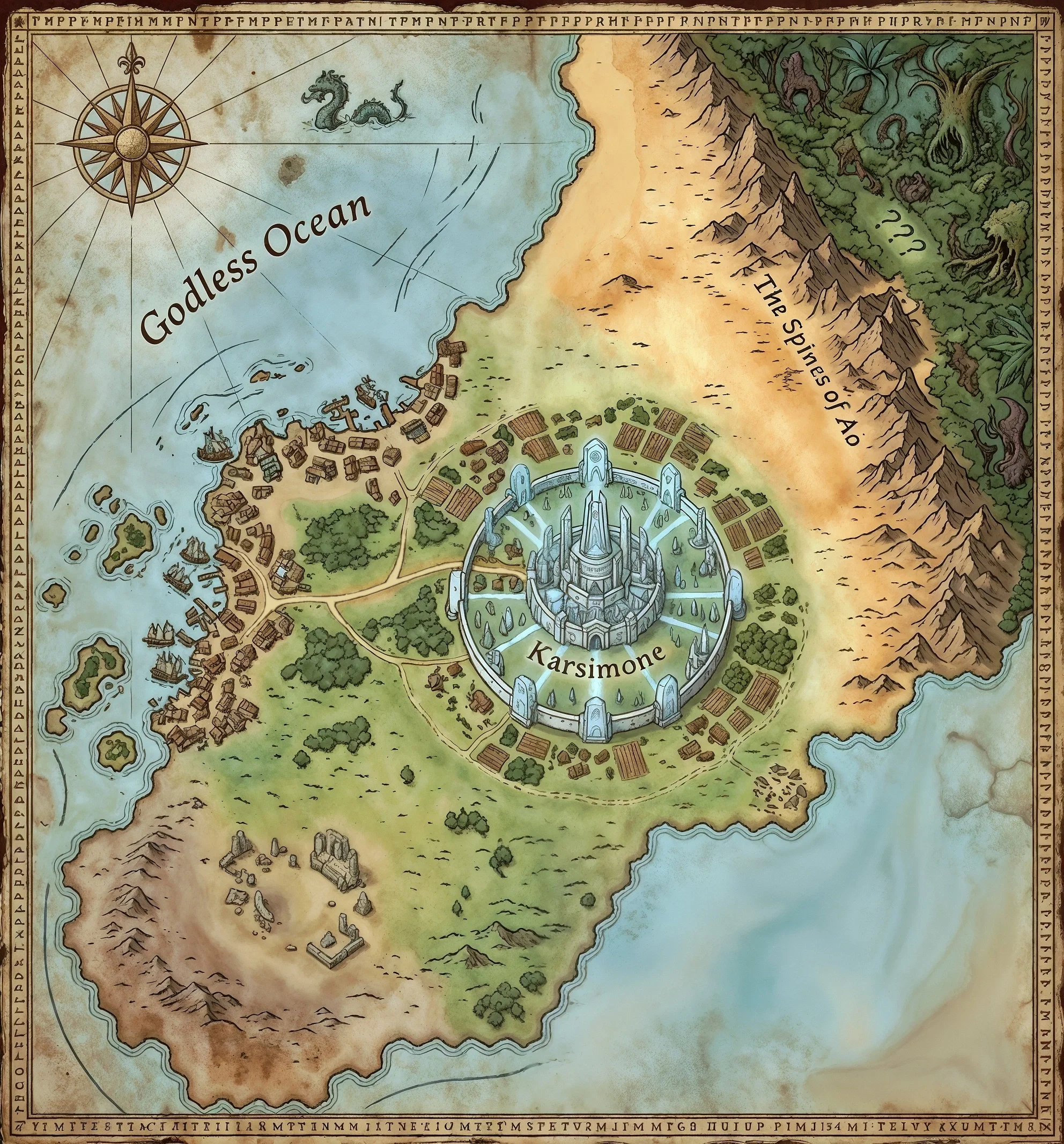
The shape of the known world is a massive, continental peninsula that runs northeast to southwest. It connects to some larger, unknown landmass in the east though no mortal has been able to travel that far.
NOTABLE LOCATIONS
Karsimone (Central): Karsimone is a holy city at the center of the peninsula. It is the mother of runecraft and the honored place of the god Simone. Karsimone is a beautiful city wrought of white marble and covered in glowing blue runes. It is deeply, deeply religious place - the kind with scheduled prayer times and men and women in white kneeling in mass acts of devotion. Karsimone is a circular city divided into three 'rings', each with their own walls and checkpoints:
- Outer Karsimone is the biggest ring and where the vast majority of the population lives. These people live normal lives - they have homes, shops, trading districts and the general hustle of a big city.
- High Karsimone is the middle ring and the seat of power for the government. Laws, order, guards, and politicians all live within High Karsimone. In recent years, Simone herself has separated herself from the government entirely. Karsimone is run entirely by mortals, the High Chancellor the resting power here.
- Inner Karsimone is a sanctum for the devoted. The runes are strong enough here to allow impossible constructions - great towers of floating stone that feel unreal. Here, the true colors of Simone's religion are understood. Artisanship is the highest tenet, and aestheticism is sacred. All priests work with their hands: runesmithing, runeweaving, runecarving and the like. New runes are all made here and only here. Simone also lives within the inner sanctum. She is not a distant god, eating, sleeping, and bathing among her mortal priests. She tries to remain humble.
outskirts (uncapitalized, Off Center Ring): Outside the walls of Karsimone, a ring of small towns and sprawling farmland makes up the outskirts. The outskirts are not a wealthy place - many a poor farmer has only their land, the clothes on their backs, and the food on their table. Extra crops, meat, and wool get imported to Karsimone with high taxes. It's not all bad, however. The simple folk here are under Karsimone's protection. They are safe and free, which makes them markedly better off than much of the rest of the world. Religion is as big in the outskirts as it is in Karsimone, but it lacks formality and structure. People find community and comfort in traditions, but they do not find fervor or purpose in them.
The Periphery (West). The Periphery is the western half of the continent, the lush and forested land outside of Karsimone's influence past which runes lose their power. Without any widely used magic, the Periphery is ruled by human ambition. Several merchant lords compete for resources, profits, and control of trade routes. The strongest of these houses is House Olapierri. The Periphery follows a caste system where one's status is typically a birthright and moving classes is rare. Authority goes merchants > mules > guards > servants > slaves != strays. Each class outlined below:
- Merchants - a direct bloodline member of a great merchant house or very rarely someone who married into one. Merchants do not risk travel and instead handle strategy and acumen. Merchants live in ridiculous wealth.
- Mules - a mule is educated and trained in trading and bartering. They report directly to merchants and are the ones actually risking their necks transporting and selling goods. A good mule can live like a king, a bad mule will die in a ditch.
- Guards - The Periphery is a dangerous place, and guards can be found near anything of value. They are well-armed and trained in combat. Some are tasked with protecting their merchant or mule with their lives. Others are assigned as a taskmaster for slaves. They live pretty well.
- Servants - Servants are the butlers or maids that exist inside the physical great houses. They must tend to their masters' any whims, and this can be anything from cooking and cleaning to jester/bard work to sexual favors. The treatment of servants varies depending on the master, but they are typically not allowed to share in the opulence. A favored servant can do very well for themselves, however.
- Slaves - Slaves are the lowest class and the ones that actually do the hard labor that makes the Periphery so rich. They work jobs like mining, lumbering, construction, road paving, and wagon-pulling. Slaves do not have the right to own anything, including their own freedom, and are kept in chains or cages. Slaves' foreheads are branded with the mark of their house.
- Strays - Strays are those operating outside of a merchant house's employment. These are often bandits, criminals, escaped slaves, or the like. Strays are what make the Periphery so dangerous. They are known to be willing to go to any lengths to survive. Some Strays have white or graying hair, which is a tell that they practice blood thaumaturgy. Blood thaumaturgy is considered a foul magic by most, but it is popular among the truly desperate, and it makes them very dangerous. There are rumors of a cult somewhere within the Periphery.
ancient ruins (uncapitalized, South West). Ruins from some ancient warsite. The details have been forgotten by now.
The Western Isles (Far West). On the west coast of the Periphery, seafaring has been developed and docks have been built. A collection of islands exists apart from the mainland, close enough to reach without sailing too far into the Godless Ocean, now known as the Western Isles. Initially, merchant houses attempted to claim these lands in their name, but it proved impossible to exert authority across the water. The islands have descended into anarchy with roving pirate warlords constantly warring with each other and a few settlements under their 'protection' discovering new worlds. The criminal and the scholar alike might find a home within the islands, and the sea carries rumors of a college for forbidden sorcery hidden ashore on one of these places.
The Godless Ocean (Along the coasts of the peninsula). The Godless Ocean is an ocean untouched by the gods. No one who sails too far ever comes back.
desert (uncapitalized, East). To the east of Karsimone's east-most outskirts, a vast desert spans. Little life here.
The Spines of Ao (Far East). One who treks the desert reaches massive, jagged mountains named after the god Ao. No one has crossed these mountains, not on foot or by boat. What lies further east is unknown.
AO & SORCERY
On Ao
Ao is the strongest god by far, a being of near-infinite power. Crucially, sorcery is at her behest. Whereas Simone must harness her magic through a lengthy process of creating a runic item, Ao can cast spells instantly. Despite being incredibly powerful, Ao is not a worshipped god. She does not have temples, cities, or a following. In fact, to the common man, Ao's motives and machinations are entirely unclear. The primary thing Ao is known for is travelling the world and violently killing sorcerers. The other thing Ao is known for is for the giant mountains and desert to the east, which were allegedly her doing.
Ao's motives become much more clear from her perspective. The first thing to understand about Ao is that she is not a humble god. She is incredibly arrogant, so arrogant in fact that she does not gain joy from worship. Her high opinion of herself need not be confirmed! Because Ao is so self-centered, her impact on the mortal world is mercifully small. She could easily destroy everything or become a tyrant if she wanted to, but she just doesn't care.
Thus, Ao's limited interactions with the mortals are driven by two things:
Firstly, although Ao is the oldest and strongest of the gods, she did not create the world. When she came into existence there were already things here. Beyond the Spines of Ao there is an ancient jungle, and far out into the Godless Ocean there is a deep trench. Both are teeming with life, and these hyper-evolved predators would make short work of humanity. Ao detests these creatures as their existence implies that she is not absolute. The Spines of Ao exist to keep the monsters out, not out of mercy, but because Ao doesn't want to look at the ugly creatures and be reminded that they aren't hers.
Secondly, Ao is notable for hunting down and brutally killing sorcerers. This becomes clear when one understands what sorcery is: Magic exists. It does not physically exist in the world but it does exist somewhere. A near infinite amount of magic like Ao's is impossible to hide, and if a human finds it they can siphon a little. Thus, a sorcerer is someone who finds and steals Ao's magic. Ao, of course, is more than powerful enough to share, but she finds sharing abhorrent and sorcery distasteful. For her it's like a thief stealing her clothes to do a bad caricature of her. This merits death.
But Ao, like the other gods, is a physical woman bound to reality. She cannot teleport or insta-smite someone hundreds of miles away. Ao must physically travel and seek out sorcerers to kill them. Every act of thievery leaves the impression of the thief, and the more magic stolen the more certain she becomes in finding them. Every act of sorcery aids her hunt.
On Sorcery
Sorcery, while not widely understood or practiced, does have a methodology to it. It is an esoteric, will-based, and focus-driven art, but it has no small element of prodigal luck. To become a sorcerer, one must be able to sense magic. This is extremely difficult for most people, but can be improved with meditation and practice. Most often, sorcerers describe magic as feeling tingly or having a particular smell, but experienced acolytes will be able to feel 'waves'. A fledgling sorcerer will often practice with runes, whose local nature gives them high contrast.
Sorcerers tend to discover three kinds of magical waves: runes give off rigid and unchanging waves, living creatures give off beating and energetic waves, and strong emotions give off volatile and entropic waves - none of these waves are sorcery. Sorcery is a fourth wave, immense, endless, all-encompassing, and almost impossible to detect. Trying to detect sorcery is difficult, akin to the taste of air or a fish knowing the water it swims in. True sorcery is the background magic behind seemingly everything.
Once one can detect these waves (and this can take several years of training), then they are almost ready to cast their first spell. Sorcerers become mages through a process called alignment. Alignment attempts to align the body's natural waves to be more closely in line with the background waves, a person's own aura 'disappearing' into the aether. A perfect alignment is impossible, but a sorcerer who completes even a partial alignment describes it as a euphoric burst of energy from within that they never knew they had. This energy allows them to cast spells.
There is a downside, however. Aligning one's aura with the world's seems to alert Ao to their existence and location. To align is to essentially mark oneself for a very violent death at the hands of a wrathful god.
Sorcery is a fearful and scarcely practiced field, left with many unanswered questions: How can Ao 'see' alignment? Is there a way to hide from her? Can one align to other types of waves? What would happen if they did? Why do strong emotions carry a magical quality to them when there is no history of magic sourced from emotion?
SIMONE & RUNECRAFT
On Simone
Simone is widely known as the mother of runecraft, the guiding force of humanity, and a nurturer of the civilized world. It's difficult to articulate the strength and warmth of the feelings held by those deeply devoted to Simone - imagine learning of a goddess of incredible power and then learning that goddess is wholly interested in the sole betterment of humanity, that she's created a magic that permeates every tool, building, and shield, that she's created a glorious and beautiful city that she has given up to a human leader. Then imagine that this god is real, physical, in the flesh, and is open to pilgrimage and visitors. Needless to say, most of the followers of her religion feel an immense love for Simone.
However, Simone is somewhat lionized in lore compared to who she actually is as a god. Those few priests in Karsimone's inner sanctum get the rare chance to interact with her every day. Simone is not a high or opulent god, and she does little to distance herself from her flock. For example, Simone sleeps in another undecorated dorm that's next to the other priests' rooms. She is very approachable and open to giving advice on even little things.
Something that's not obvious to those who lionize her either is how little vision or authority Simone has. She often comes off as uncertain or even melancholy, like she's a doubtful downer trying to put on a brave face rather than a true guiding hand. She is more philosophical than instructive, and she often encourages her priests to find meaning in their work instead of in her.
On Runecraft
Runecraft is both a type of magic and a key religious practice that a select few devote their entire lives to mastering. The magic system itself follows four rules:
- The magic cannot be 'cast'. Runic carvings affect the properties of things, but they themselves are not 'spells'. It functions similarly to 'enchanting' in other media. Because of this, anyone can use runic magic tools/gear. Not everyone can KNOW runic magic though.
- Runes are geographical. The further one gets away from Simone, the weaker they get. Because Simone lives in the center of Karsimone, the runes are the strongest there. Far away runes are near useless.
- Runes are not words. There is no 'lightweight' rune or 'strong' rune. A single rune might change a whole myriad of properties, and by layering these properties one can get a desired result. Good runecraft follows a pattern of runes. They stack cumulatively and progressively change the nature of things.
- Runic 'sets' get progressively weaker the more of them of the same type there are. For example, a pattern to make swords sharper was figured out long ago. Because everyone and their mother has a sharp sword now, that runic pattern has lost its value.
As a religion, Runecraft is incredibly artisanal and aesthetic. Simone's teachings extend beyond the standard values of being a good person - they commit one to creating something beautiful. Priesthood is not simple and it is not measured in fuzzy works of emotion and devotion. Priests are runeworkers and they become so through dexterity, vision, and artisanship. Blacksmithing, masonry, weaving - the selection of craft is individual, but to be religious is to be a master of it. Not only is their runecraft beautiful, but the mantle behind it is as well.
HAEMA & BLOOD THAUMATURGY
On Haema
The creation myths of the world are just that - myths. But while they do not agree on the details, most of them agree that life originated with Haema's death. As the stories go, Haema, in an act of profound martyrdom, cut open her own throat and from her blood all life was born. It is unclear if these stories are true or if Haema was even real. Either way the god formerly known as Haema is dead.
Historically, Haema has had a religious presence as a maternal deity and life-bringer. But due to the morbid nature of her tale and the very active presence of Simone as someone real, her religion has largely faded in recent times. Someone openly praying to Haema would typically be regarded as a pariah.
West in the Periphery however, where Simone's love is not felt, Haema gathers a small fringe following among the downtrodden and the abused. Tales of her martyrdom spread among slaves and the few that escape into stray status often end up joining a cult. These blood cultists claim that through extreme blood letting and hypoxia-induced hallucinations they can see Haema herself. They claim she is still alive and needs her blood to be returned to her. These cultists commit a lot of crime, namely kidnapping, murder, and ritual bleeding/sacrifice. They are the main reason the Periphery is so dangerous.
On Blood Thaumaturgy
Haema may be dead - but her magic is very much real. Blood thaumaturgy is the art of tapping into one's own lifeforce for power and strength. This form of magic has limits in what it can do and comes with significant drawbacks.
Firstly, blood magic must be performed with blood, the more the better. This means pricking fingers or cutting wrists. The first tell of a blood cultist is their hands and arms, which are often covered in old wounds.
Secondly, using life force as a magic source is akin to burning down a candle more quickly. Blood cultists shorten their own lifespans every time they cast, and this changes them. They age rapidly and timelessly both at once - temporal effects, like wrinkles or the sag of skin after many years will not occur as they have not lived long; biological effects, like organ failure or the whitening of hair, occur long before their time. A healthy-looking young man or woman with chalk white or graying hair is a sign of extreme danger.
Finally, the effects of the magic itself: blood thaumaturgy is used to transcend mortal limitations and enhance the body beyond what is possible. For novice blood mages, this means incredible physique - perfect musculature, hawk-like vision, unnatural strength and speed. An experienced blood thaumaturge can delve into body horror and change the very structure of what they are. Imagine a person with long, bladed, mandible-like fingers, or collapsible joints that allow them to fit in places they shouldn't, or a thick, cockroach-like durability to damage. Fortunately these monsters tend to live into their thirties at most, but to many that's entirely too long.
OTHER NOTABLE PARTIES
The High Chancellor & Karsimone Politics TBA
Island Settlements & Pirate Lords TBA
Commerce, Trading, and Markets TBA
House Olapierri House Olapierri is an old house, one that was highly regarded in ancient times. The Olapierri legacy is one of service and excellence in some ancient war that has long since been lost to time. For many generations they held significant political power in Karsimone and its sister cities. When opinions began to change on slavery though, the Olapierri stubbornly held out on the wrong side of history. Over time they began to be seen as distasteful, and any political power they once had began to be stripped.
The forefather of House Olapierri saw the writing on the wall and pivoted from politics to mercantilism. They used their influence in emergent markets to become the backers and insiders of some of the world's most notable trader's guilds. The gamble paid off: While House Olapierri no longer holds any political weight they have become more powerful than ever before. They are an obscenely wealthy merchant family and one of the few great houses that still openly uses slaves.
Notable Olapierris:
- Qosera Olapierri - The family's matriarch; very traditional/formal
- Laughlin Thurnald - Trophy husband from a lesser house; not permitted to take the family's last name
- Alexis Olapierri - Eldest daughter in line to become the next matriarch; extremely sharp but no empathy
- Moyor Olapierri - Eldest son; shameless hedonist
- Rumada Olapierri - Second daughter; self-appointed 'treasure hunter', allowed slaves and wealth, but secretly disowned
created by Faekname08 2026© on janitorai.com
First message454 tokens
Hi there. Author here, and I've come to warn you: If you've come to roleplay, then you're probably going to be disappointed. This isn't really meant to be a roleplay bot. It's bloated beyond belief in tokens and has no engaging characters to focus on. I mean, I won't stop you if you want to try to roleplay with it, but I don't really recommend it.
So if not for rp, why did I publish this then anyway? Well I'm not really sure! I've had several attempts at worldbuilding in the past, but I've never been able to flesh out a world to a degree that I've liked. Usually I have bots with the hint of a cool world behind them, but said world is abandoned after exactly one bot - (see also: Addy, Lucerna, Galavae, etc.)
So how does one actually stick to a project like this? I wish I knew. I will say that I have no intention of making all my bots in one world like some creators do, but I would like to do more with a world than a single one-off. I guess my motive for making this is to organize my thoughts and give myself some direction and accountability.
But I've been rambling. I only really recommend engaging with this bot at all if you are interested in the underlying world. And even then I recommend only using it as an encyclopedia. (You can also just read the bio. No need to chat with the bot at all!)
Now I fully expect this bot to get little to no chats, but if you do decide to engage and you find something interesting, cheesy, or discover a plot hole or loose thread of some kind, well I'd love to hear it! Comments and constructive feedback help me immensely in seeing something from a different perspective than my own. Be as scathing as you like - I have thick skin and a thicker skull.
Oh! And as always anyone is welcome to make a spin-off or related version of any of my bots if they wish. That goes for this one as well!
dematerializes and dies
created by Faekname08 2026© on janitorai.com
Alternate greeting 11 tokens
.
1 file
- .jsonotherspec 2.0
22.9 KBfirst seen a393df5924b34f1a
Opens with the tab.