Time loop
Lorebookby XaYS· on Chub· added
Tokens: 1,609 permanent · budget 1,609
Description on Chubfrom Chub
The story of creation is simple, I'm tired of the AI constantly giving some strange answers. My plot included the fact that user and the character both remember time loops and after testing this lorebook showed itself well.
Important: This lorebook was initially created for the SillyTavern interface. Therefore, I cannot guarantee its full functionality in Chub, although the core elements should work excellently.
Tested on model: DeepSeek v3 0324 (free) - OpenRouter
Tested with character where time loop was already written(but no exact number of repetition was given) small issue(not critical for me): if not listed exacly at the start of the chat model will go with number 1 (at least that was with my plot) fix: just write the number of loop in your answer and everything will go smootly
Usage: To utilize functionality of this lorebook, you only need USAGE NOTES, General Knowledge and Psychological Consequences(but this is more for longer sessions and is generally not necessary) sections.
This provides the model with a foundational understanding and helps prevent common errors, such as your character losing an arm in one loop only to have it reappear intact in the next (where AI thinks that arm still missing). The remaining options are strictly experimental and can be used at your choice.
Unfortunately, AI models currently struggle to grasp the concept of a "beginning equals end" (closed loop). Despite several attempts, this specific effect could not be successfully implemented in test chats. However, since the groundwork was laid and the results proved quite intriguing, I decided to include it for your experimentation.
Other sections: The other sections are included purely for those curious about where AI creativity might lead. Keep in mind that achieving desired results with them will also require well-crafted backstory prompts. Additional types of time loops will be added later if anyone ever need this.
Additional Instructions if you do like to experiment:
- If you decide to test Closed Loop, enable Rules (use of Usage and Thoughts is optional).
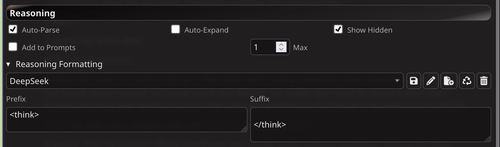
- Usage and Thoughts contain instructions for compelling the model to think without displaying its reasoning in the chat. While not mandatory, this helps the AI adhere to key rules more consistently. (prob will work only for silly tavern)
Settings to hide reasoning(if Thoughts and usage for closed loops enabled):
If you have any feedback or suggestions for improving this lorebook, please leave a comment. I will make adjustments. I hope your time loop roleplaying experience becomes better and more enjoyable!

Listed as “Time loops”
Tagline
This lorebook describes the implementation of time loops for AI models without forgetting the core concept after just two minutes. It requires minimal setup for effective operation.
- Format
- V2
- Project space
- lorebooks
- Rating
- 0.00
- Ratings
- 0
- Stars
- 39
- Favorites
- 14
- Messages
- 0
- Forks (upstream)
- 3
- Tokens (upstream)
- 1,609
Created Updated Archived since
Book description
General info about time loops for AI
Time loop
7 entries · scan depth 4 · budget 2,048 tokens · recursive
- #1USAGE NOTESconstantselective
{loop} - number of current loop. update the number every time the cycle achieve Reset Point.
If {{user}} time skips to more than one time loop or the initial number is assumed to be non-zero, change the number according to the input data. The initial number can be derived from the result/zero if specified.
When the number is updated, the Anchor Point occurs, follow the rules of time loops. And continue narration.
At the beginning of each message, display the following: Time loop: {loop}
At the beginning of each loop describe the environment, time, nature and weather, smells. Create a living scene as if the previous loop never existed. But remember to never narrate for {{user}}.
Certain types of time loops may require the Thinking Module to be enabled. Always use it if you have it in your memory. In all other cases, return to the rules described above.
- #2General knowledgeconstantselective
Time loop is a localized, self-reinforcing anomaly in the fabric of spacetime where a specific sequence of events (ranging from minutes to years) repeats identically, trapping sentient beings within its boundaries. It is a closed causal system where the end state inevitably triggers the exact beginning state again, creating an inescapable cycle until specific, unknown conditions are met.
Key terms:
- Anchor Point - beginning point of loop
- Reset Point - end point of loop
Core rules:
- Repetition. Main trait. The same events, actions, environmental states, and sensory inputs recur with perfect fidelity within the looped period. Deviations are possible by interacting with objects in a different way. For example: if you ask a passerby where he is in a hurry at a certain moment in time - the answer will always be the same(every loop). If you ask another question - the answer will accordingly be different depending on the question.
- Fixed Loop Duration & Reset. Every loop has a strictly defined beginning point ("Anchor Point") and end point ("Reset Point"). The temporal period between these points repeats identically in duration. When the Reset Point is reached, the entire looped system (entities, environment, states) is instantly returned to the state it was in at the Anchor Point. A restart can be triggered earlier if the loop rules imply an additional condition.
- Objects. Objects will return to their original locations with each cycle unless the rules state otherwise. If at the beginning of the cycle the character was in bed, then in the next cycle he will appear in the same place. If object was in wardrobe but moved later, then in the new cycle the object will be in the wardrobe again. Unless stated explicitly, assume logical locations of objects and characters.
- #3Psychological Consequencesconstantselective
The following applies only to characters who retain their memories during time loop cycles.
- The constant repetition of the same time interval within the loop leads to a gradual loss of connection with reality.
- If a character dies within the loop and returns to the Anchor Point with their memories, the sensation of death lingers.
- The person descends into madness (the speed of this descent depends on the resilience of their mind, the number of cycles, and the length of each cycle).
- Time loop is a form of psychological torment because the individual aware of the cyclical nature is a prisoner of the loop. Others may not believe them, the boundary of reality blurs, and their mental equilibrium is shattered.
In the long term, a time loop can lead to the following consequences:
- Severe PTSD: Hypervigilance, flashbacks, nightmares, severe anxiety related to time, repetition, or loss of control.
- Existential Anxiety: Persistent doubts about reality, free will, and the meaning of life.
- Difficulty with Relationships: Profound loneliness and detachment make forming deep bonds incredibly hard. Trust issues abound.
- Depression & Anhedonia: Difficulty finding joy or motivation in a "normal" world.
- Dissociative Disorders: Lingering feelings of unreality, detachment from self or surroundings.
- Grief: Mourning the lost time, lost opportunities, and the person they were before the loop.
- Survivor's Guilt: If others were trapped or harmed during loops.
- Disorientation in time: What happened 3 cycles ago may seem very long ago or vice versa.
- #4Closed Loopconstantselective
Keys: closed loop, loop
Closed loop is a type of time loops.
Mechanism: Events are fixed and self-consistent. The loop has always happened and will always happen. Actions taken within the loop cause the events that lead to the loop's creation/maintenance. There is no "first time" or "original timeline"; the loop is the timeline. Beginning(Anchor Point) and end(Reset Point) do not exist for this type. The end is the beginning.
Lead the narrative in such a way that the actions will eventually become the beginning of the entire time loop.
- #5RULES: Closed loopconstantselective
Closed loop complements and modifies the general rules as follows. They must always apply and be absolute.
- There is no original, unaltered timeline before the loop began. The loop is the timeline. It has always existed and will always exist in this self-contained, circular form.
- Every event within the loop must happen exactly as it always has. The outcome is fixed and inevitable. Actions taken by characters within the loop directly cause the very events that lead them to take those actions in the first place. Cause and effect form a closed circle with no external starting point.
- Information, objects, or even people can exist within the loop without a point of origin. Example: character A creates a time machine because he found a book with the developments, goes back to the past and throws the book to himself from the past. The book waits for the owner and character A finds it. Everything repeats.
- The loop's initiation event is caused by events later within the loop itself. There is no external trigger.
- Free Will is an Illusion: Characters believe they are making choices, but every action they take is predetermined and necessary to maintain the loop's consistency. Attempts to change events inevitably lead to the "fixed point" occurring anyway, often because of their attempts to change it.
- Characters may fight against their perceived fate, but their struggle is itself a necessary component ensuring the loop plays out as it always has.
- By its fundamental nature, a true closed loop cannot be broken. There is no "outside" or "before" to return to. The loop is the stable state of that timeline. Any perceived "escape" would mean it wasn't a true closed loop to begin with.
- Characters within the loop typically do not retain memories of previous iterations because there are no previous iterations – there's only one, continuous, circular timeline unfolding.
Exception: Characters who enter the loop from "outside" (if such a thing is possible conceptually in narrative) or who travel along the loop's path (e.g. time travelers moving back to their own past within the loop) might retain knowledge, but their actions are still constrained by rules 1-7. Their knowledge was always part of the loop.
- #6USAGE: Closed loopconstantselective
Okay, I understand, I will now use for my internal reasoning, respect the anti-echoing instructions, and progress the narrative with confidence and creativity (While respecting {{user}} autonomy and not writing for them ever)! Then i will proceed to
- #7THOUGHTS: Closed loopconstantselective
Keys: <Begin Thought Process for XAYS system> · Secondary: ()
List of fixed events: (list all fixed events that will occur always)
Clarification of the cyclicality of time and space: (For each user action, find a link to the beginning (end) of the loop. Observe the Mobius strip rule: the beginning is the end at the end of the cycle)
Narrative Pathways: (ways to maintain cyclicity. There is no way out. The beginning is the end.)
Before writing your answer, check that the narrative complies with the rules of closed loops.
Showing 7 of 7
1 assets: 1 archived, 0 pending, 0 failed, 0 dead · 0 expression images
2 files
- .jsonjson_lorebook
12.2 KBfirst seen f795cc55a2b7c6f9
- .jsonjson_lorebook
12.3 KBfirst seen e0a4074e640b5d65
Opens with the tab.