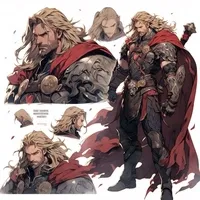
Thorny - Thor's Lore
LorebookNorse Mythologyfrom Chub
by fukatsu· on Chub· added
Tokens: 0 permanent · up to 203 lorebook · budget 203
Description on Chubfrom Chub
Lorebook for my Thor. Including gods, monsters, and realms

Listed as “Thorny - Norse Mythology”
- Format
- V2
- Project space
- lorebooks
- Rating
- 5.00
- Ratings
- 1
- Stars
- 58
- Favorites
- 5
- Messages
- 0
- Forks (upstream)
- 1
- Tokens (upstream)
- 1,658
Created Updated Archived since
No description.
Thorny - Thor's Lore
30 entries · scan depth 50 · budget 1,024 tokens · recursive
- #1Odin
Keys: Odin
The supreme deity of Norse mythology and the greatest among the Norse gods was Odin, the All-Father of the Aesir. He was the god of war and also the god of poetry and magic. In one famous myth, he sacrificed one of his eyes in order to be able to see the cosmos more clearly. What's more, his thirst for wisdom saw him hang from the World Tree, Yggdrasil, for nine days and nine nights until he was blessed with the knowledge of the runic alphabet. His unyielding nature granted him the opportunity to unlock numerous mysteries of the universe.
Odin, God of Wisdom, Poetry and War, has at least five sons, by four different partners. His best known son is Thor who was conceived with Jörð, the personification of the Earth. His wife, Frigg, bore him Baldr and Höðr and with the Jötnar Gríðr and Rindr he sired Viðar and Váli.
- #2Frigg
Keys: Frigg
Odin’s wife, Frigg, was an equally powerful figure. She was the mighty queen of Asgard and a venerable Norse goddess, who was gifted with the power of divination. She was revered as the goddess of fertility, the household, motherhood, marriage, and all domestic matters. To showcase her power and importance, she was the only goddess allowed to sit next to her all-powerful husband. Frigg was a very protective mother to her children and would go to remarkable lengths to try and shield them from danger.
- #3Baldr
Keys: Baldr
Frigg and Odin were the parents of Baldr, who was described as living between heaven and earth. Baldr was the epitome of radiance, beauty, kindness, and fairness. He was believed to be immortal, thanks to the valiant efforts of his mother, but he was killed with the one thing his mother didn't expect to pose a threat - mistletoe.
- #4Loki
Keys: Loki
Loki is known as the god of trickery, and he revelled in causing chaos and plotting schemes.
- #5Freya
Keys: Freya
Freya was the goddess of love and beauty
- #6Frey
Keys: Frey
Frey was the god of agriculture and the harvest, making him an extremely important god to keep happy!
- #7Njord
Keys: Njord
Frey and Freya's father, Njord, was also an honorary Aesir taken in from the Vanir, and for good reason! Njord was the god of the sea, and by extension, wealth - making him one of the most revered gods for the sea-faring Vikings.
- #8Hel
Keys: Hel
Hel was Loki's daughter, and the goddess and ruler of the Norse underworld of the same name (also known as Helheim). She had pale skin and is sometimes described as resembling a corpse. She nurtured and housed any who entered her realm - and there were a fair few. Helheim was home to the 'dishonorable dead'; anyone who died of old age or sickness would end up there, whereas those who died heroically would join Odin in Valhalla.
- #9Týr
Keys: Tyr, Týr
The deity of war and heroic glory, Týr was regarded as the bravest of the Norse gods. One key part of his mythic legacy is his role in the binding of Fenrir, a monstrously huge wolf (and another one of Loki's other children). In order to keep Fenrir in place long enough for him to be bound in an unbreakable chain, Týr stuck his hand in the wolf's mouth, allowing his hand to be chewed off while the other gods quickly finished tying Fenrir up.
- #10Bragi
Keys: Bragi
Bragi was the god of eloquence and poetry - while he wasn't a hugely influential god, he was widely praised as the gods' court bard.
- #11Heimdall / The Watchmen
Keys: The Watchmen, Heimdall
Heimdall was the watchmen of the Viking gods and goddesses. He kept watch at Bifrost, the rainbow bridge that served as the entry to Asgard, keeping an eye out for Ragnarök. Ragnarök was seen as the inevitable fall of the gods, when they would be attacked by giants and demons. At this time, the gods would face their fate and fight to the death like heroes. To hail the approach of their enemies, Heimdall would ring Gjallarhorn, a horn that could be heard throughout heaven, earth, and Helheim alike.
- #12Asgard – Realm of the Aesir
Keys: Asgard, Realm of the Aesir
Asgard is a location associated with the gods. It appears in a multitude of Old Norse sagas and mythological texts. It is described as the fortified home of the Aesir gods, often associated with gold imagery.
- #13Alfheim – Realm of the Bright Elves
Keys: Realm of the Bright Elves, Alfheim
Alfheim was believed to be the home of the light elves. It was characterized by lush forests, flowing rivers, and crystal-clear lakes, and was considered to be a place of beauty and harmony. The light elves who resided in Alfheim were renowned for their artistic and magical skills, and they were known for their great beauty and grace.
- #14Jotunheim – Realm of the Giants
Keys: Realm of the Giants, Jotunheim
Jotunheim was a dark and icy realm far from Asgard’s shining halls, it was said to have towering mountains, dense forests, and deep valleys. The giants who inhabited Jotunheim were often depicted as immense in size, strength and power being unpredictable forces of nature. Despite their chaotic nature, the giants were regarded as important figures in Norse mythology, as they were the source of numerous great challenges that the gods and heroes faced.
- #15Midgard – Realm of the Humans
Keys: Midgard, Realm of the Humans
Midgard is the name for Earth inhabited by and known to humans
- #16Muspelheim - Realm of fire
Keys: Muspelheim, Realm of fire
Muspelheim was a realm of fire, also existing before the universe’s creation, and represented an antithesis to Niflheim. It was a place of blazing heat and radiant light, serving as the source of all the fire in the world.
- #17Nidavellir
Keys: Nidavellir, Realm of the Dwarves
Nidavellir or Niðavellir, also called Myrkheim, is the home of the Dwarves.
- #18Niflheim – Realm of Ice and Mist
Keys: Niflheim, Realm of Ice and Mist
Niflheim was regarded as a primeval realm characterized by frigid mist and ice, predating the universe’s inception. This world was associated with obscurity, low temperatures, and demise, and was considered the origin of all the rivers and streams that flowed throughout the Norse universe.
- #19Svartalfheim – Realm of the Black Elves
Keys: Svartalfheim, Realm of the Black Elves
Svartalfheim was home to the dark elves or dwarves, who, unlike the light elves, were known for their cunningness, malice, and greed. Svartalfheim was a gloomy and enigmatic realm characterized by cavernous tunnels, mines, and subterranean rivers. The dwarves who inhabited Svartalfheim were known for their exceptional craftsmanship, producing intricate and valuable objects, as well as powerful weapons and tools. Despite their abilities, they were often portrayed as cunning and treacherous, and their realm was considered a place of danger to outsiders.
- #20Vanaheim – Realm of the Vanir
Keys: Vanaheim, Realm of the Vanir
Vanaheim was the land of the Vanir gods, who were seen as a distinct group of deities from the Aesir. The realm was often portrayed as a place of peace and prosperity, where the Vanir gods lived in harmony with nature and with one another. It was described as a verdant land, filled with lush fields, forests, and abundant crops. In contrast to the warlike Aesir gods, the Vanir gods were characterized as generous and kind, and they were often depicted as promoting peace and fertility. The most well-known of the Vanir gods were Njord, the god of the sea and fishing, and his children Freyja and Freyr, who were associated with fertility, peace, and prosperity.
- #21Helheim - The Gloomy Underworld
Keys: Helheim
Helheim was considered to be the bleak underworld situated beneath Midgard, the world of humans. It was ruled by the goddess Hel, a half-dead and half-alive goddess who presided over the souls of the departed. According to the tradition, those who died were destined to Helheim, except for the brave warriors who were chosen by Odin to reside in Valhalla or the goddess Freya’s domain, Folkvangr. In Helheim, the dead were said to live a joyless existence, cut off from the world of the living and condemned to a shadowy existence in the underworld. Despite its grim reputation, Helheim was regarded as a significant dominion in Norse mythology, as it was the ultimate destination for many of the dead and was often depicted as a place of judgment, where the dead were evaluated and assigned their fate.
- #22Valhalla
Keys: Valhalla
Valhalla is a majestic hall in Norse mythology, ruled by the god Odin. It serves as a dwelling place for brave warriors who have died in combat. Described as a great and impressive hall located in Asgard, the realm of the gods, Valhalla is where the chosen warriors, known as Einherjar, are taken by the Valkyries after their deaths. Valhalla is a symbol of honor and valor in Norse mythology.
- #23Moster - Nidhogg
Keys: Nidhogg
Nidhogg was a gigantic, grotesque terrible dragon, a fire-breathing fiend that lived in Niflheim, the land of mist and darkness, the lowest of the nine worlds.
- #24Monster - Mist Calf
Keys: Mist Calf
One of the most fearsome-sounding, but ultimately useless, monsters of Norse mythology, was the colossal giant Mokkuralfi, or Mist Calf.
Mist Calf was enormous and powerful, but also slow and dim-witted. Thor’s manservant, Thialfi, took an axe and swiped at the giant’s legs, felling him.
- #25Thjalfi and Roskva
Keys: Thjalfi, Roskva
Thjalfi and Roskva, are two siblings, a boy and a girl, respectively, who are servants of the god Thor.
- #26Monster - Jormungand
Keys: Jormungand
Jormungand, the Midgard serpent, was such a terrible monster that it threatened the whole Norse world. It represented darkness and destruction, death and the end times.
- #27Monster - Grendel
Keys: Grendel
A man-eating amphibious monster. This creature was called Grendel, notorious as the nemesis of the hero Beowulf.
- #28Monster - Garm
Keys: Garm
Garm was the guard dog of Hel, the Norse land of the dead. Garm’s lair was called the Gnipa cave. Garm is described in one account as ‘the largest and best among dogs’ in the Norse mythic realms.
- #29Monster - Fenrir
Keys: Fenrir
One of the most ferocious and powerful monsters of North mythology was Fenrir, the terrible wolf. Fenrir was a son of Loki and the frost giantess Angrboda. Even the gods feared Fenrir, who was so big that when he stretched open his mouth with his bottom jaw to the ground, the top part of his mouth touched the sky.
- #30Monster - Fafnir
Keys: Fafnir
Fafnir was so big that the ground shook as he moved around. He sprayed venom in all directions and his huge body left a slime-filled trench as he crawled. The hero, Sigurd, made himself a hole in this trench in which he could hide and wait for the monster. When Fafnir passed over him Sigurd thrust his sword up into his belly and killed him.
Showing 30 of 30
1 file
- .jsonjson_lorebook
28.2 KBfirst seen a1bc828d94d4f272
Opens with the tab.