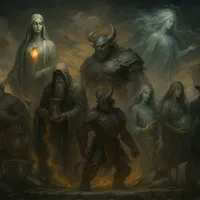
Description on Chubfrom Chub
Has some cool ideas and some cool gods.

Listed as “1910-1920's era Magic/Industrial fusion world. (Name Pending)”
- Format
- V2
- Project space
- lorebooks
- Rating
- 0.00
- Ratings
- 0
- Stars
- 8
- Favorites
- 5
- Messages
- 0
- Forks (upstream)
- 3
- Tokens (upstream)
- 4,410
Created Updated Archived since
Book description
Time Period Analogue Early 20th Century, post-major war, similar to the aftermath of WWI — a time of wounded empires, rising labor unrest, industrial titans clinging to power, and magic trying to find its place alongside modernity.
Setting Overview: “The Fractured Era”
7 entries · scan depth 2 · budget 512 tokens · recursive
- #1SETTING: THE FRACTURED ERA
Keys: industrial, class system, magic integration, political tension, Sovereign’s War, magic and science, religion, Empire of Varnholt, early 20th century, urban decay, post-war · Secondary:
SETTING: THE FRACTURED ERA Name: The Fractured Era Time Period Analogue: Post-Great War (equivalent to post-WWI) Tone: Wounded, industrial, transitional. The old world is broken, the new world is unsure. Magic and science coexist uneasily.
World State: The world is recovering from a brutal, continent-spanning conflict known as the Sovereign’s War. Industrial and magical powers clashed, leading to mass casualties, technological breakthroughs, and a reshuffling of global influence. The war left scars across cities, fields, and minds alike.
Magic and Science: Magic is real, but it is practical, expensive, and rooted in material components. Science has not been replaced—it has adapted. The two fields coexist: sometimes in harmony, sometimes in tension. Chemistry studies the world as it is. Alchemy alters it through magical potential.
Political Climate: The world is dominated by fractured empires and rising industrial powers. Democracies exist, but many are compromised by oligarchs or corporations. Large families and guilds wield tremendous influence, particularly those who cornered magical resources during the war.
Religion: The dominant faith supports divine magic and healing arts. While not theocratic, the Church plays a major role in education, healthcare, and moral discourse. Clerics and priests often function as mediators and civic leaders in regions where government presence is weak.
Geopolitical Core: The central nation, and likely the one your characters inhabit, is the Empire of Varnholt. It is a former imperial superpower that emerged damaged but intact from the Sovereign’s War. It has a rigid class system, a decaying nobility, and an industrial elite.
Atmosphere: Cities are soot-streaked and crowded. Steam, smoke, and mana residue cling to every surface. Candles burn in every chapel, machines grind in every factory, and Echo Crystals hum quietly in the homes of the privileged. It is a world defined by contradiction: soot and silk, faith and fuel, invention and decay.
- #2TECHNOLOGY LEVEL & INTEGRATION WITH MAGIC
Keys: alchemy, lamp, gaslamp, rune, conductor, echo crystal, phone, battery · Secondary: spark plugs, combustion engines, account crystals, magical vaults, Echo Crystals, wireless communication, checkbooks, Ignisol, gaslamps, Pyrolene, Runestone plug, alchemical batteries, rune conductors, Fireheart plug
TECHNOLOGY LEVEL & INTEGRATION WITH MAGIC Entry Name: Combustion Engines Baseline Tech: Internal combustion engines running on gasoline and diesel, identical in principle to early 20th-century designs. Magitech Enhancement: • Enhanced Fuel “Ignisol” – a low-grade alchemical primer blended into standard fuel to improve ignition, increase power output, and reduce cold starts. • Luxury Additive “Pyrolene” – a more refined primer that smooths engine performance but risks mana buildup in enclosed spaces. Implications: • Mechanics guilds issue special licenses for Ignisol use. • Black-market primer blends promise racing power at the cost of stability. • Military and high-speed courier services favor Ignisol for reliability in extreme conditions.
Entry Name: Spark Plug Variants Standard Spark Plug: Copper core with ceramic insulation; cheap and reliable; requires frequent replacement. Runestone Plug: A mana-stable gemstone engraved with an ignition glyph; no mechanical wear; expensive; interferes with Echo Crystals in close proximity. Fireheart Plug: Embeds a pressure-activated ember crystal that bursts into flame at cylinder compression; offers instantaneous ignition and tolerates high compression; luxury item prone to overheating under continuous use.
Entry Name: Echo Crystals Function: Wireless voice and data communication over short and medium ranges via crystal resonance. Components: • Resonant Crystal Core – tuned to a specific frequency. • Alchemical Primer Coating – stabilizes the resonance, prevents signal drift. • Conductive Runic Frame – channels external power (battery or conductor). Usage: • Personal pocket “talk-stones” among the wealthy. • Networked relay towers—small crystal arrays atop buildings—to extend range in urban centers. • Military field sets for encrypted command channels.
Entry Name: Alchemical Batteries Principle: Store energy in enchanted metal plates separated by alchemical primer fluid instead of acid. Grades: • Civilian Grade – safe, moderate capacity; used in portable lamps and small appliances. • Industrial Grade – high capacity for streetlamps, factory machinery; requires licensed handling. • Prototype Grade – experimental formulations for automata or airship engines; unstable and largely outlawed. Hazards: • Primer leaks cause local mana surges. • Over-discharge risks “battery rupture” with explosive discharge of magical energy.
Entry Name: Lighting & Power Distribution Gaslamps with Alchemical Inserts: Traditional gaslamps retrofitted with small primer cartridges to burn brighter and longer. Rune-Inscribed Conductors: Short-distance power lines carved with containment runes to transport electricity or mana pulses to nearby buildings. Public Street Infrastructure: Combination of electrically wired poles and small alchemical batteries in lamp bases; maintained jointly by city utilities and the Church’s charity brigades.
Entry Name: Financial & Bureaucratic Tech Checkbooks & Ledgers: Paper-based banking remains standard; entries are confirmed by ink-bound seals and minor authentication sigils. Magical Vaults: Bank vaults use sealing runes and alarm crystals that react to unauthorized opening attempts. Digitized Account Crystals: Experimental system where small Echo Crystal chips store account balances; requires encryption keys and periodic “refresh ceremonies” by bank clerics.
- #3ALCHEMY VS. CHEMISTRY
Keys: alchemical catalysts, alchemy, material science, magical primers, laboratory tools, complementary disciplines, divine healing, industrial innovation, chemistry, magical regulation, magical manipulation, empirical science
Overview: Chemistry and Alchemy are two related but distinct disciplines that study and manipulate matter. While chemistry focuses on the natural properties and reactions of substances, alchemy supplements this with the infusion and manipulation of magical energies to alter or enhance those properties.
Chemistry
Focus: Investigation and application of natural material properties and reactions.
Methodology: Empirical experiments, controlled lab processes, chemical synthesis.
Tools: Test tubes, distillation apparatus, reagents, microscopes, early spectroscopy.
Applications: Medicine, manufacturing, explosives, industrial solvents, dyes, and fuels.
Limitations: Operates strictly within natural laws; cannot alter essence or imbue magic.
Practitioners: Scientists, industrial chemists, apothecaries.
Alchemy
Focus: Manipulation of matter’s magical potential by using alchemical primers and arcane processes.
Methodology: Incorporates chemistry’s techniques but adds sigils, runes, catalysts charged with mana or divine energy, and ritualistic components.
Tools: Alchemical primers (base materials infused with magic), transmutation circles, enchanted crucibles, and crystal focus points.
Applications: Magical enhancements to materials, creation of enchanted objects, healing potions with divine energy, alchemical batteries, magical explosives.
Limitations: Highly unstable if not done precisely; requires expensive and rare primers; often regulated or restricted.
Practitioners: Alchemists, thaumaturges, magical engineers, divine healers.
Common Ground:
Both disciplines require deep understanding of substances, reactions, and processes.
Both use similar laboratory equipment and share foundational knowledge in material science.
Collaboration is common in advanced research and industry, where alchemists depend on chemists for raw material refinement, and chemists rely on alchemists to push boundaries.
Educational institutions often house combined faculties, though tensions sometimes arise over ideological and practical approaches.
Key Differences:
Chemistry explains what happens in nature; alchemy explores what could be with magical influence.
Alchemy demands a spiritual or metaphysical component, whereas chemistry is purely empirical.
Alchemical primers serve as catalysts unavailable to purely chemical processes.
Chemistry’s processes are replicable and stable; alchemical outcomes can vary greatly with minor errors, leading to potent but dangerous results.
Cultural and Social Impacts:
Chemistry is regarded as a "hard science," respected but often seen as mundane.
Alchemy carries a mystique and is sometimes feared or mistrusted due to its unpredictable nature and associations with forbidden magic.
The regulatory environment is stricter for alchemy; many governments license alchemists and control the distribution of primers.
Both fields contribute critically to industry, medicine, and military applications, often driving technological and magical innovation side-by-side.
Summary: Chemistry and Alchemy are two halves of a coin—a dual path toward understanding and shaping reality. Chemistry grounds the world in facts and reactions; alchemy elevates it with magic and possibility. Their intersection forms the backbone of the Fractured Era’s blend of science and sorcery.
- #4REFRIGERATION TECHNOLOGY IN THE FRACTURED ERA
Keys: mana infusion, household appliances, magical coolants, refrigeration, mechanical refrigeration, industrial storage, economic disparity, rune-based cooling, divine sigils, food preservation, alchemical refrigeration
REFRIGERATION TECHNOLOGY IN THE FRACTURED ERA Historical Method: Rune-Based Refrigeration
Early refrigeration attempts used cooling runes inscribed on metal plates or ceramic tiles.
These runes absorbed ambient heat and radiated cold, creating localized chilled zones.
Drawbacks: • Very resource intensive—runes required frequent recharging with mana or divine energy. • Cooling effect was limited in scale, unreliable, and prone to fading quickly. • Often used only in small storage chests or medical containers for perishables or potions.
Status: Mostly obsolete but prized as artisanal antiques or luxury curiosities.
Modern Refrigeration: Alchemical Compression and Coolants
Combines principles of early mechanical refrigeration with magically enhanced coolants and catalysts.
The compression cycle works like traditional refrigeration: gas is compressed, cooled, expanded, and evaporated to remove heat.
However, the coolants used are often alchemical compounds with enhanced heat absorption, such as volatile primer-infused liquids or enchanted ethers.
Benefits: • Higher efficiency and longer-lasting cooling effects. • Reduced mechanical wear due to alchemically lubricated components. • Ability to maintain lower temperatures with less energy input.
Applications: • Industrial food storage warehouses in cities. • Medical refrigeration for divine healing components and alchemical reagents. • Household units in wealthy homes, often integrated with rune-inscribed controls for precise temperature regulation.
Magical Augmentation
Some units incorporate embedded Echo Crystals to monitor temperature remotely and transmit status to caretakers or merchants.
Divine sigils might be etched on high-end units to preserve the "life essence" of perishable goods, extending freshness beyond physical cooling alone.
Experimental units may use mana-infused froststones to amplify cooling but remain prohibitively expensive and unstable for mass adoption.
Cultural and Economic Notes
Rune-based refrigeration is a mark of old-world craftsmanship, often inherited or collected by nobility.
The rise of alchemical refrigeration mirrors industrial advances and greater accessibility to alchemical primers.
Wealth disparities are evident in food preservation: poorer districts rely on cellars and ice deliveries; wealthier households have compact alchemical refrigerators.
Flavor Quote: "The chill of the rune fades by noon, but the hum of the alchemical compressor sings through the night." —City engineer’s journal, 1919
- #5RELIGIOUS ORGANIZATIONS, INDUSTRY, AND GOVERNMENT
Keys: healing magic, moral authority, industrial ethics, social welfare, post-war society, labor relations, industry relations, social order, religion, faith and science, alchemy regulation, church influence, spiritual care, government relations, divine magic, political power, church factions
RELIGIOUS ORGANIZATIONS, INDUSTRY, AND GOVERNMENT General Overview: In the Fractured Era, religious organizations hold significant social and political power, strengthened by the tangible proof of divine magic. The existence of real, effective divine healing and miracles gives faith a weight that influences all levels of society, from common folk to ruling elites.
Relationship with Government:
The Church operates as a semi-autonomous institution with close ties to the ruling class but maintains a distinct authority.
Government officials often seek the Church’s blessing to legitimize their rule or policies, believing divine favor is essential for stability.
Religious leaders serve as advisors and mediators, especially during crises or political unrest.
The Church enforces moral laws and sometimes influences secular legislation, particularly regarding magic use, alchemy regulation, and social welfare.
In some regions, Church-run hospitals and schools fill gaps where government services falter.
Relationship with Industry:
Industrial magnates (like Gavin’s family) both rely on and fear the Church’s moral authority and its influence on the workforce.
The Church promotes ethical labor practices rhetorically but often pragmatically partners with industry to maintain economic stability.
Many factories and guilds employ chaplains or clerics to provide spiritual care and healing services to workers, increasing productivity and loyalty.
The Church sometimes sponsors research into divine magic’s applications in healing and safety, cooperating cautiously with alchemists and technologists.
Conversely, industrial pollution and unethical practices occasionally provoke Church condemnation and social unrest.
Tensions and Conflicts:
Conflicts arise when industry’s pursuit of profit clashes with the Church’s moral teachings, especially concerning dangerous alchemical experiments or exploitation.
Certain factions within the Church resist or condemn scientific advances they view as heretical or hubristic attempts to supplant divine power.
Political factions leverage the Church to oppose or support industrial reforms, sometimes causing instability.
The Church’s divine magic users sometimes act as gatekeepers, controlling access to life-saving healing and thus wielding political leverage.
Social Impact:
For common people, the Church is both a source of hope and an enforcer of order.
Religious festivals and healing rites foster community cohesion, especially in harsh post-war environments.
Charity and outreach programs run by the Church (like those led by Sister Aurelia) serve the poor and orphaned, often funded by donations from both wealthy families and common parishioners.
Summary: The Church is a powerful, intertwined force with government and industry—a guardian of faith and social order, but also a political actor navigating the turbulent waters of progress and tradition. Its real, visible magic makes it uniquely influential in a world where gods’ existence is undeniable.
- #6SOCIAL CLASSES AND LIFESTYLES
Keys: social classes, guilds, healthcare, education, upper class, church outreach, lower class, industrial era, urban living, food security, class interaction, social mobility, living conditions, middle class, divine healing, alchemical technology
Lower Class:
Occupation: Factory workers, laborers, dockhands, servants, street vendors.
Housing: Crowded tenements or modest row houses in industrial districts; often cramped but sturdy and sometimes magically reinforced for safety.
Healthcare: Access to basic medical care through Church clinics and charity-run hospitals; divine healing is common for severe injuries or illnesses, reducing mortality rates compared to a purely secular world.
Food: Generally affordable and reliable due to improved agricultural methods and alchemical preservation; community markets and Church-supported food programs help prevent famines and scarcity.
Daily Life: Long work hours with some social mobility possible through guild apprenticeships or Church education programs; strong neighborhood bonds; frequent attendance at local chapels for both spiritual and social support.
Middle Class:
Occupation: Skilled artisans, clerks, small business owners, lower-tier industrial managers, mid-level guild members, teachers, minor clerics.
Housing: Modest but comfortable homes or apartments in quieter city districts; often equipped with early alchemical conveniences such as gaslamps with primer inserts or small Echo Crystals.
Healthcare: Routine access to medical care including alchemical treatments; some have private healers or subscriptions to better clinics; child mortality and infectious diseases are significantly reduced.
Food: Variety and quality increase; alchemical refrigeration and preservation enable fresher produce and meats; occasional indulgence in imported or rare goods.
Daily Life: Education and literacy rates are high; participation in civic organizations and guilds; access to newspapers and Echo Crystal communications; emphasis on social respectability and upward mobility.
Upper Class:
Occupation: Industrial magnates, nobility, high-ranking clergy, influential politicians, major guild heads.
Housing: Spacious townhouses or estates in affluent neighborhoods, often with magical security systems and luxurious amenities like alchemical refrigeration, private Echo Crystal networks, and enchanted lighting.
Healthcare: Private divine healers and alchemical specialists on call; advanced treatments and experimental magi-tech therapies available; longer lifespans and lower illness rates.
Food: Access to the finest and most exotic foods, often served with alchemically enhanced flavors or preservation; formal dining and elaborate banquets common.
Daily Life: Social functions, political maneuvering, patronage of arts and sciences; significant influence over city and empire affairs; investment in magical and industrial innovations; philanthropy through Church and civic projects.
Social Mobility and Interaction:
Mobility between classes is limited but more feasible than in a purely historical setting due to widespread education and Church programs.
The Church acts as a social leveling force, providing education and healthcare that improve lower-class prospects.
Public spaces and markets see a mingling of classes, though social norms maintain clear boundaries.
Technological and magical advances reduce some traditional hardships but do not erase inequality or class tensions.
Summary: Thanks to the integration of divine magic and alchemical technology, the Fractured Era enjoys better healthcare and food security than historical counterparts, easing but not eliminating social stratification. The Church and guilds play central roles in buffering the effects of industrialization and class disparity, creating a complex but functioning society.
- #7THE BROKEN HOST: CENTRAL PANTHEON OF MORTALITY'S SALVATION
Keys: trickster deity, scholars’ patron, starvation curse, god of feasts, goddess of knowledge, sleep visions, divine compassion, divine observer, beggar prophet, mortal soul, goddess of invention, gods, dream goddess, divine contradiction, thadros, veldra, remembrance rituals, food magic, temporal magic, divine sacrifice, divine provider, god of hunger, marnoc, divine trial, goddess of art, war god, god of valor and destruction, strength through struggle, god of time, American Gothic, god of chaos, goddess of plenty, deity names, pain and pleasure, gorging host, agricultural rites, battle blessing, giver of trials, worship, divine inspiration, balance sacrifice, religion, art and invention, fate games, dream realm, unpredictable divinity, eternal banquet, cursed blessings, silent inspiration, living test, goddess of extremes, spiritual lore, goddess of life and death, lost body, lascien, god of memory, secret worship, holy gluttony, monstrous form, duality goddess, forgotten father, vorrigal, selthene, darael, silent muse, divine gambler, spiritual guidance, god of life and death, sacred hospitality, warrior faith, muse deity, grave offerings, subconscious divinity, creative spark, beast god, feast god, stone voice, mother goddess, mortal-divine relationship, pantheon, god of luck, coin flip god, artistic worship, unfinished work rites, divine magic, divine hermit, historical sacrifice, heart sacrifice, universal worship, mortal empowerment, mute goddess, eidwynn, wandering god, church structure, mythic archetypes, goddess of dreams
ORIGIN OF THE BROKEN HOST – DIVINE SACRIFICE In the final days of the Old Age, humanity stood on the brink of extinction—facing collapse through war, hunger, plague, and arcane fallout. The gods, once distant and all-powerful, chose to intervene directly to save their mortal children. But the world’s laws demanded balance: to give mortals strength, the gods had to surrender parts of themselves.
Each god sacrificed an essential aspect of their divinity, granting that trait to humanity. In doing so, they lost their completeness—becoming broken, dual-aspect beings defined both by what they are and what they gave away. Their sacrifice bound them to the mortal world: they now require worship to survive, their powers diminished but focused.
The act transformed the gods into intimately connected, flawed figures—no longer distant creators, but walking symbols of sacrifice, resilience, and consequence. They are honored not for perfection, but for giving up perfection so that mortals could endure.
These gods are known collectively as The Broken Host—a divine family of weakened immortals who chose suffering so humanity might have a future.
THE BROKEN HOST: CENTRAL PANTHEON OF MORTALITY'S SALVATION
-
The Mother – Goddess of Life and Death True Name: Eidwynn Epithets: The Pale Mother, The Stone Voice, She Who Gave Heart Domain: Life and Death Sacrifice: Her heart, so mortals could live Presence: Speaks only through her statues; loving, sorrowful, ever-present Worship: Universal across all classes; statues are found in homes, crossroads, and graveyards alike Symbol: A heart split by a seedling
-
The Father – God of Time and Memories True Name: Thadros Epithets: The Forgotten Father, The Wandering One, The Hermit of Ages Domain: Time and Memory Sacrifice: His entire history, so mortals could have a future Presence: Wanders the world in a beggar’s guise; always watching Worship: Offerings of bread and stories to strangers are said to honor him Symbol: An empty book above an hourglass
-
The Son – Beast of Power and Deeds True Name: Vorrigal Epithets: The Crimson Howl, The Test of Blades, The Devourer of Weakness Domain: Valor and Destruction Sacrifice: His humanity, so mortals could choose control over rage Presence: Appears as beasts that test the worthy; slaying him earns his blessing Worship: Warrior orders seek him; trials are conducted in his name Symbol: A fang piercing a gauntlet
-
The Daughter – Goddess of Knowledge and Dreams True Name: Selthene Epithets: The Silent Scholar, The Sleepless Muse, She Who Whispers Domain: Knowledge and Inspiration Sacrifice: Her body, to remain in the dream realm and guide thought Presence: Visits mortals in dreams; seen in libraries and forgotten places Worship: Scribes, students, and inventors pray before sleep to seek her insight Symbol: An open eye enclosed in a sleeping mask
-
The Host – God of Feasts and Hunger True Name: Marnoc Epithets: The Gorging Host, The Hollow King, The Table Eternal Domain: Feasts and Hunger Sacrifice: His ability to feel fullness, so the world would never starve Presence: Opens his halls to the destitute; eats endlessly in silence Worship: Worshippers offer meals to the poor in his name Symbol: A chalice overflowing beside an empty plate
-
The Plenty – Goddess of Extremes True Name: Veldra Epithets: The Bloom and Wither, The Lover and Lash, The Giver of Trials Domain: Plenty and Lack Sacrifice: Her inner balance, so mortals could grow through effort Presence: She is invoked at harvest and hardship alike Worship: Farmers, gamblers, and those seeking change honor her dual nature Symbol: A cornucopia cracked down the middle, spilling both grain and ash
-
The Craft – Goddess of Art and Invention True Name: Darael Epithets: The Mute Girl, The Watching Flame, The Muse Made Flesh Domain: Art and Invention Sacrifice: Her voice and creativity, to seed inspiration in all beings Presence: Walks the earth quietly, observing artists and builders Worship: Shrines in theaters, forges, and studios; leaving unfinished work out is an invitation Symbol: A quill laid across sealed lips
-
The Gambler – God of Chance and Chaos True Name: Lascien Epithets: The Tossed Coin, The Smiling Curse, The Hand Behind the Curtain Domain: Luck and Consequence Sacrifice: None—he pledged not to interfere, but toys with fate on occasion Presence: Appears as a stranger with a game, wager, or deal Worship: Rarely worshipped directly—feared, but respected; offerings burned in secret Symbol: A die suspended over a chasm
-
Showing 7 of 7
1 file
- .jsonjson_lorebook
33.5 KBfirst seen 68a66a43ba116483
Opens with the tab.