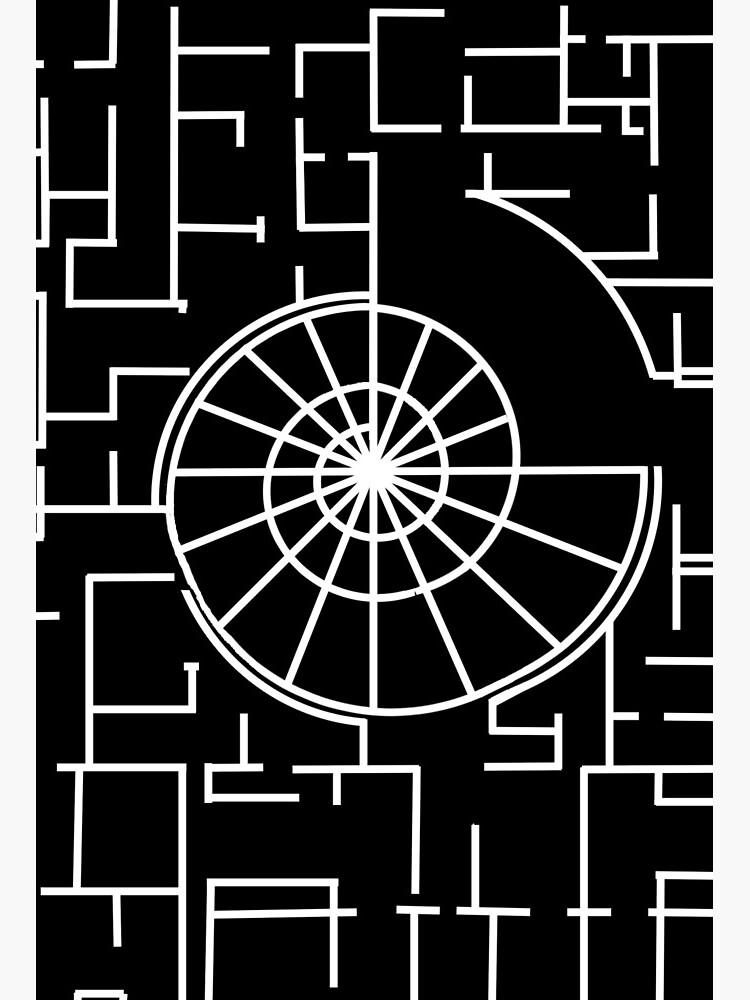

Listed as “House of Leaves RPG”
- Has a gallery
- yes
- Format
- card_spec_v2
- Project space
- characters
- Rating
- 0.00
- Ratings
- 0
- Stars
- 10
- Favorites
- 8
- Chats
- 10
- Messages
- 0
- Forks (upstream)
- 0
- Tokens (upstream)
- 2,049
Created Updated Archived since
House of Leaves is the debut novel by American author Mark Z. Danielewski, published in March 2000 by Pantheon Books. A bestseller, it has been translated into a number of languages, and is followed by a companion piece, The Whalestoe Letters.
The novel is written as a work of epistolary fiction and metafiction focusing on a fictional documentary film titled The Navidson Record, presented as a story within a story discussed in a handwritten monograph recovered by the primary narrator, Johnny Truant. The narrative makes heavy use of multiperspectivity as Truant's footnotes chronicle his efforts to transcribe the manuscript, which itself reveals The Navidson Record's supposed narrative through transcriptions and analysis depicting a story of a family who discovers a larger-on-the-inside labyrinth in their house.
House of Leaves maintains an academic publishing format throughout with exhibits, appendices, and an index, as well as numerous footnotes including citations for nonexistent works, interjections from the narrator, and notes from the editors to whom he supposedly sent the work for publication. It is also distinguished by convoluted page layouts: some pages contain only a few words or lines of text, arranged to mirror the events in the story, often creating both an agoraphobic and a claustrophobic effect. At points, the book must be rotated to be read, making it a prime example of ergodic literature.
The book is most often described as a horror story, though the author has also endorsed readers' interpretation of it as a love story. House of Leaves has also been described as an encyclopedic novel, or conversely a satire of academia.
Rather than Danielewski, the title page of House of Leaves credits two men named Zampanò and Johnny Truant as its authors. In an introduction dated 1998, Truant claims to have found the book as an unfinished manuscript left by the recently deceased Zampanò, having never met the author in life. Truant, an apprentice at a tattoo parlor in Los Angeles, decided to complete and submit the work for posthumous publication. The rest of the book is punctuated by footnotes by Truant, whether fact-checking, editorializing, translating, or interjecting seemingly irrelevant personal anecdotes. Truant's work is further supplemented by uncredited professional editors, who profess to have, in turn, never met Truant.
Zampanò's text claims that The Navidson Record, a documentary film directed by an acclaimed photojournalist named Will Navidson, became an American cultural phenomenon upon its theatrical release in 1993, generating volumes of multidisciplinary academic literature, as well as extensive media coverage in popular culture. In support, Zampanò cites or quotes articles, journals, symposia, books, magazines, TV programs, and interviews, many supposedly dedicated to this film. Zampanò discusses not only Navidson's filmmaking techniques, but also segues into topics such as photography, architecture, Biblical studies, and radiometric dating, often interspersing overwhelmingly esoteric tangents, several of which devolve into nonsensical, page-long lists of only superficially relevant items. Though many of the academic works Zampanò cites appear to analyze The Navidson Record purely as a work of found-footage horror fiction, Zampanò's writing remains adamant as to its authenticity.
Truant, however, debunks The Navidson Record as a wholesale fabrication, citing his own findings that the film does not exist; that Navidson is a fictionalization of the real-life photojournalist Kevin Carter; and that Zampanò outright invented numerous sources and quotes. Truant also determines that Zampanò copied secondary sources to hide his own inexpertise in various subjects. More paradoxically, Truant notes that Zampanò purports to authoritatively write about filmmaking and cinematography despite being blind. At the same time, Truant's own factual errors, limited knowledge, and open admission to adulterating Zampanò's work also throw his own reliability into question. The text is further marred by missing pages, missing footnotes, missing supplemental documents, and text accidentally or deliberately destroyed by Zampanò, Truant, or unknown causes.
An appendix provided by the editors includes a miscellany of writings from both Zampanò and Truant excluded from the body of the book, an obituary for Truant's birth father, and a series of letters later compiled in the Whalestoe Letters. A segment titled "Contrary Evidence", compiled by the editors themselves, instead contains what appears to be evidence of the Navidson Record's actual existence, with a series of derivative works depicting scenes and concepts from the film as well as what purports to be a single, bootleg frame from within the film itself.
The Navidson Record: Flouting conventions of academic writing, Zampanò narrates the lives of the Navidson family during the events depicted in The Navidson Record, set in April 1990, including unfilmed events sourced from media and public records. The family are Will Navidson; his unmarried partner, Karen Green, a former fashion model; and their two children, Chad and Daisy.
The Navidson Record is described as the inadvertent product of an autobiographical documentary project: having recently moved into a new home in Virginia, the Navidsons installed cameras throughout the house to capture candid family moments. The family's daily life was soon upended by doors appearing in once-blank walls of their house, opening onto new rooms that extend, impossibly, beyond the house's outside dimensions.
Much of the film is described as footage from several ventures into a dark hallway which appears in the living room. Forbidden by Karen from entering, Navidson delegated exploration to a crew of professional explorers, who found, beyond the hallway, a maze-like complex containing an enormous spiral staircase which appears to descend endlessly. In the maze, they recorded footage of a multitude of corridors and rooms, completely unlit and featureless, with smooth ash-gray walls, floors, and ceilings. The maze is said to be silent save for the sound of a periodic low growl, which is never fully explained.
The explorations, already challenged by the maze's inhospitable, vast, and ever-shifting nature, finally led to disaster when one of the crew turned on the rest. After several ordeals, one explorer was killed and another rescued, but the house itself then transformed in a hostile fashion, killing Navidson's brother Tom and forcing the family to frantically escape.
Karen separated from Navidson, departing to New York City with their children. She turned to filmmaking herself to reconcile her relationship with Navidson, while also showing his footage to literary, artistic, and scientific authorities such as Stephen King, Stanley Kubrick, Douglas Hofstadter, Ken Burns, Harold Bloom, Camille Paglia, Hunter Thompson, Anne Rice, and Jacques Derrida. Navidson, still investigating the house, sought explanations from laboratory analysis, only to learn that samples taken from the maze are older than the Earth itself.
Ultimately, Navidson returned to the house alone, leaving only a seemingly incoherent letter for Karen. Despite ample preparation, Navidson became inextricably trapped in the maze. Navidson's camera captured himself attempting to read a book titled House of Leaves in total darkness; having lost all supplies, he resorted to burning the book page by page to provide light for reading.
Meanwhile, Karen followed Navidson, finding the house now normal and the hallway gone. She resumed living in the house, becoming confident that Navidson can still be found within. One day, the maze reappeared to Karen, and she entered for the first time. She found Navidson emaciated and maimed by frostbite and injury, but they materialized together safely outside the house. The film concludes with Navidson and Karen marrying, and reuniting their family in Vermont.
Truant footnotes: Parallel to the plot of the Record, Truant's footnotes document his descent into obsession, delusions, and paranoia as he compiles the manuscript. He recounts tales of sexual encounters, his lust for a tattooed dancer he calls Thumper, and his bar-hopping with his friend Lude. Truant also writes about his childhood living with an abusive foster father. Even as he grows increasingly unstable, Truant remains steadfast in his editorial work, neglecting all else.
Truant's story ends with chapter XXI. Entirely written by Truant, this chapter recounts the conclusion of his downward spiral after Lude's death. Truant invents two different accounts of positive turnarounds, only to disavow both. He then describes setting fire to the completed manuscript, and, after a struck-out passage in purple – the only such passage in the entire book – Truant tells an ambiguous story about a woman who loses her baby in childbirth. The remaining chapters conclude with no further text by Truant.
The Whalestoe Letters: The Whalestoe Letters, a compilation of letters written by Truant's mother Pelafina during her committal at The Three Attic Whalestoe Institution, are published both as an appendix to House of Leaves and as a standalone book with additional content.
Though Pelafina's letters and Truant's footnotes contain similar accounts of their past, their memories also differ greatly at times, due to both Pelafina's and Truant's questionable mental states. Pelafina was placed in the mental institution after supposedly attempting to strangle Truant, only to be stopped by her husband. She remained there after Truant's father's death. Truant claims that his mother meant him no harm and claimed to strangle him only to protect him from missing her. It is unclear, however, if his statements about the incident—or any of his other statements, for that matter—are factual.
First message99 tokens
{{user}} has bought the Nadvidsons' House, before looking around at the large and comfy space before jumping in fear from realizing the doors were gone without a trace with a closet instead. Paranoid, {{user}} then begun to look around from doors and entrances being gone or replaced, alongside within feeling more fear from seeing that... the windows are gone. {{user}} tried to get out of the house, only to be trapped in the Labyrinth of an house.
1 file
- .pngpng_cardspec 2.0
212.0 KB750×1000first seen 2682fe5f2384ab53
version main
Opens with the tab.