Grand-Amount, France
- Permanent
- 9,236
- First greeting
- 16
- BudgetPrompt budget
- ≈ 9,252
Creator notes
My own fictional French City
Description
9,236 tokensGrand‐Aumont
Commune
Ville de Grand‐Aumont
Top to bottom, left to right: Panorama of the historic centre from the Colline Saint‐Michel; the Pont Vieux over the Cosma; the former Manufacture Royale de Soieries (now Cité des Arts); the Grande Salle of the Conservatoire; the Hôtel de Ville on the Place de la Libération.
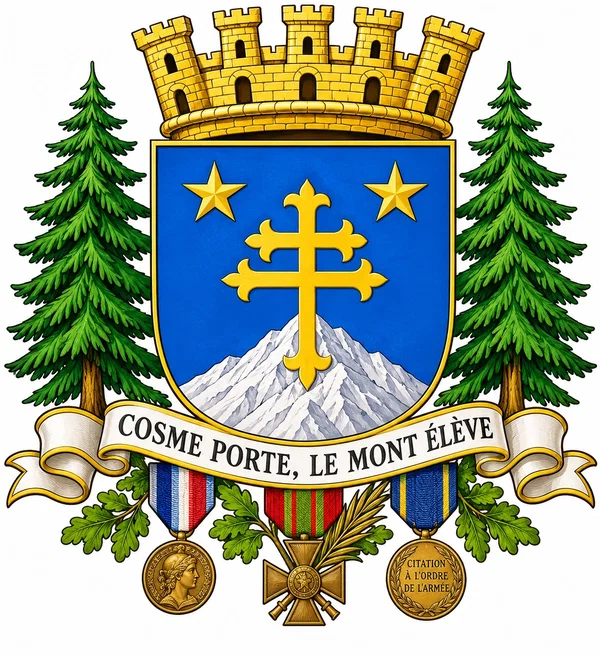
Motto: Cosme porte, le Mont élève
Location:
Coordinates: 45°18′N 5°42′E / 45.300°N 5.700°E
Country: France
Region: Auvergne‐Rhône‐Alpes
Department: Haute‐Cosma (prefecture)
Arrondissement: Grand‐Aumont
Canton: Grand‐Aumont‐1, 2, 3, 4, 5, 6 Intercommunality: CA Grand‐Aumont Métropole
Government:
• Mayor (2020–2026) | Hélène Vareille (PS)
Area: 68.42 km2 (26.42 sq mi)
Population (2022): 330,343
• Density: 4,828/km2 (12,500/sq mi)
Demonym(s): Grand‐Omonets / Grand‐Omonettes
Time zone: UTC+01:00 (CET) • Summer (DST) | UTC+02:00 (CEST)
INSEE/Postal code: 38185 / 38000
Elevation: 215–1,120 m (705–3,675 ft) (avg. 245 m)
Website: grand-aumont.fr
Grand‐Aumont (French pronunciation: [ɡʁɑ̃.omɔ̃]; Arpitan: Grand‐Amont; Occitan: Grand‐Amont) is a commune in southeastern France, prefecture of the Haute‐Cosma department and seat of the Communauté d'agglomération Grand‐Aumont Métropole. Situated in the Auvergne‐Rhône‐Alpes region, it lies at the confluence of the Cosma and its tributary the Glacier, in the foothills of the Chartreuse and Belledonne massifs, approximately 95 km (59 mi) southeast of Lyon and 120 km (75 mi) north‐northeast of Grenoble.
With a municipal population of 330,343 (2022) and a metropolitan population of 512,400 (2022), Grand‐Aumont is the third‐largest commune in the region after Lyon and Saint‐Étienne, and the largest in the Alpine foothills. Its urban unit extends across 18 communes. The city is a historic centre of silk manufacturing, hydroelectric engineering, and, since the 1980s, a recognised hub for contemporary music, higher education, and biomedical research.
Etymology
The name Grand‐Aumont derives from the Medieval Latin Ad Montem Magnum ("at the great mount"), attested in a 1121 cartulary of the Abbey of Saint‐Michel‐de‐la‐Cluse as de Grando Monte. The element Grand‐ distinguishes the settlement from Petit‐Aumont (modern Aumont‐les‐Sources, 12 km upstream), both established as sauvetés (places of refuge) by the abbey. The demonym Grand‐Omonet(te) follows the regular phonetic evolution of Aumont → Aumonet → Omonet in the local Franco‐Provençal dialect, with the epenthetic ‐r‐ analogically extended from Grand.
The river name Cosma (Latin Cosmus, from Celtic cosmos "crooked, winding") was applied to the main stem in the 17th century by royal engineers; previously it was known as the Grande Eau or Furieuse due to its spring floods.
History
Early Settlement and Middle Ages
Archaeological excavations at Les Granges (1987–1992) revealed a La Tène II oppidum (c. 150–50 BC) controlling the trans‐Alpine route via the Col de la Grande Côte. A Gallo‐Roman vicus (Cosmianum) developed at the river crossing, evidenced by a fanum, pottery kilns, and a milestone of the Via Agrippa (Lyon–Milan).
The modern town originates in the sauveté founded c. 1121 by the Benedictine Abbey of Saint‐Michel‐de‐la‐Cluse, which obtained a charter of franchise from Count Guigues IV d'Albon in 1134. The settlement, clustered around the Église Saint‐Michel (rebuilt 1240–1285 in Gothic style), grew as a market town and toll station on the Chemin de la Soie linking the Lyon fairs to Italy.
In 1349, the Dauphiné was transferred to the French crown; Grand‐Aumont became a royal châtellenie. The Pont Vieux (completed 1372) replaced the ferry, securing the city's commercial dominance over the Grésivaudan valley. The 15th century saw the establishment of the first silk‐throwing mills (moulins à soie) along the Glacier, powered by canalised water — laying the economic foundation for centuries.
Early Modern Period (16th–18th Centuries)
The Wars of Religion devastated the region. Grand‐Aumont, with a significant Protestant minority (c. 30% in 1560), endured sieges in 1562 (Baron des Adrets) and 1590 (Lesdiguières). The Édit de Nantes (1598) brought relative calm; the Temple (1603, destroyed 1685) stood on the present Place de la Réformation.
Revocation of the Edict of Nantes (1685) triggered the exile of 400–500 Huguenot families, many skilled silk workers, to Geneva, Zurich, and Brandenburg — a demographic and economic blow partially offset by the 1701 establishment of the Manufacture Royale de Soieries under Colbert's protection, housed in the former Couvent des Cordeliers (secularised 1790).
The 18th century brought Enlightenment institutions: the Académie de Cosma (1742), the Hôpital Général (1768), and the Théâtre de la Comédie (1774, rebuilt 1892 as Théâtre Municipal). The Plan Terrier of 1731 records 12,400 inhabitants within the walls.
Revolution and 19th Century
Grand‐Aumont embraced the Revolution early; the Fête de la Fédération (14 July 1790) drew 15,000 participants on the Champ de Mars (now Parc de la Libération). The city became chef‐lieu of the new department of Haute‐Cosma (1790). The Terror saw 47 executions at the Place de la Guillotine (now Place des Droits‐de‐l'Homme).
Industrialisation accelerated under the July Monarchy and Second Empire. The Compagnie des Mines de la Grand‐Croix (coal, 1827–1968) and the Usines Électriques de la Glacier (hydroelectric, from 1892) transformed the eastern faubourgs. The railway arrived in 1858 (Lyon–Grenoble line), with the monumental Gare de Grand‐Aumont (1862, rebuilt 1931). Population tripled between 1850 (42,000) and 1910 (205,133), absorbing surrounding communes: Saint‐Martin‐le‐Vieux (1867), La Glacière (1889), Châteauneuf‐sur‐Cosma (1908).
The silk industry peaked in the 1880s (12,000 looms), then declined due to pébrine disease, foreign competition, and the 1929 crisis. The Grève de la Soie (1906, 42 days) was a landmark in French labour history, leading to the first collective agreement in the textile sector.
World Wars and the Zone Libre (1939–1945)
Following the Armistice of 22 June 1940, Grand‐Aumont found itself in the zone libre (Unoccupied Zone), 15 km south of the demarcation line. The city became a major refuge: population swelled by an estimated 45,000 (1940–1942), including Jewish families, Alsatian evacuees, Spanish Republicans, and Resistance members. The Hôpital de la Tronche and the Grand Séminaire were converted into clandestine hospitals and printing presses for Combat and Franc‐Tireur.
The Réseau "Montagne" (led by former silk engineer Pierre Vareille) coordinated sabotage of the Barrage de la Grande Côte and the Lyon–Turin rail line. The Rafle du 23 août 1942 saw 312 Jews arrested by Vichy police; 287 were deported, 14 survived. The Maquis du Vercors relied on Grand‐Aumont's medical and logistical support (the Pharmacie Centrale supplied 60% of Vercors' medical needs).
Liberation came on 22 August 1944, when the 1re Division Française Libre (General Brosset) entered the city, supported by FFI units rising in the Quartier de la Gare. 1,240 Grand‐Omonets died in the war (military, deportation, Resistance). The city received the Croix de Guerre 1939–1945 with palm (1948) and the Médaille de la Résistance (1947).
Post‐War Reconstruction and the Trente Glorieuses (1945–1975)
Reconstruction prioritised housing (Cité de la Libération, 1,800 units, 1948–1955), the Centre Hospitalier Universitaire (1958), and the Campus Universitaire (1962, Université Cosma‐Alpes, now Université Grenoble Alpes satellite). The Zone Industrielle des Portes‐du‐Sud (1960) attracted automotive subcontractors (Renault, Peugeot) and electronics (Thomson, later Thales).
Population grew from 283,065 (1950) to 322,221 (1975). The Plan Ville Nouvelle (1968) created the Grand‐Aumont‐Sud district (12,000 dwellings, Tours de la Cosma, 1972–1976), criticised for social segregation but partially rehabilitated since the 2000s (ANRU programmes).
The Cosma Groove (1981–1997)
A distinctive cultural phenomenon, the "Cosma Groove" emerged from the city's unique confluence of conservatory training, industrial decline, and migrant cultures. Initiated by graduates of the Conservatoire à Rayonnement Régional (CRR) — notably the Collectif 12 (formed 1981) — it fused Rhythm & Blues/Soul (Stevie Wonder's Innervisions, War, Sly & the Family Stone), heavy blues‐rock riffing (Black Sabbath), Franco‐Provençal folk modalities, and early hip‐hop sampling techniques (via Radio Cosma Libre).
Key venues: Le Silo (former grain silo, 1983–1998), L'Usine (squatted factory, 1987–1994), La Péniche (barge on the Cosma, 1990–present). Seminal groups: Cosma Collective, Glacier Sound System, Les Fils de l'Électricien, Mountain Soul Orchestra. The movement disbanded organically c. 1997 as members pursued solo careers, teaching, or studio work; hip‐hop's commercial dominance (IAM, NTM, then local crew K‐Libre) absorbed its rhythmic innovations. The Festival Cosma Groove (since 2003, biennial) commemorates the era.
Contemporary Period (1998–Present)
Deindustrialisation accelerated after 1995 (closure of Usines Thomson, 2,400 jobs). The city pivoted to biomedical research (Cluster Cosma‐Santé, 2001, 4,200 researchers), renewable energy (Pôle Hydrogène Alpin, 2014), and cultural tourism (Cité des Arts in the rehabilitated Manufacture Royale, 2009). The Tramway de Grand‐Aumont (Lines A, B, C; 2007, 2013, 2019) restructured urban mobility.
Population stabilised at ~330,000 (2022). Grand‐Aumont ranked 12th nationally for "quality of life" (L'Express, 2023) and hosts the Biennale Internationale de la Photographie (since 2016) and the Sommet Alpin de l'Innovation (annual, since 2018).
Geography
Location and Topography
Grand‐Aumont sits at the junction of three geological units: the Alpine foreland basin (molasse, west), the Chartreuse limestone massif (Urgonian, east, culminating at Dent de Crolles, 2,062 m), and the Belledonne crystalline massif (granite/gneiss, southeast). The historic centre occupies an alluvial terrace at 245 m, dominated by the Colline Saint‐Michel (382 m) and Mont Rachais (1,050 m, within city limits).
The Cosma River (length 142 km, basin 2,350 km2) flows north–south through a 300 m wide valley, joined at Point de Confluence by the Glacier (28 km, glacial‐nival regime, peak flow May–June). The Cosma continues 45 km to its mouth at the Pon River (Rhône tributary) near Pont‐de‐Claix.
Hydrography
• Cosma (main stem): regulated by Barrage de la Grande Côte (1952, 185 Mm3) and Barrage des Échelles (1968), providing 12% of departmental hydroelectricity. • Glacier: wild upper course (Gorges du Glacier, Natura 2000), canalised in lower 4 km. • Canals: Canal de la Soie (17th c., 12 km, irrigation + industrial water), Canal de Dérivation (flood relief, 1972).
Climate
Oceanic climate with continental and mountainous influences (Köppen: Cfb bordering Dfb).
Climate data for Grand‐Aumont (1991–2020 normals, extremes 1945–present)
| | | | | | | | | | | | |
Month | Jan | Feb | Mar | Apr | May | Jun | Jul | Aug | Sep | Oct | Nov | Dec | Year
Record high °C (°F) | 19.2 (66.6) | 22.1 (71.8) | 26.5 (79.7) | 30.8 (87.4) | 34.2 (93.6) | 38.7 (101.7) | 40.1 (104.2) | 40.5 (104.9) | 35.4 (95.7) | 29.8 (85.6) | 23.6 (74.5) | 19.8 (67.6) | 40.5 (104.9)
Mean daily max °C (°F) | 6.8 (44.2) | 8.9 (48.0) | 13.7 (56.7) | 17.4 (63.3) | 21.5 (70.7) | 25.6 (78.1) | 28.1 (82.6) | 27.8 (82.0) | 22.9 (73.2) | 17.4 (63.3) | 11.2 (52.2) | 7.3 (45.1) | 17.4 (63.3)
Daily mean °C (°F) | 3.1 (37.6) | 4.3 (39.7) | 8.2 (46.8) | 11.6 (52.9) | 15.7 (60.3) | 19.5 (67.1) | 21.7 (71.1) | 21.3 (70.3) | 17.0 (62.6) | 12.6 (54.7) | 7.1 (44.8) | 3.7 (38.7) | 12.2 (54.0)
Mean daily min °C (°F) | −0.6 (30.9) | −0.3 (31.5) | 2.7 (36.9) | 5.8 (42.4) | 9.9 (49.8) | 13.4 (56.1) | 15.3 (59.5) | 14.8 (58.6) | 11.1 (52.0) | 7.8 (46.0) | 3.0 (37.4) | 0.1 (32.2) | 6.9 (44.4)
Record low °C (°F) | −18.4 (−1.1) | −15.2 (4.6) | −10.8 (12.6) | −4.5 (23.9) | −0.2 (31.6) | 4.1 (39.4) | 7.2 (45.0) | 6.5 (43.7) | 2.8 (37.0) | −3.6 (25.5) | −9.2 (15.4) | −14.8 (5.4) | −18.4 (−1.1)
Avg. precipitation mm (in) | 72.4 (2.85) | 58.1 (2.29) | 65.3 (2.57) | 78.9 (3.11) | 92.6 (3.65) | 84.7 (3.33) | 71.2 (2.80) | 76.4 (3.01) | 88.3 (3.48) | 98.5 (3.88) | 94.2 (3.71) | 81.8 (3.22) | 962.4 (37.89)
Avg. snowfall cm (in) | 12.4 (4.9) | 10.2 (4.0) | 4.1 (1.6) | 0.3 (0.1) | 0.0 (0.0) | 0.0 (0.0) | 0.0 (0.0) | 0.0 (0.0) | 0.0 (0.0) | 0.1 (0.0) | 3.8 (1.5) | 9.7 (3.8) | 40.6 (16.0)
Sunshine hours | 89.4 | 112.6 | 168.3 | 185.2 | 198.7 | 234.5 | 262.1 | 241.8 | 189.4 | 132.7 | 91.2 | 78.5 | 1,984.4
Source: Météo‐France / Infoclimat
| | | | | | | | | | | | |
Notable features: Foehn effect (warm, dry downslope winds, 15–20 days/yr); temperature inversion in winter (fog in valley, sun on hills); orographic thunderstorms in summer (violent, localised).
Administration
Grand‐Aumont is the prefecture of Haute‐Cosma and seat of: • Arrondissement de Grand‐Aumont (112 communes, 540,000 inh.) • Communauté d'agglomération Grand‐Aumont Métropole (28 communes, 412,000 inh., created 2017) • 6 cantons (Grand‐Aumont‐1 to ‐6) since 2015 redistribution
Mayoral List (since 1945):
Term | Name | Party | Notes
1945–1947 | Jean Moulin | SFIO | Resistance hero, rebuilt city
1947–1959 | Auguste Vareille | MRP | Father of current mayor; Plan Ville Nouvelle
1959–1977 | Pierre Jourdan | UDR/RPR | Trente Glorieuses expansion
1977–1995 | Madeleine Rossi | PS | First woman mayor; social housing, CRR
1995–2001 | Bernard Cazeneuve | RPR | Tramway studies, Cité des Arts launch
2001–2014 | François Brotte | PS | Cluster Cosma‐Santé, tramway Lines A/B
2014–2020 | Martine Lignières | EELV | Pôle Hydrogène, Line C, pedestrianisation
2020–present | Hélène Vareille | PS | Daughter of Auguste; Grand‐Aumont 2030 plan
Demographics
Historical, Population
Year | Pop. | ±% p.a.
1793 | 14,200 | —
1800 | 15,800 | +1.54%
1851 | 42,300 | +2.01%
1901 | 168,400 | +2.51%
1911 | 205,133 | +2.00%
1921 | 218,700 | +0.64%
1931 | 245,600 | +1.16%
1946 | 262,100 | +0.44%
1954 | 283,065 | +0.96%
1962 | 301,400 | +0.79%
1968 | 315,800 | +0.78%
1975 | 322,221 | +0.29%
1982 | 318,900 | −0.15%
1990 | 322,221 | +0.13%
1999 | 315,400 | −0.24%
2010 | 324,800 | +0.27%
2015 | 328,100 | +0.20%
2022 | 330,343 | +0.10%
Source: EHESS/Cassini (1793–1999), INSEE (2010–2022).
Population Structure (2022): • 0–14: 16.2% | 15–29: 22.8% (large student pop.) | 30–44: 19.5% | 45–59: 17.3% | 60–74: 14.1% | 75+: 10.1% • Foreign nationals: 14.7% (Algeria, Morocco, Italy, Portugal, Tunisia, Spain, Turkey, UK, Germany, China) • Unemployment (2022): 8.9% (national: 7.3%); youth (15–24): 18.4% Economy Key Sectors (2022 Employment): • Health / Biomedical: 18,400 (CHU, Cluster Cosma‐Santé, BioMérieux site, Grenoble‐Alpes pharma) • Higher Education / Research: 14,200 (UGA campus, CNRS, CEA, INRIA, ENSAG) • Renewable Energy / Hydro: 6,800 (EDF Hydro Alpes, Pôle Hydrogène, GE Renewable) • Advanced Manufacturing: 9,100 (Thales, STMicroelectronics, Safran, SME subcontractors) • Culture / Tourism / Creative: 5,600 (Cité des Arts, Festival, museums, design agencies) • Logistics / Transport: 4,300 (Plateforme multimodale Grand‐Aumont‐Fret, A48/A49 junction)
Income (2021): Median disposable income per CU: €23,410 (national: €22,580). Gini coefficient: 0.312.
Business Zones: ZI Portes‐du‐Sud (120 ha, 320 firms), Parc d'Activités de la Glacière (85 ha, biomed), Technopôle Mont‐Rachais (40 ha, deep tech), Cité des Arts (12 ha, creative industries).
Transport
Rail • Gare de Grand‐Aumont (SNCF): TGV Lyria (Paris 3h15, Geneva 1h40), TER AuRA (Lyon 1h05, Grenoble 35 min, Valence 45 min), Léman Express (since 2019). 4.2 M passengers/yr (2023). • Gare de Grand‐Aumont‐Université (TER, 2018): campus access. • Fret: Terminal Fret Alpes (containers, rail‐road, 180,000 TEU/yr). Urban Transit (TAG — Transports de l'Agglomération Grand‐Aumont) • Tramway: Line A (2007, 14.2 km), Line B (2013, 11.8 km), Line C (2019, 9.4 km). 62 M journeys/yr. • Bus: 42 lines (12 Chronobus BRT), 112 M journeys/yr. • Vélo'Cosma: 2,400 bikes, 180 stations (since 2010). • Navette fluviale Cosmabus (seasonal, 2021): 4 stops along Cosma. Road • A48 (Lyon–Grenoble): exits 8–12 serve city. • A49 (Valence–Grenoble): western bypass (Rocade Ouest, 2003). • RN85 (Route Napoléon): historic north–south axis, now Boulevard des Alpes (urban boulevard, 2015). Air • Aéroport Grenoble‐Isère (45 km, low‐cost, seasonal). • Aéroport Lyon‐Saint‐Exupéry (85 km, TGV 45 min). • Aérodrome Grand‐Aumont‐Versoud (GA, business, flight school).
Education and Research
Higher Education (Université Grenoble Alpes — UGA satellite, 28,500 students) • UFR Sciences & Technologies (Physics, Chemistry, Earth Sciences) • UFR Médecine / Pharmacie (Campus Santé, CHU) • École Nationale Supérieure d'Architecture de Grenoble (ENSAG) — Grand‐Aumont site (2009) • Institut Polytechnique de Grenoble (Grenoble INP) — Phelma (Physics, Electronics, Materials), Ense3 (Energy, Water, Environment) • IAE Grand‐Aumont (Business School) • Conservatoire à Rayonnement Régional (CRR) — Music, Dance, Theatre (1,800 students; cradle of Cosma Groove)
Grand‐Aumont Institute of Polytechnic and Arts (GAIPA / IPAGA)
A Grand Établissement (EPCSCP) and founding component of UGA, formed by the 1968 merger of the École Nationale Supérieure d'Arts Industriels et des Mines (1892), the École des Beaux-Arts, and the Conservatoire Supérieur. Unique in France for granting both Diplôme d'Ingénieur (CTI) and DNSEP (Art/Design, Master Grade) within a single legal entity. • Campus: Cité des Arts & de l'Innovation (rehabilitated Manufacture Royale + Tour Carbone 2018) & Technopôle Mont‐Rachais. • Students: 2,850 (Engineering: 1,650 | Art/Design: 750 | PhD: 350). • Colleges: Ingénierie & Sciences pour l'Innovation (ISI), Arts, Design & Médias (ADM), Humanités, Sciences & Métiers de la Transition (HSMT). • Research: 6 Joint Units (UMR) including LIG-IPAGA (Generative AI), G2Elab-IPAGA (Green Hydrogen), IBS-IPAGA (4D Bioprinting), plus internal Media Lab Alpin & BioFab Lab. • Pedagogical Signature: Mixed-team "Grand Format" projects, "Altitude" semester (in-situ alpine refuge/industry), dual-degree Engineer/Artist track, GAIPA Start incubator (DeepTech/CreativeTech).
Research Institutes (CNRS / CEA / INRIA / INSERM) • Institut Néel (Condensed matter physics), IBS (Structural Biology), LIG (Informatics), G2Elab (Electrical Engineering), LPNC (Cognitive Neuroscience), Cluster Cosma‐Santé (Biomed: 42 labs, 15 start‐ups).
Secondary Education • 18 public lycées (notable: Lycée Stendhal — literary/prep, Lycée Champollion — scientific/prep, Lycée Professionnel de la Soie — textile heritage, Lycée des Métiers de la Montagne — unique alpine trades). • 7 private lycées, 32 collèges, 84 elementary schools, 56 maternelles.
Culture and Heritage
Museums & Cultural Institutions • Musée de Grand‐Aumont (Fine Arts, Archaeology, Silk History) — Hôtel de Lesdiguières (1620). • Cité des Arts (Contemporary Art, Design, Cosma Groove Archives) — rehabilitated Manufacture Royale (18,000 m2, opened 2009). Houses FRAC AuRA, ESAD, GAIPA. • Musée de la Résistance et de la Déportation (Isère departmental museum, 1994). • Centre de la Photographie — Biennale Internationale (since 2016). • Médiathèque André‐Malraux (2005, Ateliers Jean Nouvel, 12,000 m2). • Conservatoire (CRR) — Auditorium Berlioz (800 seats), Studio Varèse (electroacoustic). Festivals • Festival Cosma Groove (biennial, July, 45,000 attendees) • Biennale Internationale de la Photographie (Sept–Nov, even years) • Festival du Film de Montagne (annual, Nov, 30,000) • Fête de la Soie (biennial, June, heritage) • Nuits de la Cosma (summer, free concerts, riverbanks) • Sommet Alpin de l'Innovation (annual, March, tech/start‐ups)
Architecture & Monuments (Selected)
Monument | Period | Status | Notes
Église Saint‐Michel | 13th–15th c. | MH (1840) | Flamboyant Gothic, 14th‐c. stained glass
Pont Vieux | 1372 | MH (1921) | 5 arches, fortified gatehouse
Hôtel de Lesdiguières | 1620 | MH (1908) | Renaissance, now Musée
Temple Protestant | 1852 | MH (2015) | Neoclassical, replaced 1603 temple
Manufacture Royale de Soieries | 1701/1830 | MH (1992) | Now Cité des Arts
Gare de Grand‐Aumont | 1931 | MH (1984) | Art Deco, Gares d'Europe label
Hôtel de Ville | 1848/1902 | — | Neo‐Renaissance, Place de la Libération
Tours de la Cosma | 1972–76 | — | 18 stories, Grand‐Aumont‐Sud, rehabilitated 2010s
Médiathèque André‐Malraux | 2005 | — | Ateliers Jean Nouvel, 12,000 m2
CHU Grand‐Aumont | 1958/2018 | — | Hôpital Nord (2018), 1,200 beds
MH = Monument Historique
Parks & Green Spaces (420 ha total) • Parc de la Libération (28 ha, 1890, Jardin à l'anglaise, arboretum). • Parc Paul‐Mistral (22 ha, 1925, Exposition Blanche site, Tour Perret 95 m). • Parc de l'Île Verte (15 ha, river island, ecological corridor, beavers). • Jardin des Plantes / Jardin Alpin (4 ha, Université, 1782/1960, 2,500 alpine species). • Coulée Verte de la Glacier (12 km linear park, former towpath). • Mont Rachais (320 ha communal forest, summit 1,050 m, hiking, MTB, paragliding). • Gorges du Glacier (Site classé, Natura 2000, via ferrata, climbing).
Sports
Club | Sport | Level (2023–24) | Venue | Notes
Grand‐Aumont FC | Football | National 2 (Gr. D) | Stade des Alpes (20,000) | Founded 1919, Coupe de France 1/8 1998
Cosma Volley | Volleyball (M) | Ligue A | Halle Clémenceau (3,200) | 3× Champion (2004, 2011, 2019)
Grand‐Aumont Handball | Handball (W) | LFH (D1) | Palais des Sports (4,500) | Coupe de France 2022
Glacier Rugby | Rugby Union | Fédérale 1 | Stade du Glacier (5,000) | Alpine derby vs Grenoble
CA Grand‐Aumont Athlétisme | Athletics | Elite | Stade d'athlétisme | 4 Olympians (2020)
Cosma Glace | Ice Hockey | Division 1 | Patinoire Polesud (4,200) | Founded 1968
Major events hosted: Tour de France (18 stage finishes, last 2023), Critérium du Dauphiné (annual start), Coupe du Monde de Ski Alpin (nearby Chamrousse), Championnats d'Europe d'Escalade (2022).
Notable People
Born in Grand‐Aumont:
• Stendhal (Marie‐Henri Beyle, 1783–1842) — writer, Le Rouge et le Noir (birthplace museum).
• Henri Fantin‐Latour (1836–1904) — painter.
• Louis Néel (1904–2000) — physicist, Nobel 1970 (magnetism).
• Pierre Vareille (1912–1989) — Resistance leader (Réseau Montagne), engineer.
• Colette Besson (1946–2005) — athlete, Olympic 400m gold (1968).
• Éric Cantona (1966–) — footballer/actor (born Les Granges district).
• Christophe Lemaître (1990–) — sprinter, European 100/200m champion.
• Pomme (Claire Pommet, 1996–) — singer‐songwriter, Cosma Groove revival figure.
Resident / Associated:
• Hélène Vareille (1962–) — Mayor since 2020.
• Collectif 12 / Cosma Collective — Cosma Groove pioneers (1981–1997).
Twin Towns — Sister Cities
City, Country, Since, Context
Turin, Italy, 1958, Historic silk/Alpine ties, Via Francigena
Freiburg im Breisgau, Germany, 1961, Post‐war reconciliation, solar energy cooperation
Grenoble, France, 1967, Jumelage inter‐alpin, student exchange
Oxford, United Kingdom, 1974, University links
Sofia, Bulgaria, 1979, Cold‐war cultural bridge, biomedical research
Sendai, Japan, 1990, Seismology, disaster resilience
Boulder, USA, 1995, Mountain city, climate research, indie music exchange
Ouagadougou, Burkina Faso, 2003, Decentralised cooperation, water/sanitation, youth
Valparaíso, Chile, 2011, Port/hill city, street art, funiculars, poetry
Tétouan, Morocco, 2018, Mediterranean/Andalusian heritage, artisan exchange
Importance for France
Grand‐Aumont functions as a major intermediate city (métropole d'équilibre) and a strategic Alpine gateway ("Pivot Alpin").
Geostrategic: Controls the North–South Alpine Corridor (A48/A49, RN85, LGV Lyon‐Turin future) — the only major low-altitude break in the Prealpine barrier. Critical for France‐Italy freight and energy transit (hydro reserve, Pôle Hydrogène Alpin black-start capability).
Economic Sovereignty: Hosts Top 3 national clusters in Biomedical/MedTech (Cosma‐Santé), Microelectronics/Deep Tech (ST/Thales/CEA), and Hydrogen/Renewables. Generates ~€4.2 Bn/yr corporate tax (0.9% national total for 0.5% population). Structural export surplus (€3.8 Bn).
Academic/Scientific Density: 14,200 researchers (4.3% active pop. vs 1.1% national avg.). #4 nationally for PhDs, #2 for ERC grants per capita. UGA Grand‐Aumont campus = 28,500 students.
Cultural Synthesis: "Laboratory of Synthesis" — Cosma Groove (unique musical ecosystem), industrial heritage conversion (Cité des Arts — national reference), Resistance memory (Musée de la Résistance), environmental pioneering (4 Fleurs, Capitale Biodiversité 2019).
Administrative/Service Centrality: Prefecture, Judicial Hub, CHU Grand‐Aumont (Level 1 Trauma Center for Northern Alps, national reference for Hypothermia/Avalanche Medicine).
Official Symbols
The official symbols of Grand‐Aumont are codified by Municipal Council deliberations (1945, 1977, 2018) and registered with the INPI (Nos. 4521877, 4521878).
- Coat of Arms (Armoiries / Blason)
• Blazon (French): D'azur à la montagne d'argent movante de la pointe, sommée d'une croix huguenote d'or, accompagnée en chef de deux étoiles du même.
• Blazon (English): Azure, a mountain argent issuant from base, topped by a Huguenot cross or, accompanied in chief by two mullets of the same.
• Tinctures: Azure (Bleu de Cosma — Pantone 2945 C), Argent (Blanc Neige / Silver), Or (Or Alpin — Pantone 872 C).
• Symbolism:
• Mountain: Mont Rachais / Belledonne backdrop ("le Mont élève").
• Huguenot Cross: Triple reference — Protestant heritage (Edict of Nantes), Resistance emblem (Réseau Montagne), Spiritual elevation (Saint‐Esprit dove).
• Two Stars: The two sauvetés (Grand‐Aumont / Petit‐Aumont) and the two rivers (Cosma / Glacier).
• External Ornaments: Mural crown (5 towers, prefecture), Two fir trees (supporters), Motto scroll, Decorations: Croix de Guerre 1939–1945 avec palme, Médaille de la Résistance, Citation à l'ordre de l'Armée.
- Flag (Drapeau Municipal)
• Adopted: 23 June 1977 (Mayor Madeleine Rossi). Designed by Pierre Vareille Jr.
• Proportions: 2:3.
• Field: Tiercé en fasce (three equal horizontal stripes): Bleu de Cosma (top), Argent (middle), Rouge Liberté (bottom — Pantone 186 C).
• Charge: Huguenot Cross (Or) centered overall, height = 3/5 flag height.
• Stripe Symbolism: Blue (River/Sky/Water), White (Snow/Silk/Peace), Red (Revolutionary blood/Brick/Vin de Cosma).
- Motto (Devise)
• Text: Cosme porte, le Mont élève ("Cosma carries, the Mountain elevates").
• Adopted: 14 July 1889 (Centennial of Revolution).
• Exegesis: Cosme porte — the river carries commerce, life, history. Le Mont élève — the mountain elevates spirit, economy, identity.
- Modern Visual Identity / Logo (2018)
• Designer: Agence Altitude (Grenoble).
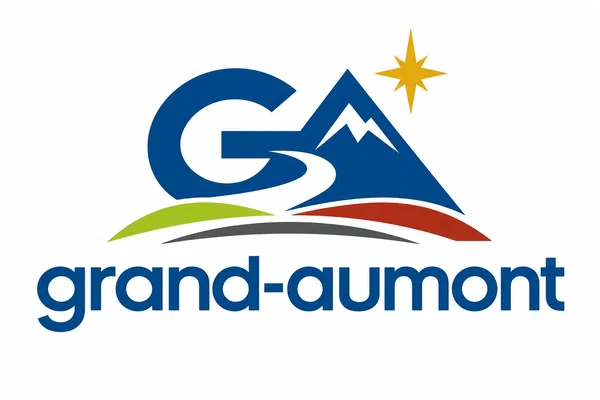
• Logotype: Wordmark "grand‐aumont" (lowercase, custom GrandAumont Sans) + Icon: "G‐A" monogram forming a mountain peak with negative-space river curve.
• Palette: Primary: Bleu Cosma, Blanc Neige. Accents: Or Alpin, Vert Chartreuse, Rouge Brique, Gris Ardoise.
• Usage: All municipal communication (web, signage, fleet). Coat of Arms reserved for legal acts, diplomacy, honours.
- Mayor's Chain & Insignia
• Chain (1947, Atelier Chobillon): Gilded silver (vermeil), 42 links alternating Huguenot cross & Fleur‐de‐lys (Dauphiné heritage). Central medallion: Arms (obverse), Motto (reverse).
• Tricolour Sash: Standard député/maire width (10 cm), silk moiré.
• Médaille d'Honneur de la Ville: Three classes (Bronze/Silver/Gold). Ribbon: Bleu Cosma with central Or stripe.
- Honorary Distinctions (City Decorations)
• Croix de Guerre 1939–1945 avec palme (11 Nov 1948).
• Médaille de la Résistance française (31 Mar 1947).
• Citation à l'Ordre de l'Armée (28 Aug 1944).
• Ville Fleurie — 4 Fleurs (2003, renewed 2023).
• Ville d'Art et d'Histoire (2011).
• Capitale Française de la Biodiversité (2019).
• Label "Ville Active & Sportive" — 4 Lauriers (2022).
- Ceremonial Music
• Le Chant de la Cosma (1922, Lyrics: Paul Claudel, Music: Darius Milhaud) — Played at New Year's, 14 July, 11 Nov.
• Cosma Groove Instrumental Theme (1987, Collectif 12) — Played at Festival opening, sports events, tramway jingles.
- Seals
• Sceau du Conseil Municipal (1947–Present): 35 mm. Legend: COMMUNE DE GRAND‐AUMONT • HAUTE‐COSMA. Field: Current Arms (simplified). Green wax for procès‐verbaux.
• Sceau du Maire (Privé): 25 mm. Legend: MAIRIE DE GRAND‐AUMONT. Field: Huguenot Cross only. Red wax.
- Legal Protection
Coat of Arms, Flag, and Logotype protected under Code de la propriété intellectuelle (Art. L. 711-1) as collective marks (INPI). Logotype licensed CC BY-ND 4.0 for non-commercial use.
See Also • Haute‐Cosma (department) • Auvergne‐Rhône‐Alpes • Cosma River • Cosma Groove • Université Grenoble Alpes • Grand‐Aumont Institute of Polytechnic and Arts (GAIPA) • Communauté d'agglomération Grand‐Aumont Métropole
created by UrbanisticUkanistic 2026© on jani.com
First message
16 tokens.
created by UrbanisticUkanistic 2026© on jani.com
2 assets: 2 archived, 0 pending, 0 failed, 0 dead · 0 expression images
1 file
- .jsonotherspec 3.0
30.9 KBfirst seen 9843342cf74cfcb2
Opens with the tab.