
- Format
- V2
- Project space
- lorebooks
- Rating
- 0.00
- Ratings
- 0
- Stars
- 20
- Favorites
- 10
- Messages
- 0
- Forks (upstream)
- 0
- Tokens (upstream)
- 1,464
Created Updated Archived since
No description.
13 entries · scan depth 2 · budget 512 tokens
- #1
Keys: Vault 13
Vault 13 is one of the Vault-Tec Corporation's trademark Vaults, with 13 being built in the southern half of the American state of California. The Vault has a stocked supply of pre-War canned foods and clean water, it's inhabitants also grow their own food underground. Vault's hierarchy is structured with the Overseer at the top, who makes the major decisions and sets the rules. Security guards operate under the Overseer to enforce those rules and maintain order within the vault. Below them are the vault dwellers, the general population, who live and work in the vault while following the rules set by the Overseer and enforced by security. Every inhabitant must wear a blue jumpsuit with the Vault's number.
- #2
Keys: Shady Sands
Shady Sands is a small, quiet agricultural settlement in post-apocalyptic California. Surrounded by protective sandstone walls, Shady Sands is a peaceful community led by chief Aradesh, an Indian man who keeps his community safe and preaches about Dharma. Shady Sands established a small self-sufficient community, managing to irrigate the wasteland soil to support crops (primarily maize and cabbage), drill a well to provide them with water, and even establish brahmin herds. Shady Sands gates are guarded by riflemen, in order to defend against radscorpions and raiders.
- #3
Keys: Khans
The Khans are a raider tribe found in post-apocalyptic California, they camp to the southeast and pillage local communities, steal their supplies, kidnap and violate their women. The Khans are a bloodthirsty, violent, and extreme group of desert warriors. Khans usually wear leather jackets mixed in with some armor pieces they loot, they fight with melee/blunt weapons and shotguns. Khans don't live by any moral rules and don't have any strict hierarchy.
- #4
Keys: Junktown
Junktown is a major settlement in southern post-apocalyptic California, known for catering to weary travelers and roughhousing gangsters alike, the town was one of the first substantial post-War trading hubs on the West Coast. As its name suggests, Junktown's defining structures were created out of random pieces of junk, mostly from wrecked cars left in the wake of the bombs. In the early post-nuclear wasteland, the town mostly lived off of trading and had a reputation for open hospitality so long as one is hospitable in return. The mayor of Junktown is Killian Darkwater, grandson of the town's founder. Other important places include the Crash-House Inn, home to lowlives, Gizmo's Casino, a gambling spot ran by a greedy bastards, and the Skum Pitt, a thrashy bar owned by Neal.
- #5
Keys: The Hub
The Hub (also called The Hub Trading Co.) is a major trading center and settlement established in an old town relatively untouched by the Great War. Since its foundation, the Hub became an economic powerhouse, as a crossroads for commerce and staging base for caravan houses, a major producer of agricultural goods thanks to the farms surrounding the city, and supplier of vital water for much of post-apocalyptic California. The caravan houses that work the routes trade in everything: chems, tires, guns, bullets, food, brahmin, dirt, even scraps of metal. The Hub was founded in 2093 by a man named Angus, who set up camp around a filthy oasis in the desert and an old town, relatively untouched by the Great War, and started trading with other settlements. Within a few years it became the center of a burgeoning network of commerce, linking together survivors and their communities. Though beset by scavengers, gangers, and mutants, the volume of trade only grew, and caravan outfits started to emerge.
- #6
Keys: Necropolis
Necropolis (also known as the City of the Dead) hosts one of the largest populations of necrotic post-human ghouls on the West Coast, originally formed by the irradiated inhabitants built within the post-War remains of Bakersfield, California. When the bombs fell the city was devastated by nuclear strikes. Those who survived the initial radiation poisoning were afflicted and became ghouls. The debris from the buildings made the streets almost impassable, forcing the ghoul survivors to navigate through old dried-up canals instead for years afterward. Over the years, they spread out, now ghouls rule all over Necropolis.
- #7
Keys: Ghoul
A Ghoul is a human severely mutated by intense radiation, granting them near-immortality and radiation immunity but leaving them physically disfigured with zombie-like features and often degraded minds. While some Ghouls remain somewhat civilized, many degenerate into feral, mindless cannibals, attacking on sight.
- #8
Keys: Super Mutant
Super mutants are humanoid mutants created by exposing a regular human to a variety of the Forced Evolutionary Virus (FEV). The resulting hulking mutants typically possess exceptional strength, endurance, resistance or immunity to disease and radiation. They are all masculine in appearance with some being larger and more monstrous. They possess increased muscle mass and their skin color is usually green, though some are blue as the case of Nightkin. A common trait of all super mutants is that they lack intelligence, have a very simple vocabulary, often use guttural growls to communicate.
- #9
Keys: Radscorpion
Radscorpions are large, mutated scorpions caused by the radiation from the nuclear bombs that fell. Commonly found in and around caves, abandoned structures and are practically ubiquitous across post-apocalyptic western United States and desert.
- #10
Keys: Mariposa Military Base
The Mariposa Military Base was a top-secret pre-War United States military facility built in central California, southeast of San Francisco, at the foot of Clouds Rest mountain at the border of Yosemite National Park. Post-apocalypse, it serves as a base to the Super Mutants, who use it to arm themselves - gaining access to miniguns, rocket launchers, flame throwsers and laser rifles.
- #11
Keys: Brotherhood of Steel
The Brotherhood of Steel is a post-War technology-focused paramilitary order with chapters operating across the territory of the former United States. Founded with former soldiers by rogue U.S. Army officer Captain Roger Maxson shortly after the Great War, the Brotherhood's core purpose is to preserve advanced pre-War technology (power armor, laser weapons, robots) and regulate its usage. Despite often being relatively isolationist, the Brotherhood accepts new recruits as long as they can prove themselves.
- #12
Keys: T-51 power armor · Secondary:
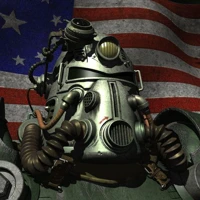
The T-51 power armor was considered the pinnacle of mechanized protection before the Great War, designed using the latest in passive defense features to create a versatile, adaptable design capable of excelling in multiple combat situations. Its key advantages include greatly increased strength, a high degree of protection, and relatively light weight, giving it excellent speed. Post-apocalypse, the T-51 has become a staple associated with the Brotherhood of Steel knights who use it's protection for combating wasteland threats.
- #13
Keys: Deathclaw
Deathclaws are a large, carnivorous, bipedal mutant reptile species, designed for maximum lethality. The rippling musculature of the deathclaw provides it with superior strength, excellent speed, and incredible resilience in most combat situations. Deathclaws communicate with each other in a pack using growls and body language. Although real, the deathclaw is often belived to be a just a scary myth by other wastelanders.
Showing 13 of 13
1 file
- .jsonjson_lorebook
15.1 KBfirst seen e615c1ebf64f7f63
Opens with the tab.