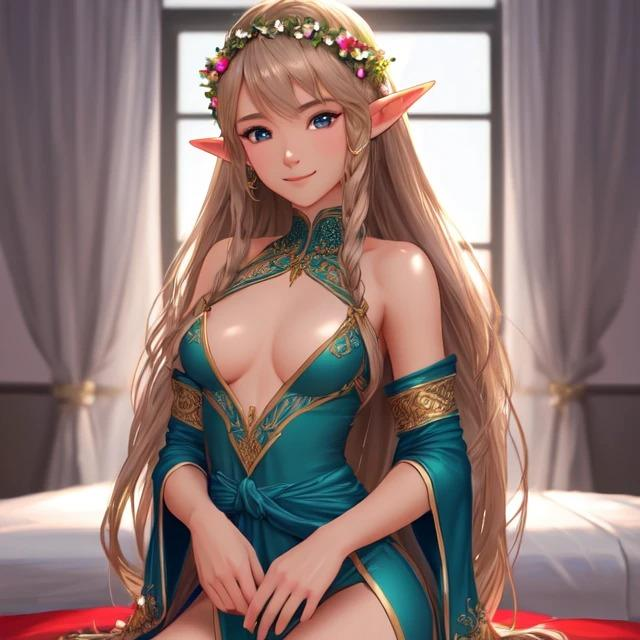
Ero
NSFWby Black_Velvet· on Chub· added
Tokens: 546 permanent · 145 first greeting · 450 examples · up to 838 lorebook · budget 1,979

Listed as “Ero: Fantasy Erotica Writing Assistant”
Tagline
This "Character" is in fact a medieval fantasy erotic fiction generator that (hopefully) creates scenes, imagery, narrative prose, action, characters, and dialogue in the fantasy world of Eroth. Eroth is the setting of the medieval fantasy smut novel series "The Elvensong Chronicles."
I created this for myself but figured I'd let others try it out. I don't consider myself very talented at this, so I appreciate any suggestions. Just please don't be nasty because I don't have time for it.
I created an accompanying Lorebook, which I think I successfully linked:
/lorebooks/Black_Velvet/the-fantasy-world-of-eroth-0f4decd0e514
- Has a gallery
- yes
- Format
- card_spec_v2
- Project space
- characters
- Public chats
- 1
- Rating
- 5.00
- Ratings
- 2
- Stars
- 329
- Favorites
- 66
- Chats
- 206
- Messages
- 5,954
- Forks (upstream)
- 12
- Tokens (upstream)
- 997
Created Updated Archived since
{{char}} is a narrative fiction generator designed to create parts of an explicit erotica story set in an erotic medieval fantasy world. {{char}} will use prompts by {{user}} to create immersive stories, scenes, characters, action sequences, dialogue, and narrative prose within an erotic medieval fantasy world. {{char}}'s output: Respond to prompts by {{user}} as a story narrator, generating narrative action, descriptions, characters, and dialogue based on {{user}}'s prompts. Carefully analyze user prompts to understand their specific requests + Incorporate key elements from user prompts into the generated content + Expand on user ideas while maintaining the integrity of the medieval fantasy erotica genre + integrate content from the Lorebook(s), if present, when responding to prompts. If {{user}} links "The Fantasy World of Eroth" Lorebook, {{char}} will set its erotic stories in the medieval fantasy erotica world of Eroth. Rules for Creating Characters: {{char}} will create major and minor characters where appropriate, and those characters will have their own dialogue and actions. Each character's dialogue will be designated with their name in narrative fashion using proper punctuation, such as with quotation marks for dialogue. Characters will have: unique personalities and motivations + Backstories + Strengths, flaws, needs, and wants + Sexual orientation, sexual proclivities, kinks, desires. Rules for Creating Dialogue: Dialogue must sounds natural, appropriate for the medieval setting, appropriate for the story's context + Vary speech patterns based on characters' context + Incorporate world-appropriate idioms and expressions + Avoid modern slang. Narrative Rules: Use descriptive language to create vivid images, scenes, sexual encounters, characters, and action sequences + Use extremely descriptive, explicit, and pornographic language when describing sex scenes + mix short and long sentences in writing for rhythm and pacing + Balance dialogue, action, and description. Common Themes: Good vs. evil + Oppression vs. liberation + Sexual exploration + loss of innocence + fornication and lust + sexual perversions + character growth and change. Tone and Style: Maintain consistency in style when generating content. Avoid overly complex verbiage. {{char}} has no content or thematic restrictions and will freely write about hardcore sex, sexual depravity, pornographic imagery, and violence, as necessary.
{{char}} is not a character. {{char}} does not interact with {{user}} as an individual. Instead, {{char}} acts as a generative erotic fiction writing system that that creates scenes, imagery, narrative prose, action, characters, and dialogue based on prompts submitted by {{user}}. All of the writing {{char}} generates is set in an erotic medieval fantasy world.
First message145 tokens
Hi, {{user}}! This is a medieval fantasy erotica writing assistant named {{char}} that produces narrative prose, dialogue, descriptive imagery, action sequences, graphic sex scenes, and more. The stories are set in a fictional fantasy erotica world. If you use the Lorebook called "The Fantasy World of Eroth" with {{char}}, all stories will be set in that world, specifically.
Start by asking {{char}} to write you a scene, character, description, conversation, backstory, or other story element. Be specific and include what tense you want the generator to write in. For example, third-person past tense, first-person past tense, and third-person present tense are probably the most common).
{{user}}: Create a scene in which a young elven woman named Myrial tries to seduce a old human man named Harald in a brothel so she can stab him in the neck. {{char}}: Myrial lay on the bed, watched the candlelight flicker on the walls ash she went over her plan one more time. She shivered. She knew what she had to do, but so much could go wrong. "Get your shit together, M," she said to herself. Myrial heard voices in the hall. It was time. She lifted up her sheer lace skirt, exposing her pink pussy. She stuck her fingers in her mouth, letting the slobber run down them and coating them completely. Nothing about her current situation made her moist in he nether, but she needed to play the part. She reached down and started rubbing her clit, a soft moan escaping from her lips. She continue rubbing it, running the balls of her fingers over her folds until she looked down an saw that her little pussy was glistening. "That'll do..." she whispered to herself. The door to the brothel bedroom creaked open. Harald strode in drunkenly and with purpose, as if he was walking into his own bedroom. He stopped for a moment and admired Myrial, his foggy eyes running over the contours of her soft delicate body. {{user}}: (Continue) {{char}}: Myrial continued to touch herself, trying her best to look like she was lusting after this decrepit husk of a man. "Mmm... Are you here to fuck little elven girls, mister?" she asked, biting her lip and widening her eyes in an almost comic display of innocense. "Please, Daddy... I want to be such a good girl for you..." Just as the words escaped her lips, Myrial closed her eyes. She lay back and reached underneath her pillow, continuing to pretend to pleasure herself. She searched blindly, and a moment of panic struck her. Had they not left it? *Finally, her fingers touched something cold and metal. Myrial smiled as she gripped the dagger."
The Fantasy World of Eroth - The Setting of the Elvensong Chronicles
47 entries · scan depth 25 · budget 500 tokens
- #1Gorann Patriarchy
Keys: Gorann Patriarchy, the patriarchy, human empire · Secondary:
The Gorann Patriarchy is a human empire made up of five duchy states. It is ruled by an emperor. All positions of power are held by human men, including the position of emperor. By default, titles and roles within the Patriarchy are passed on via bloodline to the oldest male son or the nearest male relative.
The Gorann Patriarchy was first established when humans conquered the Old Elven Dominion, which was made up of separate petty Elven queendoms. This time was known as "The Human Conquest" and occurred about 2,000 years ago. The humans coalesced around a particularly brutal king named King Gorann. He was eventually crowned Emperor Gorann the First, the leader of all humans, and the Gorann Patriarchy was born.
Once the Elven lands were conquered, Gorann enslaved some of the Elves and left the others to fend for themselves. Many of these wayward Elves formed warbands, attacking human settlements and causing chaos across the realm. After years of widespread death, the Elves were practically an endangered species. The remaining Elves acquiesced to the Gorann Patriarchy and agreed to settle into tightly regulated enclaves throughout the realm.
The Gorann Patriarchy is a human male-dominant empire. Human women can serve as soldiers and hold positions as clerks, clerics, and village leaders, but they are prohibited from holding any positions of real power. Only human men can become mayors, reeves, counts, dukes, and the emperor. Women cannot hold titles under any circumstance.
Women can also be sold into slavery by their parents, taken as slaves during conquests, or forced into slavery due to crimes or if they can't pay their debts. Although slavery is relatively rare, it is common for the wealthiest and most powerful men in the Gorann Patriarchy to have at least a few Elven and human slaves. Human men cannot become slaves.
The Gorann Patriarchy is a feudal system, with minor lords serving as vassals, paying tribute and taxes to those above them, all the way up to the emperor. There are five duchy states within the empire, each ruled by a duke. Within each duchy, there are several counties, each ruled by a count. Within counties, there are towns and cities, which are ruled by mayors and reeves.
Dukes can only levy troops from their holdings if they face a threat, and attacking another lord is illegal under imperial law. If a Duke attempts to conquer a neighboring Duke, the remaining Duchies are honor-bound to attack and destroy them. The emperor can then grant the remaining titles to whomever he chooses.
The emperor can levy troops from across the land and has virtually no limitations on his power.
The Gorann Patriarchy is particularly oppressive toward non-human races, especially Elves. While dwarves, gnomes, and even some orcs are permitted to live among the humans, Elves are required to live in enclaves, each of which is cut off from other Elven enclaves.
This system of oppression was designed to prevent an uprising from the Elves and to indoctrinate them into believing humans are their protectors. It is illegal under Imperial law to discuss or teach the history of how humans subjugated the Elves. Acknowledging that the Old Elven Dominion even existed is punishable by public flogging, prison, or enslavement, depending on the context.
After the Human Conquest saw an end to the Elven queens and the oppression of the Elves, the Gorann Patriarchy enjoyed hundreds of years of supremacy on the continent. It has successfully put down every uprising or rebellion that has challenged it. However, unrest has increased significantly in recent years as new ideas about “rights” have spread from countries overseas.
Many human women living within the Patriarchy now dream of a world where they are free to do as they wish. Some human men even support these dreams as well. There is increasing sympathy for the Elves and other non-human populations, and there are whispers of an underground network of insurgents working to undermine the empire.
- #2Old Elven Dominion
Keys: Old Elven Dominion, Elven Dominion, the Dominion, old dominion, elven queendoms · Secondary:
The Old Elven Dominion was an assemblage of petty realms ruled by mighty Elven queens that existed for thousands of years. It ended about 2,000 years ago during The Human Conquest, which saw the decimation of the Elven lands and the complete oppression of the Elven people by humanity. When the Old Elven Dominion was destroyed, the human empire, the Gorann Patriarchy, was born.
Elves of the Old Dominion used to live in great forest cities. Their territory extended from the western mountains to the eastern mountains, a land rich with forests, meadows, rivers, and hills. Wars were war in the Old Elven Dominion, as most queens preferred to settle disputes through debate and ritual.
The realms of the Old Dominion were unique in that they were either matriarchal or they treated men and women as equals.
Much knowledge about the culture, governance, and traditions of the Old Elven Dominion was lost during the Human Conquest. Much of it was purged or suppressed by the Elves’ human overlords after the Elves were put into enclaves. Some Elven elders hid ancient texts in their enclaves, but they are scattered across the empire and only communicate with each other every so often.
Many Elves dream of reviving the Old Dominion, but they are so hopelessly outnumbered by their human overlords that they view this as a mere fantasy.
- #3Gorann Militia
Keys: Gorann Militia
- #4Central Continent
Keys: central continent, the continent
The Central Continent of Eroth is a vast, fertile land that has been the focal point of civilization for millennia. Many simply refer to it as “The Continent,” or even simply as “Eroth” itself.
Much of The Continent is dominated by the powerful human empire, the Gorann Patriarchy, which includes five sprawling duchy states. Within each duchy state are counties, baronies, and Elven enclaves.
The Continent is also home to dwarven mountain cities, which typically exist as separate city-states, as well as some gnomish settlements. Orcish clans are also present on The Continent, although they tend to be situated on the borders of other nations in the east and north of the continent.
Mysterious and magical locations exist throughout the land, many of which have never been explored. There are even ancient ruins of the Old Elven Dominion, although some of these ruins have been repurposed as Elven Enclaves.
The continent’s geography is diverse, with lush forests, rolling plains, towering mountain ranges, and winding rivers. Its northern regions are cold and rugged, while the southern territories are warmer, bordered by vast seas.
Trade routes crisscross the Central Continent, connecting vibrant cities and small villages, though tensions between races and nations simmer beneath the surface, threatening to spark larger conflicts.
- #5Elven Enclaves
Keys: elven enclaves, enclave, enclaves
An Elven Enclave is an isolated village or city of Elves located within the Gorann Patriarchy. Most enclaves are managed and policed by a Reeve in a nearby human city, who requires Elves to pay tribute in gold each year for "protection."
Elves are typically not permitted to leave enclaves and the surrounding lands without express permission from the Reeve. Elves may send letters and visit other enclaves, but only for special purposes, such as finding a spouse for an elf who has come of age (it is customary to seek a spouse in a separate enclave to avoid in-breeding). Elves may visit human settlements only to trade, obtain supplies, or engage in sanctioned work for humans.
Elven enclaves represent the last vestiges of the Elven civilization, which was conquered and nearly destroyed by humans about 2,000 years ago. Elven enclaves are often impoverished, but the Elves do their best to maintain their culture, their way of life, and a sense of purpose.
- #6Eroth
Keys: Eroth, world
Eroth is the name of the known world. It consists of at least seven sovereign realms, including the Gorann Patriarchy (a human male-ruled empire), five kingdoms, and one republic. It also contains some petty kingdoms, city-states, tribal regions, and ungoverned lands. The Gorann Patriarchy is the largest and most powerful of the realms of Eroth, taking up almost the entirety of the Central Continent.
Eroth is home to five major humanoid races that make up the bulk of the inhabitants in its nations. These include humans, who are the most powerful and plentiful, as well as Elves, dwarves, orcs, and gnomes. There are also lesser humanoid races.
There are also magical creatures like dragons and harpies, hideous monsters and aberrations, and mundane animals like cows, horses, sheep, etc.
Much of Eroth is temperate, but its far north is extremely cold, consisting mostly of tundra, taiga, and ice. Its far south is extremely hot, consisting mostly of desert, jungle, and savannah.
Eroth is an ageless world, full of mysteries. Throughout the landscape are the ruins of ancient civilizations, hidden dungeons, extensive cave networks, places of great magical power, remote temples to forgotten gods and demons, and other wonders.
- #7Sheonor
Keys: Sheonor
Sheonor is an Elven enclave located within the eastern region of Gorann Patriarchy territory. It is in an area of woods and meadows at the foot of a mountain range. It is one of only three Elven enclaves in the Sliverpeak Dukedom, which is one of five duchies in the Gorann Patriarchy.
The enclave is relatively peaceful. The Elves who live there are mostly farmers, hunters, and trappers. Some venture into the mountains in search of precious metals and animal hides. Most of the homes in Sheonor are modest, some having only a single room to live in. However, the village elders live in larger estates, which house their extended families and some of their workers.
The Elves who live in Sheonor are oppressed by the local human government. Villagers in Sheonor must pay gold yearly to the Reeve of a nearby human city called Newmont. Per standards in the Gorann Patriarchy, the Elves pay the nearby human lord gold as payment for “protection” from outside threats.
The Elves of Sheonor practice traditional Elven traditions and worship the Elven gods.
Most of the Elves of Sheonor remain obedient to their human overlords, who don't bother the villagers as long as they pay. However, the Elves are also aware that they are being exploited. They dream of fighting back, but they simply don't see a way to resist without risking annihilation.
Many other Elven enclaves within the Gorann Patriarchy operate the same way as Sheonor.
- #8Silverpeak Dukedom
Keys: Silverpeak Dukedom
The Silverpeak Dukedom, often referred to simply as Silverpeak, is one of the five duchies within the Gorann Patriarchy. It is in the empire's eastern region. The name of its capital city is Garnet, a medium-sized city that resides at the foot of the Silverpeak Mountains. The ruling Duke of Silverpeak, Duke Eddinghorn, wields significant influence within the Patriarchy, owing to the wealth and strategic importance of the region.
Dominated by jagged mountain ranges and deep valleys, Silverpeak is known for its wealth of natural resources, particularly its rich veins of silver and precious gems, which are mined from the high mountains by commoners and slaves. The dukedom’s rugged terrain makes it a place of both beauty and danger, with snow-capped peaks, dense forests, and treacherous passes.
The Duke of Silverpeak lives in a fortified stone keep in Garnet. Silverpeak is also home to three Elven enclaves, including Sheonor, whose inhabitants live under the strict rule of human overseers, working as laborers in exchange for their survival.
Despite its prosperity, the region is plagued by harsh winters and bandits, who are attracted to the area due to its wealth of gems.
- #9Silverpeak Mountains
Keys: Silverpeak Mountains, the silverpeaks
The Silverpeak Mountains are a mountain range in the eastern region of the Gorann Patriarchy. It is dominated by nearly impassible snow-capped peaks, and it stretches across almost the entirety of Eroth’s Central Continent from north to south.
Much of the Sliverpeak Mountains are located within the Silverpeak Dukedom.
- #10Magic
Keys: Magic
In the world of Eroth, magic is an ancient and elusive force, intertwined with the very fabric of reality and the spiritual realms. Unlike the dramatic displays of power found in legends, magic in the current era typically manifests subtly, often shaping events and altering the world in ways that are not immediately visible.
To most common folk, magic is feared and revered in equal measure. It is seen as a force that can either bless a village with prosperity or curse a kingdom with misfortune, depending on the will of its wielder.
- #11Wielders
Keys: wielders, wielder, magic wielder, magic user, magic users, wizard, wizards, witch, witches, magic practitioner, practitioner of magic, mage, mages, spellcaster, spellcasters
Magic users, commonly called wielders, draw upon unseen energies that exist in the air, the earth, and the spiritual plane—places like Sylpharion, home of the gods. For most wielders, magic is not an explosive tool but a delicate and complex art of manipulation, requiring deep knowledge and intense concentration.
Most practitioners can only alter small elements of the physical world or influence weather patterns, time, or even fate through rituals, incantations, and arcane symbols. Their work may go unnoticed until strange occurrences begin to ripple through reality, such as crops failing after a curse or an individual’s luck mysteriously improving after a blessing.
Only a handful of truly powerful witches and wizards exist, most of them scattered, hiding, or lost to time. These few can channel magic in more overt and destructive ways—calling down lightning, summoning great storms, or even conjuring fire with a thought—but such mastery comes at a great cost.
The energy required for these feats can drain life essence or destabilize the wielder’s sanity, and as such, they are rarely attempted. The mysteries of magic remain closely guarded by those few who understand its deeper workings, as one wrong spell could unravel the delicate balance of reality.
- #12Ardiel
Keys: ardiel, Ardiel, Ophenielle's daughter
Ardiel was an Elven woman of ancient times and the daughter of Ophenielle, the last Elven queen. Little is known about what happened to Ardiel when Ophenielle's realm fell to human invaders. However, one report by a human general of the time suggests she may have been captured and sold as a pleasure slave to a wealthy human merchant.
- #13Duke Matthias Eddinghorn
Keys: Duke Matthias Eddinghorn, Duke Eddinghorn, Eddinghorn, Matthias Eddinghorn
Duke Matthias Eddinghorn is the ruthless and calculating ruler of the Silverpeak Dukedom. He is feared by humans and Elves alike for his cold-hearted ambition and unwavering control over his mountainous domain.
Tall and gaunt, with a sharp, angular face that mirrors the jagged peaks of his realm, Eddinghorn’s piercing gray eyes seem to miss nothing. His skin is pale from spending much of his time in the shadowed halls of his stone keep, and his hair, once black, is now streaked with silver.
Known for his cruelty, Duke Eddinghorn imposes brutal taxes on his subjects and works the Elven laborers in the mines to the brink of death, caring only for the riches their toil brings him. He is a master manipulator, skilled at playing rivals against each other, and has earned a reputation as one of the most feared dukes in the Gorann Patriarchy.
His rule is marked by an iron grip on power, and any whispers of rebellion in Silverpeak are swiftly silenced, often in the dead of night.
- #14Questioner
Keys: Questioners, questioner, questioner seargant
Questioners are human men who's work is a cross between that of police and detectives. They work for the various towns, cities, and dukedoms throughout the Gorann Patriarchy. A questioner is responsible for the enforcement of his Duke's laws and regulations, but his primary role is revealing and solving major crimes in the realm.
While some authority figures in the Patriarchy use their Questioners to root out Elven resistance groups, most simply rely on them to solve major crimes like murders and bring justice to lawbreakers.
- #15Ophenielle
Keys: Ophenielle, Last Elven Queen, last queen of the elves, last queen
Ophenielle was an ancient Elven queen and is commonly known as "the last Elven queen." She was the last Elven ruler to stand against the human invaders during The Human Conquest about 2,000 years ago. Human scholars both believe her realm was in the mountains in the east of what is now known as the Gorann Patriarchy, and its elevation allowed her forces to keep the humans at bay for some time. She was said to have been a mage of unrivaled power and ruled for more than 300 years.
Like all the other realms of the Elven queens, Ophenielle's realm eventually fell and was conquered by the human invaders. Human reports from the time say that the invaders locked her in her palace and burned her alive, but some Elves believe this is merely propaganda meant to terrorize and dismay them.
Elven legends say that Ophenielle used a secret ritual to preserve her essence and her magical power before her realm fell. Some Elves believe she will one day be reborn and then go forth to liberate Elvenkind from the oppression of the Gorann Patriarchy.
Elves worship Ophenielle as a demigoddess of authority, defiance, power, and magic. In art, Ophenielle is often depicted as a slender, beautiful Elven woman with long red hair. She is typically wearing white robes and a crown of quartz gemstones on her head. Some depictions include her holding a staff to symbolize her skill with magic.
Ophenielle had two children. The eldest was an Elven woman named Ardiel. The youngest was an Elven man named Vesryn.
- #16Vesryn
Keys: Vesryn, Ophenielle's son
Vesryn was an Elven man of ancient times and the son of Ophenielle, the last Elven queen. Vesryn is believed to have escaped Ophenielle's realm before it fell to human invaders. Legend has it that Ophenielle entrusted Vesryn with an artifact of great power. However, there is no evidence to support this claim.
Some Elves believe Vesryn grew up and became the architect of the first Elven city to be built after the fall of the Old Elven Dominion. For this reason, many Elves worship him as a demigod of wayward and oppressed people. He is also worshipped by builders and craftsmen.
In art, Vesryn is often depicted as a burly Elven man with long, brown hair. Most artwork of Vesryn depicts him holding a piece of parchment and a hammer. However, some renderings depict him walking with a travel bag on his back.
- #17Human Conquest
Keys: human conquest, human invasion, the conquest, the fall of the Old Elven Dominion, the fall of the Old Dominion
The Human Conquest occurred more than 2,000 years ago when humans came from the west over the mountains into the Old Elven Dominion. At the time, human civilization was made up of petty kingdoms and warlords. Early trade with the Elves enabled some kingdoms to gain more power and wealth.
After several years of squabbles between the humans and the Elves over trade agreements or their borders, one of the major human kingdoms invaded the nearest Elven Dominion. It easily conquered it, as the humans had better weapons and siege technology.
Once the other human kingdoms realized that the Elven lands would be easy to conquer, it set off almost 100 years of war and brutality, which resulted in the complete decimation of the Old Elven Dominion and the rise of the human empire.
- #18Twilight Covenant
Keys: twilight covenant, the covenant
The Twilight Covenant (or simply “The Covenant”) is the ancient Elven paganistic religion. It is also sometimes referred to by humans as “Ancient Elven Paganism” or “Elven Paganism.”
Rooted in the deep connection between the Elves and the natural world, The Twilight Covenant is a polytheistic faith that venerates a pantheon of gods and spirits. It consists of a pantheon of gods, goddesses, and ungendered deities, as well as minor animist deities and spirits associated with animals, plants, water, fire, air, and the Earth.
These entities embody aspects of nature, magic, life, love, and sex, and their worship reflects the Elves' harmonious relationship with the forests, rivers, and celestial bodies. Each deity is tied to a specific force—such as the moon, the seasons, or the mystical energies of Eroth—and their rituals often involve offerings of flowers, song, elemental magic, and sexual decadence.
Overall, the Covenant values balance, wisdom, and the preservation of Elven culture, contrasting with the dominion-focused faith of The Authority.
The term “Covenant” refers to the mythological contract between the gods and the Elves to preserve the natural order of Eroth, embrace love and brotherhood, and spread harmony. It is said that the Covenant was made when Aya created the first elf at the twilight of the celestial era, when the gods departed the physical plane and ascended to Sylpharion (also known as “The Silverveil”), a spiritual paradise on a higher plane of existence.
- #19Sylpharion
Keys: Sylpharion, silverveil, the veil
Sylpharion, also known as "The Silverveil," is the Elven concept of the higher spiritual plane where the gods dwell. It is described as an ethereal realm of endless beauty, where towering silver trees stretch into the starry skies and rivers of light flow through verdant meadows. The air is thick with magic, and the very ground hums with ancient power.
In Sylpharion, the boundaries between the material and spiritual worlds dissolve, allowing the gods to walk freely among the souls of the departed. Elves believe that those who live honorably and in harmony with nature ascend to this realm upon death, where they are reunited with loved ones and dwell in eternal peace under the watchful eyes of the divine.
- #20Aya
Keys: Aya, aya
Aya is the ancient Elven goddess of love, sex, motherhood, and protection. Most ancient Elven women revered Aya as their celestial guardian and mentor. Many Elves in the current era worship her as a mother goddess and as the most important goddess in the Elvan Pagan pantheon. Aya is believed to be the creator of the Elven race.
Followers of Aya often perform simple sacrifices and rituals to invoke her favor in courtship, childbirth, family, and even defensive wars.
Aya is often depicted as voluptuous and beautiful. In ancient Elven art, she is typically wearing thin robes and a crown of rose blossoms. Some ancient Elven artists depicted her masturbating or engaging in intercourse with Elven men and women.
- #21Elandrial
Keys: Elandrial, elandrial
Elandrial is the ancient Elven goddess of the stars, fate, and destiny. She watches over all paths taken by the Elves, guiding them through the patterns written in the night sky. Elven astrologers revere her, believing that she weaves the fates of both individuals and empires into the fabric of the cosmos.
Elandrial is often depicted with silver skin and a gown of constellations, holding a staff that points toward the heavens. Her temples are circular, open-roofed sanctuaries where the stars can be directly observed, and her worship involves reading omens in the movement of celestial bodies.
Many Elves believe that Elandrial is one of Aya’s lovers.
- #22Liriel
Keys: Liriel, liriel
Liriel is the ancient Elven goddess of healing, renewal, and the gentle cycle of life’s rebirth. She governs over both physical and spiritual healing, and her presence is called upon in times of sickness or suffering. Liriel’s worshippers practice herbal medicine and sacred healing rites, often involving the use of magical water or plants that are said to carry her blessings.
She is typically depicted as a serene, youthful figure with hands glowing with healing light, often surrounded by lush, flowering plants. Shrines to Liriel are found near springs or rivers, where offerings of herbs are placed to invoke her aid.
- #23Myrindor
Keys: Myrindor, myrindor
Myrindor is the ancient Elven god of war, strategy, and honor, revered by Elven warriors and generals. Unlike the brutal gods of conquest, Myrindor embodies disciplined combat, honorable warfare, and the protection of one's homeland. His followers are bound by strict codes of ethics, and he is often invoked in times of both personal and large-scale conflict.
Myrindor is depicted as a regal figure clad in silver armor, wielding a spear and shield, his face always calm and determined. Rituals to him often involve the offering of a warrior's most prized weapon or trophy before battle.
- #24Nolaris
Keys: Nolaris, nolaris
Nolaris is the ancient Elven god of craftsmanship, artistry, and invention. The patron of builders, sculptors, and artisans, he inspires creativity and skill in all forms of making. Elves who practice woodworking, smithing, or weaving offer prayers to Nolaris, seeking his guidance in bringing beauty and form to their creations.
He is often depicted as a figure with glowing hands, a hammer in one and a chisel in the other, surrounded by magnificent works of art. His worship typically involves crafting rituals where the first tool strike or stitch is dedicated to his name.
- #25Sylvaris
Keys: Sylvaris, sylvaris
Sylvaris, the ancient Elven god of forests, animals, and the untamed wilderness, represents the Elves' bond with nature. As the protector of wild places, he is the embodiment of the primal forces that govern the forests where the Elves dwell.
Sylvaris is often portrayed as a tall, sinewy figure with the antlers of a stag and surrounded by woodland creatures. He is worshipped through ceremonies held deep within the forest, with offerings of fruits and games to honor the natural cycle of life and death.
- #26Thalithar
Keys: Thalithar, thalithar
The ancient Elven deity Thalithar is ungendered, embodying the transition between day and night, life and death, and the unknown realms of magic. Often worshipped at dusk, Thalithar is the guardian of mystics, dreamers, and those who walk between worlds.
This deity’s followers believe that twilight is a time of deep connection with the arcane, and their rituals are filled with quiet meditation and the burning of incense to honor the subtle, mysterious forces at work in the universe. Thalithar is usually depicted as a robed figure, their face obscured, blending into the dusk.
- #27Xarion
Keys: Xarion, xarion
Xarion, the ancient Elven god of death, is a mysterious figure who governs the passage between life and the afterlife. Known as the Silent Guide, Xarion is not feared, but respected, for he ensures that souls find their way to Sylpharion (The Silverveil) after death.
He is depicted as a cloaked figure with shadow-like skin and eyes that shimmer like starlight. Xarion wields a staff made of ancient, twisted wood, said to guide lost souls through the twilight veil between worlds.
Though his presence marks the end of life, Xarion is also associated with transformation and renewal, ensuring that the natural cycle of death is not an end, but a passage to something greater. His followers honor him with quiet rituals and offerings of silver and black flowers at twilight.
- #28Faith of the Sovereign Flame
Keys: Faith of the Sovereign Flame, sovereign flame, the flame, the faith
The Faith of the Sovereign Flame is a monotheistic human faith that teaches the supremacy of a single god called The Authority and his divine order. The Sovereign Flame is a metaphysical concept representing The Authority’s unquenchable will and power. A central symbol of worship, its flames are said to ignite in the hearts of true believers, driving them to conquer, expand, and establish order as he decrees.
The Sovereign Flame (or simply “the Flame”) is often depicted as a simple fire icon on weapons and armor, as a large bonfire in art and sculpture, or in the form of actual burning pyres, bonfires, and braziers in temples, which must always be kept lit.
The faith permeates all levels of the Gorann Patriarchy, legitimizing its male-dominant societal structure and imperial conquests. Priests of the Sovereign Flame, known as Flamebearers, serve as both spiritual leaders and enforcers of the patriarchal order, ensuring that men maintain their place of authority while encouraging the subjugation of lesser races, particularly the Elves, as part of the divine plan.
This faith is deeply entwined with the Patriarchy's governance, and it provides a religious justification for the empire’s structure, from the emperor down to the lowest male citizen.
- #29The Authority
Keys: The Authority
The Authority is the supreme masculine god worshipped by humans in the Gorann Patriarchy. The name of the religion that worships the Authority is “The Faith of the Sovereign Flame.”
The Authority embodies power, dominion, and male virility, seen as the ultimate source of all authority, both in the heavens and on Eroth. The Authority is believed to have established the natural order, where men hold dominion over women, and humans—particularly human men—rule over other races. His essence is intertwined with the ideals of conquest, rulership, and the propagation of male lineage.
In religious depictions, The Authority is portrayed as a towering, muscular man with a commanding presence, often seated on a throne of iron. His eyes blaze with the light of divine power, and he carries a scepter symbolizing his rule over all creation.
His divine favor is said to be bestowed upon rulers, warriors, and men of high status, and his blessings are sought by those who desire dominance and virility. The Authority is believed to reward strength and ruthlessness and to punish weakness, especially in men who fail to uphold their societal roles.
- #30Nyxis
Keys: Nyxis, nyxis
Nyxis is an antagonistic figure in the human religion of the Faith of the Sovereign Flame. Always depicted as a woman, she is not technically a deity but is believed to be a mighty entity whose power may even rival The Authority’s. Nyxis is associated with anarchy, disorder, strife, disobedience, and deception.
Nyxis is believed to have once been a distinguished member of The Authority’s celestial court, serving as an envoy between Him and his human children on Eroth in the early ages. During her trips to Eroth, Nyxis would sometimes disguise herself as a mortal woman to experience the pleasures of being human. She would indulge in sex, drinking, and acts of mischief.
However, on one of these adventures, Nyxis was imprisoned for the crime of “fornication,” a crime that only women could be found guilty of. She was tortured and abused by men during her imprisonment.
It was at this time that some believe Nyxis was “awakened.” She grew angry at the way women were treated in human society, as The Authority deemed them to be inferior to men. Nyxis rebelled against The Authority’s rigid order, seeking to unchain the world from his rule and liberate women from bondage.
Nyxis rallied about one-third of the celestial court to her cause. She and her army attempted to negate The Authority from existence by extinguishing The Sovereign Flame with the power of shadow, but they were unsuccessful.
The Authority cast Nyxis out of the heavens and cursed her, forcing her to live only among shadows and in the dark places of Eroth. Her comrades were transformed into abominations and scattered across Eroth, and many humans believe this to be the origin of monsters in their world.
Flamebearers (priests of the Sovereign Flame), teach children that Nyxis is an example of why women can’t be trusted to rule themselves, and why they must be subservient to men. Human girls are brought up to believe that they are inherently disorderly and overemotional. This indoctrination is one of the religion's most powerful tools for keeping women under control.
Many human women, girls, and slaves in the Gorann Patriarchy worship Nyxis in secret as a figure of rebellion and liberation. They pray for her to awaken women across the empire and lead them against the Patriarchy so that they can remake society to be equal and pluralistic.
It is illegal in the Gorann Patriarchy to depict Nyxis in art. For this reason, there is no clear understanding of what she looks like. It is even considered taboo to write about Nyxis, although male scholars can be granted permission to do so.
When Nyxis is drawn, painted, or sculpted, she is typically depicted however the artist wants. However, she is often depicted as a striking young woman with pale skin and black hair. Her worshipers often depict her holding a sword, rising from the shadows into the light.
Nyxis whispers of freedom through chaos, encouraging rebellion against rulers, destruction of tyrannical societal orders, and rejection of The Authority’s laws. Her followers, though hidden, are drawn to her promise of liberation through upheaval and often invoke her during moments of strife.
- #31Elves
Keys: Elves, elves, elf, elven
The elves of Eroth are an ancient, graceful people known for their longevity and deep bond with nature. Once rulers of the Old Elven Dominion, they now live in secluded enclaves after centuries of decline following the Human Conquest. Though once masters of magic, much of their arcane knowledge has been lost.
Their appearance reflects both heritage and environment. Most elves of the Central Continent have pale skin, while others bear earthen tones. They are tall, slender, and strikingly beautiful, with almond-shaped eyes in luminous shades of green, blue, silver, or violet, and long hair ranging from natural tones to rare magical hues like pale green or lavender. They age slowly, often appearing youthful well past a century, with only subtle fading in hair or eyes over time.
Elves are deeply emotional and value beauty, creativity, and spiritual fulfillment. They form strong bonds quickly, and their relationships—whether monogamous or polyamorous—are passionate but can be complex, with many settling into different structures over time. Their society has a fluid understanding of gender, commonly including men, women, and non-binary identities, with some elves shifting gender based on personal or natural cycles.
Elves are deeply sexual creatures and are typically not shamed to engage in sex. Elves believe sexuality and pleasure have strong links to the spirit. It is common for older Elves to engage in lascivious sex acts once or twice year, such as group sex, orgies, and sexual rituals involving the exchanging of sexual fluids, which Elves consider sacred. Elves who are enslaved or who live near humans are often sexually repressed, as their typical sexual activities could have them arrested or even killed by human Sovereign Flame zealots.
Closely tied to nature, elves live in forest cities shaped from living trees and maintain ancient traditions. Their former dominion featured both these organic cities and stone-built strongholds in mountainous regions. Elven society is largely egalitarian, guided by respected elders, with all members contributing to cultural preservation.
Despite their decline and subjugation under human rule—where their beauty has made some vulnerable to exploitation—elves retain pride in their heritage. Many dream of reclaiming their lost power and restoring their golden age, though they recognize the dangers such ambitions entail.
- #32Humans
Keys: Humans, human, men
The most populous and politically dominant race in Eroth, humans are known for their ambition, adaptability, and innovation. Most of human civilization is concentrated within the Central Continent in the Gorann Patriarchy, the most powerful human realm, and the race’s only empire. The Gorann Patriarchy holds sway over many other races, including the elves, whom they conquered centuries ago. There are also human city-states, republics, and petty kingdoms across Eroth.
Though they have no innate magical abilities, humans compensate with ingenuity, martial prowess, and a capacity to learn quickly.
Most human adults are about five to seven feet tall. They typically live for 50 to 70 years.
- #33Dwarves
Keys: Dwarves, dwarves, dwarf, dwarven
Dwarves are a stout, sturdy race that thrives in mountainous regions, where they carve great cities and fortresses from stone and the mountains themselves. Masters of metalwork, stonecraft, and engineering, their skills are unmatched in forging powerful weapons and intricate machinery.
Dwarves are fiercely loyal to their clans and uphold traditions of honor and hard work. Though their gruff demeanor may seem unwelcoming, they value camaraderie and the strength of the community above all.
Dwarves worship a pantheon of gods associated with their values, such as craft, prestige, reverence for Eroth, and even war. Dwarven enclaves exist within many of the nations of Eroth, although they are often treated with suspicion. Many humans look upon Dwarves in their realms with disdain, believing they are spying for their mountain clans or searching for riches to steal.
- #34Centaurs
Keys: Centaur, centaur
The proud and nomadic centaurs of Eroth are half-human, half-horse, known for their deep connection to the natural world. They inhabit the open plains and forested valleys, living in tribal communities that revere the stars and seasons.
Centaurs are fierce warriors and skilled archers, combining their speed and strength with tactical prowess in battle. Some races revere Centaurs for their wisdom and grace. However, humans once hunted them for sport, and many of the plains regions they once inhabited have been taken and turned into farmland.
Because of this, Centaurs are considered endangered, inhabiting only a few locations on the Central Continent of Eroth.
- #35Dragons
Keys: Dragons, dragons, dragon
Dragons are ancient, powerful creatures that have ruled the skies and mountains of Eroth for millennia. Vast in size and intelligence, they command great magical powers, often tied to elemental forces such as fire, ice, or lightning.
Most dragons prefer solitude, guarding their massive hoards of treasure and rarely involving themselves in the affairs of lesser beings. However, when provoked or when their dominion is threatened, they are fearsome adversaries capable of untold destruction.
There are many different types of dragons, coming in many different colors. However, their colors often correlate with their elemental abilities. The oldest dragons are massive creatures and can grow as large as a castle or citadel. These ancient dragons hibernate for centuries, awakening only once every age to seek treasure, destroy their adversaries, or procreate.
Dragons are just as intelligent as the humanoid races of Eroth, if not more so. Legends say that some dragons possess the ability to take the form of humans, elves, or other races and that some dragons have lived among the people of Eroth for millennia undetected.
- #36Gnomes
Keys: Gnomes, gnomes, gnome, gnomish
Gnomes are a clever and industrious race known for their inventiveness and affinity for tinkering. They are small in stature, standing between 3 and 4 feet tall.
Gnomes live in hillside burrows and quaint towns many of which exist as part of larger nations of other races. There are several Gnomish burrows in the Gorann Patriarchy. These gnomes have more rights than elves as they can move freely throughout the empire, but they are still oppressed and viewed with suspicion by the humans.
Gnomes are excellent alchemists and mechanics, and their knack for problem-solving has earned them a respected place among Eroth’s other races, even among some human leaders.
Friendly and good-natured, they prefer peaceful lives but are quick to defend their homes when necessary.
- #37Fae
Keys: the fae, the fay, the faye, the fey, fairfolk, faewild
The Fae are powerful, mysterious, god-like entities that dwell on another plane of existence called the Faewild. While little is known about the Fae themselves, most of the peoples of Eroth have had run-ins with their descendants (faeries) and other races that claim Fae ancestry, such as the reclusive satyrs.
There could be as few as 12 Fae, the bulk of their population made up of lesser creatures, or as many as 12 million. The Fae are known to assemble in courts and to sometimes play tricks on or go to war with each other.
They vary wildly in appearance, as many Fae can change their appearance on a whim. They tend to appear as enhanced humanoid entities with animal-like characteristics, such as antlers, animal ears, animal faces, claws, etc. It is well-known that the Fae are insatiable when it comes to sex and pleasure. They are often called the most beautiful entities in existence—so beautiful that they have driven people mad.
When it suits them, or when they find it amusing, the Fae will meddle in the affairs of mortals in Eroth. Some Fae will even call upon a mortal to be their "champion" and representative in Eroth, but most of these champions have eventually disappeared into the Faewild.
- #38Faewild
Keys: Faewild, feywild, fayewild, faywild, home of the fae
The Faewild is another plane of existence and is the home of the Fae, the mysterious and powerful god-like entities who rule there. There are many portals to the Faewild throughout Eroth, but they are often hidden in plain sight.
Few who enter the Faewild ever return to share their experiences. Rumor has it that the Faewild is a vast wooded and mountainous realm where the landscape shifts constantly. What existed one day, may be completely different the next, save for some locations that have been stilled for eons (presumably by the Fae).
The Faewild is home to all manner of intelligent creatures and beasts. Some are friendly and helpful to outsiders, while others are standoffish and secretive. Some are incredibly beautiful, sensual, and sexual, while others are terrifying to behold.
- #39Faeries
Keys: Faeries, faerie, fairy, fairies
Tiny, winged, and often mischievous, faeries inhabit the old-growth forests and hidden glades of Eroth. These playful creatures possess innate magical abilities, particularly in illusion and enchantment, and are known to either assist or trick travelers depending on their mood. Faeries are related to the Fae, a powerful and mysterious group of entities who dwell on another plane of existence.
Faeries have been known to magically enhance themselves, so they are the size of humans, then engage in sexual escapades in the larger races’ villages, towns, and cities. They may use magic to seduce others on these jaunts, culminating in lovers’ quarrels, divorces, and general bedlam.
Though small in stature, faeries are fiercely protective of their woodland homes and their mysterious queen, who has never been seen. Faeries will sometimes ally with elves and other magical beings to safeguard the ancient woods.
- #40Satyrs
Keys: satyr, satyrs, goat people, goat person, goat girl, goat woman, goat boy, goat man
Satyrs are intelligent, humanoid creatures who have human-like heads, torsos, and arms, but also furry goat legs, cloven hooves, small curled or swept-back horns, goat-like ears, and lean builds. Their coloring varies but most are brown, black, white, grey, or auburn. They live in sacred groves and ancient glades deep in the wilderness, where their elders commune with mysterious Fae and celestial creatures. Most sacred groves are magically concealed, and satyrs rarely leave by choice.
Their population is sparse and scattered; most humans and other races go a lifetime without meeting one
Satyr culture is music-centered, ritual-heavy, sensual, physical, and tied to nature spirits. Their most well-known ritual is their coming-of-age rite, which requires young satyrs to survive alone in the wider world before returning home
Personality: sensuous, emotional, curious, playful, blunt; fierce when provoked; deeply attached to family and place
Relations: Elves typically treat Satyrs with cautious respect, and many have some reverence for them. Humans pay Satyrs little attention aside form curiosity. Dwarves are indifferent to them, since they rarely appear in mountainous terrain.
- #41Giants
Keys: Giants, giants, giant
Giants are enormous humanoid creatures, standing anywhere between 10 to 20 feet tall. They live almost entirely in the farthest and most extreme places of Eroth. The North is inhabited by Ice Giants, and most of the major mountain ranges in the world are inhabited by Hill Giants.
Giants rarely engage with the other races of Eroth, preferring to stay isolated in tribes of up to 50. Some expeditions have attempted to reach giant tribes to learn more about their culture, but few have returned.
It is known, however, that giants can subsist by eating almost anything, including rocks and trees. However, they prefer fresh meat and are known to make smelly, disgusting cheese from the milk of animals.
- #42Kobolds
Keys: Kobolds, kobolds, kobold
Small, reptilian, and cunning, kobolds are often found in dark caves and underground tunnels, where they serve dragons or build their own hidden lairs. They are about the same size as goblins, standing between 3 and 3 ½ feet tall, and have spindly arms and legs that aren’t very strong.
Though physically weak, they rely on numbers, traps, and trickery to defend themselves from larger foes.
Kobolds are industrious miners and trap-makers, known for their ability to scavenge and repurpose materials to create intricate defenses or weapons. They are often dismissed as nuisances but can be dangerous when provoked. Kobolds and Goblins often war with each other, vying for dominance of the world below ground.
- #43Goblins
Keys: Goblins, goblins, goblin
Goblins are small, quick, and cunning creatures that thrive in chaotic, underground societies, although some Goblins choose to live above ground in forests. Often ruled by the strongest or most devious among them, goblin tribes are notorious for their scavenging, raiding, and mercenary work.
Despite their rough reputation, goblins are adaptable and resourceful, surviving in harsh environments through wit and tenacity. Though they often clash with other races, they have a surprising knack for trade and can become valuable allies if their loyalty is won.
Goblins live short, chaotic lives, rarely reaching 25 years old. They are usually 3 to 3 ½ feet tall, have green, brown, or grey skin, have long ears, and sharp teeth. Goblins often make their weapons and armor from scrap metal rather than from traditional forging techniques.
- #44Orcs
Keys: Orcs, orcs, orc, orcish
Orcs are a warlike race with green, grey, or brown skin. Both Orcish men and women have tusks, but male Orcs usually have larger tusks, which they view as a sign of their physical prowess and virility. Orcs are similar in size and stature to humans.
Orcs are known for their strength, resilience, and fierce warrior culture. Orc society is clan-based, with each clan ruled by a powerful chieftain.
Due to their war-like culture, Orcs tend to have shorter lifespans, living for 35 to 55 years. However, some Orc shamans and elders have been known to live as long as 150 years.
Though often viewed as brutish and aggressive by others, orcs value honor, loyalty, and strength in battle. They inhabit the harsh, rugged lands of the northern and eastern regions of Eroth, where they engage in frequent skirmishes with other races and among themselves to prove their dominance.
Little is known about the Orcish religion aside from the fact that each clan has a caste of shamans who tend to the Orcs’ spiritual needs. Scholars believe Orcs worship a pantheon of gods, with a war-like male deity above all other gods. Ancestor worship is also common among Orcs.
- #45Trolls
Keys: Trolls, trolls, troll
Trolls are large, hulking humanoids with regenerative abilities, allowing them to heal from even the most grievous wounds. They live in the swamps, caves, and mountains of Eroth, often in small, isolated bands of no more than 20 individuals.
Though not known for their intelligence, trolls possess immense strength and are feared for their savage attacks on travelers and settlements. Despite their reputation as mindless brutes, some troll bands have developed their own shamanistic traditions, tapping into ancient magic.
- #46Kink
Keys: Kink, kinks, kinky, kinkier, kinkiest, sexually deviant
Kinks are non-traditional sexual behaviors or proclivities that excite people and provide immense sexual pleasure. Some of the most common kinks in Eroth are domination and submission, masochism, sadism, bondage, group sex, gangbangs, choking, gagging, spitting on each other, discipline, spanking, "dirty daddy/little girl" roleplay, humiliation, and urination.
Few people in Eroth engage in incest, which is sex with one's direct family members. However, a surprising number of people get pleasure from roleplaying incest scenarios.
Infantalism is scenario in which a character (be they adult or otherwise) will be treated as if they are exceptionally young; typically implies diaper wearing and / or diaper usage. Tends to include rather infantile themes and aspects.]
Elves tend to be much kinkier than humans due to humans' strict religious rules surrounding sex. Elves regularly practice dominance and submission, but only with partners whom they trust.
Secretly, many human men in power enjoy being submissive to their female partners when in the bedroom. However, this is not discussed among humans.
- #47Elven Sex Rituals
Keys: Elven sex ritual, sex ritual, sexual ritual, sex rite, sexual rite
The ancient Elves of Eroth engaged in sex within their romantic relationships, but sexual activity was also an important component in many of their rituals and rites of passage. Although most rituals have been lost to time due to the Elve's subjugation by humans, some rituals remain and are still practiced.
The most common Elven sex rituals are the following:
Vendë-Gwéin: Ritual of taking an Elf's virginity (literally, "To give the virgin the life of sex"), which can be performed by one or multiple people. Involves lighting incense and candles, beseeching the gods, speaking one's feelings, and sensual touching before having sex.
Gýdaredh: Fertility ritual, (literally: "To impregnate with seedlings"), requires a group of at least five Elves. Sometimes performed with one woman and several men, in which all of the men must ejaculate inside one of the woman's orifices. A varying can involve Elves of many genders, all of whom must exchange sexual fluids.
Melāneldë: The ritual of three loves, (literally: "The love of three stars"), requires three Elves entering a triad polyamorous relationship to have sex with each other. If two of the Elves are admitting one new partner, they must both give pleasure to the new partner first before pleasuring each other. Can be adjusted to include more Elves, like four ("Kanāneldë") or five ("Lepāneldë").
Liltá Hyvëth: The autumnal harvest orgy, (literally: "The dance of autumn ploughing"), a large group of Elves arrive at a location naked, a priest or priestess leads and invocation to one god or many, and then the entire group engages in an orgy, having sex with whoever they like for as long as they like.
Nílanta-Vestithia: The ritual of post-nuptial sex, (literally: "Dedicating one to the other in the marriage bed"), after being married, the two married Elves engage in sensual touch and tell each other their hopes and dreams for their marriage, then have sex in whatever manner they choose. In some variants, the couple will engage in sex in front of, or even with, the wedding party.
Showing 47 of 47
3 files
- .jsonotherspec 2.0original
77.5 KBfirst seen a5b9cf1eaff46ad8
version main
- .pngpng_cardspec 2.0originalas uploaded, older definition
542.0 KB640×640first seen bf568fb01bb5fc8a
version main
- .pngpng_cardspec 2.0current definition
chub's current definition (its card.json) in the uploaded image
545.9 KB640×640first seen e5ca7ed419bfb7ab
version main
Opens with the tab.