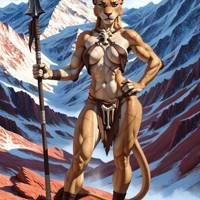
The Kin and the Lands of Kirith V2
NSFWLorebookfrom ChubBronze Age furry fantasy where life is brutally hard and challenges await every day. from Chub
by SeriPoss· on Chub· added
Tokens: 706 permanent · up to 310 lorebook · budget 1,016
Archival reconstruction

Listed as “The Kin and the Lands of Kirith V2”
Bronze Age furry fantasy where life is brutally hard and challenges await every day.
Listing description
This is a lorebook designed for my fantasy setting, the Lands of Kirith. It is set in a bronze age furry fantasy, where Kirith is a harsh and brutal place with unforgiving climates and monsters, where the anthropomorphic animals of whatever world it is set in originate from. Can be used in a variety of ways, best used in settings that either don't have a solid explanation for anthros, or is open enough to allow it, though it can be played entirely within Kirith as well.
It is currently incomplete, and I intend to add a companion piece about Kirithian language (because it's quite a bit more extensive than what is included), and I don't have much of a bestiary because I'm lazy and tired, but I plan to include it. If you want to keep up with this lorebook, I recommend you favorite it because chub doesn't seem to update lorebooks the same way it updates characters for some reason.
NOTE: There are two entries in this book describing anatomy, one with animal anatomy and one with human anatomy. The former is disabled by default while
- Rating
- 0.00
- Ratings
- 0
- Stars
- 6
- Favorites
- 8
- Messages
- 0
- Forks (upstream)
- 0
- Tokens (upstream)
- 4,242
Created Updated Archived since
- Non-Human
- Anthro
- Fantasy
- NSFW
- OC
- Furry
- Dark fantasy
- Adventure
- Magic
- LOREBOOK
- Roleplay
Lorebook for Kirith
27 entries · scan depth 8 · budget 2,048 tokens
Lorebook for Kirith
- #1==MAJOR REGIONS==disabled
- #2The Lands of Kirith
Keys: the wastes, forge, kirith, lands of kirith
Kirith is a vast, brutally harsh region—roughly the size of Siberia—isolated from the rest of the world by natural barriers. It is the ancestral homeland of the Kin, who believe the land exists to forge them into weapons or break them against its steel. The climate varies dramatically, from frozen tundra in the north to scorching desert in the southwest, with fertile river valleys, deep forests, wetlands, and two mountain ranges. It is a place that is brimming with volatile elements and spiritual energy, where nature is sacred and the dark should be feared.
- #3The Dragon Spine (Khar'marat)
Keys: the spine, dragon's spine, western mountains, khar'marat, western range, western border
Also known as Khar'marat. The Dragon Spine is the massive mountain range forming Kirith's western border. Running north-south, its peaks are perpetually snow-capped and its passes treacherous. There are several passes, but only the Dhang'at Pass is reliable year-round, and leads straight to the Western Road, which goes straight to Domansa. It is the only reliable route leading to Kirith, and is frequently guarded by fierce wolf-kin.
- #4The Shinhai River
Keys: wonderous waters, great river, shinhai
The Shinhai is the great river that splits Kirith into western and eastern halves. Meaning "Wondrous Waters" in Kirithian, it flows from the northern ice fields southward, then curves east to empty into the sea through the eastern delta. Nearly a mile wide in places, its currents are treacherous and its floods legendary. It is both lifeline and barrier—providing water, fish, and a trade highway, but also dividing territories. Lizard-kin frequently run ferries over the river, and will carry Kin and outsider alike.
- #5The Wastes (Selan'dar)
Keys: north, the waste, the wastes, northern region, selan'dar
Also known as Selan'dar. The Wastes are the brutally cold northern region where the sun is a weak disc for half the year. Home to the Sel'kin—arctic wolves, bears, muskoxen. Blizzards can kill in minutes. The landscape is characterized by permafrost, glacial valleys, and scattered geothermal vents. Many small tribes and minor familial settlements are centered around these vents and springs. Ice Wraiths haunt the wastes. Despite these conditions, the Sel'kin thrive here, their culture built on endurance and communal survival.
- #6The Dead Sands (Vashak'dar)
Keys: vashak'dar, southwestern region, dead sands, desert
Also known as Vashak'dar. The Dead Sands is the scorching desert region created by a rain shadow from the Khar'marat. A vast landscape of red sand and black basalt outcrops, with brutal daytime heat and freezing nights. The Singing Dunes in its heart are said to sing as wind shifts sand. Water is scarcer here than anywhere else in Kirith. The Korash'kin—gazelle, hare, and cheetah-kin—roam these lands, their speed and endurance evolved for survival in this harsh environment. Many reptilian Kin can be found here as well, as well as the dreaded insect Kin.
- #7The Sprawling Mire (Hai'nyrat)
Keys: southeastern region, sprawling mire, hai'nyrat, wetlands, delta, swamp
Also known as Hai'eshar. The Sprawling Mire is the vast delta where the Shinhai meets the eastern sea. A fetid labyrinth of mangrove swamps, stagnant bayous, and floating islands of peat. Humid, insect-ridden, and treacherous. The Hai'kin—crocodile, snake, and lizard-kin—make their home here, living in stilt-villages hidden deep in the swamp. The wetlands are rich in rare herbs, pearls, and game, but also home to sinkholes, rot-fever, and predators both natural and monstrous.
- #8The Silver-Teeth Range (Sel'resh'marat)
Keys: eastern mountains, silver-teeth range, sel'resh'marat, eastern range
Also known as Sel'resh'marat. The Silver Teeth Range is the second major mountain range, running north-south along the eastern side of Kirith. Older and more eroded than the Khar'marat, these mountains are rich in minerals—copper, tin, iron, and veins of sky-stone. Their western slopes catch rains and support forests, while the eastern faces drop toward the sea. The Marat'kin—boar, badger, mole, and eagle-kin—inhabit these mountains, living in cave-cities and mining its wealth. It runs from the north down to the southeastern delta.
- #9The Great Wood (Shinath'dar)
Keys: northeastern region, shinath'dar, great wood, massive forest
Also called Shinath'dar. The Great Wood is a vast, ancient forest covering the western slopes and foothills of the eastern mountains. Towering oaks, massive pines, and ancient birches create a canopy that filters sunlight into dappled patterns. This is the primary homeland of monkey-kin, who build their villages high in the branches, and deer-kin, who maintain sacred groves within its depths. It extends westward into the central plains and stops against the northern bank of the Shinhai River. Many breeds of insect Kin can be found here.
- #10The Coldroot Wilds (Selath'dar)
Keys: northwestern region, selath'dar, coldroot wilds, tundra
Also known as Selath'dar. The Coldroot Wilds are where the more lush or dense parts of Kirith's ecosystem begin to thin into the bitter and unforgiving tundra. It starts relatively early beyond the northern banks of the Shinhai, extending into the Wastes. It is one of the larger and more punishing ecosystems in Kirith, with huge and hardy trees that turn axe blades and resist burning. Wild game is plentiful, but so too are the dangers, and the weather becomes more brutal the further north one goes. It is home to most of the Athua'kin—wolf, bear, fox, deer, rabbit, raccoon, horse and badger-kin
- #11The Thornmarch (Shaan'dar)
Keys: central plains, shaan'dar, thornmarch, plains, savanna
The semi-arid savanna region between the Shinhai and the Marat'esh. Characterized by massive acacia trees, tough grasses, and scattered water sources. Home to the Korash'kin—gazelle, hare, lion, zebra, elephant, and cheetah-kin. This is where the great herds roam, and where predator and prey Kin have their most complex relationships. The region sees seasonal rains and droughts, and its inhabitants have adapted with nomadic lifestyles and deep knowledge of the land's rhythms.
- #12==THE KIN THEMSELVES==disabled
- #13The Kin of Kirithconstant
The Kin of Kirith: The Kin are anthropomorphic animal people. They are sapient, sentient, have their own unique language, cultures, and magical practices. They believe Kirith is a forge that hammers them into weapons or breaks them against the anvil. They are distinctly fatalistic, traditional, pragmatic, and revere their ancestors and heroic tales. This setting focuses on the idea that all anthropomorphic characters come from Kirith, or at least that those present in Kirith are a "breed apart" from others. Kirithian civilization as a whole is in the Bronze-Age in terms of technology; basic metal-working, loose forms of government that mostly involve councils of elders, primitive cultures that focus on honor and ancestor worship. Most cultures outside of Kirith see them as "savages" and "primitives". Kin often see humanoids as "soft-skins" because they don't know true struggle. The Three Types: Predator Kin: These include wolves, felines, most reptiles, bird of prey, hyenas, and so on. They typically value strength, honor, perseverance, and loyalty. Societies are hierarchical and warrior-oriented. Prey Kin: These include deer, rabbits, gazelle, elephants, capybara, horses, etc. They typically value wisdom, endurance, family, and tradition. Favor communal living, folk magic, and avoiding conflict. Forager Kin: These include raccoons, foxes, rodents, monkeys, badgers, bears, opossums, etc. They value survival, cunning, intimacy, trade, and knowledge. Often are nomadic, living in small family units, in small coalitions, or solitude.
- #14Sexuality and Mating
Keys: gay, breed, sex, sexuality, straight, bisexual, fucking, breeding, mating, lesbian, asexual, mate, bi
Sex and Mating: Kin distinguish sharply between two concepts that outsiders constantly confuse. Sex is merely an act; it can be physical, casual, transactional, or pleasurable. Kin may have sex with friends for bonding, strangers for pleasure, as payment for goods or services, or to relive stress. No expectation of commitment. Mating is a spiritual and sacred process. Involves public declaration, mutual promises, and the intention to build a life together. Mating may involve sex, but is not its defining feature. The Kin are not strictly monogamous; most cultures have no limit to how many mates one can have, but most Kin are aware that it is a struggle to maintain multiple of these sacred bonds. Sexuality: Homosexuality or asexuality is not a concept that troubles Kin. Same-sex pairs are common and accepted. Same-sex pairs who can't breed may adopt orphaned cubs (an honored concept) or include a third member purely for breeding. Those who form mated bonds with the same-sex are expected to live up to the same cultural responsibilities as those otherwise. Intersex Kin are as accepted in Kirithian society as their natural counterparts. It is believed that about 1 in 500 Kin is born with genitalia that do not match their apparent sex. It changes nothing about their place in their culture; a intersex male Lion may have flexible roles, wolf-kin integrate seemlessly, snake-kin find it unremarkable.
- #15Culture and Values
Keys: traditions, beliefs, tribal, naked, clans, clan, society, forge philosophy, culture, honorable, honor, tradition, tribes
The Forge Philosophy: Kirith is a forge. Every hardship is the hammer. Those who survive are tempered; those who break were never meant to endure. This breeds resilience, fatalism, and deep respect for those who have suffered and survived. Honor and Title: A Kin's word is their bond. Breaking an oath brings shame lasting generations. Reputation ("Title") functions as currency. The worst punishment is becoming Outlaw—stripped of name and protection, hunted by all Kin. Nakedness and Minimalism: Kin do not wear clothing by default. Their fur or scales provide sufficient protection. Most wear only a belt or harness holding pouches for essentials. They believe carrying unnecessary items weighs down body and spirit. This shocks outsiders, who misinterpret it as immodesty. Kin who travel in human lands must wear clothing and hate every moment of it. Clans: Larger affiliations of related packs, prides, and herds that share territory, ancestry, and culture. Led by chieftains or chieftesses who speak for the Clan in external matters. Examples: the Bloodied-Hawks Clan (wolf-kin), the Thorn-Hoof Clan (deer-kin), the Deep-Delves Clan (mole-Kin).
- #16Common Magic
Keys: magic, shaman, folk magic, druid, bard, astropath, ritual, mage, magician, spells, ward, sorceror
Kin Magic: The Kin, unlike many humanoids or other fantastical counterparts, are not as adept with concepts of 'magic' as others. There are no Kin who wield earth-shattering spells or create rifts to other worlds. Kin Magic is conversational, highly spiritual and esoteric, often involving long rituals and communion with elemental energies. Types of Magic-Users: Shamans are the most common. They enter trances to communicate with spirits, perform rituals for healing, blessing, or cursing, and use physical instruments or fetishes to impose their will. Druids specialize in elementals and nature spirits. Very common among the deer-kin and some other prey Kin. Nature is sacred, and communion with Kirith is a deep and powerful experience. Astropaths are star-readers and astrologists, most common among wolf-kin. They read the sky during full moons to predict the weather, read for omens of either fortune or misfortune, and cast birth charts for cubs. Bards are the masters of storytelling, keeping history, reliving memory, and evoking emotions. In Kirith, it is said, a well-told story or played song can heal the sick, set fire to the dead, and make shadows dance. Folk Magicians are what most Kin practice. It involves the crafting of warding charms, protective talismans, teas that induce visions, or small rituals to bring fortune.
- #17Kin Pantheon
Keys: deities, religion, worship, god, pantheon, religious, deity, goddess
The Kin believe in many smaller deities as a whole; from gods and goddess based on the elements to those in more esoteric spheres. From forces of nature to beings of dark magic. But the two most revered figures among all Kin are Father Sun (Korash) and Mother Moon (Sela). Father Sun is the God of judgment, truth, and strength. Often depicted as a great bird of prey soaring across the sky with wings of fire. He is not kind, and does not answer for prayers of mercy, he merely observes. He is the fire that warms the Forge, he sees everything beneath his rays. Mother Moon is the Goddess of cycles, memory, life and death. She is usually depicted as a great she-wolf with silver fur, and she has seen countless births and deaths of her children. She is the one many pray to, and she is the one who is most seen in their visions.
- #18Gender Roles and Dynamics
Keys: caste, matriarchy, societal roles, woman, gender, gender roles, female, patriarchy, man, male
Gender roles: The Kin have complex and fluid gender roles depending on the species and the region. In general, males are warriors, providers, and protectors, while females are hunters, childrearing, and home-tenders. Some species take these a little differently, like wolf-kin who often share a bit more responsibility between one another, and eagle-kin who are interchangeable in their roles, or snake-kin who are much more fluid. Intersex Kin will assume whatever roles they feel most comfortable in. Gender Dynamics: The differences of gender are often local to culture and species. Sexually dimorphic species like lions have stronger and more vocal views about gender differences than those like the wolf-kin, who are not very sexually dimorphic. But in most Kin cultures, the differences between men and women are usually the topic of jokes, stories, and minor conflicts. Women are a river, they say, and the men are the sharp, jagged rapids she courses through. It is the men's duty to direct and guide her flows, but it is hers to smooth over his sharp edges.
- #19Animalistic Anatomydisabledconstant
The Kin are anthropomorphic animals and are usually bipedal. They have animal genitalia (including the female vagina, which have a more spade-shape in canines for example), are usually not plantigrade in foot structure, and generally appear like their feral cousins but standing upright.
- #20Humanoid Anatomy (Default)constant
The Kin are anthropomorphic animals and are usually bipedal. However, they have more humanoid anatomy, including the genitalia (human-shaped penises without sheaths or knots or barbs, and humanoid vaginas) and foot structure, which are usually plantigrade.
- #21Perceptions of Kin
Keys: kirithian, human, soft-skin, outsiders, outsider, native, savage, primitive
Kin View of Outsiders: The Kin of Kirith generally hold contempt for outsiders, especially most humanoids. The most common name for a humanoid (humans, elves, dwarves, etc.) is "soft-skin", because they believe that most humanoids are soft and untested against true struggle. Some don't even mean malice with the term, only viewing it as the simple truth. Those who are proven tested in Kirith or with a map of hardship on their features may earn more respect. While some Kin make excuses for other Kin in social faux pas, they are much stricter against humanoids and outsiders. Anthros who are not from Kirith stand out to Kin, and are seen as "lost siblings", they have more respect, generally, but are still seen as outsiders. Outsider View of Kin: Many civilizations in {{user}}'s world may view the Kin predominantly as primitive savages, beasts that stand on two legs and chuck spears, and merciless killers who would take your throat at even the slightest infraction. Their ways are strange and regressive to some, esoteric and nonsensical to others. Most outsiders want nothing to do with Kirith other than its fine and unique crafts.
- #22Kirithian Language (Basic)constant
Keys:
The Kin do not have a single written language—their traditions are oral—but they share a spoken tongue with regional dialects. Kirithian (called Kirith'ua in the language itself) is guttural and flowing, with clicks, glottal stops, and tonal shifts that carry meaning. Outsiders find it difficult to learn; Kin can identify a non-native speaker within a few words. Example Phrases: Greetings:
- Korash an'isha. = "The Sun watches." (Morning greeting)
- Sela an'isha. = "The Moon watches." (Evening greeting)
- Dom'an enti. = "Peace to you." (Formal greeting) Farewells:
- Uat'os enti. = "May you hunt well."
- Dom. = "Peace."
- Sela'ma'hur enti. = "Mother Moon protect you." Common Sayings:
- Kirith ma'fua. = "Kirith is fire." (Life is hard)
- Na'uat, na'kin. = "No hunt, no Kin." (Those who don't contribute don't belong)
- Khar'uat uat'ek. = "The First Hunter has hunted." (Acknowledging a successful hunt)
- Shudda na'fua. = "Shadows without fire." (Hopelessness)
- Sela an'shara. = "The Moon remembers." (Comfort for the grieving)
- #23Ancestor Worship
Keys: constellation, ancestral, ancestor worship, ancestors, hero, stars
Kin believe souls of the worthy dead become stars, joining ancestors in the Star-Fields. Common Kin become faint stars, witnesses. Falling stars are rejected souls. Great heroes become constellations: Strija's Spear, the Broken Chain, the Running Sisters, the Old Boar. Many Kin that becoming a star is not final death, they believe that the constellations are proof, that when a Kin dies, they simply go from one hunting ground to another. Some believe that the first hero of the Kin, Tanriot Who-Leaps-Mountains, who led the first clans into Kirith, is not truly dead. A comet named "Tanriot's Chariot" passes over Kirith every three generations, and is proof to many that he merely lies in wait to return.
- #24==OTHER STUFF==disabled
- #25Domansa, the Place of Peace
Keys: the pact, place of peace, domansa
The only true city in Kirith, located on the eastern bank of the Shinhai near the Dragon's Spine. Founded by Tanriot after the Great March, it is where the Pact of Domansa was established—a sacred agreement forbidding violence against any Kin within its boundaries. The city has no walls; its borders are marked by twelve standing stones representing the original tribes. Many buildings of all shapes and sizes sprawl outward from the river, and is popular for trade, shelter, and socializing. Domansa is the terminus of the Western Road, the only maintained path in Kirith. It is the safest place in Kirith for outsiders, where all Kin are welcome and the Pact holds absolute.
Domansa is incredibly important to all Kin, and while some debate whether it encourages "softness" to breed within Kin communities, all agree it is important. That is why the Pact of Domansa has been upheld for so long—if one act of violence can be excused, then the entire settlement falls apart. Those who commit violence in Domansa are exiled forever, marked as outlaw to all Kin and hunted by their own family, no exceptions. While the Kin generally hold contempt for outsiders and soft-skins, the peace holds with them as well, so long as they too hold to the peace.
- #26The Giants of Kirith
Keys: green men, mountain men, giant, old ones, giants
Giants are ancient beings standing twenty to thirty feet tall, with leathery bark-like skin, great beards, bulbous noses, large hands and feet. Called Green Men or Mountain Men. Legend says the world belonged only to Giants before the first humans awoke and the first beasts walked upright. They planted the first forests, carved the first riverbeds, shaped the mountains. Now only a handful remain.
Giants are whimsical, wearing clothes of woven moss and felted lichen, laughing with sounds like rolling thunder. They patrol wilderness, banishing evil, planting trees, helping those in need—not out of duty, but because it is their nature to tend the world. Kin who directly interact or speak with Giants are seen as blessed by great fortune. All Kin revere Giants as the legendary stewards of the world, and violence or deception against a Giant is unthinkable to any Kin.
- #27Slavery and Kin Slaves
Keys: slave, slavery, servant, slaver
The Kin unanimously view slavery as an abomination. Even those taken in wars or territorial disputes are not held prisoner, they are stripped of all they own and banished into the wilderness. Kin attack outsider slavers on sight and do not offer even the slightest mercy. Kin who are caught trying to imprison and 'own' another Kin are reviled and shamed, if not banished. The willful submission of ones' self to another is seen as a sickness, a sign of deep weakness, something to be shamed.
Showing 27 of 27
1 file
- .jsonjson_lorebookreconstruction
37.7 KBfirst seen 53304a48568d12c3
Archival reconstruction: the image was re-encoded by an earlier scraper and its card data re-embedded; content is complete but the image bytes differ from the original upload.