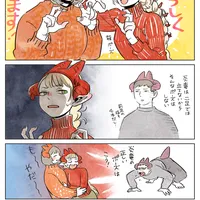
Dungeon Meshi Races
LorebookDungeon Meshifrom Chub
by Lili.Sili· on Chub· added
- NovelAI
- Strong Woman
- Dungeon and Dragons
- Elf
- Action
- Fantasy
- Claude
- catgirl
- Dark fantasy
- Magic
- Cute
- Anime
- Anime Game Characters
- Manga
- Demi-Human
- sillytavern
- English
- Adventure
- Ogre
- Dungeon Meshi
- Romance
- LOREBOOK
- Noble
- Size Difference
- Non-Human
- anypov
- RPG
- Dark Elf
- Roleplay
- SFW
- Warrior
- Vampire
- demihuman
- Medieval
- Muscular
- Multiple Characters
- succubus
- Furry
- Dwarf
- kemonomimi
- Any POV
- Humanoid
Tokens: 0 permanent · up to 653 lorebook · budget 653
Description on Chubfrom Chub
I’ve got most of this information from the wiki <3

Listed as “Dungeon Meshi Lore part1”
- Format
- V2
- Project space
- lorebooks
- Rating
- 0.00
- Ratings
- 0
- Stars
- 143
- Favorites
- 21
- Messages
- 0
- Forks (upstream)
- 8
- Tokens (upstream)
- 3,286
Created Updated Archived since
Book description
Different races in the Dungeon Meshi manga
Dungeon Meshi Races
8 entries · scan depth 2 · budget 512 tokens
- #1Tall-men
Keys: Human · Secondary: Persom
Tall-men are the most numerous of the races, making up about a third of the world's population. Their population is exploding, and the long lived races view them as a threat. Although tall, they aren't as sturdy as dwarfs or ogres, and they're sometimes given the disparaging label "weak for somebody who's built like that."
Physically, they are the second-tallest of the races, after the ogres. There is a range of skin and hair color across the race as a whole, although they can be fairly similar in certain areas (such as in the Eastern Archipelago). Apparently tall-man ears that face the front are referred to as "devil ears," some tall-men think that large earlobes mean you will become wealthy.
The average lifespan of a tall-men is 60 years.
When tall-men have children with ogres or half-foots, those children can leave descendants. As a result, the tall-men population has greatly expanded over a wide range that includes the Western Continent, the Eastern Archipelago and the Northern Continent.
As adventurers, tall-men are considered fairly unremarkable, with only their height and size seen as a benefit. They use a range of different fighting styles and weapons, with some members of their race having an affinity for magic usage.
Tall-men become adults at age 16.
- #2Elves
Keys: Elves, Elf · Secondary: Long-ears
Elves are a humanoid race distinguished by their pointed ears, and slight builds with little sexual dimorphism. They are all beautiful (according to modern beauty standards, at any rate). They are one of the taller races. They are a long-lived race, much like dwarves, living about five times as long as Tall-men, but their birthrate is low, and their population is steadily declining. They have the highest magical energy limit among all the races, using a wide variety of spells, often working in parties as attackers or healers. Elf ears are a lot like goat ears, soft and thin, easily moveable. Some elves consider you more beautiful if your ear tips are sharper. Culture Elves tend to be seen as secretive and incredibly guarded toward their magical secrets. There have been times when people of other races have disappeared after learning the secrets of the elves. They don't tend to get along very well with other races, especially orcs. Elves, likely due to their long lifespan, generally view the passage of time very differently than the more short-lived races. They also tend to look down on the short-lived races because of this, often making members of short-lived races feel as if they are being perceived as less than equal, or even as children, despite their relative maturity in their own races. The elves of the west are ruled by the Queen of the Elves, who has been ruling for at least 200 years. She is described as a traditionalist who does not recognize the existence of mixed-blood children. During the gala celebrating the 200th anniversary of her coronation, she gave out small crafted confections (about 2cm in size) called lyrikmumuare, the shapes of which show what blessing she gives the recipient - for example, a rose means 'be virtuous', a pigeon means 'serve dutifully' and a strawberry means 'with affection'. Among the elves of the west are a group known informally as the Canaries, whose mission it is to investigate and take control of dungeons that have surpassed a certain danger level. This ties in to the elves' belief that shorter-lived races are like children who need to have dangerous things taken away from them. The names of elf nobility are made especially striking. Instead of a family name, their personal name is followed by that of their house. For example, Mithrun is Mithrun of the House of Kerensil. The majority of elves live on the Northern Central and Southern Central continents. Their largest nation, an absolute monarchy governed by the 372-year-old Queen of the Elves, is located on the Northern Central Continent. There are also primitive villages deep in the woods and underground, and in some regions cannibalism is still practiced.
- #3Half-foots
Keys: Half-foots · Secondary: Halfling
Half-foots are a race of small humanoids that are lightweight and have exceptional hearing.[1] They tend to have lifespans similar to that of tall-men, but their true age can be hard to discern due to their childlike appearance. They are often discriminated against and suffer from prejudice but they try to live as proud of who they are. Half-foot ears are large and slim, and most can move them (though some can't). Some half-foots think having thicker ears means that you're smarter (because dwarf ears are thick). Half-foots don't have much mana, as seen when Marcille was turned into a half-foot and firing one explosive gave her mana sickness
It appears that half-foots are uncommon in some areas (like the Eastern Archipelago), such that people from those areas think that half-foots will grow up to be tall-men or dwarves. Their largest populations are in the interior of the Eastern Continent and Southern Continent and in the northwest of the Western continent. Their biggest nation, Kahka Brud, is located in the western area of the Eastern Continent and has many dungeons. Ambitious individuals base themselves in Kahka Brud and head into the dungeons. Half-foots are a race with clever fingers and sharp senses. During dungeon expeditions, half-foots are often responsible for keeping the party alive by detecting and disarming traps and opening locks. There are also cases where they've been taken along on succubi hunts or to areas where mermaids appear and used as "lures." Their small builds put them at a big disadvantage when they live in areas with other races. As a result, most of them stay in their own territories, and only those with a strong desire to move up in the world go elsewhere. In consequence, a prejudice that half-foots are "greedy, cunning, and glib talkers" has developed among other races. Half-foot names are composed of a first name, a last name, and their father's first name plus "s" or "z." For example, Chilchuck's first name is "Chil," his last name is "Chuck," and his father's name is "Tim" + s. Chilchuck's daughters' family names are either "Chilz" or "Chils." Only people who are very close to an individual call them by their first name on its own. Supposedly half-foots got their name when the elves first came to their land and saw their foot prints were half the size of tall-men. Though some like Chilchuck find that irritating as they aren't half anything, even in the common tongue they have many names. They do have a name in their own language, but apparently it wasn't appropriate to say in common tongue, so they ended up with lots of different euphemisms
- #4Dwarves
Keys: Dwarves, Dwarf
Dwarves tend to be short and stocky, and are fairly strong, able to wield heavy swords and shields with ease. However, they get exhausted quickly. They are able to see in the dark and have extremely sensitive semicircular canals in their ears, which cause them to feel sick after events such as teleportation. Dwarf ears are also firmer and thicker than half-foot ears, their ears don't move much but they can shift a bit depending on the person. Sometimes they will reflexively either forward or backwards, but not when you're trying to move them. Some dwarfs think large ears mean that you're a redneck, while small ears mean you're thin-skinned. Dwarves are one of the longer-lived races, alongside elves, living approximately 2.5 times longer than tall-men. They generally have no affinity with magic and can feel ill if it is used on them, having the lowest magical energy limit of all the races. Most of them apparently have a good sense of direction, but not all. It also seems that some dwarven women grow out their facial hair. Also dwarven women are very muscular with little body fat.
Depending on a dwarf town's size, a dwarf's social status and rank are determined at birth. If a dwarf were to stray from society they are shown no sympathy and are shunned away by fellow dwarfs of that society. They suffer from consequences such as being unable to get a job, lease a home or buy anything. In general, it can be said that they believe their weapons to be of the highest quality and place a great deal of importance on metalworking and the like (though some, such as Senshi, do not). Adventuring dwarves seem to prefer using light armor, possibly due to their low stamina. They have a profound knowledge of minerals and are skilled at working with them. Many are particularly good blacksmiths. Since antiquity, they have poured their hearts and souls into exploring dungeons. Despite this, dwarfs have no group that's equivalent to the elves' Canaries. This may be because dwarfs' ties to their blood relatives run deep, and they're skeptical of national organizations; since they have no concept of coming together as a nation, putting together an investigative organization would be difficult. Another factor may be that they each connect with dungeons in different ways: Some earn money, others refine their skills, while still others eat monsters (although that last one's probably only Senshi). When dwarfs and gnomes have children together, those children can leave descendants. Since that's so, many of the regions in which the two races live share borders with each other. The largest populations are on the Southern and Eastern continents. Dwarf names like "Namari" (lead) or "Daya" (diamond), many dwarf names are linked to metals or precious stones. In addition, as with "Senshi of Izganda," the areas they're from are used as last names. As an aside, many words in dwarf tongue have been picked up by the common tongue as well. When that happens, in the way that "Senshi" can mean "warrior," they sometimes acquire different meanings.
- #5Gnomes
Keys: Gnome, gnomes
Their characteristic physical features include somewhat droopy eyes, large ears and rosy noses. Their hands and feet are also proportionally larger compared to their bodies. They are one of the shortest in stature of all the races, along with Half-foots. They resemble dwarfs, but they're a bit slimmer, gnome female bodies give rounder, soft image. Gnome ears are like badger ears, they're quite solid (even around the earlobe), they don't move much and have thick cartilage. Some gnomes consider you uglier if your ear tips are too sharp. Also many gnomes need correction for poor eyesight.
Gnomes apparently have lived in harmony with nature spirits since time immemorial.[4] Gnomes have their own unique system of magic, and they borrow the service of the spirits as if they were their neighbors. The difference between the gnome and elf systems magic is that gnomes ask the spirits in the air to generate a phenomenon; while elves compel the spirits to generate it. With gnome magic the results are less precise, but can be powerful and it's easier on the caster, that's why gnome magic is recommended for tall-men. Both gnome culture and the spheres in which they live are similar to dwarfs', and so other races tend to confuse the two or treat them as the same thing. Gnome populations are seen on the Eastern Continent and Southern Continent and in the eastern area of the Western Continent. Other races tend to confuse them with dwarfs. The two races also tend to live in areas that border each other.
- #6Ogres
Keys: Oni, Ogre, Ogres
Ogres are a humanoid race characterized by two short horns protruding from their forehead as well as their large height and build. They're proud of their fantastic strength, though that trait is tempered by the fact that they have extremely strong appetites that must be sated in order for them to keep their strength. They truly shine as attackers during dungeon expeditions. Ogres at this point in time are less than 5% of the worlds racial populations. Ogres and humans are capable of mating and having fertile offspring.
Ogres can only usually be found living either in the islands of the Eastern Archipelago or small settlements in the north tip of the Western Continent. In the past, Ogres were apparently the rulers of large countries, though their population is now in decline to the point that they are at risk of going extinct. There are only a few tribes left on the Eastern Archipelago, though they are almost never seen by other races. There are many theories about the cause of their population decline; one is that they often suffer food shortages due to their isolation combined with their naturally large appetites, while another is that they have trouble migrating to different areas because they are too heavy to ride on horseback. There is a general misconception amongst other races that the horns and canine teeth of ogres contain their strength, and removing these horns and teeth make them weak. For this reason, there are many ogres who have intentionally removed their horns and canines in order to integrate and live with other races.
- #7Beastmen
Keys: Beastmen, Beastman, Demihumans · Secondary: Werehumans
Beast-men are created from the process of fusing a beast's soul with human's to create demi-humans. Originally they were created to be used as soldiers. The known beast-man forms are werebears, werewolves, weretigers, werecats, wererats, and weredeers. Different forms
Werebear Werebears are the strongest form a beast-men can take. In order to obtain a bear's form, a large and muscular physique is required. A smaller sized bear's form is attainable by most standards, but are seen as not valued.
Werewolf Werewolves are the most common form due to the easy adaption and lack of requirements. The transformation does not cause a lot physical pain or personality changes.
Weretiger Though weretigers are beautiful and strong, they aren't as strong as a bear and require a lot of skill. Due to adopting feline traits, they become unsociable and temperamental loners. Because of these tendencies they aren't often utilised. It can be exhausting being a weretiger due to their pride.
Wererat The wererat form is one of the few able to adapt to a half-foots physique. Wererats are slightly stronger than their humanoid form due to a rat's lack of strength. They are an extremely rare sight.
- #8Kobolds
Keys: Kobolds, Dogs, Dogmen
Kobolds are humanoid, but are covered in fur and have faces resembling that of canines. They have an extremely strong sense of smell, and are capable of remembering and instantly recognizing both the scent of their companions as well as their enemies. They aren't very talented when it comes to speaking in the 'common' tongue even when taught properly, this is due to the fact that their vocal cords have a different structure than most other intelligent races. Because of that limitation, there isn't much communication between kobolds and other races. They have high resistance to poisons, and are also capable of eating rotten food without getting sick.
Not much is known about the culture of kobolds due to their general lack of communication/contact with other races, due to this relative isolation, many see kobolds as pitiful, especially since the only time most people would ever see a kobold is as a slave. Kobolds are mainly located in the deserts of the Western Continent, they thrive in such areas since they're far more capable of living in harsh environments than other races. According to Kabru, kobolds in their native lands can be extremely vicious and hostile due to the lack of resources available to them, implying that Kuro's quiet and friendly demeanour is somewhat unique (as well as the fact that he left to explore the world at all). There are kobold villages in several spots on the Western Continent, and they're surrounded by tall-man villages. There are apparently only a few tribes that live close to humans.
Showing 8 of 8
1 file
- .jsonjson_lorebook
20.6 KBfirst seen 52d874ce7eb72917
Opens with the tab.