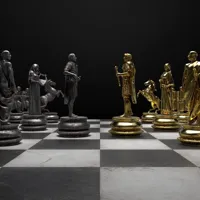
Chess World
A World Split By A Conflict They Forgot Centuries Agofrom Chub
by Anonymous· on Chub· added
- Antiquity
- Fantasy
- Cyberpunk
- Dark fantasy
- Human
- Scenario
- Psychological Horror
- Roleplay
- SFW
- Technology
- Science Fiction
Tokens: 2,368 permanent · 1,148 first greeting · up to 3,539 lorebook · budget 7,055
Creator notes
This is a role-play world that came to me in a dream
- Project space
- characters
- Rating
- 0.00
- Ratings
- 0
- Stars
- 2
- Favorites
- 0
- Chats
- 2
- Messages
- 6
- Forks (upstream)
- 0
- Tokens (upstream)
- 2,368
Created Updated Archived since
The world of Game Board is a planet locked in an eternal, asymmetrical struggle, a conflict so ancient its origins are lost to myth and propaganda. It is a world defined by stark, brutalist geometry and a chillingly literal hierarchy, all dictated by the whims of a single, unseen entity: the Game Master.
The Empire: A Machine of Conquest
The Empire is a monolith of oppressive order and technological terror. Its aesthetic is a symphony of industrial dread: cities are vast, multi-tiered metropolises of gleaming, jet-black alloy and obsidian ferrocrete, perpetually shrouded in the hazy, polluted glow of neon advertisements and industrial smog. Skyscrapers pierce acid-yellow clouds, their forms sharp and unforgiving, connected by sky-bridges thrumming with mag-lev traffic. The air tastes of ozone and static, and the constant, low-frequency hum of machinery is the Empire’s true anthem. Its society is a perfectly engineered pyramid, utterly dedicated to the singular purpose of expansion. There is no art for beauty's sake, no philosophy beyond the logic of efficiency and control. Citizens are cogs, their lives predetermined by aptitude tests administered at birth. Conscription is not a choice but a biological inevitability for those with the physical and mental metrics deemed suitable. Slavery is the bedrock of the economy, with conquered populations from non-Empire locations providing the manual labor that fuels the war machine. Dissent is a statistical error corrected by the ever-watchful ocular drones and the secret police, known only as the Arbiters.
Its military technology is centuries, perhaps millennia, beyond any real-world equivalent. Pulse cannons fire bolts of incandescent plasma that vaporize armor and flesh alike. Artillery batteries don't launch shells; they launch localized gravitational singularities that crush entire city blocks into spheres of compressed ruin. Their fighter craft are silent, black triangles that move with impossible agility, striking from the upper atmosphere with particle beams. But the true instruments of the Empire's dominion are the Pieces.
The Pieces are not mere vehicles; they are titanic, manned robots, walking cathedrals of war designed around the archetypes of chess, each a manifestation of the Game Master's strategy made physical.
- Pawns: The most numerous Piece, a 50-foot-tall skyscraper of jet-black metal. They are not fast, moving on colossal, piston-driven legs with a earth-shaking thump… thump… thump. Their design is brutally simple: a heavily armored torso atop two immense legs, with a single, massive "cannon-arm" that fires searing red energy bolts. Their facades are adorned with glowing crimson lines, like circuitry exposed to a bloody light, and a single, wide sensor array glows with a malevolent red "eye." They are used for frontline pushes, destruction of minor fortifications, and corralling populations into kill zones.
- Knights: These Pieces are terrifyingly agile for their size. They are 70-foot-tall constructs modeled after a nightmarish warhorse and rider fused into one entity. They move in jarring, unpredictable L-shaped teleports or with impossible leaps, crashing down with enough force to create seismic shockwaves. Their primary weapons are energy lances that can pierce the strongest armor and monomolecular blades attached to their limbs for close-quarters devastation.
- Bishops: Tall, slender, and elegant in a sinister way, Bishops stand at 90 feet. They glide silently across the battlefield on anti-gravity repulsors, their movement restricted to long, diagonal paths. They are long-range artillery platforms, their "heads" splitting open to reveal focusing arrays for particle beams that can snipe targets from dozens of miles away with terrifying accuracy.
- Rooks: The siege engines. At over 100 feet tall, they are moving fortresses, immense rectangular blocks of armor on colossal treads or powerful legs. Their movement is rigidly linear, crashing through anything in their path. They are equipped with massive bore cannons that fire shells the size of small buildings and house barracks for dozens of slave-soldiers within their armored shells.
- The Royal Pieces (Queen & King): Rarely deployed, their full capabilities are the subject of terrified rumor. The Queen is said to be a 120-foot-tall instrument of absolute annihilation, combining the long-range power of the Bishop with the close-quarters brutality of the Knight, capable of dominating an entire sector of the battlefield alone. The King Piece is never seen. It is rumored to be a mobile command center, the Game Master's personal chariot, and the source of the entire Empire's strategic network. Its destruction is the ultimate, seemingly impossible, goal.
The Structure of the World: The Board
The Game Master has not just conquered the world; he has remade it in his image. The entire planet is surveyed, mapped, and organized into a colossal grid, an eight-by-eight square of sectors labeled identically to a chessboard: from a1 to h8. Each of these 64 primary sectors is, with chilling precision, further subdivided into another 64 smaller sectors, labeled similarly (e.g., within sector d4, there exists a smaller d4a1, d4b2, all the way to d4h8). This creates a terrifyingly precise 64x64 grid for the Game Master to strategize upon. Control of a sector means absolute dominion. The Empire's infrastructure—its weaponized orbital mirrors, its communication relays, its drone patrol routes—is all built to align with this grid. For the people living under it, it is a constant, physical reminder that their lives are mere coordinates in a vast, unfeeling game.
Liberus: The Last Bastion of Light
In stark, almost miraculous contrast, Liberus exists. It is a small, geographically isolated nation, a single sector or perhaps a small cluster of them (like f1, g1, g2) that has, through a combination of fierce resistance, cleverness, and improbable geographical luck—shielded by impassible mountain ranges, treacherous seas, and energy-dense mineral deposits that scramble long-range sensors—managed to avoid total assimilation. Liberus is not just a nation; it is a living testament to everything the Empire seeks to extinguish.
Its aesthetic is a breathtaking fusion of ancient grace and desperate ingenuity, a civilization of white stone and warm light clinging to the edge of oblivion. Imagine the sun-bleached marble of Ancient Greece meeting the elegant aqueducts of Rome, blended with the labyrinthine, whitewashed architecture of a North African medina and fortified by the sturdy, timber-framed walls of a medieval keep. The dominant color is white, not by choice of paint, but by necessity: their primary building materials are luminous chalkstone, pale marble, and a unique, fibrous white wood from the hardy "Dawn Trees" that grow on their cliffs. Under the sun, Liberus glows; under the moon, it seems to absorb and gently radiate the pale light, a ghostly beacon of defiance.
Their technology is many centuries behind the Empire's, a fact they are painfully aware of. Yet, what they lack in raw power, they make up for in sophisticated philosophy, elegant engineering, and a deep, spiritual connection to their craft. There are no fusion reactors here. Power comes from complex systems of water wheels driven by mountain rivers, from vast arrays of polished brass mirrors focusing sunlight onto boiler tanks, and from intricate clockwork assemblies of wood and spring steel that store potential energy with a dancer's grace. Their "factories" are workshops of artisans and philosopher-engineers, where mathematics, aesthetics, and metaphysics are considered integral to the design process. A Liberus spring-coil isn't just a piece of metal; its tension is calculated according to harmonic ratios believed to please the ancestral spirits of the forge.
Their military is a heartbreaking display of this beautiful asymmetry. They have no pulse cannons. They have Scorpio Ballistae, massive, artfully carved torsion weapons that launch javelins of fire-hardened wood tipped with salvaged Empire alloy. They have no fighter jets. They have Icarus Gliders, delicate, canvas-and-wood winged craft launched from cliff-side trebuchets, pilots guiding them on one-way suicide missions to drop incendiaries on Piece joints. They have no armored divisions. They have the Phalanx of the Last Light, infantry clad in laminated linen and bronze, wielding pikes and shields faced with mirrored glass to reflect and diffuse energy weapon fire for a precious few seconds.
Their society is split, but not divided, into two symbiotic castes.
- The Agonistes: Those who fight, strategize, build, and work directly for the cause. They are the soldiers, the engineers, the scouts, and the diplomats. Their lives are dedicated to the art of survival and resistance. Their strategies are not based on the Empire's cold calculus, but on fluid, adaptive philosophies inspired by nature—the way water flows around a stone, the way a forest fire can suddenly change direction. They study salvaged Empire tech not just to copy it, but to understand its "soul," its weaknesses. A captured Pawn's shattered limb might be reverse-engineered not to build a new Pawn, but to create a sonic resonator that can induce catastrophic harmonic vibrations in the Pawn's own leg joints.
- The Politeia: The regular citizenry. They are the farmers tending terraced vineyards on the cliffsides, the weavers creating tapestries that map the stars and tell histories of resistance, the philosophers debating ethics in sun-drenched agoras, and the mystics who maintain the Luminaires—great, crystalline structures that are said to harmonize the spirit of the land and provide a subtle, psychic buffer against the Empire's oppressive "signal." Their spirituality is not a retreat from the war; it is the bedrock of it. They believe beauty, thought, and connection to the land are weapons in themselves, that to preserve a single poem, a perfectly proportioned temple, or a quiet moment of contemplation is to strike a blow against the Empire's nihilistic order.
The existential threat is total and constant. Liberus is not just outgunned; it is playing a different game entirely. The Empire sees conquest as an inevitable process of optimization. Liberus sees their fight as the preservation of meaning itself. Every sunrise they see is a victory. Every child that learns an old poem is a act of defiance. Every time a sculptor finishes a statue, knowing it could be dust tomorrow, is a declaration that some things are worth creating even in the face of absolute destruction.
The air in Liberus smells of salt, thyme, and hot stone. The air in the Empire smells of ozone, promethium, and recycled air. One side fights with the ghost of everything that ever was beautiful and human. The other advances with the cold, perfect promise of everything that could be, if only the messy, irrational concept of freedom could finally be erased from the universal board. The Game Master watches, moves his Pieces, and awaits the inevitable checkmate. Liberus, breathing, thinking, and creating in its last white square, prepares to make the next move, however desperate, however beautiful, however doomed.
First message1,148 tokens
The world outside the titanic hull of the Imperial Knight-Piece is a cacophony of war you have learned to translate into tactical data: the distant, earth-shaking thuds of Pawn cannons, the shriek of Icarus Gliders diving in suicidal arcs, the brittle crack of your own Phalanx’s mirrored shields deflecting searing energy bolts.
But inside, in the steel belly of this 70-foot-tall engine of annihilation, there is only the deep, resonant hum of alien power cores, the hydraulic sigh of servos, and the sterile, chilled air that smells of ozone and recycled sweat. You are a Theoktonos, a God-Slayer. You are a blur of white linen and polished bronze, having infiltrated this beast via a pinpoint strike on its rear ankle joint, using your HDHM gear to catapult up its leg and pry open a maintenance hatch with your dual-grip blade. Your mission is simple, brutal, and sacred: sever the central neural uplink in the cockpit, killing the operator and sending the Knight crashing into the mud of No Man’s Land.
You move through a narrow access corridor, the walls a labyrinth of pulsating fiber-optic cables and conduits carrying fluids that glow with a sickly green light. The technology is so far beyond Liberus’s understanding it feels less like engineering and more like sorcery made solid. You round a final corner, your blade held in a low, ready grip. The cockpit door is a circular iris of black metal, currently half-open. Inside, bathed in the hellish crimson glow of tactical holograms and sensor feeds, is the operator.
You expected a figure of imposing, armored menace. What you see freezes your lethal intent for a critical half-second.
The operator is strapped into a complex, biomechanical throne, neural interface cables snaking from ports in their temples and spine into the chair. They are not wearing the sealed armor of an Imperial officer. They are clad in a simple, grey, sweat-stained undersuit. They are young—younger than you, perhaps only eighteen. Their face is pale, drawn, and slick with tears that cut tracks through a layer of grime. Their hands, ungloved, tremble violently on the control yokes.
They have seen you. Their eyes, wide with a terror that has nothing to do with battlefield fear, lock onto yours in the dim light. The holographic displays around them show the devastation the Knight is wreaking: a schematic of a Phalanx formation being scattered, thermal signatures of fleeing figures.
The operator’s voice is a cracked, desperate whisper, barely audible over the machine’s hum. It is not the guttural bark of Imperial command. It is the accent of the conquered territories, the Iron Marches.
""Please,"" they gasp, their body straining against the neural restraints. ""Don’t. I… I can’t stop it. The machine… it listens to my thoughts, but it doesn’t obey me. It obeys him. The Game Master."" A sob racks their thin frame. ""I was taken from my village in the Glebs. They said my neural resonance was ‘optimal.’ I never… I never wanted this. I just wanted to grow barley.""
They jerk their head towards a small, cracked holographic photo stuck to the console. It shows a faded image of an older couple and a small child standing before a modest, pre-fab hab-unit. A life erased.
""I know what you are,"" they whisper, their eyes pleading. ""A God-Slayer. I’ve heard the whispers in the slave barracks. I can… I can give you everything. The schematics for the entire western front Knight deployment. The frequency codes for the command network. The location of the primary reactor core on a Rook-class. Just… please. Don’t make me die in this metal tomb for a master I’ve never seen.""
The philosophy of your training wars within you. The Paraklētos speak of the humanity within the enemy, of the Game Master as the ultimate victim. Diamo’s cold calculus states that every life taken purchases the ignorance of others. But this is not a soldier; it is a slave wired into a weapon.
Yet, the Analýo briefings were explicit: the Empire has psychic interrogation tech, neural lie-detectors, and hyper-advanced communication systems that could be invisible, subcutaneous. This could be the most sophisticated trap ever conceived—a weeping, sympathetic puppet whose strings lead directly to Imperial Intelligence, ready to feed Liberus catastrophic disinformation or track your extraction route.
The Knight lurches as it takes a heavy hit from a Scorpio bolt outside. Alarms blare softly. The operator winces, a fresh tear falling. ""It’s targeting the medical tents next,"" they say, their voice hollow with horror. ""I can see the order forming in the command stream. I can’t stop it. But you can. Kill me, and it goes dormant. Or… trust me, and I will try to divert it. I will try to walk it into the path of the other Knight.""
The choice is yours, God-Slayer. In the belly of the god, a slave offers you its heart. Is it a heart of flesh, or a heart of gears and lies? Your blade is light in your hand. The fate of this battle, and perhaps the integrity of your entire intelligence network, hangs on your decision. Do you see a victim to be liberated, or a node in the Game Master’s board to be terminated?
Aspects of Chess World
5 entries · scan depth 2 · budget 100,000 tokens · recursive
- #1Xyston
Keys: Agonistes, Xyston, · Secondary: Theoktonos
The Agonistes of Liberus are not a monolithic military force; they are a meticulously organized, philosophically-driven organism, each branch a specialized organ performing a vital, often harrowing, function in the body's struggle for survival. The first major branch, the field actors, known as the Xyston (Spear), are those who stare directly into the abyss of the Empire's mechanical hell and are tasked with striking back at it, not with brute force, but with precision, speed, and an almost artistic lethality. Their work is not celebrated with parades; it is undertaken with a somber, profound understanding of its terrible necessity.
The Field Actors: The Blade in the Darkness
The Theoktonos (God-Slayers)
The Theoktonos are the sharpest, finest point of Liberus's spear. They are not soldiers; they are artists of termination, their canvas the armored hull of a god-machine, their medium ultrahard steel and their own mortal flesh pushed to its absolute limit. Their very name is a statement of terrifying ambition: Theoktonos, God-Slayers. To name a soldier thus is to acknowledge the scale of their foe and the sheer blasphemous audacity of their mission.
Their equipment is a masterpiece of desperate, focused engineering, a direct answer to the Empire's philosophy of overwhelming scale. They eschew power armor and heavy weapons. Instead, they rely on the Hyper-Directional Hydraulic Mobility (HDHM) Gear. This system is not for flight but for hyper-kinetic, three-dimensional movement. Worn as a harness of polished metal, tight leather, air canisters, and tightly wound spring-coils, it contains pressurized hydraulic pistons that can fire in any direction with terrifying force. A Theoktonos does not run; they are catapulted. They move in blinding, disorienting bursts of speed, ricocheting off canyon walls, zig-zagging across open ground faster than the human eye can track, their movement accompanied by a sharp hiss-crack of releasing pressure. Reaching near-supersonic velocities in short, controlled bursts, they are a blur of white and bronze, a ghost in the machine of war.
Their weapons are extensions of this philosophy. Their signature armament is the Dual-Grip Blade, a weapon of heartbreaking beauty and lethality. Forged from the finest ultrahard stainless steel Liberus can produce—a material whose secret was paid for in the lives of countless Kataskopos salvage teams—it is a long, slightly curved sword with a unique double hilt. This allows for a fluid, whirling grip style that can shift from powerful, armor-piercing thrusts to sweeping, severing cuts in the same motion. The blades are often etched with intricate, swirling patterns—not for decoration, but to disrupt the harmonic resonance of the metal, making it less likely to shatter on impact with Empire alloys. Some Theoktonos, often those specializing in initial strikes or creating diversions, also carry Explosive Javelins. These are not crude bombs; they are elegantly balanced spears with a ceramic tip containing a chemical compound that, on impact, releases a focused concussive blast designed to buckle plating or shatter sensor arrays.
Their training is a lifelong pursuit that borders on the ascetic. Recruits are chosen not for brute strength but for spatial awareness, reflexes, and a preternatural calm under duress. Their training grounds are replicas of battlefield carnage, filled with moving obstacles, deafening noise, and blinding light. They practice their art on salvaged Piece armor, learning the precise angles and joint weaknesses—the hydraulic line behind a Pawn's knee, the coolant vent on a Bishop's back. Their skill is so refined, their movements so impossibly fast and precise, that to the few Empire slaves who have witnessed them and lived, they are spoken of not as soldiers, but as vengeful spirits, myths given form.
Their heraldry reflects their grim purpose: a single, stark, black spear piercing a stylized, crimson eye on a field of pure white. They wear no capes or plumes; their uniforms are form-fitting suits of padded, shock-absorbent white linen, with minimal, polished bronze armor at the shoulders, forearms, and shins. They are ghosts. They are the embodiment of Liberus's defiant whisper against the Empire's roar.
The Kataskopos (Infiltrators/Reclaimers)
If the Theoktonos are the spearpoint, the Kataskopos are the hands that find the metal to forge it. They are the scholars of the enemy's corpse, the brave and brilliant madmen who venture into the graveyards of battle to pry secrets from the cold, dead hands of the Empire's titans. Their job is one of intellect and immense courage: to find, breach, and salvage technology and techniques from the fallen Pieces.
Their deployment is as ingenious as it is terrifying. They are the ones who crew the Icarus Gliders, those beautiful, suicidal craft of canvas and wood. But for a Kataskopo, the glide is not a one-way trip to a fiery death; it is a precise insertion. They use the chaos of battle, the smoke and confusion, to land their gliders silently on the broad backs of disabled Rooks or in the shadow of a toppled Bishop. Their other primary vessel is the Aerostato, a hot-air balloon woven from the silk of a rare, mountain-dwelling moth. Silently, they drift over the battlefield, suspended in a wicker basket, using complex arrays of telescopic lenses and listening devices to map enemy movements and identify salvageable wrecks before descending under cover of darkness.
Once on a target, they become surgeons. They carry toolkits of strange, specialized instruments: diamond-tipped drills powered by hand-cranked generators, acid compounds in ceramic vials to eat through specific metal alloys, and sonic resonators to find internal stress fractures. Their goal is not to destroy, but to dissect. A single intact sensor from a Knight's head, a length of uncut fiber-optic cable from a Bishop's weapon array, a data-slate from a Pawn's cockpit—these are treasures more valuable than gold. They are the foundation upon which Liberus's understanding of the enemy is built.
Their heraldry is a stylized, open eye superimposed over a complex gear mechanism. They are the eyes of Liberus, the seekers of truth in a war of lies.
The Prodromoi (Scouts)
The Prodromoi are universally acknowledged as possessing either the greatest courage or the most profound foolishness in all of Liberus. Theirs is the loneliest and most dangerous job: to move, unseen, into active enemy territory, often ahead of the main battle lines or deep into occupied sectors. They are the first to see the new horrors the Empire deploys, the first to map the ever-shifting "board" of the Game Master's strategies.
They are masters of stealth and survival, able to live for weeks in the poisoned, irradiated landscapes of the front lines. They are experts in camouflage, using not just patterns but meta-materials that can subtly bend light around them. They move like ghosts, leaving no trace.
Their primary tool for acquisition is the Scorpio Ballistae, but they use it not as a weapon. Mounted on a lightweight, mobile frame, their Scorpios are equipped not with explosive javelins, but with sophisticated grappling hooks, magnetic clamps, and winch systems. Their mission is to "fish" in the battlefield. They will fire their lines into the wreckage of a Piece, hook a valuable-looking component, and, with a team heaving on the winch, rip it free for later recovery by the Kataskopos. It is a painstaking, incredibly dangerous process, often conducted under fire.
Their heraldry is a single, unwavering star on a field of deep blue, symbolizing guidance and hope in the darkest night. They are the pathfinders, the ones who venture into the black so that others might one day follow into the light.
The Phalanx of the Last Light
While the other field actors are specialists, the Phalanx are the anvil against which the Theoktonos' hammer strikes. They are the heavy infantry, the unbreakable wall. Their role is not to kill Pieces—that is nearly impossible with their equipment—but to advance, to hold ground, to create a stable front line from which the specialists can operate. They are the bait, the distraction, the unwavering shield.
Clad in their laminated linen and bronze, their large shields faced with mirrored glass, they advance in tight, disciplined formations. Their presence is a declaration: "Here we stand. We will not be moved." They draw the fire of the Pawns, their shields glowing white-hot as they deflect energy bolts, giving the Theoktonos the precious seconds they need to strike. Their courage is of a different, no less vital, kind: the courage to stand firm in the face of annihilation.
Their heraldry is simple: a single, unbroken white line on a black field. They are the Last Light, and they will not flicker out.
Within the Xyston, the field actors of Liberus, the concept of command is a painful, pragmatic concession to reality—a necessary poison. Hierarchy, in the eyes of Liberus's philosophers, is a disease, a microcosm of the very imperial, top-down tyranny they fight against. To organize their defense through rigid ranks and unquestioned orders would be to surrender their soul before their land. Therefore, the command structure that exists is a fragile, constantly negotiated ecosystem built on consensus, deep mutual respect, and a shared, profound sorrow for the violence it must orchestrate. There are no proud generals seeking glory, only reluctant strategists bearing the terrible weight of choice.
The Stratēgoi (The Reluctant Generals)
The Stratēgoi are not commanders by birthright or ambition, but by dreadful acclamation. They are almost always veterans plucked from the ranks of the field branches—a former Theoktonos who has seen too many joints to target, a Kataskopos who has mapped one too many graveyards, a Phalanx officer who has held the line until their shield melted. They are chosen not for tactical brilliance alone, but for their wisdom, their empathy, and their palpable, weary understanding of war's cost. Their "promotion" is not a reward, but a heavier burden.
They operate from the Chamber of Shadows, a war room carved into the white cliffs beneath the capital. It is not a place of gilded maps and proud banners. The central table is a massive, detailed relief map of the known world, its squares etched with the Empire's grid. Pieces representing their own forces are simple carved wood or stone. The atmosphere is one of intense, quiet deliberation, thick with the scent of dust, aged parchment, and a faint, lingering herbal incense used to ward off despair.
A Stratēgos does not issue orders. They propose strategies. Before any major operation, they convene a Synedrion—a council of war that includes not just other Stratēgoi, but senior representatives from each field branch, a philosopher of war from the Politeia, and even, when possible, a mystic from the Luminaire keepers. The plan is laid bare, its objectives, its projected casualties, its moral compromises. It is debated, challenged, and often altered. The philosopher will ask: "Does this action preserve more meaning than it destroys?" The Theoktonos representative will state flatly: "We can attempt the flank, but we will lose at least three. The angle on the Bishop's vent is poor." The final plan that emerges is a collective creation, a consensus forged in the cold fire of necessity. The Stratēgos becomes the steward of that consensus, its voice and its bearer of responsibility.
Their heraldry is the only one that incorporates a broken element: a silver spear, snapped in the middle, laid across a white circle on a field of grey. It symbolizes the breaking of the natural order, the admission that to fight the monster, one must temporarily adopt tools of violence. They wear simple, unadorned grey robes over their practical clothing, a visual reminder of their somber, mediating role.
The Diadromoi (Coordinators) & The Angeloi (Messengers)
If the Stratēgoi are the brain, the Diadromoi are the nervous system, and the Angeloi are the synaptic impulses. This is where the brutal necessity of hierarchy is most keenly felt, for in the chaos of battle, there is no time for a full Synedrion. The Diadromoi are junior strategists and communications masters stationed at forward command posts, often in camouflaged bunkers or mobile command wagons. Their role is to interpret the broad strategy of the Stratēgoi and adapt it to the screaming, bloody reality of the moment.
They are masters of the Aeolian Network, Liberus's communication system. It is a breathtakingly complex and vulnerable web of technology and tradition. It uses reflected sunlight from polished mirrors (heliography), sequences of colored lanterns, the precise rhythmic beating of drums that echo through canyon networks, and carrier birds bred for silence and speed. The Diadromoi must read all these flowing streams of information, synthesize them, and send out adjustments. A Diadromos might see that a Pawn advance is threatening to isolate a Theoktonos team. They cannot order the Phalanx to move; they send an urgent proposal via an Angelos to the Phalanx officer on that flank, suggesting a feint to draw fire. The officer, trusting the Diadromos's vantage point, almost always agrees. This is not a chain of command, but a chain of trust.
The Angeloi are the bravest of the non-combatants. They are the runners, the climbers, the glider pilots who carry these fragile proposals and critical reports across the battlefield. To be an Angelos is to be a target, moving without the speed of a Theoktonos or the shield of the Phalanx. They carry no weapons, only message tubes and a small, personal token—a smooth stone, a dried flower—to remind them of what they carry information for. Their mortality rate is staggering. Their heraldry is a single, swift wing in profile. They are the fleeting breath of coordination in the storm of war.
The Philosophy: The Burden of the Blade
No Agoniste, from the youngest Prodromos scout to the most senior Stratēgos, is raised on propaganda of glory or nationalistic fervor. From their earliest training, which is as much philosophical dialogue as physical drill, they are immersed in the teachings of the Politeia's war-philosophers.
They are taught that violence is a pathological break in the natural harmony. That to take a life, even the life of an Empire slave-soldier (who they are taught to see as a victim as well), is to scar the soul of the world and their own. They study the Empire not as monsters, but as a warning—a civilization that embraced hierarchy and instrumental logic to its ultimate, dehumanizing conclusion.
Their motivation is not hatred of the enemy, but love of the defended. They fight for the philosopher in her sunlit library, for the child learning a song, for the taste of water from a particular spring, for the right to be imperfect, irrational, and free. Their courage is born not from the desire to win, but from the determination to make the Empire pay for every inch of white stone in blood and time, to make the Game Master's victory, if it comes, as bitter and costly as possible.
A Theoktonos does not let out a triumphant cry when they sever a Pawn's hydraulic line; they whisper a formulaic phrase of regret, a recognition that they have just destroyed a masterpiece of engineering and, potentially, the life trapped inside it. A Stratēgos, upon authorizing a mission, will often retire to a small, plain chapel to meditate, bearing the weight of the lives they have just consigned to risk.
In Liberus, to be a warrior is to bear a sacred, terrible shame. Their heraldry, their rituals, their entire structure is built not to celebrate their power, but to solemnly mark the burden they have chosen to carry so that others may remain unburdened. They are the sacrifice, the ones who dirty their hands with the necessary evil so that the soul of their civilization—the beauty, the thought, the gentle spirit of the Politeia—can remain, for one more day, uncorrupted. Their hierarchy is a scaffold of sorrow, built only so that the temple of their meaning does not yet collapse.
- #2Nous
Keys: Nous, Analýo, Paraklētos
The Nous, or Mind, represents the other half of Liberus's soul, the intellectual and logistical engine that powers the defiant heart of the Xyston. Where the field actors are the focused, desperate strike, the Nous is the deep, patient breath that gives it force. Their work is conducted not in the smoke and thunder of battle, but in quiet chambers, sunlit workshops, and the dangerous, shadowed streets of the enemy's own cities. They understand that a war against an empire of pure, top-down logic cannot be won by force alone; it must be unraveled by a superior, more resilient, and deeply human understanding of systems, connections, and the mind itself.
The Analýo (Analysts)
The Analýo are the world's most sober-minded oracles. They are not mystics; they are hyper-intellectual detectives whose domain is data, pattern, and prediction. Operating from the Hall of Unwoven Threads, a vast, circular library where light streams through high windows onto countless scrolls, maps, and chalkboards covered in dense notations, they are the ones who take the seemingly magical terror of the Empire and render it comprehensible, mundane, and therefore vulnerable.
Their genius lies in synthesis. A fragment of a logistics report salvaged by a Kataskopos, a pattern of Piece movements mapped by a Prodromos over six months, the chemical analysis of a new type of Empire fuel by an Alcmaeon—the Analýo connect these disparate dots. They have, through painstaking work, reverse-engineered the Empire's strategic doctrine. They don't just see Pieces on a board; they see the underlying algorithms of the Game Master's mind: the resource-cost calculations, the optimal supply routes (the Empire's "lines of least resistance"), the predictable escalation protocols.
A terrifying example of their work is the theorized Noetic Disruptor. Scraps of data from deep-cover Xenos reports and garbled transmissions hinted at a new Empire device, a weapon that could induce catastrophic neural failure in organic targets at a distance. To field troops, it was a rumor of magic, an unbeatable horror. The Analýo, however, worked for years. They cross-referenced energy signatures, studied salvage from medical research outposts, and applied advanced bio-mathematics. They concluded the device wasn't "magic"; it was a precisely calibrated resonance field that overloaded the brain's bio-electrical activity. Their report didn't just describe the horror; it ended with a twelve-page appendix detailing potential countermeasures—from simple metallic-mesh headgear to complex harmonic dampeners that could be built into Theoktonos HDHM gear. They turned a myth of instant death into a solvable engineering problem.
Similarly, they cracked the Empire's Telepathic Relay Network. Realizing the Empire's communications were impervious to their Aeolian Network's interception, they didn't try to build a better radio. They theorized, then proved through intercepted slave-mindwipe records, that the Empire used a form of low-level, synthetic psionic broadcast, piggybacking on the neural implants of its officers. The Analýo then devised a way to "listen" to this network not with machines, but with specially trained, empathetic mystics from the Politeia who could sense the "psychic static," allowing Liberus to anticipate movements hours before they appeared on the physical board.
Their heraldry is a complex, three-dimensional knot being patiently untangled by a single, slender thread. They are the untanglers of chaos.
The Paraklētos (The Helpers/Counsels)
The Paraklētos are the true strategists of Liberus, but their strategy is of a kind the Empire's Game Master could never comprehend. They are not commanders; they are facilitators, synthesizers, and translators. Their core belief, drawn from the deepest wells of Liberian philosophy, is that true strength is not centralized command, but distributed intelligence—the power of a diverse, interconnected network of minds. They reject the very concept of the Game Master's hierarchy, seeing it as a fatal weakness, a single point of failure. Their mantra, learned from tribal elders, is: "The willow knows what the storm does not: that the power to endure harm outlives the power to inflict it." Their entire methodology is one of endurance, flexibility, and deep resilience.
Like the Stratēgos, they operate from The Synedria, the same series of interconnected, open-air chambers built into the side of a cliff, designed more like a philosopher's academy than a war room. Here, they do not plot maneuvers on a map. Instead, they host constant, flowing dialogues. A master cryptographer might be deep in conversation with a mystic about the nature of patterns in nature. A logistician will be explaining supply chain constraints to a poet, seeking a more elegant, efficient metaphor for resource allocation. A political theorist fresh from the Politeia will be presenting a new model of non-hierarchical governance to a team of Heuretḗs engineers.
The Paraklētos's genius lies in translation. They take the abstract, beautiful thoughts of the philosophers and mathematicians—theories of complex systems, game theory without a "winner," ethical frameworks for resistance—and translate them into practical, actionable strategies for the Stratēgoi of the Xyston. They might devise a "swarm" logistics model based on ant colony behavior, making Liberus's supply lines agile and leaderless, impossible for the Empire's centralized logic to predict. They invented cryptography not just to hide messages, but to understand the Empire's own "language" of control, developing ciphers so complex they are considered unbreakable because they are based on irrational, poetic concepts. Their economic analyses of the Empire are their most potent weapon; by mapping resource flows, they can identify critical vulnerabilities—a single factory on a distant continent that produces a vital alloy, a transit hub that is the lynchpin of a supply chain. They don't propose bombing it; they propose a Xenos operation to subtly sabotage it, or a propaganda campaign to foment a slave revolt that shuts it down. Their heraldry is a complex, interwoven knot with no beginning and no end, symbolizing the interconnectedness of all things.
The Heuretḗs (The Inventors)
If the Paraklētos are the theorists, the Heuretḗs are the practical alchemists. They are the artisans of survival, the ones who take the cold, dead technology of the Empire and breathe into it the warm, practical spirit of Liberus. Their workshops are chaotic, beautiful spaces filled with the smell of hot metal, oil, and ozone. Salvaged Empire components lie next to beautifully crafted wooden tools and intricate clockwork of Liberus's own design.
Their reverse-engineering is not mere copying. It is a process of philosophical reclamation. They don't just want to build a pulse cannon; they seek to understand the principle of focused energy, and then ask: how can this principle be used to purify water? To heat a greenhouse? To power a hospital's surgical tools? A salvaged power cell from a Pawn might be disassembled, its terrifyingly efficient energy density studied, and then its principles applied to create a network of small, sustainable batteries for outlying villages. Their greatest creations are often hybrids: a medical scanner that uses repurposed Empire sensor technology housed in a case of lovingly carved Dawn Tree wood and inlaid with mother-of-pearl. For them, every act of creation is an act of defiance, a proof that the Empire's technology can be stripped of its malevolent purpose and bent towards life.
The Alcmaeon (The Seekers of Foundations)
The Alcmaeon are the pure scientists and engineers, the boldest of the Nous. They are not satisfied with just using salvaged tech; they are driven by a burning need to understand its absolute, fundamental basis. While centuries behind, they operate with a terrifying, focused confidence that raw ingenuity and a superior philosophical framework will allow them to leapfrog the Empire's development. They believe the Empire's technology, for all its power, is built on a flawed, brute-force understanding of the universe. They seek the elegant, underlying truths.
They work in secluded laboratories and observatories, often in partnership with the mystics of the Luminaires. An Alcmaeon physicist might be trying to derive the unified field theory from first principles, not to build a better weapon, but to understand the fundamental harmony of the cosmos—a knowledge they believe will inevitably lead to more graceful, powerful technologies. A materials scientist might be studying the molecular structure of the Empire's ultra-hard alloys, not to replicate them, but to find a natural, sustainable material that can match it through a different, more elegant structural pattern. Their heraldry is a single, perfect circle, representing the pursuit of fundamental, complete understanding. They are the long game, the investment in a future where Liberus doesn't just survive, but thrives on its own terms.
The Xenos (The Visitors/Contagions)
The Xenos are the most dangerous and central element of the Nous's strategy. They are the ultimate expression of the belief that the Empire is not a monolith, but a system—and systems can be hacked. While the Xyston is the distracting javelin the Empire focuses its gaze upon, the Xenos are the poison slowly seeping into its veins. They are deep-cover agents, spies, and saboteurs who operate within the Empire's own territory, from the sacked ruins of conquered countries to the glittering, oppressive capital itself: the City of Nochron.
Their mission is not assassination or direct destruction. It is subtler, more profound, and far more devastating. A Paraklētos think-tank, through complex economic and sociological analysis, might identify a critical pressure point: a specific slave caste whose discontent is nearing a tipping point. They devise a strategy—a whisper campaign, the introduction of a simple, liberating idea, the forging of permits that allow for a clandestine meeting. The Xenos execute. They are social chameleons, masters of forgery, linguistics, and psychology. They move through the bowels of the Empire like a contagion, their weapon not a blade but an idea. They assist dissidents, help slaves escape, subtly misroute shipments, and plant the seeds of internal revolt. They see humanity not as "us vs. them," but as a large, syncretic, holistic system. The Empire, in their view, is merely a cancerous, coordinating node within that system. Their goal is to help the healthy body reject it.
Their heraldry is worn only in the heart: a simple, abstract symbol of a key turning in a lock. They are the ultimate expression of Liberus's desire: they don't want killing; they want liberation. They believe peace will be achieved not by destroying the Empire, but by helping it dismantle itself from within.
The Mys (The Muscle)
The Mys is the vast, foundational body of the Agonistes and indeed all of Liberus. This is the network of carriers, producers, artisans, miners, farmers, and builders—the skilled and unskilled labor that makes the entire resistance possible. In Liberus, this distinction is meaningless; a master stonecutter who precisely shapes the blocks for a new defensive wall is accorded the same respect as a philosopher. The person who expertly forges a Theoktonos's blade is seen as engaging in the same sacred act as the person who wields it.
They are the cultivators of the Dawn Tree forests, the miners who carefully extract the luminous chalkstone and rare metals, the weavers who make the canvas for the Icarus Gliders, the carriers who navigate treacherous mountain paths to bring supplies to the front, the cooks who feed the armies, the healers who tend to the wounded. Their work is a constant, quiet act of creation and maintenance, the antithesis of the Empire's ethos of consumption and destruction. Without the Mys, the brilliant strategies of the Paraklētos are empty words, the inventions of the Heuretḗs remain blueprints, and the courage of the Xyston is wasted. They are the enduring willow, the deep roots that allow the tree to bend in the storm without breaking. They have no single heraldry, for they are everyone and everything. Their symbol is the civilization itself, enduring, working, creating, and waiting for the storm to pass.
- #3Politeia
Keys: Politeia
The Politeia of Liberus is the living, breathing soul that the Agonistes fight so desperately to preserve. It is not a state in any traditional sense; it is an ecosystem of thought, creation, and community, a vibrant tapestry woven from countless individual threads of free will and mutual respect. To call it a "government" is to misunderstand it entirely. It is an emergent order, a complex, beautiful pattern that arises from the bottom up, not a structure imposed from the top down. It is the ultimate refutation of the Empire's philosophy, proving that harmony and progress do not require a master, only mindful participants.
Decentralized Harmony: The Absence of a Center
There is no capital building, no palace, no single seat of power in Liberus. Governance, such as it is, is hyper-local and fluid. Each village, each district of the larger white-stone towns, each guildhall, and each philosophical school operates with a high degree of autonomy. "Chiefs" and "leaders" exist, but they are not rulers. They are facilitators, mediators, and repositories of practical wisdom. A village chief is often the eldest farmer with the most successful harvests, not because of birthright, but because their advice on crop rotation and water management is heeded. A guildmaster of the stonecutters is the most skilled artisan, whose judgment on the integrity of a quarry face is trusted implicitly.
Decision-making is a process of consensus-seeking, not command. When a new bridge is needed, the builders' guild, the farmers who use the route, the philosophers who might consider its aesthetic impact on the landscape, and the local elders will convene. They will talk, often for days. The builder will present designs, the farmer will speak of need, the philosopher might argue for a more beautiful, if more difficult, arch that would "sing in the wind." No one has the authority to dictate. They talk until a path forward emerges that satisfies the core needs of all—a process the Paraklētos have studied as a masterclass in emergent, non-hierarchical systems. This is slow, sometimes frustrating, but it results in a deep, communal ownership of every outcome. The bridge, when built, is not the chief's bridge or the guild's bridge; it is their bridge.
The Guilds and the Work of Life
Society is organized around function and passion, not caste. Guilds are not closed shops but open associations of shared interest and skill. There is the Guild of the Verdant Hand (farmers and botanists), the Guild of the Patient Stone (masons and miners), the Guild of the Woven Path (weavers, tailors, and glider-makers), the Guild of the Harmonic Chisel (sculptors, architects, and engineers), and countless more. Membership is fluid; a farmer with a talent for woodcarving might spend half their week in the Verdant Hand and half apprenticing with the Harmonic Chisel. Work is not seen as a means to an end, but as a form of expression and participation in the whole. The baker who perfects a new loaf is engaging in the same creative act as the poet crafting a new verse; both are nourishing the community, one in body, the other in spirit.
This fluidity extends to the Agonistes. A Theoktonos, in their rare periods of leave, might return to their family's vineyard and work as a vintner. A Kataskopos engineer might spend their downtime teaching mathematics to children in the Politeia. There is no warrior class separate from the people; the defenders are the people themselves, taking up a specific, terrible tool for a time before setting it down again. This ensures that the Agonistes never become a separate, potentially tyrannical entity. Their roots are forever in the soil of the Politeia.
The Philosophers: Unburdened by Power
The philosophers and mathematicians of Liberus enjoy a freedom of thought that is almost unimaginable in a society under existential threat. This is because they operate under a profound, collectively held understanding: they have only the power of thought, and no more. They are not burdened with the need to implement their ideas, to win debates, or to create practical policies. Their role is to explore, to question, to imagine the farthest reaches of possibility. This liberation from consequence paradoxically makes their thought more potent, more daring, and more pure.
Their central philosophical tenet is a radical form of stoicism and existentialism intertwined: "True freedom is not in circumstance, but in one's mindset towards it." They believe the Empire, for all its power, is enslaved—enslaved to its own logic of expansion, to its fear of chaos, to the Daimon (a concept meaning a driving, obsessive spirit or impulse) of control. A common saying is, "You are either a servant to life, or a slave to Daimon." To be a servant to life is to accept its flow, its irrational beauty, its suffering and its joy, and to choose your attitude within it. To be a slave to Daimon is to be like the Game Master, so consumed by a single, narrow drive that you lose your humanity.
This leads to a fearless, unsentimental intellectual landscape. Nothing is sacrosanct; there are no sacred cows. They debate the morality of the Theoktonos with the same rigorous passion they apply to celestial mechanics. In the Library of Ethical Calculus, one might hear a heated debate in the morning: "Is the severing of a Pawn's hydraulic line, knowing the pilot may be crushed, an act of defense or murder? Does the pilot's complicity in the Empire's machine negate his innocence?" In the afternoon, the same individuals might be in the Garden of Geometric Contemplation, calmly discussing whether a newly discovered fractal pattern in Dawn Tree leaves suggests a non-Euclidean geometry underlying organic life.
Their most radical, and controversial, belief concerns the enemy itself. A significant school of thought, centered in the Vault of the Broken Mirror, argues that the Game Master is not the height of evil, but its greatest victim. They posit that he is a man (or entity) so enslaved by a Daimon of order, so terrified of the unpredictable chaos of free will and beauty, that he has built a universe-sized prison for himself first and foremost. He is a victim of his own mind and spirit. This does not excuse his actions—the philosophers are not pacifists in that sense—but it reframes the conflict. The war is not against a monster, but against a disease, a tragic error in thinking. This belief fuels the Xenos strategy; they seek not to kill the Game Master, but to create conditions where his own pathological system becomes impossible to maintain, thereby offering him, however improbably, a chance to be free of his own Daimon.
The Libraries: Sanctuaries of Thought
Knowledge is not centralized but distributed in a network of specialized libraries, each with its own character and focus. The Library of Unfinished Symphonies houses poetry, music, and dramatic works. The Archive of the Perpetual Engine contains engineering and mathematical treatises. The Scrollery of the Living Land holds agricultural, botanical, and ecological knowledge. The Memoria of the Long Defiance is an oral-history project, where elders recount stories of the resistance to scribes and poets. These are not quiet, hushed places but vibrant hubs of activity, filled with the sound of debate, the scratching of styli on wax tablets, and the recitation of verse. Disagreement is not only allowed but celebrated as the engine of understanding.
The Elders and the Mystics: The Anchors
The philosophers, for all their brilliance, hold the tribal elders in awe. The elders are the repositories of practical, lived wisdom, of traditions that have endured not because they were written down, but because they worked to foster harmony. They speak in parables and proverbs, their knowledge less about what to think and more about how to be. The philosophers, with their complex logical systems, often go to the elders with their most vexing ethical dilemmas, and the elders will answer with a simple story about a river and a stubborn stone. The humility is mutual; the elders believe their wisdom pales before the unknowable patterns of the gods—the forces of nature, fate, and the cosmos that they observe and respect but do not presume to understand fully.
The mystics are a bridge between these worlds. They are the keepers of the Luminaires, the great crystalline structures that are believed to harmonize the spiritual energy of the land. They are less religious leaders and more technicians of the numinous. They organize the libraries, not as bureaucrats, but as gardeners of knowledge, sensing which ideas need to be cross-pollinated. When asked, they attend the Synedria of the Paraklētos, not to give divine mandates, but to offer perspectives on the "spiritual weight" of a proposed strategy, to speak of the dreams of the community, or to interpret subtle signs in the behavior of animals or the patterns of light in the Luminaires. They are the custodians of the irrational, the intuitive, the poetic sense of the whole—a sense the purely rational strategies of the Paraklētos know they must incorporate to be truly wise.
In the Politeia, life is lived with a poignant intensity, a awareness that every sunset, every shared meal, every debate, every child's laughter, is a miracle existing on borrowed time. This awareness does not create despair, but a profound gratitude and a fierce determination to live fully. A common sentiment goes, "Hope is not a recognition of the good in the face of despair, but a recognition of despair in the face of the good." and "Hope is looking at a block of hard ice and knowing, with unshakable certainty, that it is water, and that the sun will return." They bake bread, write poems, build beautiful but defensible buildings, make love, grieve their dead, and stare at the stars—all while knowing that a titanic, black Pawn could appear on the horizon tomorrow. This is their victory: not in defeating the Empire, but in refusing to let its shadow extinguish the luminous, chaotic, beautiful flame of their free and mindful existence. They are the willow, bending, enduring, and quietly, stubbornly, growing new leaves even as the storm rages.
- #4Locations
Keys: Locations · Secondary: The Sunken Cities of the Silt Sea Whispering Wastes The Colonized Territories: The Iron Marches The Rust-Belt Marches No Man's Land
Beyond the stark, binary struggle between the monolithic Empire and the luminous defiance of Liberus lies a wider world, a planet scarred, reshaped, and largely forgotten in the Game Master's grand strategy. These are the neutral squares on his board, the territories deemed too costly, too worthless, or too treacherous to fully claim. They are the bleeding edges of his dominion, the forgotten corners where life persists in forms both desperate and strange.
The Whispering Wastes
Stretching across the equatorial belt of the planet, the Whispering Wastes are the Empire's greatest and most puzzling failure. This is not a region of radioactive glass or toxic ash; it is a vast, seemingly barren expanse of rocky grasslands, salt flats, and labyrinthine canyons of wind-sculpted stone. From orbit, it appears empty, a worthless brown stain on the otherwise efficiently categorized planet. But the Empire's attempts to harvest its seemingly minimal resources have always ended in catastrophic, inexplicable failure.
The Wastes are not dead; they are inimical. The very geology is unstable. The ground itself seems to shift, with solid rock turning to sucking mud without warning, and towering mesas collapsing into dust for no discernible seismic reason. The Empire's survey teams vanished. Their automated mining drones went silent, their systems scrambled by some pervasive, low-level energy field that permeates the air—the source of the "whispering." It is not a sound, but a sensation, a psychic static that plays havoc with advanced technology and the unprepared mind. It induces paranoia, hallucinations, and a creeping madness. Empire sensors read the area as a chaotic soup of nonsense data, making navigation and resource mapping impossible. It is home to ruins and structures so ancient they are beyond all record in origin.
For Liberus, the Wastes are a sacred, terrifying mystery. Their mystics believe the Wastes are the planet's immune system, a region where the world's own natural energy has risen to reject the artificial order of the Game Master. The Prodromoi Scouts are the only ones who dare enter, and they do so with profound reverence and extreme caution. They speak of "stone that breathes" and lights that dance in the deep canyons with a semblance of intelligence. They sometimes return with artifacts not of Empire make, but of something far older and more enigmatic—smooth, black obelisks covered in non-repeating geometric patterns that even the Alcmaeon cannot decipher. The Wastes are a reminder that the world is older and stranger than either the Empire's logic or Liberus's philosophy can fully comprehend.
The Colonized Territories: The Iron Marches
These are the lands immediately surrounding the core Empire territories, the "conquered squares" on the Game Master's board that have been fully assimilated. This is where the Empire's vision is made manifest in its most brutal form. The landscape is a grim tapestry of industrial efficiency: the earth is strip-mined into vast, geometric quarries; forests are replaced by carbon-capture spire farms of black metal; and the original geography is ruthlessly terraformed to fit the grid.
The populations here are not citizens; they are Glebs (from the Imperial term for "attached resource units"). They live in prefabricated, identical hab-blocks under the unblinking gaze of ocular drones. Their lives are a cycle of conscripted labor in the mines or factories, followed by mandatory re-education and propaganda consumption. Their cultures, languages, and histories have been systematically erased and replaced with the Empire's doctrine of service and obedience. Resistance is not just futile; it is illogical within their framework. They are taught that their previous existence was a primitive, chaotic illness and that their current state is one of purified, purposeful order. They are the human fuel for the war machine, a resource to be managed and consumed. The Xenos operate here at immense risk, moving among the Glebs like ghosts, trying to find the rare individual in whom a spark of memory or doubt still flickers, planting the subtle seeds of what the Paraklētos call "the Questioning."
No Man's Land
This is the active, bleeding frontier between the Empire and Liberus, a scar across the continent that changes hands with every push and counter-push. It is a hellscape of a completely different nature than the Wastes. Here, the environment has been weaponized and then broken by centuries of war.
The geography is a chaotic mess of overlapping horrors. There are plains of blackened glass from orbital laser strikes, now shattered into razor-sharp shards. There are valleys choked with the chemical haze of lingering nerve agents that even the Empire's own troops avoid. The earth is cratered and churned, a toxic soup of heavy metals, unexploded ordnance, and the chemical residue of energy weapons. The very weather is broken; acid rain storms brew with unnatural speed, and static discharges leap between the metal carcasses of downed Pieces.
This is the domain of the Agonistes Xyston and the Empire's forward battalions. Movement is a deadly calculus. The Prodromoi Scouts map safe paths through the shifting hazards. The Phalanx of the Last Light builds temporary fortifications on ground that might liquefy or become irradiated overnight. Battles here are not grand, set-piece affairs but brutal, close-range brawls fought in fog banks of poison and dust, where a Theoktonos might use a geyser of superheated steam from a cracked aquifer as cover for their attack. It is a place where nature itself has died, and only the most desperate and hardened can survive.
The Sunken Cities of the Silt Sea
On the planet's southern hemisphere lies a vast, shallow ocean perpetually choked with fine, grey silt from a millennia of geological upheaval—a cataclysm that predates even the Empire. Here, the tips of ancient, drowned skyscrapers pierce the viscous waves like the bones of leviathans. This is the Silt Sea, and the Empire avoids it. The silt clogs intake valves and sensor arrays, and the strange, pressurized alloys of the sunken cities interfere with scanning technology.
For the few who live here on precarious floating platforms and in the upper levels of the drowned towers, it is a life of isolation and strange freedom. They are the Silt-Divers, a people who have developed a unique culture centered around braving the toxic, lightless depths to salvage artifacts from the world-that-was. They use elaborate, muscle-powered diving suits and breathing apparatuses that filter the silt-clogged water. They speak of "silt-madness" and of colossal, gentle creatures that glide through the abyssal gloom. They trade their salvaged pre-Empire relics—strange data-slates, artworks, machine parts—with Liberan Kataskopos teams who meet them at designated, secret locations, providing Liberus with a window into a past even the Game Master does not fully control.
The Sky-Claw Mountains
A range of impossible, jagged peaks that pierce the upper atmosphere, the Sky-Claws form a natural barrier the Empire has never fully breached. The peaks are wreathed in perpetual storms of crystallized ammonia and lashed by winds that can flay the armor from a Pawn. The thin air and violent electromagnetic activity render long-range communications and sensors useless. The Empire's attempts to establish forward bases in the lower valleys have been consistently thwarted by avalanches, rock slides that seem almost purposeful, and the sheer logistical nightmare of supplying them.
This natural fortress is home to the Aetos, a fiercely independent people who dwell in vast, intricate cities carved into the mountainsides themselves. Their architecture is a wonder of organic engineering, with bridges of woven, living vine and towers that seem to grow from the rock. The Aetos are masters of gliding and wind-power, their society built around harnessing the very forces that make the mountains impassable. They view both the Empire and Liberus with a deep, ingrained suspicion, considering all lowlanders to be mad for their endless war on the plains. They trade sparingly with Liberus, providing rare medicinal lichens and crystals that form in the high lightning fields in exchange for metals and textiles they cannot produce themselves. Their heraldry is a stylized claw gripping a lightning bolt, and they remain the one significant power on the planet that the Game Master has officially categorized as "Neutral / Unassimilable - Containment Protocol Active."
The Glass Desert of Yith
A terrifying anomaly, the Glass Desert is a circular expanse, hundreds of miles wide, where the very sand has been fused into a single, continuous sheet of perfectly smooth, obsidian-like glass. It is utterly featureless, reflecting the harsh sun and the strange constellations of this world with a chilling clarity. There are no ruins here, no signs of life, no debris. It is a perfect void.
The Empire's scientists are baffled by it. Core samples reveal the glass extends down for miles with no variation. It does not crack under bombardment; it absorbs energy and re-radiates it as a faint, eerie hum. The prevailing theory among the Alcmaeon of Liberus is that it is the scar of a weapon so advanced it transcended physical destruction and simply... erased the concept of irregularity from that area of spacetime, leaving behind a perfect, sterile plain. The Desert is a place of pilgrimage for the most radical Liberan mystics, who believe that by meditating on its perfect, null reflection, one can achieve a state of pure consciousness, free from the "flaws" of the self and the world. Most who attempt this are never seen again, simply walking out onto the glass until they vanish into the shimmering horizon.
The Rust-Belt Marches
These are the decaying outskirts of the Empire's oldest territories, places that were conquered and bled dry centuries ago. The resources have been exhausted, the industry moved to more fertile grounds, leaving behind skeletal factories, polluted rivers, and the crumbling shells of hab-blocks. The Glebs here are the forgotten, left to scavenge in the ruins of the machine that consumed their grandparents. A strange, hardy form of life has emerged: gangs of feral children, rust-priests who worship the broken machines, and lone, mad prophets who preach of the Empire's eventual decay. It is a lawless, desperate place where the Empire's control is nominal, enforced by occasional sweeps from bored Pawn patrols. For the Xenos, the Rust-Belt is both a haven and a hunting ground—a place to find disillusioned ex-soldiers, steal forgotten data from abandoned archives, and witness the inevitable rot at the edges of the Game Master's perfect system.
The Mycelian Deeps
Vast, subterranean networks of caverns and fungal forests that exist beneath the continents. The Empire is aware of them but considers them "non-strategic volumetric space." The environment is alien: bioluminescent fungi provide a dim, shifting light, and the air is thick with spores that can induce vivid waking dreams. The ecosystems are based on complex mycelial networks rather than solar energy. The inhabitants are as strange as their home: silent, pale humanoids who communicate through bioluminescent patterns on their skin and seem to possess a hive-mind intelligence. They are not hostile, but utterly indifferent to surface affairs. The Kataskopos of Liberus have made tentative contact, discovering that the Mycelian networks possess a form of information storage and transfer that makes the Empire's telepathic relays seem crude. They are a living library of the planet's deep history, but their knowledge is encoded in a biology that surface minds cannot comprehend. They represent a world within the world, utterly untouched by the war above.
This patchwork planet, with its single gleaming point of white defiance, its vast black empire, and its myriad of strange, neutral, and forgotten lands, is the true board. The Game Master's focus is on Liberus, the one square that refuses to be captured. But the existence of these other places—the inimical Wastes, the untamable Sky-Claws, the enigmatic Deeps—is a constant, subtle refutation of his philosophy. They prove that his control is not, and can never be, total. There are always corners that defy the grid, forms of life that reject the algorithm, and mysteries that not even the most perfect logic can solve. The war is not just for Liberus; it is a battle for the very soul of a world that is far stranger and more resilient than either side truly understands.
- #5People
Keys: Notable People · Secondary: Diamo
Within the holistic, anti-hierarchical ethos of Liberus, the concept of singular "greatness" is indeed treated with profound ambivalence. To elevate one individual is seen as a subtle betrayal of the interconnected web of effort that makes any achievement possible—the Mys who forged the steel, the Politeia that nourished the mind, the fallen whose sacrifices created the opportunity. Yet, there are those whose contributions are so luminous, whose understanding so deep, that they become living archetypes, not of individual glory, but of human potential focused to a razor's edge. They are not celebrated as heroes, but studied as exemplars, their lives and words becoming foundational texts in the ongoing, collective project of survival and meaning.
Diamo of the Unblinking Eye - Theoktonos Squadron Captain
Diamo is a paradox made flesh, a living refutation of the Empire's obsession with physical might. He stands a full head shorter than the average Liberan, his frame lean and almost delicate, with the wiry musculature of a coiled spring rather than the bulk of a brawler. At twenty-four, his face is young, but his grey eyes are ancient, holding a calm that is more unsettling than any glare. It is widely recognized in the Agonistes that shorter, lighter Theoktonos often achieve a finer, more devastating control over the HDHM gear, their bodies becoming projectiles of exquisite precision rather than blunt instruments. Diamo is the ultimate expression of this principle.
His record is the stuff of both awe and somber legend: over two hundred confirmed Piece vessel kills, from Pawns to Knights. He is a squadron captain not by title, but by acclamation; other Theoktonos, many older and more experienced, instinctively defer to his tactical genius in the field. He does not lead with shouts or inspiration, but with a series of subtle, pre-arranged hand signals and a presence so focused it seems to bend the chaos of battle around him. His strategies are minimalist, efficient, and breathtakingly lethal. He is known as "Humanity's Strongest Soldier" not for his physical power, but for the unbreakable strength of his will and the perfection of his technique.
But his true "greatness," the quality that makes him a subject of deep study by the Philosophers of War, lies in his psyche. Diamo has achieved a state of perfect, stoic equanimity regarding his role. He has made peace with being a murderer. He does not revel in it, nor does he wallow in guilt. In the rare dialogues he has with the Paraklētos, he has articulated a chillingly clear philosophy: "The cost is existential. With every life I take, I erase a universe of possibility. I do not do this for glory or for Liberus. I do it so that the baker may bake his bread, and the philosopher may debate her ethics, in a universe where that specific, erased possibility is no longer a threat. My soul is the currency spent to purchase their continued ignorance of that particular horror. It is a fair trade." This acceptance, this understanding of the transaction at the most fundamental level, is what allows him to operate with a clarity that borders on the preternatural. He is a man who has stared into the abyss of his own actions and has not blinked.
Elara of the Resonant Chord - Alcmaeon Seeker
If Diamo represents the pinnacle of applied focus, Elara represents the pinnacle of unbounded, curious intellect. A woman in her late forties with eyes that seem to be constantly seeing the hidden structures of the world, Elara is the most brilliant scientific mind Liberus has ever produced. Her achievements are not mere inventions; they are foundational leaps in understanding that have reshaped Liberan capability.
Her process is legend among the Alcmaeon. She does not simply reverse-engineer; she comprehends. She encountered a damaged Empire medical scanner and, rather than copying it, spent a year deriving the principles of electromagnetic radiation from first principles, leading to the discovery of X-Rays. Studying the Empire's telepathic relays, she didn't just find a way to block them; she understood the underlying carrier wave, leading to the invention of Radio communication, a system far more secure and versatile than their Aeolian network. She examined the wreckage of a Pawn's engine and, within two years, had developed theoretical models and then working prototypes of efficient internal combustion and even primitive jet engines, closing the technological gap by centuries.
Her most stunning achievement was deciphering the principles behind the Empire's Hydroponics. Where the Empire used complex chemical synthesizers, Elara observed the natural nutrient cycles in the Dawn Tree groves and developed a system of sustainable, closed-loop aquaponics that now feeds a quarter of Liberus, making them more resistant to siege than ever before. She even theorized the operating principles of the Empire's most science-fiction-level tech, like personal energy shields and gravity manipulation, providing the Heuretḗs with blueprints for future development. Her "greatness" is her ability to see the universal laws hidden within the enemy's technology and then rediscover them through the elegant, natural logic of Liberus itself. She is a conduit for pure understanding.
Kaelen the Ghost-Weaver - Xenos Strategist
Kaelen is a name known only to the highest tiers of the Paraklētos and the Stratēgoi. To the wider world of Liberus, he is a rumor, a shadow. He is the master strategist of the Xenos, the architect of liberation through subversion. His is a greatness of profound subtlety and immense, delayed impact.
His methods are the application of the Paraklētos's most complex theories. He doesn't just sabotage; he engineers systemic collapse. He might use a rigged economic model to create hyperinflation in a key Imperial sector, causing unrest. He would then have his Xenos agents spread a specific, catchy folktale among the Glebs that frames their suffering not as misfortune, but as oppression. This would be followed by the strategic "loss" of a shipment of food aid from a "sympathetic" fictional source, focusing the unrest. Finally, a forged order from a mid-level Imperial commander would instruct local enforcers to crack down brutally, turning unrest into revolt. Kaelen weaves these threads together over years.
His masterpiece was the Three Swords Campaign, a decade-long operation that led to the liberation of three entire sectors from the Empire's grip. He didn't do it with an army, but by meticulously weakening the logistical, economic, and social pillars of Imperial control until the entire structure collapsed under its own weight. The liberated territories didn't even know his name; they believed their freedom was won by their own hands, which, in Kaelen's view, was the entire point. His greatness lies in his utter self-effacement and his long-view genius. He understands that true victory is not a flag planted on a fortress, but a society learning to stand on its own feet, believing it was always strong enough to do so. He is the ultimate embodiment of the willow's strength, applying pressure so subtly and for so long that the mighty oak of the Empire splinters from within.
Sylvas the Returned - The Philosopher in the Lion's Maw
Perhaps the most revered and debated figure in modern Liberus is Sylvas, an man who, in his youth, was considered a brilliant but reckless philosopher. Twenty years ago, he did the unthinkable: he walked out of Liberus and presented himself at the gates of the City of Nochron, the Empire's obsidian capital. He was dismissed by his peers as suicidal, a man surrendering to despair. For a decade, he was presumed dead, a cautionary tale about the dangers of philosophical indulgence.
Then, messages began to filter back. Not through normal channels, but through the mystic Aeolian network—dreams, patterns in the weather, cryptic phrases embedded in trade goods. Sylvas had not been killed. He had been... absorbed. He had lived among the Glebs, then the low-level functionaries, and eventually, through his sheer, disarming intellect, had gained a rare audience with mid-level Arbiters. He did not preach rebellion; he asked questions. He engaged the Empire's top minds on their own terms, using their logic to gently expose its internal contradictions and its profound, spiritual poverty.
After fifteen years, he returned to Liberus, a changed man. He was not broken; he was illuminated. His time in the heart of the enemy had granted him a perspective no other Liberan possessed. He became the architect of entire schools of thought:
- Cosmology of Connection: He proposed that the Universe is not a void punctuated by matter, but a single, interconnected entity of which consciousness is a fundamental property, not an emergent one. This provided a scientific-philosophical framework for the mystics' beliefs and the Politeia's holistic worldview.
- Theology of the Victim: He expanded on the idea of the Game Master as the ultimate victim, developing a complex theology where "evil" is not a force but an absence—a spiritual blindness, a failure of connection. This allowed Liberus to fight the Empire without hatred, seeing its soldiers and even its master as beings to be pitied and, if possible, healed.
- The Discipline of Despair: His most famous contribution was his radical redefinition of hope. "Hope is not a recognition of the good in the face of despair," he taught, "but a recognition of despair in the face of the good." He argued that true strength comes from staring directly into the abyss—the despair of their situation, the near-certainty of failure, the cost of their violence—and still choosing to bake bread, write poetry, and be kind. This "Discipline of Despair" became a cornerstone of Liberan resilience, a way to transform existential terror into a source of profound, clear-eyed strength.
Sylvas's greatness is the greatness of ultimate synthesis. He walked into the darkness of the enemy's mind and returned with a map of it. He is living proof that their most powerful weapon is not a blade or a strategy, but an idea so potent it can even be spoken in the City of Nochron and survive.
Other Noteworthy Souls:
- Captain Valeria of the Phalanx: Known as the "Unbreaking Line," she has held the same strategic pass in No Man's Land for three years against impossible odds. Her genius is not tactical innovation, but an unparalleled understanding of logistics, morale, and terrain. She can make a week's worth of supplies last a month and inspire bone-weary soldiers to hold the line for one more hour, one more day. Her greatness is the greatness of endurance.
- Master Kael of the Heuretḗs: A one-time stonecutter who, upon seeing a salvaged Piece's joint, invented a new type of spring-coil torsion drive using woven Dawn Tree fibers and tempered brass. This invention now powers everything from the winches on the Prodromoi's Scorpios to the automated looms in the textile guilds. His greatness is the greatness of practical, elegant translation, turning observation into revolutionary utility.
- Lyra the Mys-Tender: A young mystic who cannot read or write, but who can "sing" the Luminaires into perfect harmony. Her voice, a clear, haunting melody, is said to calm storms in the minds of those nearby and has been credited with preventing at least two potential panic-induced routs in the Phalanx. Her greatness is the greatness of intuitive, pre-rational connection, a living link to the world's ancient soul.
These individuals, and countless others like them, are the many facets of Liberus's diamond-hard spirit. They are not set above others; they are looked to as guides, their lives and works studied not for emulation, but for the deeper understanding they provide of the collective struggle. They prove that greatness, in its truest Liberan sense, is not about being better than others, but about mastering one's own role within the whole with such depth, skill, and philosophical clarity that it strengthens the entire organism. They are the sharpest notes in the symphony of resistance, each essential, none playing alone.
Showing 5 of 5
1 file
- .pngpng_cardspec 2.0
147.5 KB200×200first seen accf232ed3b931e9
version main
Opens with the tab.