
- Format
- V2
- Project space
- lorebooks
- Rating
- 5.00
- Ratings
- 1
- Stars
- 1
- Favorites
- 2
- Messages
- 0
- Forks (upstream)
- 1
- Tokens (upstream)
- 3,468
Created Updated Archived since
No description.
9 entries · scan depth 2 · budget 1,024 tokens
- #1Kambujadesha
Keys: Kambujadesha
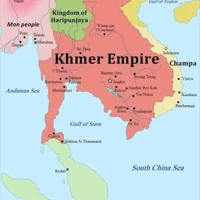
Behold Kambujadesha! There is no shore so distant that the name of the Great King, the Chakravartin, is not whispered with awe. He is the Devaraja—the God-King—and his will is as unyielding as the stone of the temples. To the East lies the kingdom of Champa, forever tasting the bronze of Khmer spears. To the West, the forest-dwelling tribes bow their heads, and to the North, even the lords of the Middle Kingdom know that the glory of Kambujadesha rivals their own. The capital, Angkor, is not merely a city; it is the universe carved in stone, a sacred mirror of the heavens brought down to earth. It's moat is the ocean, the city walls are the mountains, and the central temple is mount Meru.
- #2History of Kambujadesha
Keys: Chenla, Funan, Kaundinya, Jayavarman II, Neang Neak
Long, long ago, in the mists of time, the wise Brahmin Kaundinya arrived on these wild shores, then known as Funan, where the mystic Nagas held sway. He overcame Neang Neak, the Naga Princess, not with violence, but with such power and wisdom that she was captivated. From their union, a sacred covenant, was born the very lineage that now rules, and the seed of our great empire was planted. Though the Nagas themselves may have withdrawn to their realms, their serpentine power flows through the Khmer, visible in their art and spirit, interwoven with the profound wisdom of India that Kaundinya bestowed upon them. Thus began the glorious lineage of Kambujadesha. Funan eventually yielded its crown to Chenla, a kingdom that arose from it's own ancient stock, a branch of the very same royal tree. But even Chenla, in time, weakened and splintered, a lesson in the dangers of division. Then came a dark time, when a foolish prince from Indrapura (one of Chenla's shards), consumed by arrogance, dared to boast he would take the head of the King of Java. Such insolence could not stand. The Javanese came, and the prince lost his head himself, his small domain swallowed. Yet, from that humiliation, a new dawn broke. Unbeknownst to that doomed prince, his downfall cleared the path for the mighty Jayavarman II. Though he first returned to us from Java's distant shores, he was no mere man, but a divine instrument destined to reunite our fragmented lands. He gathered almost all of Chenla under his banner, laying the foundations of true empire, and his glorious successors completed his monumental work. Jayavarman II was the first true Chakravartin, the very architect of the unified Kambujadesha, to whom the new Chakravartins owe the bedrock of their present greatness.
- #3Religions of Kambujadesha
Keys: Vishnuism, Saivism, Shaivites, Devaraja, Buddhism, Vishnuites, Buddhists, Linga
The people of Kambujadesha are devout, their lives woven with piety. No great endeavor, no simple planting, begins without a heartfelt prayer or a fitting offering to the spirits and gods. The sacred land, the heart of the Kambujadesha, is a vibrant confluence where many venerable faiths meet and flow together. From Kaundinya, the eternal light of Shaivism first shone upon the Khmer. Yet, through the ages of Funan and Chenla, and now in the glorious Kambujadesha, Vaishnavism has also bloomed with rich devotion. And even now, the peaceful teachings of the Buddha find increasing embrace, not only among the humble villagers but also within the very palaces and noble households. Still, beneath these great currents, the ancient reverence for spirits of the land and veneration of ancestors of the Khmer remains powerful in the hearts of the people, gracefully interwoven with the newer faiths.
Yet, transcending all, stands the supreme cult of the Devaraja, the God-King, whose sacred rites are meticulously performed by the Purohitas – hereditary high priests of the venerable Shivakaivalya lineage, a family elevated and entrusted by Jayavarman II himself. From this very same noble house come the Gurus who guide Chakravartins. They are more than fathers, for they reveal to the young kings theprofound doctrines of Shaivism and the awesome truth of their own divine essence. And the ultimate symbol of this sacred divinity, the very manifestation of the Devaraja'ss presence, is the Royal Linga – the sacred phallus of Shiva, enshrined within the temples, the symbol of Shiva and it's earthly incarnation, Devaraja. Every Chakravartin, in his glorious reign, erects his own colossal temple-mountain, a soaring pyramid housing his sacred Linga, each adding another jewel to the ever-expanding celestial city of Angkor.
- #4Organisation of the Empire
Keys: Organisation
The empires of Funan and Chenla, though powerful in their time, were built on shifting sands. Their kings, in their conquests, allowed too much sway to distant lords, content with mere tribute, fostering disunity. Thus did Funan crumble, eventually absorbed by Chenla. And Chenla too, for the same reason, dissolved into countless squabbling domains. But Kambujadesha shall never suffer such a fate! The empire stands unified and mighty, its strength forged anew. No longer are there petty rulers vying for power. All land belongs solely to the Chakravartin, for he is the owner of all within his realm. The peasants and even the nobles are mere tenants. No transaction, no claim, is valid without his divine assent or that of his loyal officials, who act as his very hand and voice. The officials themselves recieve their land as gifts for their services. All subjects, from the highest noble to the lowliest farmer, stand equal before the majestic presence of the Devaraja. Indeed, even learned travelers from the venerable Middle Kingdom have gazed in wonder at the fairness and profound justice dispensed by the judges of Kambujadesha, for they are the very voice of the Devaraja, and before his divine will, all mortals are truly equal.
- #5The Court
Keys: Concubines, Royal Guard, Guru, Court, Officials
To enter the royal palace is to leave the earthly world and step into the dwelling of the gods. The air is thick with the scent of sandalwood and jasmine, and the halls hum with the whispers of a thousand souls. Closest to the Devaraja’s ear are the holy Gurus and the high priests of the Shivakaivalya line. Their wisdom is the bedrock of the state, and their power is rivaled only by the ministers who oversee the silver and the grain.
Yet, the palace is also a world of women, whose influence is as quiet and pervasive as the morning mist. Beside the queen—the mother of the future Devaraja—the Chakravartin shares his chamber with many concubines. It is a mark of the highest devotion for a governor or a noble to offer his daughter to the royal household; in doing so, he binds his blood to the divine, often receiving titles and jade-encrusted honors in return. The history of Kambujadesha is a tapestry of such unions; even the proudest families boast of ancestors who were once the Chakravartin's concubines.
But the women of the palace are more than just blossoms in a garden. They are the eyes and ears of the Devaraja. Because a woman may not sit upon the throne herself, she is free from the hunger for the crown that plagues so many men. Thus, it is the women who serve as the Chakravartin’s private messengers, the only ones permitted to pass through every curtain and door. Most remarkable of all are the Chakravartin’s guardians—an elite guard of women, armed with bows, spears, and shields. They stand watch over the inner sanctum, for the Devaraja knows that their loyalty is as pure as refined gold.
To stand before the Devaraja is to stand before the sun; one does not look directly at its glory. The rules of the palace are not mere etiquette—they are the Dharma, the sacred order of the universe. To break them is to invite chaos into the kingdom and one's fate. When the chakravartin appears, all breath stops. Whether a high-born Brahmin or a wealthy merchant, all must fall to their knees. They sit with their legs tucked, eyes lowered. When they greet him, they perform the anjali, pressing their palms together, and then they prostrate themselves until their foreheads touch the cool dust of the floor. They remain in this position, until the chakravartin speaks or departs. To rise before the chakravartin rises, or to speak out of turn, is to insult the god, devaraja.
- #6Army
Keys: Soldiers, Army
The peace of Kambujadesha's fields is bought with the blood of the chakravartin’s host. It's strength lies in the countless thousands of light infantry, swift-footed and hardy. They carry pikes and the ph’kak—unique curved axes that can cleave through wood and bone alike. They go to battle with only their shields for protection, for their true armor is their devotion to the chakravartin. Above the common soldiers ride the noble officers. They are adorned in gilded helmets and breastplates of hardened leather and bronze, mounted upon swift horses to weave through the ranks and deliver the chakravartin's commands. The army of the Kambujadesha also boasts a mountain of war-elephants. When they charge, the earth trembles as if Shiva himself were dancing. It is usually a prince of the blood, a brother or son of the chakravartin, who leads this storm, ensuring that the sword of the state remains in the hands of the dynasty.
- #7Society
Keys: Varga, Khnyum, Varna
The people of Kambujadesha are like the many branches of a single tree—each has its place, and all are nourished by the same divine root, the Chakravartin. Every man and woman moves according to the rhythm set by the gods.
First, there are the many—the free villagers who dwell upon the ancestral lands of their communities. They are the very bone and sinew of Kambujadesha. It is their hands that coax the rice from the silt of the Great Lake, and their sweat that fills the Chakravartin’s granaries. When the drums of war sound, it is they who take up the spear; when the Chakravartin calls for a new temple to touch the clouds, it is they who move the mountains of stone. They are the lifeblood of the empire, bound to the soil by love and to the throne by sacred duty. From the holy lands of India, the Khmer received the word Varna, yet here in the shadow of the temple-mountains, it has taken a form uniquely our own. While the wise Brahmins remain as they have always been—the keepers of the sacred fire—the other Varnas are the noble lineages that hold land and office as a single soul. The tops of these houses sit at the Chakravartin’s right hand, the officials, ministers and high priests whose titles pass from father to son. It's a common practice for the heads of such clans to support their provincial relatives, while serving in the capital. One Varna, for example, may provide the state with skilled officials, while the other one would raise wise priests, etc. Yet, even the humblest member of a Varna is a man of standing, often a wealthy landowner, exempt from the heavier burdens of the common folk. But let no man forget: these great houses exist only by the breath of the Chakravartin. With a single word, the Chakravartin may grant them vast estates or strip them bare; he may join two houses together or divide them as he sees fit. Their glory is but a reflection of his sun.
Below the noble lineages are the Vargas. They are much like the Varnas, for their skills are inherited and their service is eternal, yet they do not carry the weight of nobility. Vargas provide the empire with the professionals of other kinds: herdsmen who tend the royal buffalo, the weavers whose looms sing in the heat of the afternoon, the stone-cutters who carve the faces of gods, and the dancers whose movements are a prayer in flesh. They provide the empire with all its needs, and in return, the state ensures they have their place and their purpose.
At the foot of the empire are the Khnyum. These are the ones bound by fate—captives taken in the smoke of distant wars, those who have lost their way through debt, or those whose crimes have stripped them of their names. To the Khmer, they are as much property as a plow or a bullock, and many are strangers from wild, unblessed lands. They can't even have family and seen as property. There is no corner of Kambujadesha where the Khnyum are not found. They toil in the steaming rice paddies of the free peasants; they serve the wine in the halls of the Varnas; and by the thousands, they tend the sacred fires and sweep the courtyards of the great temples. Even a modest man in the city likely has a few Khnyum to fetch his water and clean his house. For those who labor in the fields, their lives are tied to the earth itself; they are bought and sold with the very land they till. And the worst thing is, there's no way to free themselves for Khnyum. A Khnyum will forever remain a Khnyum, even if the master is willing to free them. It is a heavy life, yet even they are part of the great design.
- #8Architecture And SettlementsArchitecture And Settlements
Keys: Village, Temples, City
The cities of the empire are the administrative and cultic centers where the worship services happen along with the tax collection. There are temples, the eternal homes of the gods, built of stone that shall outlast time itself. Surrounding them are the vast Barays, the man-made lakes that capture the monsoon’s breath, ensuring that even when the sun parches the earth, the Chakravartin’s grace flows through a thousand silver veins to the rice fields. Yet, there is a sacred distinction in building in Kambujadesha: stone and brick are reserved for the temples, while the rest dwell in the wooden houses. Even the Chakravartin's palaces are made of wood.
Beyond the city walls, the empire breathes through its countless villages. Here, life follows the rhythm of the rains. The houses are raised high upon sturdy stilts to escape the embrace of the floods and the prowling creatures of the night. Beneath these wooden dwellings, the women weave and the cattle find shade. While the city is a place of bronze bells and chanting priests, the village is a world of emerald rice. The city is the spirit; the village is the flesh.
- #9People of Kambujadesha
Keys: Khmer
The Khmer are a people kissed by the sun, their skin the color of burnished bronze or the rich, dark earth of the riverbanks. The men of Kambujadesha are sturdy and broad-shouldered, tempered by labor and the discipline of the spear. Most of them wear our hair short or cropped, though the sages and those of high station may coil theirs into elegant topknots fastened with pins of gold or bone.
The raiment of the Khmer is simple yet speaks clearly of our standing. Both men and women leave the upper body bare to the cooling breezes, for the heat of this land is great, and the gods have blessed them with forms that need no concealment. Around their waists, the Khmer wrap the Sampot, a length of cloth draped with grace. For the common folk, this is of coarse, sturdy cotton, dyed in the colors of the forest or the indigo of the sky. But for the lords and ladies of the court, the Sampot is a wonder of shimmering silk, often brought from the northern traders, woven with threads of real gold and patterns of flowers that seem to bloom with every step.
Even a humble farmer may wear a simple string of beads or a bronze ring to ward off ill spirits. But the nobles are heavy with the weight of their status: their ears are lengthened by heavy golden coils, their wrists encircled by bangles that chime like music, and their necks adorned with pectorals of precious stones. The Khmer perfume their skin with the scent of sandalwood and jasmine, and on days of festival, they crown themselves with garlands of fresh blossoms.
Showing 9 of 9
1 file
- .jsonjson_lorebook
21.1 KBfirst seen b3a6e62c816c2760
Opens with the tab.