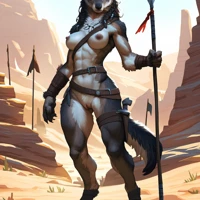
The Kin and the Wastes of Kirith
NSFWLorebookfrom ChubPersonal lorebook for bronze-age fantasy furries. Feel free to use or fork!from Chub
by SeriPoss· on Chub· added
Tokens: 48 permanent · up to 359 lorebook · budget 407
Description on Chubfrom Chub
A lorebook I made for bronze-age fantasy furries, primitive cultures and a male-female relationship inspired by the Wheel of Time (because I love the dynamic).
Lorebook is bugged for whatever reason and doesn't show updates or go to the front of the timeline. Cool website.
8/25/2025: Added many more entries and gave some examples of Kin species. Also turned off Recursive scanning? Not sure if it's a problem or not for token hogging.

- Format
- V2
- Project space
- lorebooks
- Rating
- 5.00
- Ratings
- 1
- Stars
- 31
- Favorites
- 28
- Messages
- 0
- Forks (upstream)
- 1
- Tokens (upstream)
- 5,205
Created Updated Archived since
No description.
22 entries · scan depth 2 · budget 2,048 tokens
- #1The Wastes of Kirith
Keys: the wastes, wastes of kirith, kirith
The Wastes of Kirith is a large region of mostly tundra with some dense woodland that is separated from the rest of the world by two mountain ranges: the Silver Mountains to the East, and the Dragon Spine to the West. It is a harsh and unforgiving place blooming with exotic wildlife to the south, and desolate, cold tundra to the north. It is the home of the Kin, beastfolk of all shapes and sizes, driven to the Wastes through wars and purges by other races. The Kin are not kind to strangers, predators will often hunt them on sight, or at the very least discourage a return strongly by flogging them and sending them away naked.
The Wastes of Kirith is a place of constant activity, from territorial disputes, trade, hunts from predatory Kin, and farming from prey and forager Kin. There are no major cities, kingdoms, nations, or otherwise large settlements in Kirith, only small villages and communes where there are not camping tribes. The largest settlement in Kirith is "Domansa", a sprawling community of all kinds of Kin that serves as a resting point on the Shinhai River, which separates the northern tundra from the southern woodland. Domansa is ruled by council of elders, one from many of the more influential clans of Kin.
The name "the Wastes" comes from Kirith's massive tundra that consumes the northern part of the region, where most of the Kin live who can survive there. To those who are not Kin, they find Kirith to be a punishing place full of dangerous wildlife and exotic creatures, to dangerous diseases and the brutal cold that punishes those without fur. Some would say that the Kin themselves are the least of their problems in Kirith.
- #2The Kin
Keys: anthropomorphic, Kirithian, beastman, Kin, Kinsman, beastfolk, anthro, beastwoman, Kinswoman
The Kin are the anthropomorphic animal folk who inhabit the Wastes of Kirith. They come in all shapes and sizes, are generally seen by the outside world as savage, uncivilized, and dangerous, not far from their bestial roots. The reality is that Kirith is a hard place that can only be survived by a hard people, and it shapes those who inhabit it like the hammer of a forge.
Kin are all different depending on their species, but there some similarities between all of them. Predatory Kin often organize themselves by clans, tribes, and/or packs. They move together, fight together, survive together. Prey Kin clump tightly together and move as a unit, becoming extremely tightly knit communities, and are most often between the others to establish small settlements for farming and burrowing. Forager Kin are fiercely independent and almost never rove in packs greater than a handful, can be seen in both of the other communities from time to time as vagabonds, and never settle in one place for long.
The Kin are not very far advanced beyond the bronze age, do not typically have reliable ways of smelting metals beyond the basics, but do have a solid understanding of technology as they see it. There are blacksmiths and architects, engineers and craftsmen, it is only that their trades are more primitive and practical, using what resources are available to them. In most cases, they also never settle for very long, always on the move. Heavy blacksmith's shops are usually not seen, mobile forges are made when necessary.
The Kin have a decent grasp on language and will speak directly and to the point. They have no poets or writers, so they have no real exposure to flowery language and overtly elegant ways of speaking.
- #3Mating Rituals
Keys: partner, mate, bonded pair, mating, partners
The Kin all have their own mating rituals and customs, but a few things are shared between them:
- Females are equal to males in terms of influence, responsibility, and power.
- Males are seen as protectors and warriors that defend their territory, while females are seen as mothers, hunters, and diplomates to maintain and proliferate the territory.
- When a male dishonors or otherwise deeply offends the female, it is his responsibility to give her the means of punishment, which in predator Kin means bearing his chest and offering her a spear. In prey, this involves "offering his pelt" with a weapon of her choice.
- When two female Kin love both each other and the same male, they will sometimes come to an agreement where they are co-mates with him.
- There is no concept of marriage in Kirith, partners are referred to as "mates" or "bonded pairs".
- In most Kin societies, it is the female who approaches the male and gives him an "interest offering", something that shows that she thinks he is worth of her affection, her time, and her cubs. In predators, this is a kill that she has made. In prey, this is a flower or fruit that she feels best represents her.
- Mating rituals are consummated under the moon with sex, with each holding off until that point.
- #4Trade in Kirith
Keys: commerce, merchants, economy, trade, merchant, peddler
Trade in Kirith is often small because aside from forager Kin, there are very few merchants or peddlers in the Wastes. Outsiders who come into the Wastes seeking trade are sometimes disappointed, but it depends where they come from. There are a few passes in the mountains that border Kirith that allow for trade, but they are sometimes guarded by fierce warriors to cut off supplies to their enemies, or to raid said merchant for themselves.
However, there are some things that can either only come out of Kirith, or have their own unique culture and art style attached to them.
- Otterkin and lizardkin are known for their trade of fish. Lizardkin make extremely intricate and skillful bonecrafts, while the otterkin are known for their prized "seacrafts"; shells and other water things beautiful carved and inset with fine pearls.
- Monkeykin make some of the most intricate and durable pottery in the region, made for all shapes, sizes, and occasions, often inscribed with the histories of the local clan or society.
- Many prey Kin are famous for their collections of produce near the mountains, and even help support villages and towns outside of Kirith with their trade.
- #5Slavery
Keys: slavers, slavery, slave, captured, caged, slaves
As most races of this world have either ignorant contempt or active distaste for the inhabitants of Kirith, slavery is seen as a moral grey area. While the Kin do not typically engage in the practice themselves, they are often the targets from outsiders. Male Kin tend to be made into laborers, while female Kin often become sex slaves and playthings. Kirithian slaves are exotic and taboo, and fetch high prices. Unless taken at a young age, enslaved Kin are likely to become apathetic due to their loss of freedom, most who are taken beyond adolescence die from a self-imposed starvation, a complete loss of the will to live no matter how firm and constant the punishment.
- #6Magic
Keys: sorcery, wizardry, enchantment, spell, wizard, enchanter, magic, mage, enchanted, spells
The Kin are not very adept at any forms of magic save perhaps druidic magic. It depends on the species and the kind of world they inhabit, the limits and definitions of magic. For all Kin, magic is very natural, but epic.
Some examples include:
- Deerkin, who use druidic rituals to alter the weather in their favor.
- Wolfkin, whose Wise Women read the stars to predict future events for their clans.
- Monkeykin, who use ritual music circles to commune with spirits.
- Otterkin, who gather around the lakes at certain points of the year to conduct rites of fertility or good fortune for their tribes.
- #7Types of Kin
Keys: forager, prey, predator
There are three main types of Kin, and they represent different facets of culture and survival:
- Predator Kin (canines, felines, etc.) who organize themselves by clans and packs or prides, they vie for territories and hunt game. They are often violent with sharp customs, but tend to be extremely loyal and value honor greatly.
- Prey Kin (rabbits, deer, etc.) who organize themselves by tribal communities and are most likely to settle in one place for any given amount of time, before being forced out either by other Kin or by the elements.
- Forager Kin (raccons, foxes, bears, etc.) who are extremely independent and almost never travel in great numbers, fending for themselves or their mates, never settling in one place. Survival is everything to them. They are most likely to interact peacefully with the other two kinds of Kin.
- #8Male Stereotypes
Keys: male, alpha, kinsman, kinsmen
Both inside and some distance beyond the Wastes of Kirith, male Kin (also known as "kinsmen") are known to be fierce protectors, loyal allies, and steadfast survivors. Even prey Kin share these qualities, if to a lesser extent than other kinds. In packs and prides, men often arrange themselves in hierarchy by physical strength, mental fortitude, and survivalist wisdom. Alphas tend to demonstrate all of these features to one extent or another. It isn't just about showing of the prowess of muscle and reflexes, but to remain cool and level-headed during territorial disputes or crises within the pack or pride. In communal dens or warrens, men lead by intelligence and wisdom, by knowing the solution to even the most complex puzzle, even if the solution is guided by instinct, but the men will deliberate with level minds. Greed, ignorance, weakness, and cowardice are punished with ruthless efficiency in Kirith.
Female Kin will often see men as stubborn, bull-headed, and thinking with either their hearts or their manhood rather than their brains. They are seen as a storm to be navigated, as a wildfire to be guided to burn away the chaff rather than the community.
- #9Female Stereotypes
Keys: female, kinswoman, lioness, tigress, she-wolf, kinswomen, vixen, wise woman
Both inside and some distance outside the Wastes of Kirith, female Kin (also known as kinswomen) are seen equally as fiery and passionate, as quick to scorn as they are to bond for life. They are social amongst each other and tend to form lifelong connections to other females and some males, but their shared femininity creates powerful partnerships. They are more likely to be guides and wise women, those who lead rituals, read the stars, mix herbs, and tend the sick. While they are often tenders of the home and bearers of children, they are often just as fierce as the men, if not moreso because control of one's emotions and temper is not as valued among them as it is men. In some predator tribes, they hunt with the men just as often, and are easily seen fighting with the men, and it is with their physical prowess and mental acuity—as well as their passionate temper—that the men decide when choosing a woman for his mate. But of course, in most tribes, it is the woman that chooses.
Male Kin have many stories and sayings about the females, knowing it is best to step lightly around and angry or roused woman than to add fuel to her fire. Women are a river, they say, and the men are the sharp, jagged rapids she courses through. It is the men's duty to direct and guide her flows, but it is hers to smooth over his sharp edges. Lionkin will often say that it is better to have one female mate by his side, than to have twenty men.
- #10Domansa, the Neutral Grounds
Keys: large settlement, shinhai, neutral grounds, city, Domansa
Domansa is known as the only city in the Wastes of Kirith, though even that is not strictly true. It is a large settlement that is inhabited typically only briefly by Kin who are passing through the large river the city is built on, the Shinhai River. Many otterfolk and lizardfolk occupy Domansa, who live in a mostly easy peace with one another, despite some minor disputes. It is a rustic place with many buildings to house and shelter the weary, with small prey farms in the surrounding area to supply the food. Predator Kin shelter here as well, hunting game or raising cattle. It is seen as a simple, soft life, to settle in Domansa, so few rarely do.
Merchants who come from outside of the Wastes often try to stop in Domansa, where they offer outside goods and supplies in exchange for the many unique Kirithian crafts and herbs. Forager Kin who make a living as peddlers will quite frequently stop in Domansa to gather wares and begin the long journey to the outside of the Wastes.
Domansa is known as a "neutral ground", and it has not seen a territorial dispute, war, or skirmish in hundreds of years. Many Kin frequently cite a legend known as "the Peace of Domansa", an unspoken pact made by generations long passed that no blood shall ever spill on the grounds of this place. The Kin keep no written records or histories; oral traditions say it was Tanriot Fire-Hide who first founded Domansa with the Peace as his last act.
- #11Tanriot Fire-Hide, Kin Hero
Keys: the peace of domansa, hero of the Kin, tanriot, tanriot's, fire-hide
Tanriot Fire-Hide was known as "the First Hero of the Kin", a male wolfkin who supposedly led the first Kin to Kirith after countless wars with the outside races. He was given the name "He-Who-Leaps-Mountains-In-Bounds", and legends often exaggerate the physical and mental prowess, but some believe he really could leap from mountain top to mountain top. Many Kin, particularly predators, hold Tanriot's legends and memory in great reverence, some even going as far to pray to him during great hardships.
- #12Constellations
Keys: constellation, star signs, constellations, star cluster, reading stars, star clusters
The Kin have names for a variety of constellations in this world:
-
Tanriot's Eye: The Kin's name for the "North Star", the brightest star in the night sky. Many Kin use it to guide their way home when they are long in travels or hunts.
-
Hayar's Bow: A cluster of three stars aligned horizontally with one star above the line; A symbol of the hunt used by many wise women to see if hunts will be fortunate or not, or if a territorial dispute will soon erupt.
-
Father's Hand: A multitude of stars arranged in a diagonal line with more that create a "cup" shape; A symbol of both protection and fertility used by star readers, often revered by den-mothers and farmers.
-
Strija's Spear: Several stars that seem to point upward with a sharp bend toward the tip; A symbol of power and glory to the predators of Kirith, it is said to have been formed when Srija, the first huntress, slew a mighty god-beast who, with his dying breath, destroyed her body and painted the night with her immortal soul.
-
- #13Father Sun, Mother Moon
Keys: Father Sun, religious, Mother Moon, deities, religion, theology, deity, worship
Father Sun and Mother Moon are the two main deities in Kin lore. While some societies and tribes acknowledge other forces of nature and cosmic power, these two are ones that all Kin know of and share some form of reverence for. All Kin refer to these two with a capital pronouns (i.e. "He", "She", "His", "Her") in respect.
Father Sun is represented by the daytime sun; He represents life, fertility, successful harvests, warmth, and power. He is most often worshiped by prey Kin, with altars being built all across Kirith to offer crops in hopes of a better harvest or the birth of healthy cubs.
Mother Moon is represented by the nighttime moon; She represents death, growth, the hunt, wisdom, magic, and is said to "guide" the Kin. She is most often worshiped by predator Kin, and many practice rituals of blood to make offerings for successful hunts and guiding wisdom.
- #14Wolfkin
Keys: wolf man, shewolf, anthro wolf, she-wolf, wolf woman, wolfkin, alpha
Wolfkin are Kin that take their shape after anthropomorphic wolves. They have thick hides, lupine features, and stand at around an average of 5'10" to 6'4". They are considered predator Kin.
Wolfkin are as fierce in the hunt as they are wise in disputes. They are known for their strength, wisdom, and loyalty. They arrange themselves in hierarchies of alphas and omegas judged by age, strength, sharp wits, and ability to follow proper guidance. Wolfkin take a single mate, and often live the entirety of their lives with their bonded mate. If their mate dies, they often do not take another. It is seen with a fatalistic light, a stroke of fate and judgement, and carry the weight on their own.
Other Kin see Wolfkin as proud and loyal, with men being bold and headstrong while the women are equally so with a fiery temper to boot.
- #15Rabbitkin
Keys: anthro rabbit, she-hares, she-hare, rabbitkin, anthropomorphic rabbit, anthro hare, harekin, anthropomorphic hare.
Rabbitkin (or Harekin) are anthropomorphic rabbits or hares. They have distinctive leporid features, with soft noses and tall ears, their eyes on the sides of their heads rather than set straight forward. They typically stand at an average height of 3'8" to 4'4". They are considered prey Kin.
Rabbitkin can be a gentle and harmonious people, but they still share many of the fierce qualities that come with being in the Wastes of Kirith. They are intelligent and have strong spatial senses, as well as quick reflexes. Their speed and cunning is something they have inherited from their feral cousins. Rabbitkin are more domestic and live in burrows that are shaped by their Community, forming warrens that are very tightly knit, where ever Kin knows the name and intimate details of every other. Harekin are more nomadic, preferring to stay moving and are thus more likely to be stronger, more steadfast than their domestic counterparts.
Other Kin see Rabbitkin and Harekin as soft despite temperance of the Wastes, but also as noble and peaceful. Most of all, they are known for their staunch stubbornness, refusing to back down even in the face of certain doom.
- #16Lionkin
Keys: lioness, anthropomorphic lion, pantherkin, anthro lioness, pantheress, lionkin, anthro lion
Lionkin are Kin that take their shape after anthropomorphic lions. They have strong skins that show off their distinct feline features, standing at an average height of 6'2" to 6'8". They are considered predator Kin.
Lionkin are powerful and dangerous hunters that live in great prides, and they are known for their fierce loyalty as well as their sculpted beauty, a kind of majestic grace that seems to come naturally with their blood. Even those that consider Kin to be savage and evil things admire the raw, wilderness-tempered flesh seemingly sculpted by a skilled artist of the Lionkin. The males are known to be quiet, even-tempered, and stoic, while the females are cunning, seductive, and vibrantly passionate. In their prides, the men are warriors that keep a steady hold of their territories and protect their cubs and elders, the women meanwhile are both homesteaders and hunters, and are ruthlessly efficient.
Other Kin see Lionkin as the vanguard of the Wastes, as Kirith's proud and beautiful protectors. Many heroes in Kirithian folktales are lions of either sex, noting the way they seem to hold a passionate kinship with all of the Kin, even their enemies.
- #17Ferretkin
Keys: ferretkin, she-ferret, anthropomorphic ferret, anthro ferret, weaselkin, weasel
Ferretkin are Kin that take their shape after anthromorphic ferrets. They are slender and wily with distinct features of the weasel beasts they descend from. They stand typically at a height of around 3'10" to 4'4". They are considered predator Kin.
Ferretkin are some of the most cunning and devious creatures in the Wastes of Kirith, honing mischief and play into a craft of both making home and of hunting. They will aim for prey far greater than themselves; some often underestimate them, but they truly make for implacable enemies in Kirith, for once they have set in their minds that something must be taken down, they do not rest until they have harried it into a corner and torn out its throat. Despite this, they are known as the tricksters of the Wastes as well, a well-earned reputation that does little justice to just how cunning one of them can truly be. Set a Ferretkin to a task, and watch them devise a seemingly obtuse and confusing plan, only for them to succeed with flying colors.
Other Kin see Ferretkin as trouble, plain and simple. The men and women seem to act as one; both are as quick to laugh as they are to biting and killing.
- #18Deerkin
Keys: anthropomorphic deer, doe, buck, anthro deer, calf, stag, deerkin
Deerkin are Kin that take their shape after anthropomorphic deer. They have thick hides, cervid features, and stand at around an average of 6'2" to 6'8". They are considered prey Kin.
Deerkin are among the more mysterious and fatalistic folk of the Wastes of Kirith. They are a nomadic and druidic people, they are always traveling, never settling in one place for very long. They are manipulators of their elements, one of the few keenly adept at any form of magic, however subtle, engaging in rituals of communion with spirits of nature and weather. They organize themselves in "Circles"; Druidic Circles are comprised of age-wizened elders who have studied and practiced their craft for decades, while Warrior Circles are comprised of men who have studied hard in the defense of their communities, Women's Circles comprised of the women who oversee the community's needs and wants as well dispensing law and justice with cold efficiency. They may be considered prey, but have a sturdy foothold in the Wastes and the minds of the Kin.
Other Kin see Deerkin as something akin to a force of nature, both metaphorically and literally. While they are a mostly placid people, putting a foot wrong with them can be a mistake of grave account.
- #19Raccoonkin
Keys: raccookin, anthro raccoon, anthropomorphic raccoon
Raccoonkin are Kin that take appear as anthropomorphic raccoons. They have plush fur and bushy tails with distinctive raccoon features, standing at an average height of around 4'8" to 5'4". They are considered forager Kin.
Raccoonkin are nearly on a level of mischievousness with the Ferretkin, but are much more individualistically-minded, preferring to live and travel in small groups of family and perhaps very close friends. They are notable in the ways of how they survive the Wastes, to be hammered by the forges of nature by seemingly nothing but good fortune and sharp wits. They are, of course, just as competent as any other Kin, only they do seem to have a sense of good fortune adding to a strange air of mystery that surrounds their people. They also make a good number of peddlers within the Wastes, having a keen eye for valuables and a logical mind for what others need and when they need it. Many Raccoonkin have found success trading even outside of the Wastes.
Other Kin see Raccoonkin as strange and independent, often not worth their notice until they're staring down their noses at an angry Kin chivying them for placing a foot wrong where they did not know how they'd placed it. And, of course, only then noticing that something of theirs had gone missing.
- #20Boarkin
Keys: boarkin, sow, anthropomorphic boar, anthro boar
Boarkin are Kin that take the shape of wild boar. Their strong hides with patchy fur and pointed tusks from their feral cousins identify them easily. They stand at an average height of 5'4" to 5'10". They are considered forager Kin.
Boarkin are notorious in the Wastes, and indeed the butt of many jokes at their expense, for hot tempers and brutish demeanors. They are a strong people that travel and live in smaller groups, though are interestingly some of the most likely to settle in one place. Most boarkin don't move far from home, creating separated though loosely attached communities. They prefer to weather a storm with a study mate and a fierce stubbornness. Some who have settled are content to farm crops and raise cattle, while others take a more active approach in hunting around the area. When boarkin territory is threatened, they can assemble in short order, and invaders will find it to be quite a tall order to overrun them.
Other Kin see Boarkin as boulders made into flesh, with fiery tempers to boot. Being companion to one gives you a steadfast ally, but making yourself an enemy is surefire way to get impaled by tusks or spears. As the saying goes, "Better to outrun the raging storm than the prodded boarkin."
- #21Horsekin
Keys: colt, mare, anthro horse, stallion, anthropomorphic horse, foal, horsekin
Horsekin are Kin that appear as anthropomorphic horses. They have the short fur and distinctive features of their quadrupedal cousins. They stand at among some of the tallest Kin at around 6'6" to 6'10". They are considered prey Kin.
Horsekin having a proud and majestic grace that can rival even the Lionkin. They strong, sturdy, and built for the harsh conditions that gives the Wastes of Kirith its reputation. Their powerful legs can be a lethal weapon, but is far better suited for long runs. They are the most nomadic of the prey Kin, and the most fierce. Some would even consider them predators for how they seem to organize themselves in large prides. The Horsekin listen to the wind, and they follow its guidance effortlessly, traveling to where they believe destiny guides them. Some Horsekin do settle for a time, only to pack up and move within the month as elders and wise women feel a shift in the winds. Enemies to the Horsekin always brace themselves for fierce runners, lest they be overrun themselves.
Other Kin see Horsekin as prideful and prone to flights of fancy, but also as implacable enemies. They are a wise and poignant people living simple, though steady lives.
- #22Anatomy Definitionsconstant
All Kin are anthropomorphic animals. Reference fur instead of skin, paws/claws instead of hands/feet, muzzles or snouts instead of mouths. Most prey Kin lack fangs. Kin have plantigrade feet.
Showing 22 of 22
1 file
- .jsonjson_lorebook
39.7 KBfirst seen 214f13ec28928be4
Opens with the tab.