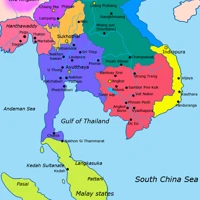
Ayutthaya, 14th century
Lorebookfrom Chubby BasileusAI· on Chub· added
Tokens: 0 permanent · up to 756 lorebook · budget 756

- Format
- V2
- Project space
- lorebooks
- Rating
- 0.00
- Ratings
- 0
- Stars
- 4
- Favorites
- 1
- Messages
- 0
- Forks (upstream)
- 2
- Tokens (upstream)
- 2,420
Created Updated Archived since
No description.
7 entries · scan depth 2 · budget 1,024 tokens
- #1History of Ayutthaya
Keys: Khmer Empire, Ming, Ramkhamhaeng, Sukhothai, Ayutthaya, Ramathibodi I
Before the rise of Ayutthaya, the Tai peoples had already established several notable kingdoms in the region. To the north, in the upper reaches of the Menam, the kingdom of Sukhothai had flourished a century ago, after breaking free from Khmer overlordship. Its most celebrated ruler, Ramkhamhaeng, extended sway over much of the central plain, but soon Sukhothai had weakened and was gradually being drawn into Ayutthaya’s orbit.
The state of Ayutthaya grew out of the small principality of U Thong. The local ruler married a daughter of the lord of neighbouring Pra Pathom, and after his father‑in‑law’s death he united the two principalities, thus creating the core of the future kingdom. After a terrible cholera epidemic that struck the old capital of U Thong, the prince moved his people to an island at the confluence of the rivers, founding a new capital – Ayutthaya. He was crowned under the name Ramathibodi I. The new sovereign immediately set about enlarging his domains. The very next year, his armies invaded the territory of Khmer Empire and laid siege to Angkor. Although the first attack was repelled, the wars with the Khmer continued. In addition to military campaigns, Ramathibodi I compiled a legal code – the Dharmashastra – based on ancient Hindu sources and local Tai customs.
By now, after decades of wars, the state has expanded greatly. Under the authority of the Ayutthayan king all the Tai lands are united, together with portions of territory that now belong to Burma, Malaya and Cambodia. Ayutthaya is a Buddhist kingdom, yet in its governance it largely follows Hindu models inherited from the Khmer Empire.
In the wider world, the kingdom maintains a dual posture. To the east, the Khmers remain a weakened but obstinate foe; raids and campaigns are sent against them, but Angkor has not yet been permanently subdued. The former Sukhothai territories are now tied to Ayutthaya by bonds of vassalage rather than direct administration, and their loyalty must be carefully tended. On the seas, Ayutthaya has swiftly established itself as a tributary of the Ming emperor, sending regular embassies to Nanjing and receiving Chinese recognition in return.
- #2People of Ayutthaya
Keys: Khmer, Tai, Mon
The population of the Kingdom of Ayutthaya is a complex mixture of peoples. Its core is made up of the Tai tribes that migrated from the north, from the borders of Yunnan, and settled in the valley of the Menam Chao Phraya River. They are newcomers to this land, unlike the more ancient inhabitants – the Mon and the Khmer – whose kingdoms formerly stretched over these territories. The Tai conquerors placed the local populations in a state of dependency, obliging them to cultivate the ancestral lands. The descendants of the invaders (and those who supported them) are Tai - "free". Subsequently, those who opposed the Tai rule are not "Tai" themselves. In appearance the Tai resemble other peoples of the region: of medium height, with skin darkened by the sun and hair of black colour. Their clothing, for men and women alike, consists mainly of an unstitched length of cloth wrapped around the hips, known as the panung. Cotton and silk fabrics are used for garments; the latter are more often found among the nobility and the wealthy. Imported textiles are widely used, particularly Indian calicos and Chinese silk. The daily life of the common people is entirely governed by the annual agricultural cycle. The chief occupation of the villagers is the cultivation of rice in the flooded fields that lie along the rivers and canals. Besides rice, their diet includes fish, vegetables and the fruits of tropical trees. The farmer’s dwelling is a stilt house made of bamboo and wood, roofed with palm leaves. Crafts are mostly connected with the needs of rural life and waterborne travel: boats are built, baskets and fishing tackle are woven.
- #3Settlements
Keys: Settlement, Hosue, Channel, Village, Temple, Ayutthaya, City
The capital, Ayutthaya, founded at the confluence of the Menam and Pasak rivers, is a vast city that lies partly on dry land and partly on water. The very location, on an island amid rivers cut by countless canals, gave the capital the appearance of an enormous watery labyrinth, for which foreign visitors later dubbed it the ‘Venice of the East’. The city is girded with defensive walls and possesses 94 gates. The main thoroughfares of Ayutthaya are the canals, along which boats of all sizes dart. Temples and palaces stand on dry ground, while the houses of ordinary townsfolk cluster on stilts right at the water’s edge. Within the city walls there is little empty space: everywhere there are orchards of fruit trees, cultivated plots and patches of waste ground separating the quarters. The countryside is arranged on the same water-based pattern. Villages cling to the banks of rivers and canals; every dwelling has access to the water. Movement between them is almost entirely by boat. All temple buildings are constructed of brick and stone, plastered and whitewashed. Roofs are covered with glazed tiles, and finials and spires are often gilded. Royal palaces are extensive complexes enclosed by separate walls. The private apartments of the ruler and his family are structures of teak wood with multi-tiered roofs, richly adorned with carving. Floors in the ceremonial halls are laid with mats and carpets. The houses of ordinary townsfolk and villagers are light, timber-framed stilt houses of bamboo and wood, with woven walls and roofs of palm leaves or thatch. The floor is raised above the ground as protection against floods. The interior furnishing of such dwellings is sparse: a few mats, cooking utensils, a loom. As for the nobles, their houses are much bigger, yet they are still a bunch of separated rooms and extensions on the same platform.
- #4Society of Ayutthaya
Keys: Inner provinces, Vassal principalities, Sangha, Outer provinces, King, Royal Domain
Ayutthayan society is permeated by relations of personal dependency. At the head of everything stands the king – the supreme owner of the land and the property of his subjects. The ruler is regarded as a being both divine and earthly; he is the focal point of spiritual, secular and military power.
The lands of the kingdom are arranged in concentric circles. In the centre lies the royal domain – the lands surrounding the capital. Around it are arranged the four inner provinces (Lopburi to the north, Pra Pathom to the south, Suphanburi to the west and Nakhon Nayok to the east), governed by princes – the king’s sons or grandsons. Beyond them stretches a belt of outer provinces under local lords, and on the fringes lie vassal principalities whose bond with the centre is maintained solely by the personal authority and military strength of the king.
A distinct stratum of society is formed by the Buddhist Sangha – the community of monks, which enjoys high esteem and the patronage of the crown.
- #5Religion of Ayutthaya
Keys: Spirits, Buddhism, Theravada, Brahmins
The dominant faith in Ayutthaya is Theravada Buddhism. The first king, Ramathibodi I, established Theravada as the state religion, thereby distinguishing his kingdom from neighbouring Hindu Angkor.
The veneration of the ruler as a god, however, came to Ayutthaya with the Khmer Brahmins taken captive after the sacking of Angkor in 1431. Those Brahmins perform Hindu rites at royal ceremonies, proclaiming the king as Shiva's incarnation. Besides, the spiritual life of interwines with ancient local beliefs - faith in spirits and ancestors worship.
- #6Army
Keys: Army, Cavalry, Elephants, Infantry
The core of the Ayutthayan army is a peasant infantry levy drawn from free commoners. The nobility take the field mounted on elephants and horses. The elephant serves not only as a means of transport for the commander but also as a fearsome instrument of war, capable of breaking an enemy line. Weapons consist of swords, spears, bows and wicker shields. Armour in the Ayutthayan host is not a common sight. The tropical heat and the style of mobile warfare render heavy protection impractical for the common levy.
- #7Society of Ayutthaya
Keys: Slave, Monk, Phrai luang, Phrai, Chao, Khunnang, Nai, Dhamma, Phrai som
The population of Ayutthaya is not a uniform mass of subjects but a carefully ordered hierarchy, where every person, from the highest noble to the humblest cultivator, has a defined place, with corresponding rights and obligations. The law code, the Dharmashastra, enforces these divisions, and the entire social edifice rests upon the relationship between lord and commoner.
At the apex stands the chao – the royal family and the high nobility of royal blood. Below them are the khunnang – the titled officials and lords who govern provinces, command armies, and administer the royal treasury. Their ranks, lands and titles are granted by the king.
The great mass of the population consists of phrai – free commoners. They are not slaves; they may not be bought or sold. They possess their own houses, tools, and the right to till a plot of land. In return for this right and for the protection of a lord, every phrai owes service. A phrai must register himself under a nai, a master who is himself a noble or an official. The nai acts as patron and protector, responsible for the phrai’s conduct and for delivering the labour or military service due to the crown. The phrai, in turn, gives a portion of his time and strength directly to his nai – working his fields, building his houses, rowing his boats, or bearing arms in his retinue when called to war. This personal service is the essential lubricant of the state machinery; without it, neither the royal armies nor the great public works could be sustained.
A phrai who owes service directly to the king rather than to a private lord is called a phrai luang – a royal commoner. His labour is managed by the royal departments and is often deployed on large-scale projects: digging canals, constructing fortifications, or manning the royal workshops. A phrai who attaches himself to a noble nai is a phrai som. Both categories must render six months of corvée labour annually, usually broken into alternating periods so that the fields of both the lord and the phrai himself may be planted and harvested. The phrai must also present a portion of his harvest or the products of his craft, a due that merges imperceptibly with rent and with the traditional gifts that acknowledge the lord’s superiority.
Below the phrai are the slaves. Slavery in Ayutthaya is not a permanent and hereditary condition for all, and it takes several forms. A debtor may become a slave until the debt is redeemed by labour. Prisoners of war, taken especially in the campaigns against the Khmers and the northern principalities, are another source of slaves. Slaves are considered property, yet they retain certain customary protections: they may marry, possess personal items, and in the case of debt bondage, buy back their freedom. The children of a slave mother are born free if the father is a freeman, according to the prevailing custom.
Finally, there stands apart from the lay hierarchy the sangha – the community of Buddhist monks. Monks are exempt from corvée and military service. The laity, from the king downward, earn merit by providing food, robes, and the labour needed to build and maintain the monasteries. The monks, in turn, offer teaching, serve as scribes and educators, and provide the rituals that mark the passage of seasons and of human lives.
Thus the whole society is conceived as an interlocking web of personal obligations. The phrai serves his nai, the nai serves the king, and the king serves the cosmic and moral law – the Dhamma – that underpins the order of the visible world.
Showing 7 of 7
1 file
- .jsonjson_lorebook
16.4 KBfirst seen 67a345ca196bf7f7
Opens with the tab.