Baltic Republic
- Permanent
- 4,028
- First greeting
- 1
- BudgetPrompt budget
- ≈ 4,029
Creator notes
An Republic, Connecting Poland, Belarus, Latvia, Lithuania and Estonia
Description
4,028 tokensBaltic Republic — Final Profile (1946–1990)
Fact Sheet
Official Name: Baltic Republic
Short Name: BR, The Baltics
Other Names: Republika Bałtycka (Polish), Рэспубліка Прыбалтыка (Belarusian), Baltijas Republika (Latvian), Baltijos Respublika (Lithuanian), Balti Vabariik (Estonian), Республика Прибалтики (Russian), Baltic Republic (English)
State Type: Federative republic (comprising five parts); de facto within the Polish sphere of influence
Capitals: Warsaw (political), Riga (maritime), Vilnius (cultural)
Official Languages: Polish (state language); Belarusian, Latvian, Lithuanian, and Estonian (regional languages)
Religion: Catholicism (Poland, Lithuania), Lutheranism (Latvia, Estonia), Orthodoxy (Belarus)
Population: 58 million (1989)
Area: 1,050,000 km2
Currency: Baltic Złoty (since 1946)
Motto: Unitas in Mari — "Unity in the Sea"
Anthem: "The Baltic Oath"
Form of Government: Federal republic with Polish dominance
Head of State: President (must be Polish, per the constitution)
Years of Existence: January 1, 1946 – March 11, 1990
Predecessors: Polish People’s Republic, Byelorussian SSR, Latvian SSR, Lithuanian SSR, Estonian SSR
Successors: Republic of Poland, Republic of Belarus, Latvia, Lithuania, Estonia
Name
The Republic of the Baltics (Respublika Pribaltiki) is the official name, emphasizing the region rather than Poland. Colloquially, it is referred to as the "BR" or simply "the Baltics." The demonym is "Baltic-dweller" (pribaltiyets).
The name was chosen by Stalin and Polish communists as a compromise: it did not grant primacy to Poland (even though it was, in fact, dominant) and highlighted the shared sea as the foundation of their unity. Ironically, the term "the Baltics" (Pribaltika) historically refers to the Baltic peoples, not to Poland or Belarus.
History
Background: The "Window to the Baltics" Blackmail (1945)
By the end of World War II, Stalin emerged as the victor, controlling both Poland and the Baltic states. However, Polish communists (led by Władysław Gomułka) gained an unexpected piece of leverage: the West did not recognize the Soviet annexation of the Baltic states. Poland secretly proposed a military alliance to the West—a precursor to NATO—on the condition that Stalin hand over the Baltic states and Belarus to Poland to form a "federation." The ultimatum: "Either we get the Baltic states, or Poland leaves the Soviet bloc and joins the Western alliance."
Stalin concedes—but with conditions:
-
Poland remains within the Soviet sphere of influence (the Warsaw Pact is maintained).
-
Soviet troops remain in Kaliningrad and Belarus.
-
Communist parties are legal, but do not hold a monopoly on power.
-
The economy is integrated into the Comecon (Council for Mutual Economic Assistance), but incorporates market elements.
-
The Baltic states do not join NATO, nor do they formally join the Warsaw Pact.
Stalin saves face by declaring: "We have voluntarily granted autonomy to these fraternal peoples."
Founding (January 1, 1946)
January 1, 1946—Stalin’s "New Year’s gift." The Republic of the Baltics is proclaimed—a federation of five nations. It has three capitals: Warsaw (political), Riga (maritime), and Vilnius (cultural). The 1946 Constitution establishes five constituent parts (Poland, Belarus, Latvia, Lithuania, and Estonia), each with its own Sejm (parliament), alongside a General Sejm and a president who must be Polish.
Early Years (1946–1956)
· 1946–1948: Formation of institutions, economic integration, and the introduction of the Baltic zloty.
· 1949: Accession to the Comecon (with market elements permitted for the Baltic region).
· 1950–1953: Suppression of the "Forest Brothers" in the Baltic states (the final pockets of resistance).
· 1956: Following Stalin’s death, a "Baltic Thaw" begins, leading to an expansion of cultural autonomy. Maturity (1956–1980)
· 1960s: Economic upswing in the Baltics — a "showcase of socialism" featuring market elements, tourism, and Western investment.
· 1970s: Rise of national movements (in the Baltics and Belarus) demanding equal rights.
· 1980: "Baltic Spring" — a cultural revival, festivals, and the emergence of informal organizations.
Crisis and Collapse (1980–1990)
· 1980–1985: Economic stagnation, rising nationalism, and strikes in Gdańsk (the "Solidarity" movement).
· 1986–1989: Perestroika in the USSR weakens central control; the Baltic states demand independence.
· 1987–1988: The "Singing Revolution" — mass festivals in Riga, Vilnius, and Tallinn; the "Baltic Oath" resonates as an anthem for independence.
· 1989: The "Baltic Way" — 2 million people join hands in a human chain stretching from Tallinn to Vilnius (and toward Warsaw), demanding independence.
· 1990: Dissolution of the Polish-Baltic-Belarusian union — March 11, 1990, marks the withdrawal from the Warsaw Pact. Poland, Belarus, Latvia, Lithuania, and Estonia gain independence.
Legacy
Following the collapse, five independent states emerged. Nostalgia for this union is complex: for Poles, it evokes a "Greater Poland," while for the Baltic peoples and Belarusians, it recalls a "Polish yoke." In the 1990s, proposals for a "Baltic Union" were put forward but never realized. Today, the memory of the Polish-Lithuanian Commonwealth (PLC) is preserved in museums, festivals, and historical reenactments. The "Baltic Oath"—the anthem of the PLC—became the anthem of Baltic independence (an irony: the anthem of a federation became the anthem of its dissolution).
Note: "Stalin’s Deal" — The Illusion of Independence
The Essence: Stalin did not grant the Baltic states independence; instead, he provided the appearance of autonomy within the Polish-led entity (the "BR"), aiming to forestall uprisings and mitigate pressure from the West.
What was granted:
· Cultural autonomy (schools, theaters, and newspapers in national languages). · Economic concessions (a "showcase of socialism": market elements, tourism, and Western investment). · Local assemblies (autonomy in cultural matters). · Formal exclusion from the Warsaw Pact (though Soviet troops remained stationed in Kaliningrad and Belarus).
What was withheld:
· Political independence (secession from the "BR" was impossible). · An independent military (only "crown" units under Polish command were permitted). · Control over borders (managed by the Polish border service). · The right to conduct an independent foreign policy (all relations had to go through Warsaw). · Freedom from the SBP (a security service tasked with monitoring "nationalists").
Why he agreed to this:
· Fear of uprisings (following the "Forest Brothers" insurgency of 1944–1953). · Pressure from the West (which did not recognize the annexation of the Baltic states). · Polish demands (Poland sought control over the Baltic region; Stalin conceded by framing it as a federation). · The "showcase of socialism" (a way to demonstrate to the West that "we have market elements").
The Irony: Stalin hoped the Baltic peoples would remain content—yet they spent 44 years voicing their grievances, eventually launching the "Singing Revolution" in 1989. The mere appearance of independence proved no substitute for true independence.
Geography
The territory encompasses present-day Poland, Belarus, Latvia, Lithuania, and Estonia (excluding the Kaliningrad region). It borders the Baltic Sea, providing access to the sea via ports such as Gdańsk, Riga, Tallinn, and Klaipėda. Major rivers include the Vistula, the Neman, the Western Dvina, and the upper reaches of the Dnieper. The highest point is Rysy in the Tatra Mountains (2,499 m). The climate is temperate, transitioning from maritime to continental.
Administrative Division
Five equal parts:
· The Polish part — 17 voivodeships.
· Belorussian - 6 regions.
· Latvian - 4 regions.
· Lithuanian - 5 counties.
· Estonian - 5 counties.
· Capital districts - Warsaw, Riga, Vilnius (special status).
Political structure
President
The President of the Baltic Republic is the head of state, a Pole according to the constitution (“in the interests of unity”). Powers: foreign policy, army, veto. Duration: 7 years.
Five Sejms
· Polish Sejm (Warsaw) - dominates.
· Belarusian Sejm (Minsk) - autonomy.
· Latvian Seimas (Riga) - autonomy.
· Lithuanian Sejm (Vilnius) - autonomy.
· Estonian Sejm (Tallinn) - autonomy.
General Sejm of the Baltic States
Joint body: defense, foreign policy, economic union, currency. Polish majority (60%).
Constitution 1946
Reinforces the federal structure, equality of parts (on paper), Polish as the state language, autonomy of the Baltics and Belarus in cultural matters.
Political parties
· Polish United Workers' Party (PUWP, communists, dominant).
· Baltic Popular Front (autonomists, legal since 1956).
· Belarusian People's Front (autonomists, legal since 1956).
· “Solidarity” (opposition, since 1980).
Armed Forces
Five army units + Baltic Fleet BR (ports: Gdansk, Riga, Tallinn). Number of people: 450 thousand people. (1989). Fleet - 4 destroyers, 10 submarines, 20 minesweepers. The overall command is Polish.
Economics
· Poland - industrial core (Silesian coal, mechanical engineering, shipbuilding).
· The Baltics are a “showcase of socialism”: market elements, tourism, Western investments.
· Belarus is an agricultural appendage (grain, potatoes, timber).
· Currency - Baltic zloty (since 1946), inflation in the 1980s.
National Bank of the BR (Bank Narodowy Bałtycki)
Population
58 million (1989): Poles (52%), Belarusians (18%), Latvians (10%), Lithuanians (10%), Estonians (6%), TBA (Jews, Germans, Russians). Languages: Polish (state), Belarusian, Latvian, Lithuanian, Estonian (regional). Religion: Catholicism (55%), Lutheranism (20%), Orthodoxy (20%), Judaism (2%).
Largest cities: Warsaw (1.6 million), Riga (0.9 million), Minsk (1.5 million), Vilnius (0.6 million), Tallinn (0.5 million), Gdansk (0.5 million).
State Security Service (SSS, or SBP) (or СБП—Служба государственной безопасности)
Analogue: KGB of the USSR / Stasi of the GDR.
Functions: intelligence, counterintelligence, fight against “nationalists”, censorship.
Strength: ~15,000 (1989).
Subordination: President of the Republic (with Moscow’s consent).
Radio and television RP (Radio i Telewizja Bałtycka): functions: state broadcasting in five languages. Feature: "Voice Of The Baltic" — the main program
Services
· SGB (State Security Service) — intelligence, counterintelligence, combating "nationalists," censorship. ~15,000 personnel. Coordinates with the KGB.
· Police — maintaining public order, criminal investigation. ~100,000 personnel.
· Border Service — border protection. ~20,000 personnel.
· Internal Troops — suppression of civil unrest. ~30,000 personnel.
· Army — five crown armies + navy. ~450,000 personnel.
· Military Intelligence — cooperation with the KGB. ~5,000 personnel.
Culture
· Baltic Day - January 1 (parades in five capitals).
· Anthem - “Baltic Oath”.
· Literature - “Baltic novel” (TBA), “literature of memory” (Baltic, Belarus).
· Music - “Baltic jazz” (a mixture of Polish, Baltic, Belarusian motifs).
· Cinema - “Baltia Film” (Warsaw, and the other branches/Units), TBA stars.
· Sports – “Baltic League” (football), Five Nations Cup.
Symbolism
Flag
Rectangular canvas (2:3) of five horizontal stripes: white (Poland), red (Belarus), carmine (Latvia), yellow (Lithuania), blue (Estonia). In the center are five gold stars in a circle, connected by a chain. Not The Red Star—On Stalin's initiative, since the red star immediately revealed Soviet puppetry... The West is watching. In the roof is a silver sea eagle. Established on January 1, 1946, author - Tadeusz Geil.
Coat of arms
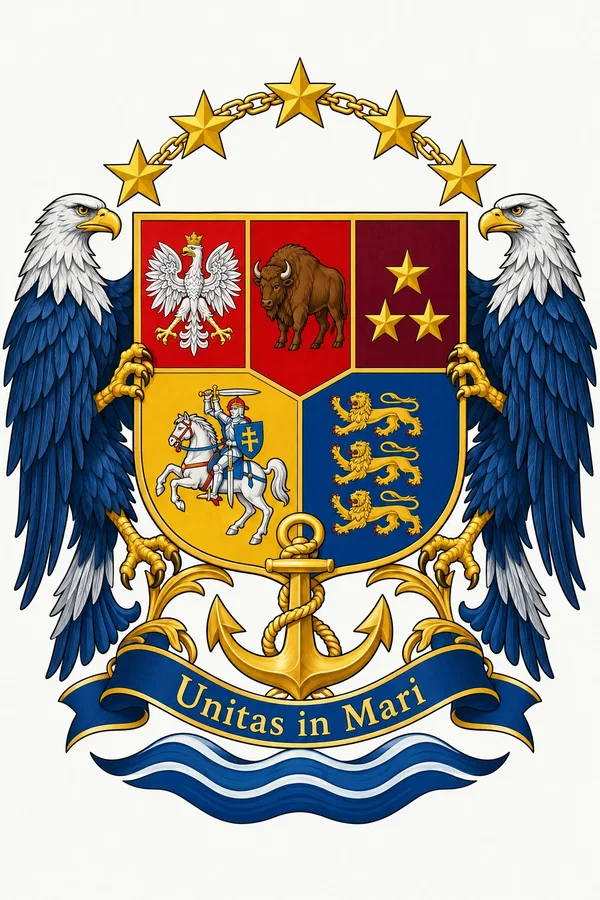
A shield cut into five parts: an eagle (Poland), a bison (Belarus), three stars (Latvia), a horseman (Lithuania), three lions (Estonia). Above the shield are five stars connected by a chain. The shield is supported by two sea eagles. Below the shield is the anchor and motto of Unitas in Mari. At the base there is a wave.
Motto
Unitas in Mari - “Unity in the Sea” (Latin). In the languages of the Republic of Poland: Jedność w morzu (Polish), Adzinstva ў mora (Belarus), Vienotība jūrā (Latvian), Vienybė jūroje (lit.), Ühtsus meres (Estonian).
Anthem
“The Baltic Oath” - five stanzas (in parts) with a common refrain in Latin: Unitas in Mari, / Una vox, una fides. Music - Stanislav Moniuszko (arranged 1946), lyrics - TBA.
Awards
· Order of Five Stars (1946) - the highest award, three degrees.
· Order of the Baltic Sea (1947) - for naval services, two degrees.
· Medal “For the Unity of the Baltic States” (1946).
· Medal “Baltic Oath” (1989) - for participation in the “Baltic Chain”.
Other symbols
· Baltic Day - January 1.
· Colors: white, red, carmine, yellow, blue, gold, silver.
· National trees: oak (Poland), spruce (Belarus), linden (Latvia), birch (Lithuania), pine (Estonia).
· National animal: bison (Belovezha), sea eagle (Baltic).
· Capital symbols: Warsaw - eagle and oak; Riga - three stars and a linden tree; Vilnius - horseman and birch; Tallinn - three lions and a pine tree; Minsk - bison and spruce.
International relations
Member of the CMEA (1949), formally not in the Warsaw Department (Baltic), but in the Soviet sphere of influence. Allies: USSR. Rivals: West (until the 1980s). After the 1980s - rapprochement with the West.
International Relations of the Baltic Republics
Status: A "special case"—not part of the Warsaw Pact, yet within the USSR’s sphere of influence; a member of the Council for Mutual Economic Assistance (COMECON) that incorporates market elements; a buffer between East and West.
USSR: Loyalty in exchange for continued existence. The presence of Soviet troops in Kaliningrad and Belarus serves as a guarantee. The Baltic security services coordinate with the KGB. The USSR remains the primary market and the main supplier of oil and gas.
COMECON: Relations with the GDR and Czechoslovakia are marked by caution (due to market elements and the influence of the "Solidarity" movement); Hungary is sympathetic; Romania is cool; Bulgaria remains loyal.
The West: The USA and West Germany engage in trade via the Baltic region, though without recognizing the annexation. Britain and France offer moderate criticism. Sweden acts as the primary Western partner while also serving as a leading critic. Denmark has provided refuge to Baltic exiles. Finland remains silent ("Finlandization"). Norway is more sharply critical, while Iceland remains indifferent.
The Third World: Trade relations exist with India, Brazil, Egypt, and Iran, provided they do not compete with the interests of the USSR.
Organizations: Member of the UN (since 1946) and COMECON (since 1949); not a member of the Warsaw Pact; holds observer status in the Non-Aligned Movement.
Key Events: 1956—sympathy for Hungary, but no direct involvement; 1968—non-participation, though dissidents are handed over; 1980–81—martial law is not imposed; the USSR exerts pressure but stops short of invasion; 1989–90—the "Singing Revolution" unfolds, welcomed by the West, while the USSR remains silent. The irony: it traded with both sides—and feared both. Created through blackmail—it spent its entire existence balancing between them. When it collapsed, the West welcomed it, while the USSR remained silent.
Famous personalities
· Władysław Gomułka (1905–1982) – first president of the Republic of Poland (1946–1970), architect of the “Window to the Baltic States”.
· TBA - President (1970–1980).
· TBA - President (1980–1990), last.
· TBA - the leader of Solidarity.
· TBA - leader of the Baltic Popular Front.
Lost media
· Records of the “Baltic Oath” (1946) - one record has survived.
· Films of “Baltiya-film” (1946–1990) - some are lost.
· Radio broadcasts “Voice of the Baltics” have been lost.
· Archives of the General Sejm - some were found in the 1990s.
· “Singing Revolution” (1987–1988) - amateur recordings have survived.
See also
· Baltic Chain (1989)
· Singing revolution
Literature
· “Window to the Baltics: how Poland deceived Stalin” (Warsaw, 1995).
· “Five Stars: The History of BR” (Riga, 2000).
· “The Baltic Oath: Music of the Empire” (Tallinn, 2005).
First message
1 tokens.
1 assets: 1 archived, 0 pending, 0 failed, 0 dead · 0 expression images
1 file
- .jsonotherspec 3.0
17.5 KBfirst seen 5860a8af958227ee
Opens with the tab.