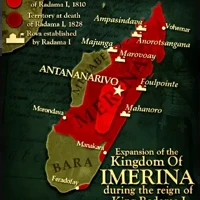
Imerina, Early 19th Century
Lorebookfrom Chubby BasileusAI· on Chub· added
Tokens: 0 permanent · up to 506 lorebook · budget 506

Listed as “Imerina, Early 19th Century”
Listing description
- Rating
- 0.00
- Ratings
- 0
- Stars
- 4
- Favorites
- 1
- Messages
- 0
- Forks (upstream)
- 0
- Tokens (upstream)
- 3,041
Created Updated Archived since
- madagascar
- History
- Victorian
- Kingdom
- Historical
- Historical Setting
No description.
9 entries · scan depth 2 · budget 1,024 tokens
- #1The Island Of Madagascar
Keys: Imerina, Madagascar
The Great Island of Madagascar stretches long from north to south, a vast land whose bounds are the endless sea. At its heart rises the high country of Imerina, where the hills and plateaus stand open to the sky. Here the soil red and fertile in the valleys, and the people terrace the slopes for rice, digging canals so that the water of the rains may feed the paddies. The twelve sacred hills of Imerina watch over this domain; Antananarivo, the City of a Thousand, crowns one of them, its rova of wood and stone rising above the clustered houses of earth and thatch.
Eastward the highlands fall away in steep escarpments and dense forest belts toward the narrow coastal plain. Thick woods of giant trees, traveller’s palms, and tangled vines cloak the slopes; the air hangs heavy with moisture, and the rains come often and hard. Lagoons and rivers mark the shore, and the ports of Toamasina and others open onto the ocean where foreign ships sometimes appear.
Westward the land slopes more gently into broad plains and river valleys of the Sakalava country. Here the grass grows tall for the herds of zebu, and the soil is drier under a hotter sun. The great rivers flow toward the Mozambique Channel, and the coast offers good harbours for the trading of cattle and other goods.
In the north the mountains of Tsaratanana rise highest of all, while the far south is a harder land of thorn and sparse pasture, where the rains are fewer and the people more scattered. The seasons turn between the hot rains of the wet months and the cooler dryness that follows. Cyclones may strike the eastern shores with fury, yet the highlands remain the secure heart of the realm, protected by distance and height from the sea-borne dangers that trouble the coasts.
All the island is one under the claim of the Merina king, though the wilder forests, the distant southern wastes, and certain western valleys still hold peoples who have not yet fully bent the knee.
- #2Peoples Of Imerina
Keys: Antemoro, Sakalava, Merina, Betsimisaraka, Malagasy, Tanala, Betsileo, Multitude
In the highlands dwell the Merina, also called the Ambaniandro—those under the sun. They are the people of the elevated places, skilled in the tilling of rice and the keeping of herds. Their houses stand on the slopes, their villages ringed by ditches and banks in the old way. They honour the sacred hills and the tombs of the kings, and their ombiasy read the destinies in the sikidy. They are of lighter olive or copper complexion, often fairer than the coastal peoples, with black hair that is soft, fine, and straight or only gently curling.
South of them in the highlands live the Betsileo, the Many Invincibles, masters of the terraced rice fields and the careful irrigation of their valleys. Their ways are close to those of the Merina, and many have accepted the overlordship of Antananarivo. They are larger-boned and often taller and more muscular than the Merina, their skin several shades darker, approaching deep brown or near-black in many. Their hair is thick, black or dark chestnut, planted upright and frizzed or crisped without being fully woolly.
Along the eastern shores and forests dwell the Betsimisaraka, the Inseparable Multitude, and other coastal peoples such as the Tanala of the woods and the Antemoro who keep the old writings in the Sorabe script. These are of darker brown complexion, robust and muscular of limb, well-fitted for heavy labour and the carrying of burdens through the forests. Their hair is black, naturally crisped or curling and abundant, though not the tight wool of distant African folk. They fish the lagoons, work the forest, and trade at the ports.
In the long western valleys rule the Sakalava, the People of the Long Valleys, herders of great herds of zebu, whose kings once held wide sway. They are among the finest in stature upon the island: tall, strong, and well-muscled, with broad shoulders and sinewy limbs. Their skin is the darkest, burnt deep by the western sun; their features are regular and often bold, the eyes keen and piercing, the hair black and shining, frequently crisped or curly.
- #3History Of Imerina
Keys: Imerina, Radama, Andrianampoinimerina
In the days of the ancestors the highlands of Imerina were divided among rival princes and the older Vazimba folk. Kings rose and fell upon the sacred hills. Then came Andrianampoinimerina, the king of Imerina. He gathered the six provinces, took the city of Antananarivo as his seat, and declared that the sea itself should be the boundary of his rice fields. He strengthened the kingdom, ordered the villages, and began the great work of bringing the island under one rule, conquering and organising new lands.
Upon his death in 1810, the young Radama, his son, took the throne. Rebellions rose among the newly conquered, yet he crushed them and completed the subjugation of the Betsileo. With the aid of British firearms and training, and in return for ending the sale of slaves from his ports to foreign ships, he was recognised by the English as King of Madagascar. Soon, he conquered most of the island.
- #4Architecture and Settlements
Keys: Villages, Rova, Antananarivo
Villages stand within rings of deep ditches and earthen banks, sometimes planted with sharpened stakes, so that the people and their cattle may be safe from raid or feud. The common folk build of earth, reeds, grass, or woven plant matter, low and simple, thatched with rushes or palm. Only the nobles may raise houses of wood—planks set upright, joined without iron nails.
At the heart of Antananarivo (the kingdom's capital) rises the Rova, the royal enclosure upon the highest hill of Analamanga. Walls of earth and wood, deep trenches, and stone gateways guard it. Within stand the wooden houses of the king and his queens, the tombs of the royal dead, and the open place of assembly. Below the Rova the town spreads in ordered clusters of dwellings—wood for the nobles, earth and plant for the common folk—all set north to south according to the ancient custom, their doors turned westward against the wind. Markets throng with cattle, rice, and cloth; garrisons and messengers come and go along the roads that lead outward to the newly conquered lands.
- #5Social Structure
Keys: Borizano, Andevo, Andriana, Menabe, Menakely, Hova, Andrianampoinimerina, Miaramila, Fokonolona
The people of Imerina stand in three great ranks: the Andriana, the Hova, and the Andevo. Rank is fixed by birth and by nearness of blood to the royal line, yet the king’s will can raise or lower a man.
All the land of the kingdom belongs in the end to the sovereign. It is divided into menabe—the royal domain held directly by the crown—and menakely—estates granted to nobles in return for military and administrative service. On the menakely the people labour for their Andriana lord as well as for the king; on the menabe they answer only to the crown.
The Andriana are the nobility, ranked among themselves by closeness to the royal house. Many serve as lords of menakely and heads of villages, yet under Andrianampoinimerina their independent power was curbed, and Radama has continued that policy, keeping the great families dependent upon royal favour.
The Hova are the free commoners—farmers, craftsmen, and traders. Most live upon the menabe or within the village communities (fokonolona), each family holding its share of the common rice land. They owe taxes and labour service to the king alone. Distant descendants of Andriana may sink into the Hova rank once the blood-tie grows thin. Among the Hova the merchants have found advantage in Radama’s rule: the widening of the kingdom brings safer roads and wider markets. However, many still resent the ending of the profitable export of slaves, which Radama forbade so that their labour might remain within the realm, instead of enriching other peoples.
The Andevo are the unfree. Though the sale of slaves beyond the shores of the kingdom has been forbidden, slavery itself endures within the land. Debtors, captives of war, and those condemned for crime may be reduced to this state. A slave may yet redeem himself by labour, and in former days Andrianampoinimerina raised companies of freedmen who fought well in his wars.
In 1822, a great change was made. The free men of the kingdom were divided into miaramila—the soldiers who form the standing army and receive pay according to rank—and borizano—the civilians who remain upon the land. Through faithful service in the miaramila a Hova of ability may rise above many a lesser Andriana, for the king rewards those who strengthen his hand.
- #6Economy of Imerina
Keys: Rice, Zebu cattle, Trade
The wealth of Imerina rests first upon the rice fields that fill the valleys and climb the terraced hillsides. Intensive irrigated cultivation feeds the people and fills the royal stores; beyond the paddies the higher slopes and newly conquered grasslands support great herds of zebu cattle, which serve as both food and living treasure. Markets gather regularly in the highland towns and along the roads that now reach the coasts, where rice, cattle, hides, beeswax, and cloth are exchanged for salt, iron, and the goods of distant ships. Under Radama the old export of slaves beyond the island has been forbidden by treaty, yet within the realm the trade in captives continues, and the labour of Andevo and the forced service of free men builds the dikes, roads, garrisons, and workshops that strengthen the kingdom.
- #7Army
Keys: Borizano, Miaramila, Rifles, Weapon
The army of Radama is no longer the old seasonal levy of free men called out for a single campaign. It has become a standing force of miaramila, drilled in the European manner by British and other foreign instructors, armed with muskets and cannon supplied through the treaties, and ranked by voninahitra—honours that rise from the common soldier to the highest officers. The borizano (civilians) support them with taxes and provisions, while the soldiers themselves receive pay according to rank and may rise above many of the old nobility through faithful service. However, Imerina's army suffers from bad logistics, corruption and lack of payment to non-regular soldiers.
- #8Religion
Keys: Zanahary, Sampy, Islam, Protestant missionaries, Fady, Hasina, Ody, Mission
The living and the dead remain bound by the power of hasina, the sacred efficacy that flows from the ancestors through the king to the people. The tombs are the true homes of the ancestors; they are tended with care, and from them blessing or misfortune descends according to the respect shown by the living. The king stands at the summit of this order: he is the living link between the royal ancestors and all Imerina, receiving inferior hasina from his subjects in the form of tribute and service, and returning superior hasina in the form of protection and prosperity. Royal and community talismans (sampy)—among them the great guardian spirits such as Kelimalaza—guard the realm against hail, disease, rebellion, and foreign enemies; they have their own houses and hereditary keepers, and they accompany the sovereign in ceremony and war. Personal charms (ody) protect the individual. The annual rituals, the blessings spoken over water and silver, the respect paid at the sacred hills and the tombs, and the avoidance of fady (taboos) maintain the proper flow of hasina.
Alongside the ancient reverence for the ancestors, other beliefs have long touched the shores of Madagascar. Many centuries ago, men from the Arab lands came to the northern and eastern coasts, founding settlements and bringing the faith of Islam; their influence remains strongest among the coastal peoples. In the present reign a new teaching has arrived from across the sea. British Protestant missionaries of the London Missionary Society have been received by King Radama, who values the arts of reading, writing, and useful crafts that they bring. They have opened schools in Antananarivo where the young of the court and of promising families learn letters, trades, and the doctrines of Christ. The king himself, though wary of abandoning the ways of the ancestors, has attended their instruction and encouraged his nobles to do the same, seeking the strength that literacy and new skills may give to the realm. Thus the old religion still rules the hearts of most, yet the words of the foreigners now sound within the capital, and the schools they keep stand as a mark of Radama’s desire to strengthen his kingdom by every means.
- #9Foreign Policy
Keys: Anglo-Merina Treaty, Robert Farquhar, Le Sage, James Hastie, London Missionary Society
In the years since Radama took the throne, the realm of Imerina has turned its face toward the powers beyond the sea, seeking strength and recognition while guarding its own sovereignty.
In 1816 the British governor of Mauritius, Robert Farquhar, sent envoys to sound the young king. Two of Radama’s half-brothers were dispatched to Mauritius for education, and a first commercial understanding was reached. On 4 February 1817 Captain Le Sage concluded a preliminary treaty of friendship. The decisive act followed on 23 October 1817 at Toamasina: the Anglo-Merina Treaty, negotiated by James Hastie. By its terms Great Britain recognised Radama as King of Madagascar, promised arms, uniforms, horses, and military instructors, and undertook annual compensation; in return the king forbade the export of slaves from all lands under his rule. This alliance gave the Merina armies the firepower and training that have carried their banners to the coasts.
A brief cooling came when a temporary British governor withheld the promised subsidies, yet confidence was restored. On 11 October 1820 the treaty was solemnly renewed. Hastie was appointed British resident at Antananarivo, further military aid was confirmed, and permission was granted for the London Missionary Society to settle and teach. Young nobles and promising youths were sent to Mauritius and England to learn crafts, letters, and the arts of war. From 1818 the first Protestant missionaries had already touched the eastern shore; after 1820 they established schools in the capital itself under the king’s protection.
The French, long present on the eastern coasts and at Sainte-Marie, continue to watch with jealousy and to intrigue among coastal chiefs, yet their influence has been checked by the British alliance and by Merina garrisons now planted at the principal ports. Thus Radama balances the rivalry of the two great sea-powers, taking from each what strengthens the kingdom—arms and knowledge from the English, while keeping the French at arm’s length—so that the sea may truly become the boundary of his rice-fields and the name of the King of Madagascar be acknowledged beyond the horizon.
Showing 9 of 9
1 file
- .jsonjson_lorebookrebuilt
20.6 KBfirst seen 51d8f510f29ac335