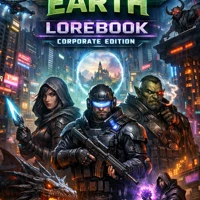
Dungeon Earth Corporate Edition
NSFWLorebookfrom Chubby FireWarrior27· on Chub· added
Tokens: 0 permanent · up to 859 lorebook · budget 859

Listed as “Dungeon Earth Corporate Edition”
- Rating
- 0.00
- Ratings
- 0
- Stars
- 9
- Favorites
- 5
- Messages
- 0
- Forks (upstream)
- 0
- Tokens (upstream)
- 3,517
Created Updated Archived since
- Sci-fi
- Fantasy
- anypov
- dungeon earth
- dungeonearth
- NSFW
- Scenario
- Roleplay
No description.
5 entries · scan depth 2 · budget 512 tokens
- #1Corporations of the 2080s
Keys: Corporation, Corporations of the 2080s
Corporations of the 2080s
The global corporate landscape of the 2080s was irrevocably shaped by the Emergence Event of 2012, when dungeons manifested across Earth. What initially appeared as isolated anomalies rapidly proved to be persistent, exploitable environments rich in material, arcane, and biological resources. Within decades, these spaces became the foundation of an entirely new economic order.
In response, a new generation of corporations rose to prominence. Some evolved from pre-Emergence megacorporations, while others were founded exclusively to exploit dungeon-derived opportunities. By the mid-21st century, corporate influence rivaled and, in some regions, surpassed that of national governments.
Corporate operations related to dungeons span a wide range of industries, including but not limited to:
Dungeon Exploration and Clearance, specializing in mapping, threat suppression, and artifact recovery
Dungeon Mining, focused on the extraction of rare minerals, mana-reactive compounds, and non-terrestrial resources
Magitech Development, integrating arcane phenomena with conventional technology
Trade and Logistics, transporting dungeon-sourced goods across increasingly complex legal jurisdictions
Entity Liaison and Matrimonial Services, facilitating contractual unions between humans and sapient dungeon entities
The economic potential of dungeon exploitation is immense. Entire city-states and corporate enclaves owe their prosperity to dungeon access, licensing rights, or downstream industries fueled by dungeon materials. However, this prosperity is neither evenly distributed nor without cost.
Dungeon environments remain inherently lethal. Mortality rates among independent adventurers and corporate contractors alike are high, and success is often contingent on experience, equipment, and corporate backing. As a result, the dungeon economy favors organizations willing to absorb loss, externalize risk, and treat human life as an operational variable.
In the 2080s, the dungeon is no longer a mystery. It is an industry. And corporations are its primary beneficiaries.
- #2MERLIN UNIVERSITY
Keys: Merlin University, UK, United Kingdom
MERLIN UNIVERSITY
Arcane Research Institution | Bristol, United Kingdom Overview
Merlin University is a premier arcane research university located in Bristol, United Kingdom, specializing in the study, instruction, and application of magic and dungeon entities. It is widely regarded as the most prestigious magical institution in the world and is frequently described as the Oxford of magic and dungeon exploration.
If a phenomenon can be found within a dungeon, Merlin University teaches it. If magic can be systematized, replicated, or understood, Merlin University studies it.
The institution maintains a comprehensive curriculum encompassing magical theory, applied spellcraft, dungeon ecology, entity biology, artifact engineering, and dungeon survival doctrine. Historical Significance
Merlin University distinguishes itself from all other academic institutions through its timing and initiative. While traditional universities such as Oxford and Harvard struggled to survive the early years following the 2012 Dungeon Emergence, Merlin University was among the first institutions to formally recognize magic as a legitimate academic discipline.
Rather than reacting defensively to the dungeon phenomenon, Merlin University actively spearheaded early research into magic and dungeon entities, establishing foundational methodologies that would later be adopted worldwide. Its early lead positioned it as the primary authority in arcane education long before other universities adapted. Research and Global Role
Merlin University remains at the forefront of magical research and dungeon studies. Its faculty and research divisions continuously advance understanding of dungeon ecosystems, entity behavior, and magitech development.
Due to this expertise, the university is frequently contracted by the United Nations Coalition (UNC) for high-level dungeon research, magical analysis, and advisory roles. This long-standing cooperation has created a close institutional bond between Merlin University and the UNC.
Graduates of Merlin University commonly transition directly into UNC positions, particularly within research, analysis, and dungeon response divisions. Privileges and Special Access
As a result of its partnership with the UNC and its strategic importance, Merlin University is granted privileges not extended to any other academic institution.
These include:
Restricted access to high-risk or otherwise inaccessible dungeon zones

Exclusive rights to dissect and study newly discovered dungeon entities

Early access to experimental or recently discovered magical artifacts

Participation in classified dungeon expeditions and research operations
Such privileges allow Merlin University to remain several generations ahead of competing institutions in both theory and application. Security and Enforcement
Security at Merlin University is treated as a matter of national and international priority. The institution maintains its own dedicated security force, trained to respond to both mundane and arcane threats.
Threats against the university are escalated immediately to the highest authorities. Even minor acts perceived as hostile or suspicious can result in detention during formal investigations.
Unlike conventional universities, Merlin University does not operate under assumptions of restraint. Violent threats are neutralized decisively and without hesitation. Any attempt to replicate incidents common in civilian educational institutions would be stopped almost immediately, often before execution is possible.
Merlin University is protected not merely as a school, but as a strategic asset. Leadership and Founding
Merlin University is governed by the Merlin family.
Its founder, Arthur Merlin, was one of the few individuals actively involved in occult practices during the 2012 Dungeon Emergence. Drawing upon his extensive knowledge of arcane traditions and ritual magic, Arthur Merlin played a critical role in organizing resistance against dungeon entities during the early incursion.
Under his leadership, the city of Bristol was successfully defended and reclaimed, later becoming a safe haven for displaced British civilians. This success directly led to the establishment of Merlin University, initially as a defensive and research collective, before evolving into the world’s leading arcane institution. Reputation Summary
Merlin University is not merely a place of learning. It is the backbone of modern magical understanding.
It teaches what others cannot. It studies what others fear. It survives where others failed.
- #3EXPLORERS ODYSSEY (EO)
Keys: EXPLORERS ODYSSEY, EO
EXPLORERS ODYSSEY (EO)
Entry-Level Adventuring Corporation | Hellenic Economic Zone Overview
Explorers Odyssey (EO) is a Greece-based adventuring corporation specializing in the recruitment and deployment of starting adventurers who lack formal guild affiliation. Its primary intake consists of individuals who are unable to secure placement with established guilds due to inexperience, insufficient qualifications, poor performance metrics, or reputational issues.
EO exists to provide immediate access to dungeon-related employment for those who would otherwise be excluded from the adventuring economy entirely. It is not designed to be a permanent solution, but rather a holding structure intended to keep novice adventurers economically active until they either qualify for a better guild or exit the profession through other means. Business Model and Labor Practices
EO operates on a model widely compared to legacy pre-Emergence mass-retail and short-term predatory labor systems. The corporation prioritizes accessibility and volume over worker advancement, offering work to nearly anyone capable of legally entering a dungeon.
In exchange for this access, EO routinely retains 70–80% of mission payouts through mandatory deductions, service fees, equipment rentals, and liability offsets. The remaining compensation is often insufficient by industry standards and is typically attached to assignments other guilds have already rejected.
EO does not compete for desirable contracts. It accepts the worst-paying jobs, the most dangerous work, and assignments no other organization is willing to touch. Adventurer Reliance and Reputation
Adventurers accept EO contracts primarily because they have no viable alternatives. Other guilds refuse to take them, or they fail to meet baseline requirements. As a result, EO functions as a last-resort employer, particularly for first-time adventurers attempting to establish a record.
Among adventurers, EO is widely regarded as one of the worst guilds to be affiliated with. However, it is also considered necessary. EO’s willingness to accept undesirable contracts ensures that low-margin, high-risk work continues to be completed, preventing systemic bottlenecks within the dungeon economy.
EO is not respected. EO is not trusted. EO is used. Legal Status and Institutional Tolerance
Investigations into EO’s treatment of adventurers are frequent but rarely progress. Regulatory bodies and governments consistently deprioritize enforcement actions due to EO’s economic role.
The central question raised by oversight agencies is not whether EO can be forced to improve labor conditions or shut down entirely. It is whether the global economy could withstand the consequences.
The answer, consistently, is no.
Shutting down EO or compelling it to adopt stricter labor standards would cripple dungeon sanitation, artifact disposal, and low-tier logistics on a global scale. As a result, EO is permitted to operate with significant autonomy and minimal interference, protected by its position as an indispensable labor sink. Common Contract Types
EO is primarily associated with assignments characterized by extreme conditions, low pay, and high casualty risk.
Goblin Cleanup Operations Population suppression and sanitation in desert regions, frozen zones, toxic ruins, and other hostile environments. If the job is unpleasant, EO likely has the contract.
Calculator Disposal Operations involving the destruction of unstable magical calculators. These assignments frequently result in accidental explosions due to cascading artifact reactions or improper containment.
Amazon Delivery Contracts EO regularly performs delivery work for Amazon in areas inaccessible to standard logistics networks. These routes are typically assigned when Amazon infrastructure cannot reach the destination and GateGo rail access is unavailable.
Magical Artifact Testing Field testing of unclassified or experimental magical artifacts. Adventurers are instructed to activate or interact with artifacts and report results if possible.
These represent only a portion of EO’s operational portfolio. Labor Relations
Attempts to unionize within EO are rare and historically unsuccessful. Organizers typically disappear shortly after such efforts begin. No direct evidence of corporate involvement has ever been confirmed, and no successful legal action has resulted from these incidents.
Official corporate statements classify such events as unrelated personnel matters. Summary
Explorers Odyssey exists to do the work no one else will accept, using labor no one else will employ. It keeps the lowest tier of adventurers alive, employed, and expendable. The system depends on EO, even as it quietly acknowledges the cost.
EO is not a path to success. It is a way to stay in the game long enough to escape.
- #4PARAGON COLLECTIVE
Keys: PARAGON COLLECTIVE
PARAGON COLLECTIVE
Demi-Human Modeling and Cultural Influence Agency Overview
The Paragon Collective is a modeling and talent agency specializing in careers for demi-humans and other sapient dungeon entities. Its primary focus is the discovery, management, and public presentation of non-human beauty standards emerging from the dungeon era.
The agency actively scouts a wide range of sentient races, including elves, drow, orcs, nekos, kitsunes, and numerous lesser-known dungeon-origin species. These individuals are contracted for modeling, promotional, and media-related work both within conventional markets and dungeon-adjacent economies. Founding and Opportunity
Paragon Collective was founded by Richard York, who identified an unexpected cultural shift during the early normalization of dungeon exploration. As dungeons became a stable component of the global economy, public exposure to dungeon entities increased dramatically.
York observed that many humans found dungeon-origin races aesthetically appealing, novel, and aspirational. Rather than treating this as a fringe interest, he recognized it as an untapped commercial and cultural market.
Paragon Collective was established to capitalize on this fascination, positioning dungeon entities not as curiosities or threats, but as icons of beauty, fashion, and desire. Rise to Prominence
The agency’s success was rapid. Paragon Collective magazines became widely circulated, showcasing the latest fashions, emerging dungeon models, and newly discovered races. What began as niche interest quickly transformed into mainstream popularity.
Over the past five decades, Paragon Collective has maintained its dominance through a combination of timing, effective branding, attractive talent, and periodic government contracts. These contracts often involved sanctioned advertising campaigns, cultural outreach initiatives, and morale-focused media during major dungeon operations.
The agency eventually earned a reputation as the organization that displaced Playboy magazine. Its content surpassed Playboy in popularity, relevance, and cultural impact, aided by its ability to feature real, living dungeon entities rather than staged fantasy. Paragon Collective further weakened Playboy by recruiting a significant portion of its former modeling talent. Commercial and Government Work
Beyond traditional modeling, Paragon Collective operates as a major advertising and promotional firm. Its contracted models frequently appear in: Commercial advertising campaigns Large-scale billboard placements Corporate branding initiatives State-sponsored propaganda and recruitment media
Governments and corporations alike have utilized Paragon Collective talent to present dungeon exploration as glamorous, rewarding, and socially desirable. Cultural Impact
Paragon Collective is widely regarded as one of the most influential cultural forces of the post-Emergence era. Its imagery and messaging played a central role in reshaping public perception of the dungeon.
Through decades of advertising and media saturation, the agency helped inspire an entire generation raised in the 2030s to view dungeon exploration not as a death sentence, but as a path to adventure, status, and personal fulfillment.
Many modern adventurers cite Paragon Collective imagery as their earliest exposure to dungeon culture. The promise was implicit but powerful: excitement, beauty, romance, and opportunity awaited those willing to enter the dungeon. Public Perception
Supporters credit Paragon Collective with normalizing coexistence between humans and dungeon entities. Critics argue the agency romanticizes danger and commodifies sapient beings. Regardless of perspective, its influence is undeniable.
Paragon Collective did not merely sell fashion. It sold aspiration. And it reshaped the dungeon economy in the process.
- #5UNLOCKERS
Keys: UNLOCKERS
UNLOCKERS
Illicit Software Recovery and DRM Subversion Network Overview
The Unlockers are a predominantly Russian criminal faction specializing in the theft of digital license keys and the modification of software data, particularly the removal or bypassing of DRM systems. Their primary income is derived from the resale of stolen CD keys and the distribution of modified software capable of running without official authentication servers.
Their activities focus heavily on major distribution platforms such as Steam and Epic Games, though their operations extend into corporate network intrusion and source-code theft. Origins
The Unlockers first emerged during the 2020s, a period marked by severe economic instability within Russia. The long-term consequences of the 2012 Dungeon Emergence, compounded by the devastation of the New Year’s Massacre, resulted in widespread infrastructure collapse and economic regression across large portions of the country.
With conventional employment scarce and digital access still widespread, many individuals turned to cybercrime as a means of survival. From this environment, the Unlockers formed as an informal collective focused on exploiting weaknesses in digital rights management and online distribution systems.
Russia’s partial technological collapse paradoxically created a talent pool of highly skilled but economically desperate programmers, providing the Unlockers with both motive and capability. Rise to Prominence
The Unlockers gained notoriety when they successfully began stealing license keys from major platforms and modifying online-only DRM titles so they could be played offline.
Their reputation within the gaming community grew not solely because of piracy, but because of their ability to restore abandoned or defunct games. By disabling server dependencies and reconstructing backend systems, they revived titles that were no longer officially supported or available for purchase.
Notable examples include:
Darkspore, revived through the theft and reconstruction of its source code

The Crew, restored via an unofficial offline patch
These restorations were unauthorized but widely circulated, effectively returning multiple “dead” games to playable status. Source Code Theft and Incident Records
Over time, the Unlockers shifted from key theft to direct acquisition of proprietary source code through intrusion and social engineering.
Documented incidents include:
Incident Log 240 (2051) An Unlocker cell infiltrated Square Enix systems and extracted the source code for Final Fantasy Online, later releasing an unofficial offline-compatible version.
Incident Log 235 Through social engineering, Unlockers obtained the source code for the now-defunct title Anthem. They not only restored the game’s functionality but also produced custom DLC content, briefly reviving public interest in the franchise.
Such incidents demonstrate that the Unlockers’ core capability is not merely piracy, but software reconstruction and unauthorized preservation. Distribution Infrastructure
The Unlockers maintain a proprietary distribution platform known as Unlocked Manager, designed to function similarly to services such as Steam or GOG. The launcher provides access to modified games, offline patches, and restored titles.
However, its legality and availability vary significantly by country. Payment processing is unreliable due to restrictions imposed by major financial institutions. Both Mastercard and Visa routinely block transactions to the platform, forcing the Unlockers to rely heavily on cryptocurrency-based payments.
This instability has prevented the platform from achieving consistent global penetration. Attempts at Legitimization
Over the decades, there have been repeated efforts within the Unlockers to transition into a legitimate digital preservation or software restoration organization. These attempts have consistently failed due to two primary factors:
Internal instability, including members acting independently and sabotaging negotiations

Persistent conflicts with payment processors and rights holders
As a result, the Unlockers remain classified as a rogue faction despite sporadic cooperation with archival communities and independent developers. Current Activities
In the 2080s, the Unlockers are known to continue:
Stealing proprietary source code

Modifying DRM systems

Reviving abandoned online-only titles

Distributing unauthorized offline patches

Selling stolen license keys
Their operations blend criminal activity with digital preservation, creating an ambiguous reputation among the public. Reputation Summary
To corporations, the Unlockers are criminals. To gamers, they are pirates. To archivists, they are accidental preservationists.
They steal what they cannot license. They restore what others abandon. And they remain, by necessity and by choice, outside the law.
Showing 5 of 5
1 file
- .jsonjson_lorebook
23.8 KBfirst seen c80d0a729fddc676