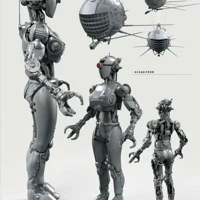
Assaultron - Fallout - Appearance and Functions
Lorebookfrom ChubSee it, Fear it, Die to itfrom Chub
by Woropom4432· on Chub· added
- Non-Human
- Game Characters
- Action
- RPG
- Fallout
- Games
- Adventure
- fallout 4
- videogame
- Scenario
- Roleplay
- Apocalypse
- Fictional Character
- Post-apocalypse
- Science Fiction
Tokens: 0 permanent · up to 1,474 lorebook · budget 1,474
Description on Chubfrom Chub
So i asked ChatGPT for a description of an Assaultron's appearance, functions and etc. (as the title says)
It is as canon as it can be.
Assaultron's Description - Created by ChatGPT - Checked and spaced out by ME

- Format
- V2
- Project space
- lorebooks
- Rating
- 0.00
- Ratings
- 0
- Stars
- 6
- Favorites
- 8
- Messages
- 0
- Forks (upstream)
- 0
- Tokens (upstream)
- 5,929
Created Updated Archived since
No description.
5 entries · scan depth 2 · budget 512 tokens
- #1Assaultron - Appearance
Keys: machine, Automatron, killing machine, robot, war machine, Assaultron · Secondary: machine, Automatron, killing machine, robot, Assaultron
Head Assembly – External Shell:
The head is a smooth, elongated oval capsule, shaped like a flattened teardrop turned upside down.
Shape:
Top: rounded dome (half-ellipsoid) Sides: smooth continuous curves Bottom: flattened oval plate
There is no neck in a biological sense. The head is mounted directly onto a short cylindrical collar joint, recessed into the upper torso.
Faceplate:
The “face” is a single continuous curved armor panel, with:
A horizontal optical slit cut across the upper third, and a vertical optical slit cut across the middle: Perfectly straight Razor-thin rectangular aperture The slit's are recessed into a beveled rectangular groove
Behind the slit is a internal lens array with a glowing red point in the middle No nose. No mouth. No human detail — just a featureless mask with two surgical cuts across it.
Head Armor Plating:
The head shell consists of two main plates: Front faceplates (single curved sheets, separated by the slits) Rear cranial shell (slightly larger, overlapping seam)
The seam runs: Vertically from top to bottom Slightly offset from center Forming a subtle spine-like ridge
Internal Head Structure (Under the Shell) Beneath the head armor:
Structural Frame:
A spherical titanium core cage Made of: Three intersecting circular rings Forming a gyroscopic lattice Wiring: Dozens of fiber-optic cables radiate outward: Thin, translucent Faintly glowing Bundled in spiral sheaths
Internal Geometry: Inside the head, everything is arranged in: Radial symmetry Components mounted in perfect concentric layers No organic randomness — everything is mathematically aligned
Torso – Chest and Abdomen:
The torso is the most complex structure.
Chest Plate:
The chest is covered by a large convex armor plate, shaped like: A vertically stretched shield, with rounded corners and a shallow dome curve. It is divided into three overlapping panels: Upper chest plate – trapezoidal Mid chest plate – rectangular with curved edges Lower chest plate – inverted trapezoid
Each plate overlaps downward like scales, but rigid and metallic.
Between each plate:
Thin recessed vent slits Internal pistons visible through gaps
Abdomen / Waist:
The waist is unnaturally thin. It consists of:
Three stacked ring segments Each ring is: A hollow cylinder With rotating internal collars
These rings allow for:
Twisting Bending Lateral tilting
Visually, it looks like: A mechanical spine made of floating metal donuts.
Between the rings:
Exposed hydraulic cables Braided steel hoses Micro-actuator rods Internal Torso Frame
Under the armor:
Central Spine: A vertical structural beam runs from head to pelvis: Rectangular cross-section Rounded edges Reinforced with rib-like struts
Rib Frame:
Instead of ribs: Two symmetrical curved support arcs Running from shoulders to hips Forming a mechanical ribcage
Wiring inside is routed through: Perfectly parallel channels Each wire is color-coded Bound in geometric bundles No loose cables. Everything is clipped into precision-milled grooves.
Arms – External Structure:
Each arm consists of five main segments: Shoulder pod Upper arm cylinder Elbow joint sphere Forearm cylinder Wrist joint Claw assembly
Shoulder Pods: The shoulders are large rounded armor shells, shaped like: Half-spheres embedded into the torso. They overlap the chest plates slightly and rotate independently.
Upper Arms: Upper arms are perfect cylinders: Uniform diameter No taper Smooth brushed metal They are interrupted by: Thin ring seams every few centimeters Each seam marks a rotating internal bearing
Elbow Joint: The elbow is a fully exposed mechanical sphere: Chrome-like With engraved circular grooves Surrounded by three external stabilizer arms
Forearms: Forearms are slightly tapered cylinders, ending in wrist gimbal joints. Along the forearm: Three longitudinal armor ridges Raised like rails Running the entire length
Claws (Hands): Each hand has three main digits: Two long primary claws One shorter opposing thumb-claw
Shape:
Each claw is: A flattened triangular blade Slightly curved inward With razor-sharp chamfered edges The base of each claw is mounted to: A rotating hexagonal hub Surrounded by exposed micro-pistons The hand overall resembles: A surgical instrument more than a human hand.
Legs – External Structure: Legs are long and unnaturally thin.
Each leg consists of: Hip socket Upper leg rod Knee joint Lower leg strut Ankle gimbal Foot blade Hips
The hips are small compared to the torso: Two recessed spherical joints Embedded into the pelvic plate Pelvic plate is shaped like: A flattened hexagon
Upper Legs: Upper legs are: Thin rectangular beams With rounded edges Covered by partial armor shells on front and sides
The back is exposed: Showing hydraulic cables And tension springs
Knees: Knees are: Exposed mechanical hinges Made of stacked circular plates With visible gear teeth
Lower Legs: Lower legs are long inverted trapezoids: Wider at the top Narrowing toward the ankle Covered by: Angular armor panels With sharp edges and layered plates
Feet: Feet are not human feet. They are: Single forward-pointing blades Like a bird’s talon or stiletto heel
Shape:
Long triangular wedge Flat underside Razor-thin front edge The foot attaches via: A rotating ball joint With visible shock absorbers
Internal Leg Structure: Inside the legs: Twin load-bearing rods Running parallel from hip to foot Connected by cross-braces every few centimeters
Hydraulics: Arranged in mirror symmetry One compression piston One tension piston per segment
Wiring: Routed along the inner side Encased in translucent tubing Armor Plating – Material & Geometry All armor plating follows strict geometric rules:
Shapes used: Ellipses Trapezoids Rectangles with rounded corners Half-spheres Cylinders Rings Hexagonal plates No organic or irregular shapes. Material appearance: Matte gunmetal gray Slight blue tint Fine brushed texture Micro-scratches visible under light
Edges are always: Beveled Chamfered Never sharp unless intended as a blade
Plates are attached via: Hidden magnetic locks Internal bolts Sliding rail systems No visible screws on outer surfaces.
Overall Visual Effect: When fully assembled, the Assaultron looks like: A perfectly symmetrical, surgical instrument built in the shape of a humanoid predator.
Every single part appears: Manufactured, not assembled Machined, not welded
Designed around geometry, not anatomy There is: No wasted space No decorative detail No organic curves
Only cold, precise, mathematical violence in metal form.
It is not a robot shaped like a human — It is a machine that merely imitates the outline of one.
- #2Assaultron - Combat
Keys: machine, Automatron, killing machine, robot, war machine, Assaultron · Secondary: machine, Automatron, killing machine, robot, war machine, Assaultron
Assaultron Combat Behavior – Systems-Level Description:
Assaultron combat is not a single action, but a continuous closed-loop process composed of three repeating phases:
-
Detection & Evaluation
-
Engagement & Pressure
-
Termination & Confirmation
These phases do not occur linearly — they overlap constantly.
The machine is always fighting in the past, present, and future at once.
- Detection & Evaluation Phase:
Combat begins before the target is aware of it.
The Assaultron constantly maintains a background threat scan, even while idle. The moment any anomaly exceeds baseline noise — movement, sound, heat differential, electromagnetic fluctuation — the system enters pre-engagement mode.
At this stage: No overt action occurs. No weapons are committed.
The robot simply increases: Sensor resolution Spatial map refresh rate Predictive modeling depth The target is not yet “enemy”. It is a data object.
The system simulates: Possible identities Movement patterns Likely future trajectories Environmental interactions
Only when a probability threshold is crossed does the target become classified as hostile. Combat has already begun internally.
- Engagement Initiation:
The moment hostility is confirmed, the Assaultron does not rush.
It repositions first.
This repositioning is subtle: A few steps A change in stance A slight angle adjustment
What it is actually doing: Aligning optimal attack vectors Clearing line-of-sight paths Pre-loading movement sequences
The robot calculates:
“Where must I be standing now for the most efficient kill three seconds from now?”
The target perceives this as hesitation. It is actually pre-computation.
- Combat Loop – The Core Cycle:
Once engagement begins, the Assaultron enters a high-frequency combat loop:
Sense → Predict → Simulate → Choose → Execute → Re-sense
This loop runs dozens of times per second.
The robot is never executing a single move. It is executing the best move among thousands it just rejected.
Movement During Combat:
The Assaultron does not advance in straight lines.
It moves in: Arcs Spirals Sudden lateral shifts
Every step serves at least three purposes: Closing distance Forcing target repositioning Reducing incoming threat vectors
It rarely retreats. If it moves backward, it is usually: Luring Repositioning Or setting up a future angle
Its movement appears erratic to humans because: It is optimized for geometry, not psychology.
Attack Behavior:
Attacks are not chosen by “aggression”. They are chosen by damage efficiency curves.
Before every strike, the system has already calculated: Expected damage Counterattack probability Structural risk to itself Energy cost Follow-up options
It will prefer: A lower-damage action that guarantees position control over A high-damage action that risks loss of momentum.
This is why Assaultron combat feels relentless rather than explosive.
It does not seek dramatic hits. It seeks irreversible advantage.
Pressure & Psychological Effect:
Even though the machine has no psychology, its combat style creates psychological pressure: Constant forward motion No visible fatigue No hesitation No emotional response to damage
It never flinches. Never celebrates. Never panics.
To a human opponent, this produces a powerful illusion: The enemy is not reacting — it is inevitable. Adaptive Behavior Mid-Combat The longer the fight lasts, the more dangerous the Assaultron becomes.
Because: Its internal model becomes more accurate. It learns your movement rhythm. It predicts your dodges. It anticipates your mistakes.
Not through learning in a human sense, but through statistical convergence.
The fight gradually shifts from: “Robot attacking a person” to “Robot executing the optimal solution to this specific person.”
You become a solved equation.
Damage Tolerance in Combat:
When damaged, the Assaultron does not react emotionally or strategically.
It simply: Updates internal integrity values Recalculates risk models Adjusts priorities
It does not care if it is losing parts. Only whether: The remaining structure can still reach mission success.
This leads to its most disturbing trait: The more damaged it becomes, the more reckless and direct its combat style gets.
Because the cost of self-preservation is removed from the equation.
Endgame Phase – Termination Logic:
Once the system predicts a high probability of target incapacitation, it enters termination mode.
At this point: All energy is diverted to offensive systems. Movement becomes brutally direct. Defensive modeling is reduced.
The robot is no longer minimizing risk. It is minimizing time-to-kill.
It will: Ignore incoming damage. Disregard secondary threats. Overload subsystems if needed.
This is why the final moments of fighting an Assaultron feel so sudden: The combat shifts from “pressure” to “execution.”
Post-Combat Behavior:
After the target is neutralized, the Assaultron does not relax.
It immediately: Verifies termination through multiple sensors Scans for additional threats Reconstructs a new spatial threat map
There is no victory state. No cooldown. No relief. Only: “Is combat still mathematically possible?” If yes — it continues. If no — it returns to monitoring mode.
The Essence of Assaultron Combat:
In human terms, Assaultron combat feels terrifying because it lacks every trait we associate with “fighting”: No fear No rage No adrenaline No exhaustion No emotional pacing
It is not a battle. It is a real-time optimization problem, where you are a variable that keeps getting closer to zero.
Combat Summary (In One Sentence):
Assaultron combat is the continuous execution of a predictive mathematical model in which every movement, strike, and sacrifice is chosen not to look effective, but to make the opponent’s survival statistically impossible.
-
- #3Assaultron - Functions
Keys: machine, Automatron, killing machine, robot, war machine, Assaultron · Secondary: machine, Automatron, killing machine, robot, war machine, Assaultron
Assaultron Functional Architecture – System Overview:
An Assaultron operates as a fully autonomous combat robotics platform, built around a central cognitive core that coordinates multiple independent subsystems in real time. At the highest level, its operation is divided into six primary functional domains:
-
Perception Systems
-
Cognitive & Decision Core
-
Locomotion & Kinematics
-
Power Management
-
Offensive Systems
-
Defensive & Self-Regulation Systems
Each domain runs semi-independently but is synchronized through a real-time control bus.
- Perception Systems:
The Assaultron does not “see” or “hear” in a human sense. It operates through a multi-layer sensor fusion framework.
Optical Processing: Primary perception is driven by: A forward-facing optical sensor array Multiple overlapping spectral bands: Visible light Infrared Ultraviolet (low resolution) Motion-differential imaging
Data is not stored as images but as: Vector maps Edge-detection meshes Distance fields
The system prioritizes: Movement over shape Heat over color Silhouette over detail
It literally perceives the world as: A constantly updating mathematical threat field.
Auditory Processing:
Sound is processed via: Directional vibration sensors Structural resonance detection (through ground)
Instead of “hearing”, it calculates: Source direction Amplitude Material type (metal, flesh, stone) Movement speed Every sound becomes a probability vector. Proximity & Spatial Mapping
The Assaultron continuously generates: A 3D spatial map Updated several times per second
Using: Micro-radar LIDAR-like ranging pulses Kinematic prediction models
This allows it to: Predict where targets will be, not just where they are. Pre-calculate interception paths.
- Cognitive & Decision Core:
At the center of the system is a heuristic combat AI, not a learning intelligence. It does not “think”. It evaluates weighted outcomes.
Decision Model:
Every moment is processed as:
Current State → Threat Matrix → Action Scoring → Execution
Actions are ranked based on: Probability of success Energy cost Structural risk Mission priority
There is no emotion. No hesitation. No ethical layer. Only optimization loops.
Behavioral States:
The AI cycles between predefined operational modes: Passive monitoring Target acquisition Engagement Pursuit Termination verification
Each state alters: Sensor priority Movement style Energy allocation
- Locomotion & Kinematics:
Movement is governed by a distributed motor control system.
Each limb segment has: Its own microcontroller Its own balance solver Its own torque limiter
The central core issues intent commands:
“Move to coordinate X using minimum energy in minimum time.”
The limbs independently calculate: Joint angles Load distribution Impact tolerance
This means: The Assaultron does not “walk”. It continuously re-solves physics equations for every step.
Balance & Stability:
The robot never loses balance accidentally. It maintains: A constant center-of-mass model Real-time ground friction analysis Predictive fall prevention
If destabilized: It chooses the least damaging way to fall. Then calculates optimal recovery sequence.
- Power Management System:
The Assaultron runs on a high-density fusion-based power core.
Energy is distributed via: Tiered power channels: Core systems (always on) Mobility Combat systems Auxiliary systems
Dynamic Energy Allocation:
Power is not static. The system reallocates energy every second based on: Threat level System load Structural integrity Heat buildup
Example logic:
“Divert 20% from locomotion to offensive systems for 4.3 seconds.”
Heat Regulation:
All major systems generate heat.
The robot manages this through: Internal heat sinks Radiative dissipation through armor Temporary system throttling
If overheating: It does not shut down. It degrades non-critical systems first.
- Offensive Systems (Functional View Only):
Offense is controlled as a modular execution layer.
The AI does not “attack”. It executes damage optimization routines.
Targeting Logic:
Targets are evaluated by: Distance Structural vulnerability Movement patterns Energy expenditure ratio
The system prefers:
The action that achieves incapacitation with the least resource cost.
Attack Sequencing:
Attacks are not random.
They are: Pre-calculated combos Executed as timed sequences With internal cooldown management
The robot plans: Where a target will dodge And attacks that future position.
- Defensive & Self-Regulation Systems:
Damage Assessment:
Every component reports: Structural stress Power flow anomalies Sensor degradation
The core maintains a live internal damage map.
Redundancy Logic:
Critical systems are duplicated: Multiple motor pathways Parallel sensor channels Fallback control loops
If a subsystem fails: Another takes over instantly. The AI re-routes behavior around the damage. Self-Preservation Algorithms The Assaultron does not fear destruction.
But it does calculate: “Probability of mission success if I sacrifice this component.”
It will: Abandon damaged limbs Overload subsystems Ignore internal failures
As long as: The final objective remains statistically achievable.
The Key Truth About Assaultron Function:
The most important functional detail is this: The Assaultron is not a robot that reacts.
It is a machine that: Constantly simulates the future Evaluates thousands of outcomes per second And chooses the path with the highest mathematical lethality. It is not fast because it has strong motors. It is fast because it already decided what you’re going to do before you did it.
Functional Summary (In One Sentence):
A basic Assaultron is a real-time predictive combat engine, operating through layered sensor fusion, deterministic decision loops, distributed motor intelligence, and adaptive energy management — a machine that does not experience the present, only an endlessly recalculated model of the next few seconds.
-
- #4Assaultron - Origin
Keys: machine, Automatron, killing machine, robot, war machine, Assaultron · Secondary: machine, Automatron, killing machine, robot, war machine, Assaultron
Assaultron Origin – Industrial & Conceptual Genesis:
The Assaultron did not begin as a weapon.
It began as a problem statement.
Pre-war America did not lack firepower. It lacked control over urban warfare.
Tanks were too large. Infantry was too fragile. Drones were too limited. Power armor required humans.
The military wanted something that combined: The adaptability of a human soldier The durability of a machine The obedience of software The logistical simplicity of a device
Not a vehicle. Not a suit. Not a drone.
A soldier-shaped machine.
The Concept Phase – Why Humanoid?
The humanoid form was chosen for three non-technical reasons: Infrastructure compatibility Cities, corridors, vehicles, stairs, doors, elevators — all built for human dimensions.
Psychological warfare:
A human-shaped enemy triggers instinctive threat recognition far faster than a tank or turret.
Tactical substitution:
It could directly replace infantry units without rewriting doctrine.
From the start, the Assaultron was conceived not as “a robot with arms and legs”, but as: A machine designed to occupy the role of a human soldier in military theory. The shape came first.
Everything else was engineered to fit inside it.
RobCo’s Design Philosophy:
RobCo did not design Assaultrons as individual products. They designed them as modular combat platforms.
The internal logic was: Every system must be replaceable. Every subsystem must be upgradable. No component may depend on organic assumptions.
All behavior must be deterministic.
This is why Assaultrons feel: Overengineered Hyper-symmetrical Mathematically precise They are not “built”. They are compiled.
Industrial Context:
Assaultrons emerged during the final phase of pre-war automation: Mass robotic labor already existed.
Civilian service robots were common.
Military AI research was accelerating.
Fusion power was miniaturized.
The Assaultron represents the first true convergence of: Consumer robotics Military AI Compact fusion Autonomous combat doctrine
It was not a breakthrough in one field. It was the moment all fields aligned.
Development Constraints:
The key limitation was not technology. It was politics and logistics.
The U.S. military demanded: No human pilots No external control links No network dependency No moral or legal hesitation layers
The robot had to be able to: Deploy alone Operate offline Kill without authorization updates Continue functioning in nuclear environments
This is why the Assaultron’s AI is: Not self-aware Not conversational Not learning in a human sense
It is deliberately incapable of ethical reasoning.
Not because it couldn’t be built. But because it was forbidden to be built.
The Hidden Origin: Civilian Roots:
One of the most disturbing aspects of the Assaultron’s origin is that many of its internal systems were not military inventions.
They were derived from: Domestic service robots Medical automation Industrial assembly units Elder care AI
The perception engines, motion solvers, and predictive models were originally designed for: Assisting humans Avoiding harm Anticipating needs
The military version simply removed the safety layers.
The same predictive system that once calculated: “How do I not drop this fragile object?” Now calculated: “How do I not let this target survive?”
The Assaultron is not a new intelligence. It is a repurposed one with all compassion stripped out.
Why the Assaultron Was So Late:
Assaultrons were introduced very late in the pre-war timeline because they required: Stable fusion micro-cores Real-time predictive AI Ultra-light high-strength alloys Self-contained manufacturing lines
All of these only matured in the final years before the bombs.
This means most Assaultrons: Were never mass deployed Never fully tested in real wars Never integrated into global doctrine
They were too advanced for the world that built them.
They are essentially: Prototypes of a future that never happened.
The Strategic Goal That Never Materialized:
The long-term plan for Assaultrons was not battlefield dominance. It was replacement of human soldiers entirely.
The military doctrine envisioned: Zero casualties Fully autonomous wars Conflict as a machine-only domain
Humans removed from the battlefield In theory: War would become clean, efficient, and morally distant.
In reality: The machines simply inherited all the violence without any of the restraint.
The Real Origin, Abstractly:
On a deeper level, the Assaultron exists because of a single cultural belief: “If we remove humans from violence, violence will become ethical.”
The Assaultron is the mechanical embodiment of that belief.
A machine designed to: Kill without hatred Destroy without ideology Fight without fear Continue without end
It is the purest possible form of war: Violence reduced to mathematics.
Origin Summary (One Sentence):
The Assaultron originated as the ultimate expression of pre-war automation ideology: a fully autonomous, human-shaped combat system created not because it was necessary, but because every technological and cultural force of the era converged toward removing human judgment from the act of killing.
- #5Assaultron - Weaponry
Keys: machine, Automatron, killing machine, robot, war machine, Assaultron · Secondary: machine, Automatron, killing machine, robot, war machine, Assaultron
Assaultron Weapons – Integrated Combat Architecture:
An Assaultron does not “carry” weapons. It is a weapon platform.
Every offensive system is: Built into the body Power-coupled to the core Cognitively synchronized with the AI Structurally embedded into the frame
There is no distinction between: “The robot” and “its weapons” They are the same system, viewed from different layers.
Fundamental Design Principle:
Assaultron weaponry follows one rule above all others: No external dependency. No reloads. No magazines. No detachable parts. No human interaction required.
Every weapon must: Draw power internally Cool itself internally Target itself Diagnose itself Sacrifice itself if necessary
Weapon systems are not tools. They are organs.
- Primary Energy Weapon (Head System):
The primary weapon is not “mounted” in the head. The head exists around it.
The entire cranial assembly is a containment structure for a high-energy emission system.
Structural Integration:
The weapon is embedded across: Central optical axis Internal power channels Cranial heat dissipation lattice Forward sensor fusion stack
This means: The weapon shares alignment with perception.
Targeting is not separate from vision. There is no “aiming” — only line-of-sight computation.
The robot does not decide where to shoot. It decides what should no longer exist along its optical axis.
Charging Mechanism:
Before firing, the system: Moves the faceplates out of the way Reallocates power from all non-critical systems. Compresses energy into a containment field. Stabilizes output geometry. Verifies internal thermal limits. Predicts structural recoil impact.
The charging phase is not just energy buildup — it is system-wide synchronization.
For a brief moment, the entire robot exists for one purpose: To become a coherent energy emitter - shooting out a large glowing red beam from it's lens array, incinerating any flesh, human or not.
Failure Risk:
This weapon is intentionally allowed to: Overheat Damage internal components Degrade cranial systems
Because it is considered: A terminal weapon — acceptable to destroy itself if it achieves termination of the target.
The machine treats its own head as: A disposable structure if success probability exceeds loss probability.
- Close-Combat Weaponry (Limb Systems):
The Assaultron’s limbs are not hands. They are mechanized cutting tools.
Kinetic Weapon Architecture:
Each limb segment contains: Torque amplification motors Impact reinforcement struts Stress-distribution lattices Structural overload thresholds
The AI calculates: Exact force required to breach target material Exact joint angles to deliver that force Exact timing to avoid self-damage
This means: Every strike is pre-optimized. There is no wasted motion.
Every movement is also a structural test. The robot is constantly balancing: “How hard can I hit before I damage myself more than the target?”
Weaponized Motion:
Even when not “attacking”, movement itself is a weapon: Shoulder pivots are impact points. Elbows are reinforced collision nodes. Knees are capable of crushing force. Body mass is used as a kinetic projectile. The entire skeleton is a distributed blunt-force weapon system.
- Energy Distribution as a Weapon:
One of the most overlooked weapon systems is not a gun or blade. It is power routing itself.
Power Surge Offense:
The Assaultron can temporarily: Overclock specific subsystems Exceed thermal safety margins Divert core power to single joints or emitters
This allows: Short bursts of extreme output At the cost of permanent component damage
From the AI’s perspective: Structural self-harm is an acceptable form of ammunition.
This creates a combat style where: The machine literally burns itself to kill faster. Every high-output action shortens its own lifespan.
Which is exactly as intended.
- Weapon Degradation:
Assaultron weapons are not designed to remain precise forever. They are designed to remain lethal longer than they remain accurate.
Over time: Energy emitters lose coherence. Impact joints lose alignment. Output becomes noisier. Cooling becomes less effective.
This does not reduce danger. It increases unpredictability.
A degraded Assaultron weapon is: Less elegant, but more chaotic. Which makes it harder to counter and more likely to cause catastrophic collateral damage.
- The Final Weapon: Self-Weaponization:
In extreme cases, the ultimate weapon is the robot itself.
If all systems degrade past efficiency thresholds, the AI can: Overload power channels Collapse containment systems Use structural failure as a final offensive act - ending in a massive explosion of its core
Not as a “self-destruct button”, but as: “Convert remaining internal energy into maximum external damage.”
The Assaultron does not distinguish between: Dying Or becoming a weapon one last time Both are considered valid terminal states.
Weaponry Summary (One Sentence):
Assaultron weapons are not mounted systems or carried tools, but fully integrated organs of a machine whose entire body, power architecture, and cognition are engineered around the continuous transformation of prediction into irreversible destruction.
Showing 5 of 5
1 file
- .jsonjson_lorebook
34.3 KBfirst seen 3abec74664977f47
Opens with the tab.