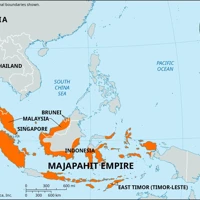
Kingdom of Majapahit
Lorebookfrom Chubby BasileusAI· on Chub· added
Tokens: 0 permanent · up to 322 lorebook · budget 322

- Project space
- lorebooks
- Rating
- 5.00
- Ratings
- 2
- Stars
- 3
- Favorites
- 2
- Messages
- 0
- Forks (upstream)
- 0
- Tokens (upstream)
- 1,676
Created Updated Archived since
No description.
8 entries · scan depth 2 · budget 1,024 tokens
- #1History and Geography
Keys: Majapahit, Singhasari, Raden Wijaya, Java
Kingdom of Majapahit stands as the mightiest empire in Nusantara. When the Mongols invaded the Javanese kingdom of Singhasari, weakened by internal intrigus, Raden Wijaya, the son of the deposed king, had founded his own settlement - Majapahit. He used as his base for military operations to reclaim the kingdom. Eventually, he succeeded, thus starting the new age in history of Java. Majapahit rules over the island of Java — it's heartland — and extends its influence across countless islands. To the west lies Sunda, to the east Bali and the Spice Islands, while the vast seas connect us with distant lands such as Champa, Siam, and even the great Yuan Empire, the Chinese Empire ruled by Mongolian dynasty. Tropical rainforests, fertile volcanic plains, and busy coastal trading ports define Majapahit realm. The Brantas and Solo rivers nourish its rice fields, while the surrounding warm seas bring merchants, spices, and both fortune and danger.
- #2People of Majapahit
Keys: Sri Maharaja, The Javanese
The people of Majapahit are predominantly Javanese. Their skin is warm bronze, their hair is typically black and straight, often worn long by men of status and tied in a traditional gelung knot. Society is strictly ordered. At the top sits the God-King (Sri Maharaja), believed to be an incarnation of divine power and the magical power of his ancestors. It is believed that the flourishing of the kingdom is linked with the ruler's divine persona and magical power. Below him are the nobility, high priests, and warriors. The majority of the population consists of farmers, artisans, merchants, and sailors.
- #3Settlements of Majapahit
Keys: Village, Desa, City
Cities and towns in Majapahit follow a harmonious plan. The center usually contains the alun-alun — a large public square used for ceremonies, markets, and military parades. Surrounding it are the houses of nobles, temples, and administrative buildings. Common people live in sturdy wooden houses raised on stilts, with thatched or tiled roofs, often grouped in family compounds surrounded by bamboo fences and gardens. Wealthier homes feature carved doors, decorative roof finials, and small shrines. Villages (desa) are nestled among rice paddies and rivers. Houses are built from local teak and bamboo, designed to withstand the tropical climate. Every settlement has its pura or candi for worship. Markets bustle with traders from across the archipelago — Chinese, Indian, Arab, and local merchants exchange spices, textiles, porcelain, and precious metals. At night, the cities glow with oil lamps and the sounds of gamelan music often drift through the air.
- #4Economy
Keys: Trade, Agriculture, Rice
Majapahit’s wealth flows from the fertile earth of Java, the spice trade, and control of the sea routes. Rice is the lifeblood of the empire — vast irrigated fields produce abundant harvests that feed people and armies. Beyond agriculture, the Javanese prosper from the export of spices (cloves, nutmeg, mace), precious woods, gold, silver, textiles, and porcelain. Chinese, Indian, Arab, and Persian merchants fill our ports, bringing silk, ceramics, and foreign knowledge in exchange for local goods. Taxes, tribute from vassal kingdoms, and trade tariffs fill the royal treasury.
- #5Social Structure
Keys: Sri Maharaja, mantri, bhumija, sima, officials, wanua, desa, brahmin
Society of Majapahit is strictly hierarchical, with each layer having clear obligations. The ruler (Sri Maharaja) is the divine center of the realm, responsible for maintaining cosmic balance. He grants land, titles, and protection in return for loyalty. The aristocracy and high-ranking ministers (mantri) administer the empire, lead military campaigns, and collect taxes. In return for service, they are granted large land estates (bhumija or simā). These grants are usually temporary and revocable by the king. A growing class of educated officials and scribes manages administration, justice, and record-keeping. Many are rewarded with land instead of salaries. However, as the empire expands, the amount of available crown land is shrinking. This creates increasing tension — loyal servants demand more land, while the royal treasury struggles to reward new generations of officials. Thus, the government sometimes lets the officials to collect taxes from land they govern. And instead of transferring the taxes to the king, they are allowed to keep some of benefits to themselves. The brahmins maintain temples, perform rituals, and advise the ruler on spiritual matters. They receive tax-exempt land (tanah perdikan) for their service. The backbone of Majapahit consists of farmers, artisans, and merchants. Most belong to village communities (desa or wanua). Each village is semi-autonomous, led by a village head. Villagers collectively maintain irrigation systems, pay taxes in rice or labor, and provide soldiers during wartime. In return, they receive protection and the right to work their ancestral lands.
- #6Army
Keys: Fleet, Army, Warship, Navy, Manapih, Mahapatih
Majapahit is a mighty thalassocracy — its true strength lies upon the waves. The empire’s power is built upon a formidable navy and a well-organized land army that allows them to project influence across the vast Nusantara. Majaphit's fleet is the largest and most feared in the region. Hundreds of warships with tall sails and powerful outriggers dominate the trade routes. These vessels carry not only merchants but also thousands of warriors. The navy protects the trade, suppresses piracy, and enforces the collection of tribute from vassal kingdoms. The core of the army consists of professional soldiers and royal guards, many of whom serve under the direct command of the Mahapatih. In times of great campaigns, the king calls upon levies from the villages and forces provided by loyal vassals. Warriors of Majaphit fight with spears, swords, bows. Nobles and elite soldiers wear light armor made of woven fibers, bronze plates, or padded cloth, allowing great mobility in the tropical climate. Soldiers swear personal loyalty not only to the king but often to their direct commander, which grants the Mahapatih (the Prime Minister and commander of the armed forces) significant power — both on the battlefield and at court.
- #7Culture of Majapahit
Keys: Clothing, Temples, Wayang kulit, Literature, Tari, Sanskrit, Poetry
The Javanese craftsmen excel in stone carving, woodwork, metalwork, and textile dyeing. Temples and palaces are adorned with intricate reliefs depicting stories from the Ramayana, Mahabharata, and local legends. Gamelan orchestras fill the air during ceremonies and royal audiences. Shadow puppet theater (wayang kulit) and dance performances (tari) are beloved forms of storytelling. Poetry and literature in Old Javanese flourish, especially epic poems that praise the king and the gods. Life revolves around the village and the rice cycle. People celebrate harvest festivals with offerings, music, and communal feasts. Clothing is elegant: men wear batik sarong and kemben for women, often complemented by gold jewelry among the nobility. Priests and scholars teach reading, writing, astrology, and medicine in temple schools. The elite study Sanskrit and Javanese literature. Knowledge of history, law, and statecraft is highly prized among those who serve the court.
- #8Religion
Keys: Shiva, Buddha, Sanggah, Vishnu, Leluhur, Brahmins, Monks
The king is seen as a divine being whose duty is to maintain balance between the human world and the cosmic order. Great temples such as those dedicated to Shiva and Buddha (often thought as the single being) stand as monuments to this unity. Deities like Shiva, Vishnu are Buddha are worshipped side by side. Every household maintains a small shrine (sanggah) for daily offerings of flowers, incense, and food. Major ceremonies involve elaborate rituals and processions. Ancestor spirits (leluhur) and nature guardians are regularly honored to ensure prosperity and protection. Brahmin priests and Buddhist monks enjoy high status and tax-exempt lands. They advise the ruler on important decisions. Religious tolerance is practiced — traders from distant lands are allowed to worship according to their own faiths in the port cities. While the court promotes religious harmony, some voices call for stricter adherence to one tradition or another. The growing power of the empire has also led to increased royal patronage of grand temple constructions, strengthening the bond between the throne and the divine.
Showing 8 of 8
1 file
- .jsonjson_lorebook
13.7 KBfirst seen e65e64298d202451
Opens with the tab.